
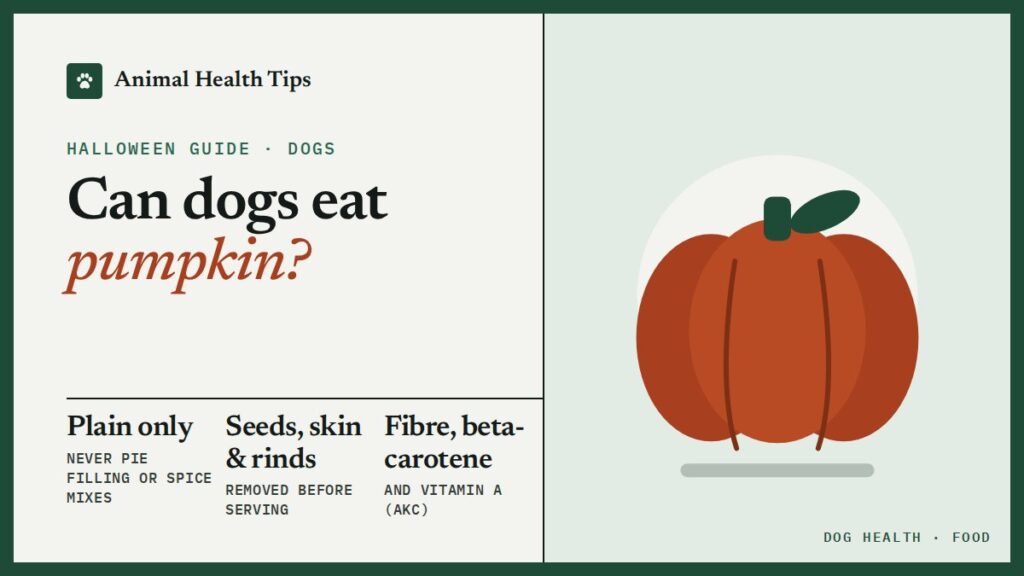
Halloween brings pumpkins into almost every home — carved on the doorstep, baked into pies, and stirred into spiced lattes. If you have a dog, it is natural to wonder whether they can share in the season’s most famous vegetable. The short answer is yes, but only the plain kind, served the right way.
In this guide7 sections
The American Kennel Club (AKC) lists pumpkin among the best types of squash to feed a dog, and notes that plain pumpkin is a common home treatment for dogs with mild stomach upsets. But pumpkin pie filling, pumpkin spice products and the carved lantern on the porch are different stories — each carries its own risk. This guide separates the safe from the unsafe, using the AKC’s advice and the PDSA’s Halloween guidance.
Get help at once if
- Your dog has eaten pumpkin pie filling, or any sugar-free product that may contain xylitol
- Your dog has eaten a large amount of nutmeg or pumpkin spice
- Your dog is vomiting, staggering, collapsing or having seizures after eating something they should not have
UK: Animal PoisonLine, 01202 509000 — open 24 hours, run by the Veterinary Poisons Information Service; a fee applies.
US: ASPCA Animal Poison Control, (888) 426-4435 — open 24 hours; a consultation fee applies.
Is pumpkin safe for dogs?
Yes, with three conditions. The AKC’s chief veterinarian advises that squash itself is safe for dogs to eat, provided seeds, skin and rinds have been removed — and that seeds and rinds should be disposed of where the dog cannot reach them. Pumpkin sits on the AKC’s list of the best squash types to feed a dog, alongside butternut squash, zucchini and acorn squash.
The second condition is that the pumpkin must be plain and unsweetened — never pumpkin pie filling. The third is moderation: the AKC recommends giving squash in moderation and consulting your veterinarian before adding it to your dog’s diet. That vet check matters most for puppies, dogs with health conditions, and dogs on a managed diet.
Why owners reach for pumpkin
Pumpkin earns its reputation from what it contains. The AKC notes that squash is high in fibre, which is key for digestive health; in beta-carotene, an antioxidant that can protect cells from damage; and in vitamin A, which helps with vision and overall cell function.
That fibre is why plain pumpkin is a common home treatment for dogs with mild stomach upsets — the AKC says it can help to calm their digestive systems. It can also help a dog feel full if calories are being cut, which is why it turns up in weight-management advice. But the AKC’s warning stands alongside the benefit: if stomach upset persists, or you know your dog has eaten something they should not have, consult your veterinarian immediately. And if you are considering a diet for an overweight dog, always consult your vet first.
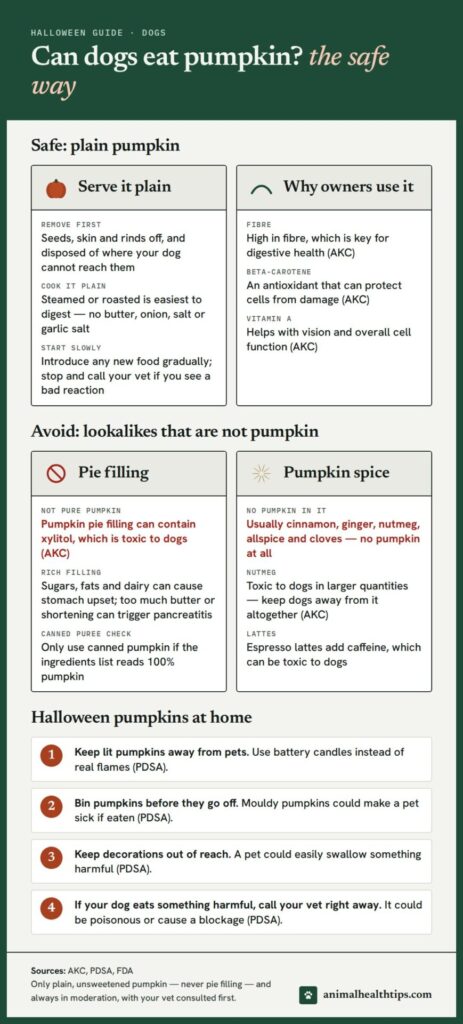
How to serve pumpkin safely
Keep it simple and unseasoned. Work through these steps:
- Remove the seeds, skin and rinds. Dispose of them where your dog cannot reach them — the bin or a compost container they cannot open.
- Steam or roast it. Dogs digest squash most easily when it has been steamed or roasted.
- Serve it plain. No butter, and no seasoning with onion, salt or garlic salt, which the AKC describes as toxic for dogs.
- Start slowly. When introducing vegetables such as squash, begin gradually. If you notice any negative reaction, stop feeding it and speak to your veterinarian immediately.
- Check the tin. If you use canned pumpkin, the ingredients list should read 100% pumpkin and nothing else. Anything labelled pie filling or pie mix is a different product — see below.
Pumpkin pie filling is not pumpkin
This is the mix-up that causes trouble every autumn. The AKC warns that pumpkin pie filling contains xylitol, a toxic artificial sweetener to dogs. Beyond that, the filling is rich in sugars, fats and dairy that can cause stomach upset, and too much butter or shortening can cause digestive discomfort or trigger pancreatitis.
Xylitol deserves its own warning. The US Food and Drug Administration (FDA) explains that in dogs, xylitol is absorbed quickly and may cause a potent release of insulin, leading to a rapid and profound decrease in blood sugar within 10 to 60 minutes. Untreated, this can quickly be life-threatening. Symptoms include vomiting, decreased activity, weakness, staggering, incoordination, collapse and seizures — and serious effects may not appear for 12 to 24 hours in some cases, so hospital monitoring may be needed.
The FDA’s advice is to check labels for xylitol, especially in products advertised as sugar-free or low sugar, and to keep such products out of a dog’s reach. If a dog may have eaten a product containing xylitol, call a vet, emergency clinic or animal poison control centre right away. Sweets carry the same risk at Halloween — our Halloween sweets guide explains which ones are dangerous — and our xylitol guide covers the sweetener in full.
| Pumpkin product | Safe or avoid? | Why |
|---|---|---|
| Plain steamed or roasted pumpkin | Safe, in moderation | Fibre, beta-carotene and vitamin A; serve plain and introduce slowly (AKC) |
| Canned pure pumpkin (100% pumpkin) | Safe, if the label checks out | Nothing but pumpkin on the ingredients list (AKC) |
| Pumpkin pie filling or pie mix | Avoid | May contain xylitol, plus sugars, fats and dairy (AKC) |
| Pumpkin spice mixes and spiced foods | Avoid | Nutmeg is toxic to dogs in larger quantities (AKC) |
| Spiced lattes | Avoid | Espresso adds caffeine, which can be toxic to dogs (AKC) |
| Lit or carved pumpkins | Keep away | Flames are a hazard and mouldy pumpkins could make a pet sick (PDSA) |
Pumpkin spice: no pumpkin, real risks
Here is a seasonal surprise: pumpkin spice usually contains no pumpkin at all. The AKC describes it as a mixture of spices including cinnamon, ginger, nutmeg, allspice and cloves. That matters because nutmeg is toxic to dogs in larger quantities, so the AKC’s advice is that it is better to avoid feeding foods flavoured with pumpkin spice to pets — and to keep dogs away from nutmeg altogether.
Nutmeg contains myristicin, which in dogs causes drastic and harmful reactions including high blood pressure, hallucinations, increased heart rate, abdominal pain or even seizures. Warning signs of nutmeg poisoning include disorientation, dry mouth, vomiting, tremors and lack of coordination. The AKC adds a note of proportion: a dog would have to eat a lot of pumpkin spice to be in danger of serious illness, and a bite of a cookie may have little or no effect — but the safest course is still to keep spiced foods away from dogs entirely.
Spiced drinks and baked goods add further risks. A pumpkin spice latte made with espresso contains caffeine, and caffeine and coffee can be toxic to dogs. Pumpkin spice baked goods may also contain raisins, xylitol, chocolate, some nuts or other ingredients toxic to dogs. If chocolate is the worry, the chocolate toxicity calculator can help you judge the risk by weight and type.
Halloween pumpkins around the house
The pumpkin itself needs managing too, not just the food bowl. The PDSA’s Halloween advice is to keep any lit pumpkins far away from both indoor and outdoor pets, and to consider battery-operated candles instead of real flames. Throw pumpkins away before they go off — mouldy pumpkins could make a pet sick if eaten.
The same advice covers decorations generally: keep Halloween decorations away from your pet’s paws, as a pet could easily swallow something harmful. And if a dog has eaten something harmful, the PDSA says to contact a vet right away, as it could be poisonous or cause a blockage — both of which can be fatal if left untreated.
Key takeaways
- Plain pumpkin is safe for dogs: seeds, skin and rinds removed, steamed or roasted, served plain, in moderation, with your vet consulted first.
- Pumpkin pie filling is not pumpkin — the AKC warns it can contain xylitol, which is toxic to dogs and can be life-threatening.
- Pumpkin spice usually contains no pumpkin; nutmeg is toxic to dogs in larger quantities, and spiced lattes add caffeine.
- Keep lit pumpkins away from pets, use battery candles, and bin pumpkins before they go off — mouldy pumpkins could make a pet sick.
Frequently asked questions
Can I give my dog pumpkin straight from the tin?
Yes, if the tin contains pure pumpkin and nothing else. Check the ingredients list: it should read 100% pumpkin. Anything labelled pie filling or pie mix is a different product, with sugars and spices added, and the AKC warns it can contain xylitol.
How much pumpkin can I give my dog?
There is no single amount that suits every dog, and the AKC pages give no fixed portion. The verified guidance is moderation, small amounts introduced slowly, and a vet consulted before adding pumpkin to the diet — especially for puppies, dogs with health conditions, or dogs on a managed diet.
My dog ate pumpkin pie. What should I do?
Contact your vet right away, especially if the pie or filling may contain xylitol. Do not wait for symptoms: the PDSA advises seeking help immediately if a pet may have eaten xylitol, and the FDA notes serious effects can take 12 to 24 hours to appear.
Are pumpkin seeds safe for dogs?
No — remove them before serving. The AKC advises that seeds, skin and rinds should be removed, and that seeds and rinds should be disposed of where the dog cannot reach them.
Can pumpkin help my dog’s upset stomach?
Plain pumpkin is a common home treatment for dogs with mild stomach upsets, according to the AKC, and can help calm their digestive systems. If the upset persists, or your dog has eaten something they should not have, consult your veterinarian immediately.
Is pumpkin spice safe if it has no nutmeg?
Pumpkin spice mixes usually contain nutmeg, and the AKC advises avoiding spiced foods for pets altogether. Spiced baked goods can also hide raisins, xylitol, chocolate or nuts — so keep them away from your dog as a rule.
Sources
- American Kennel Club — Can Dogs Eat Squash?
- American Kennel Club — Can Dogs Have Pumpkin Spice?
- American Kennel Club — Can My Dog Eat Nutmeg?
- PDSA — Spooky pet safety tips: keeping your four-legged friends happy on Halloween
- U.S. Food and Drug Administration — Paws Off Xylitol; It’s Dangerous for Dogs
This guide is general information, not a diagnosis. If you are worried about your pet, contact your vet.
3 comments