Sweet potato is on many Thanksgiving tables — Thanksgiving falls on 26 November this year — and dogs will hope for a share. The short answer is yes, with a condition: plain, fully cooked sweet potato is a safe treat, but the Thanksgiving casserole is a different dish. Brown sugar, marshmallows, butter and pecans turn a healthy vegetable into a rich, fatty bowl, and sugar-free versions may hide xylitol, which is poisonous to dogs.
In this guide6 sections
Call your vet now if your dog ate sugar-free casserole, or casserole with pecans
- Note what was in it, how much was eaten, and when.
- Do not wait for symptoms: xylitol can drop blood sugar within 10 to 60 minutes.
- Never try to make your dog vomit at home. Only a vet should decide that.
- UK: Animal PoisonLine, 01202 509000 — open 24 hours, run by the Veterinary Poisons Information Service; a fee applies.
- US: ASPCA Animal Poison Control, (888) 426-4435 — open 24 hours; a consultation fee applies.
Can dogs eat sweet potatoes?
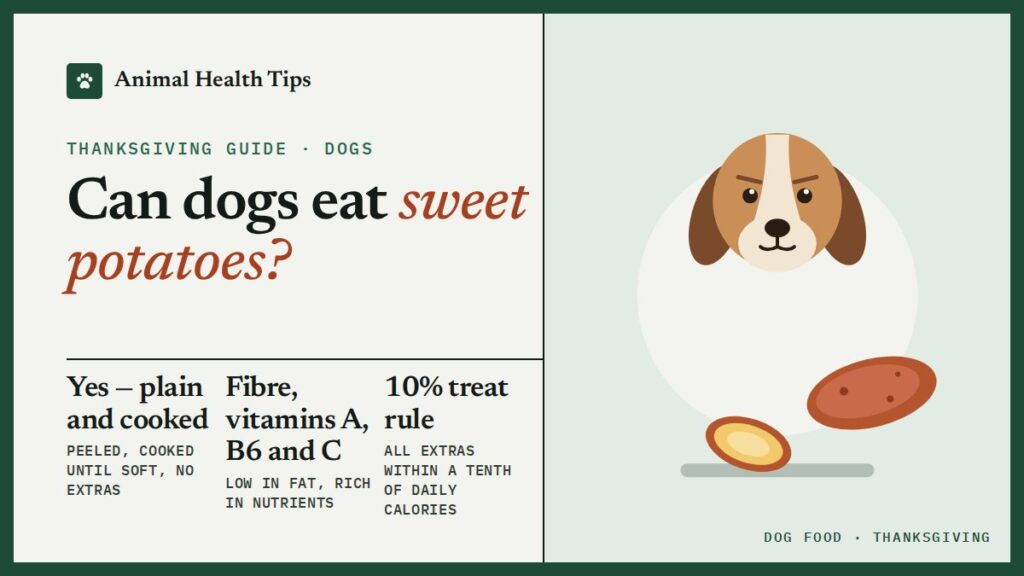
Yes. The American Kennel Club says dogs can eat sweet potatoes, but only plain and fully cooked. They are an excellent source of dietary fibre, which helps the digestive system work more effectively, and they are low in fat and rich in vitamins A, B6 and C, plus calcium, potassium and iron. Vitamin A is essential for healthy eyes, muscles, nerves and skin, and vitamin C is critical for a properly working immune system. Sweet potatoes are also a great source of beta-carotene, and as a whole food they are less likely to cause an immune response or damage the digestive tract — which is why they are a popular carbohydrate in commercial dog foods.
There is one caution. The AKC notes recent research suggesting sweet potatoes, while not poisonous, may not be appropriate as a main part of a dog’s diet: the FDA issued an alert about reports of canine dilated cardiomyopathy — a disease of the heart muscle — in dogs eating certain pet foods with peas, lentils, other legume seeds or potatoes as main ingredients. That concern is about diets built around those ingredients, not an occasional plain treat, but it is a good reason to keep sweet potato as a treat, not a staple.
How to serve sweet potato safely
Cook it until soft and take the skin off: the AKC says the sweet potato must be cooked and the skin removed, because skin left on makes it harder to digest, and PDSA agrees. Never feed a dog a raw sweet potato: raw pieces are difficult to chew, can upset the stomach and can potentially cause intestinal blockage, and serving it soft lessens the choking risk, especially for dogs that gulp their food.
Keep the portion small and plain. PDSA’s general rule for dog vegetables is a small amount as an occasional treat, in bite-sized pieces, with no oil, butter, salt or flavourings. The AKC’s treats rule covers the amount: treats should make up no more than 10 percent of a dog’s daily calories, counting every extra, from training treats to table scraps. Exceeding it can lead to nutritional imbalance or unwanted weight gain. Talk to your vet before introducing any new food, and start with a small amount to see how your dog reacts.
Be careful with some dogs. For dogs that are diabetic, overweight or less active, the AKC says to give only a minimal amount and proceed carefully, because sweet potato has a high glycaemic index. Too much can also cause bone and muscle weakness through excessive vitamin A, and sweet potato should not be a dog’s main source of nutrition — animal protein should be a daily part of the diet.
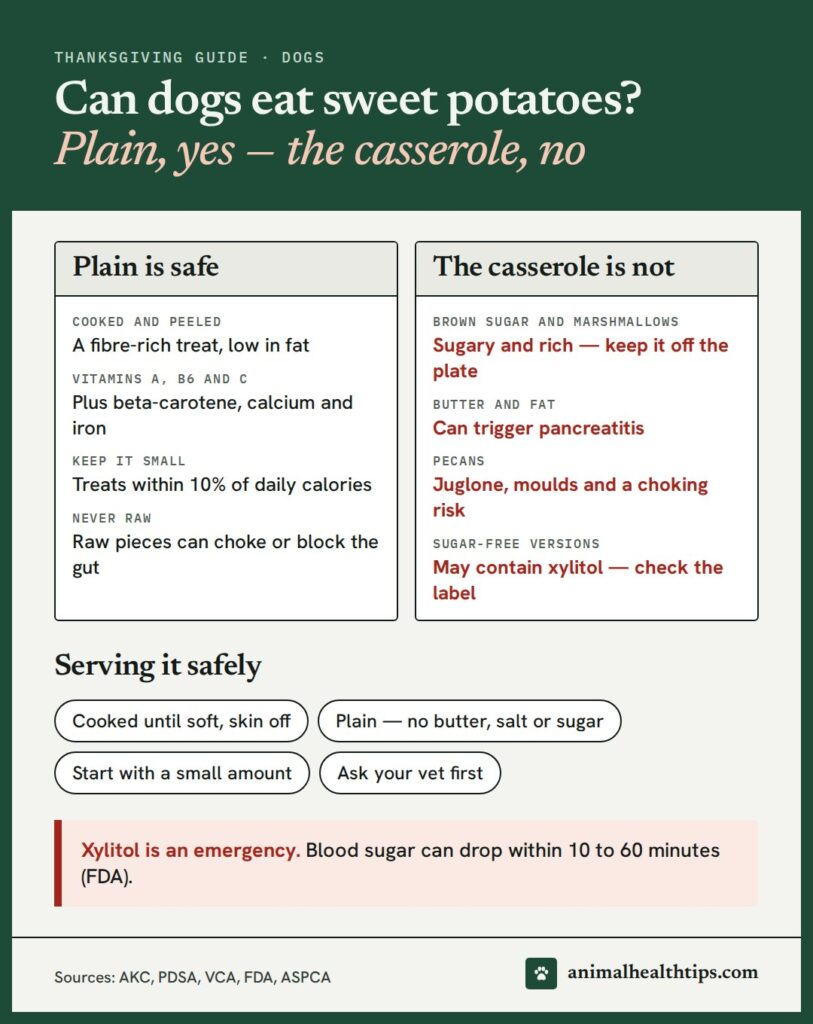
Why the casserole is a different dish
Plain mashed sweet potatoes are generally safe, the AKC says — but avoid versions topped with brown sugar, marshmallows or maple syrup. Thanksgiving foods are safe only when prepared plainly and served in small portions.
| On the table | What’s in it | Safe for a dog? |
|---|---|---|
| Plain cooked or mashed sweet potato | Peeled, cooked until soft, no extras | Yes — a small amount |
| Sweet potato casserole | Brown sugar, marshmallows, butter | No |
| Casserole with pecans | Juglone, fat, moulds — and a choking risk | No — call your vet |
| Sugar-free casserole | May contain xylitol — check the label | No — call your vet |
Fat is the first problem. A casserole is rich in butter and fat, and pancreatitis — inflammation of the pancreas — may be triggered in some cases by a fatty meal, VCA explains. Its exact cause is unknown, but the common signs are nausea, vomiting, fever, lethargy, abdominal pain, diarrhoea and decreased appetite, and severe cases can cause shock and even death. The AKC adds that high-fat Thanksgiving foods raise the risk: turkey skin is high in fat and increases the risk of pancreatitis.
Pecans deserve their own warning. The AKC says pecans should not be given to dogs: they contain juglone, which can cause severe vomiting and other digestive issues, and they are a high-fat nut whose fat could lead to pancreatitis. They can also carry moulds and mycotoxins that cause tremors and seizures, and aflatoxin from Aspergillus mould, and they are a choking hazard. If a dog eats pecans, even a small amount, contact a veterinarian right away.
Sugar-free versions carry a different poison. Xylitol is poisonous to dogs: the FDA says it is quickly absorbed and may trigger a potent release of insulin, causing a rapid and profound drop in blood sugar within 10 to 60 minutes, and untreated this can quickly be life-threatening. Serious effects may not appear for up to 12 to 24 hours, so a dog may need hospital monitoring. The ASPCA adds that xylitol can cause low blood sugar and potentially liver damage within 12 to 24 hours. The FDA lists sugar-free desserts and baked goods generally as products that may contain xylitol, so check the label — and if a dog may have eaten xylitol, call a vet, an emergency clinic or animal poison control at once.
What should I do if my dog eats sweet potato casserole?
- Work out what was in it: plain casserole, or a version with pecans or a sugar-free sweetener — and how much, and when.
- A small nibble of plain casserole: watch for vomiting, diarrhoea, lethargy or belly pain, and call your vet — especially for a small dog.
- Casserole with pecans: contact your vet right away, even for a small amount.
- If xylitol may be involved: treat it as an emergency and call your vet, an emergency clinic or animal poison control at once. Do not wait for symptoms.
- Never try to make your dog vomit at home. Only a vet should decide that.
- Keep the packaging or the recipe for the vet.
What can I give my dog instead at Thanksgiving?
- A few small bites of plain, fully cooked, boneless, skinless turkey with no seasoning — see our guide to whether dogs can eat turkey.
- Plain green beans — see our guide to whether dogs can eat green beans.
- Plain pumpkin puree (not pie filling) — see our guide to whether dogs can eat pumpkin.
- Tell your guests that nothing from a plate is for the dog, and keep leftovers and the bin out of reach.
Key takeaways
- Plain, fully cooked, peeled sweet potato is a safe treat for dogs, in small amounts.
- Keep all treats to no more than 10% of your dog’s daily calories.
- The casserole is the problem: sugar, butter, pecans and possible xylitol.
- Xylitol can drop blood sugar within 10 to 60 minutes — treat it as an emergency.
- Never feed a dog raw sweet potato.
Frequently asked questions
Can dogs eat sweet potatoes?
Yes — but only plain and fully cooked. A small piece of peeled, cooked sweet potato is a fibre-rich treat, low in fat and rich in vitamins A, B6 and C. Never feed one raw, and keep the skin off.
Can dogs eat sweet potato casserole?
No. The casserole adds brown sugar, marshmallows, butter and often pecans, making it rich and fatty. Sugar-free versions may contain xylitol, which is poisonous to dogs. Plain mashed sweet potato is the safe version.
How much sweet potato can a dog have?
No approved source gives a serving by dog weight, so this article gives none. The AKC rule is that all treats together should make up no more than 10% of daily calories.
Can dogs eat raw sweet potato?
No. Raw pieces are difficult to chew, can upset the stomach and can potentially cause intestinal blockage. Cook the sweet potato until soft and remove the skin.
Are sweet potatoes bad for dogs with diabetes?
Proceed carefully: the AKC says diabetic, overweight or less active dogs should get only a minimal amount, because sweet potato has a high glycaemic index. Ask your vet first.
What if my dog eats casserole with pecans?
Contact your vet right away, even for a small amount. Pecans contain juglone, are high in fat, can carry moulds and mycotoxins, and are a choking hazard.
Sources
- American Kennel Club — Can Dogs Eat Sweet Potatoes?
- American Kennel Club — Thanksgiving Foods for Dogs
- American Kennel Club — How Many Treats Can My Dog Have?
- American Kennel Club — Can Dogs Eat Pecans?
- PDSA — Your Dog’s Diet
- VCA Animal Hospitals — Pancreatitis in Dogs
- US FDA — Paws Off Xylitol; It’s Dangerous for Dogs
- ASPCA — People Foods to Avoid Feeding Your Pets
This guide is general information, not a diagnosis. If you are worried about your pet, contact your vet.