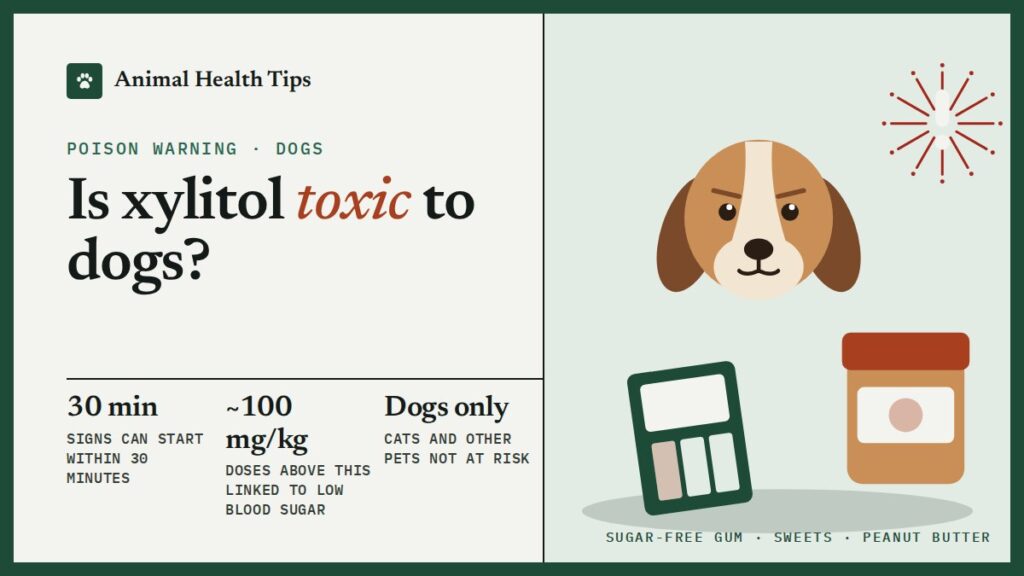
It happens in seconds: a pack of sugar-free gum on a coffee table, a handbag knocked off a chair, a peanut butter jar licked clean. Xylitol, the sweetener behind so many “sugar-free” products, is one of the most dangerous poisons a dog can swallow at home. Small amounts can crash blood sugar within half an hour; higher doses can damage the liver. Knowing what to do before it happens is what saves dogs.
In this guide7 sections
Go to a vet now if your dog eats anything with xylitol
- Do not wait for symptoms. Signs can take hours to appear, and treatment works best when it starts early.
- Do not try to make your dog sick at home. Only a vet should decide that, because inducing vomiting can make a low-blood-sugar dog worse.
- Take the product’s packaging with you, and note the time your dog ate it.
- UK: Animal PoisonLine, 01202 509000 — open 24 hours, run by the Veterinary Poisons Information Service; a fee applies.
- US: ASPCA Animal Poison Control, (888) 426-4435 — open 24 hours; a consultation fee applies.
What is xylitol, and where is it hiding?
Xylitol is a sugar alcohol used to sweeten sugar-free products (Merck Veterinary Manual). It occurs naturally in berries, plums, corn, oats, mushrooms, lettuce, trees and some fruits, and is mostly extracted from corn fibre or birch trees, which is why labels may say wood sugar, birch sugar or birch bark extract. It is an FDA-approved food additive, common in human food.
The Merck Veterinary Manual lists where dogs meet it:
- Sugar-free gum, sweets (candies), mints, peanut butter and baked goods
- Toothpastes, chewable vitamins and supplements, cosmetics, deodorants and hair care products
- Sugar-free medicinal syrups
Xylitol amounts in products vary wildly and can even vary between flavours of the same brand, Cornell University’s veterinary college warns. Sugar-free gum is the most common source of xylitol poisoning reported to Pet Poison Helpline, according to VCA. Only a small handful of peanut butter brands contain xylitol, but Blue Cross says to always check the ingredients label, and UC Davis advises double-checking before putting peanut butter in a chew toy. If a food, gum, sweet or medicine is marked “sugar-free”, check the ingredient list for xylitol.
Why is xylitol so dangerous to dogs?
In most mammals, xylitol has no notable effect on insulin levels. In dogs, it stimulates a rapid, dose-dependent insulin release, says the Merck Veterinary Manual. Cornell puts the scale of it: an exaggerated insulin release 3 to 7 times the amount normally needed to metabolise regular sugar, causing very low blood sugar (hypoglycaemia) within 30 to 60 minutes of ingestion.
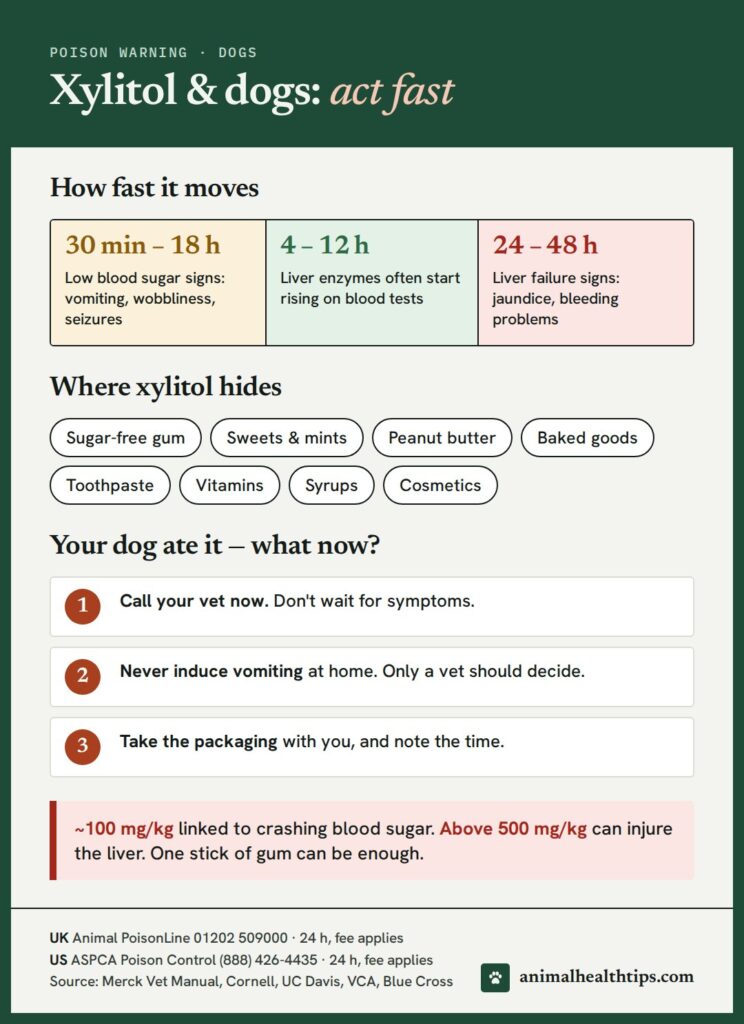
The dose matters. Merck links doses above about 100 mg per kg of body weight to hypoglycaemia in dogs, and doses above 500 mg per kg to possible severe liver failure; in general, VCA explains, lower doses cause hypoglycaemia and higher doses cause liver failure. Exactly how xylitol injures the liver is still unknown.
Strikingly, dogs are the only domestic species in which xylitol toxicosis has been reported; cats are not at risk, according to Merck and UC Davis. For dogs, though, even small amounts are extremely toxic and can cause hypoglycaemia, seizures, liver failure or death (VCA). Depending on the product’s concentration and the dog’s size, Blue Cross says just one stick of chewing gum can be enough to be toxic.
Signs of xylitol poisoning in dogs
Signs of hypoglycaemia can develop within 30 minutes of ingestion, but may be delayed up to 12 to 18 hours if the xylitol is in a substrate that slows absorption, such as some gum products (Merck Veterinary Manual). UC Davis gives the same window: clinical signs from 30 minutes to 18 hours, depending on the product. Blue Cross adds that in most cases symptoms start within 30 minutes, but can take up to 12 hours, and says never to wait for symptoms before seeking veterinary help.
Watch for:
- Vomiting
- Weakness and lethargy
- Ataxia: lack of coordination, stumbling, appearing drunk
- Disorientation and tremors
- Seizures or collapse, and in the worst cases coma
Liver injury moves more slowly. Signs may not appear until 24 to 48 hours or more after ingestion, though liver enzymes often rise within 4 to 12 hours (Merck), and VCA notes liver failure is possible within 24 to 48 hours at higher doses. Signs include lethargy, vomiting, jaundice and clotting problems, and dogs with enough xylitol for liver failure may or may not show low blood sugar first (VCA). If your dog has also eaten something else risky, check the chocolate toxicity calculator or the human food safety checker.
What to do if your dog eats xylitol
- Call your vet immediately. Do not wait for symptoms to appear. If it is out of hours, call your nearest emergency vet, or Animal PoisonLine in the UK or ASPCA Poison Control in the US.
- Do not try to make your dog sick at home. Emesis should only be attempted under veterinary supervision in a dog that still looks normal (Merck), and VCA warns that some dogs may already be hypoglycaemic, so inducing vomiting can worsen the signs.
- Do not give activated charcoal. It does not appreciably bind xylitol and is not recommended, according to Merck.
- Take the packaging with you, and note the time of ingestion and roughly how much your dog ate. There is no specific test that detects xylitol; Cornell says diagnosis is based on the history of exposure, the clinical signs and blood work, so what you bring helps.
- Expect your dog to be hospitalised. Cornell says dogs are typically kept in for a minimum of 12 to 24 hours, with liver enzyme values rechecked about three days after exposure.
How vets treat xylitol poisoning
Merck describes the treatment: intravenous dextrose to correct the hypoglycaemia, IV fluids and electrolytes, monitoring of blood glucose and liver values, and management of liver injury if it develops. Your vet may also induce vomiting, but Cornell notes this is usually only possible within about 30 minutes of ingestion and before low-blood-sugar signs start.
The outlook depends on how quickly treatment begins. Merck says the prognosis for uncomplicated hypoglycaemia is good with prompt treatment, but guarded to poor once severe liver damage develops: in one study, 62.5% of dogs with clinical liver injury signs died or were euthanised despite aggressive veterinary intervention. That is why the first hour matters so much.
How to keep your dog safe from xylitol
- Keep xylitol and xylitol-containing products out of your dog’s reach, including handbags, coat pockets, school bags and low kitchen surfaces. Dogs are expert raiders.
- Read labels. Watch for the word “sugar-free” and check the ingredient list for xylitol, wood sugar, birch sugar or birch bark extract, especially on peanut butter, sweets and baked goods.
- Use toothpaste made for dogs, never human toothpaste. Some human toothpastes contain xylitol, and a dog that chews the tube can swallow a lot.
- Tell everyone in the house. Children, guests and dog-sitters should know that sugar-free gum is not a harmless treat to share.
Key takeaways
- Xylitol is extremely toxic to dogs but has not been reported to harm cats.
- Doses above about 100 mg/kg are linked to crashing blood sugar; above 500 mg/kg, severe liver injury is possible.
- Signs of low blood sugar can start within 30 minutes, but can be delayed up to 18 hours; liver damage can appear 24 to 48 hours later.
- Never wait for symptoms and never induce vomiting at home. Call a vet immediately and take the packaging.
Frequently asked questions
How much xylitol is toxic to a dog?
There is no safe amount. Merck links doses above about 100 mg/kg to hypoglycaemia and above 500 mg/kg to severe liver injury. Because xylitol levels vary wildly, Blue Cross warns that one stick of gum can poison a small dog.
How quickly does xylitol affect dogs?
Low-blood-sugar signs can begin within 30 minutes, but may be delayed 12 to 18 hours with slow-absorption products like some gums. Liver injury can take 24 to 48 hours or more, so a dog that looks fine is not necessarily safe.
Is xylitol toxic to cats?
It has not been reported in cats or other domesticated mammals (Merck, UC Davis). It appears to be a dogs-only danger.
My dog ate xylitol. Should I make it vomit?
No, not at home. It should only be attempted under veterinary supervision in a dog that still looks normal, and can worsen things if the dog is already hypoglycaemic. Call your vet first.
Which peanut butters contain xylitol?
Only a small handful of brands, and the list changes, so always check the label. Look for xylitol, wood sugar, birch sugar or birch bark extract, and skip the product if any appear.
Can a dog recover from xylitol poisoning?
Often, yes, if treatment starts quickly: the outlook for uncomplicated low blood sugar is good. But it is guarded to poor once severe liver damage develops. In one study, 62.5% of dogs with liver injury signs died or were euthanised despite aggressive treatment.
Is birch sugar the same as xylitol?
Yes. Xylitol from birch trees may be labelled birch sugar, wood sugar or birch bark extract. Treat any of those names as xylitol.
Sources
- Merck Veterinary Manual — Xylitol toxicosis in dogs
- Cornell University College of Veterinary Medicine — Xylitol toxicities
- UC Davis School of Veterinary Medicine — Xylitol poisoning in dogs
- VCA Animal Hospitals — Xylitol poisoning in dogs
- Blue Cross — Xylitol poisoning in dogs
This guide is general information, not a diagnosis. If you are worried about your pet, contact your vet.