Halloween is five days away, and the shops are full of dog costumes: pumpkins, hot dogs, ghosts and superheroes, all sized for dogs. It is tempting to dress your dog up for the photos. But before you do, it is worth asking the question the charities ask first: does your dog actually enjoy it? For many dogs, the answer is no — and the signs are easy to miss if you do not know what to look for.
In this guide6 sections
The guidance from the American Kennel Club (AKC), RSPCA Australia, the PDSA and the ASPCA is consistent, and it is stricter than most costume packaging suggests. A costume is only safe when it passes every check at once: fit, freedom of movement, nothing to swallow, and a dog that is genuinely comfortable. This guide runs through those checks, the stress signs that mean stop, and the kinder alternatives — plus how to keep Halloween night calm whether your dog dresses up or not.
Take the costume off at once if
- Your dog freezes, will not move normally, or struggles to remove the costume
- Your dog is panting, lip licking, showing the white of the eye, or tucking its tail
- The costume covers the nose, mouth or eyes, or is so tight the dog cannot breathe easily
- Your dog has swallowed part of the costume, or is choking, gagging or in distress — contact your vet right away
Should dogs wear Halloween costumes at all?
The honest answer from the charities is: only sometimes, and only the dogs that enjoy it. The PDSA advises not dressing pets up for Halloween or any time of year, unless it is for a practical reason such as keeping them warm or safe in the dark. RSPCA Australia puts it more bluntly: as a general rule, do not dress a pet in a costume if it makes them uncomfortable or restricts their movement or senses in any way — and if in doubt, give it a miss.
The AKC draws the same line from the other side. Its chief veterinarian’s advice, quoted in the AKC’s Halloween guidance, is that a costume must not limit movement, sight or the ability to breathe, and a dog should never be left unattended in one. A veterinary behaviourist quoted by the AKC adds that owners should not dress a pet unless they are absolutely sure the pet will be thrilled with the idea, because some dogs are fearful of being handled and may be sensitive to having clothing put on them.
That does not mean every costume is a bad idea. A dog that is relaxed, moving normally and happy to wear a light bandana or simple outfit for a short, supervised photo is a different case from a dog that stands stiff and still while its owner takes pictures. The difference is in the dog’s body language — and that is where most owners go wrong, because a frozen dog can look, in a photo, like a patient dog.
How to tell if your dog is stressed in a costume
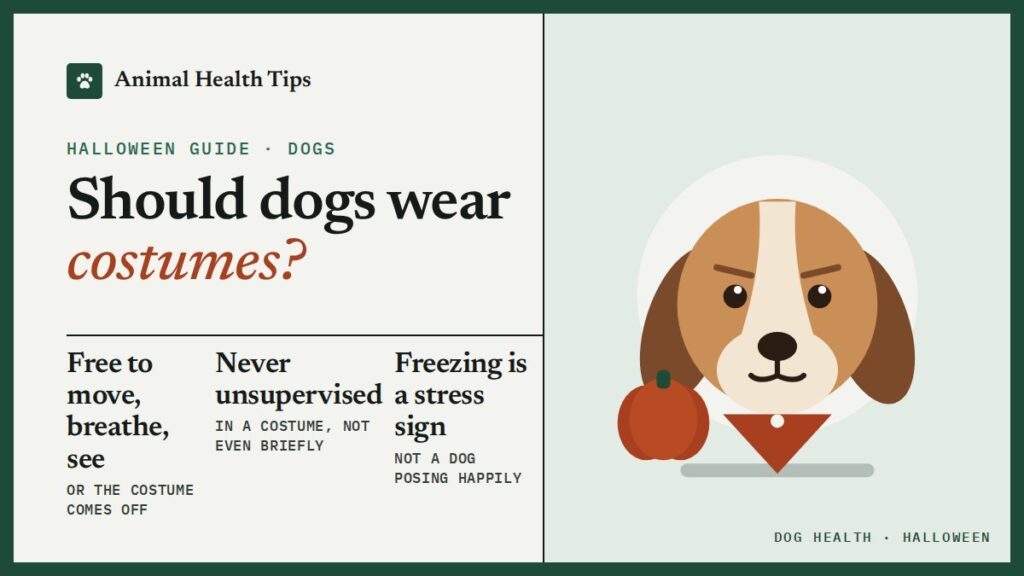
Start with the most misread sign: freezing. RSPCA Australia lists difficulty moving normally, including freezing, as an obvious sign of discomfort when a pet is dressed up. A dog that suddenly goes still in a costume is not posing. It is coping. If your dog will not walk normally, or moves in slow motion, the costume should come off.
The other signs build a clear picture. RSPCA Australia lists anxiety signs such as panting, lip licking and showing the white of the eye — sometimes called whale eye — and says that if the pet is trying or struggling to remove the costume, you should remove it immediately. The AKC’s behaviourist adds more: tail tucking, retraction of the ears, pacing and restlessness, shaking or cowering, moving in slow motion, refusing treats, hyper-vigilance, yawning, lip licking and panting.
Watch for the pattern, not a single sign. One yawn on a warm evening may mean nothing. A dog that freezes, tucks its tail, licks its lips and turns away when you reach for the costume is telling you, several ways at once, that it wants it off. Trust the combination, and do not push through it for one more photo. A dog that is stressed by a costume will also be stressed by the rest of Halloween night, and that stress is avoidable.
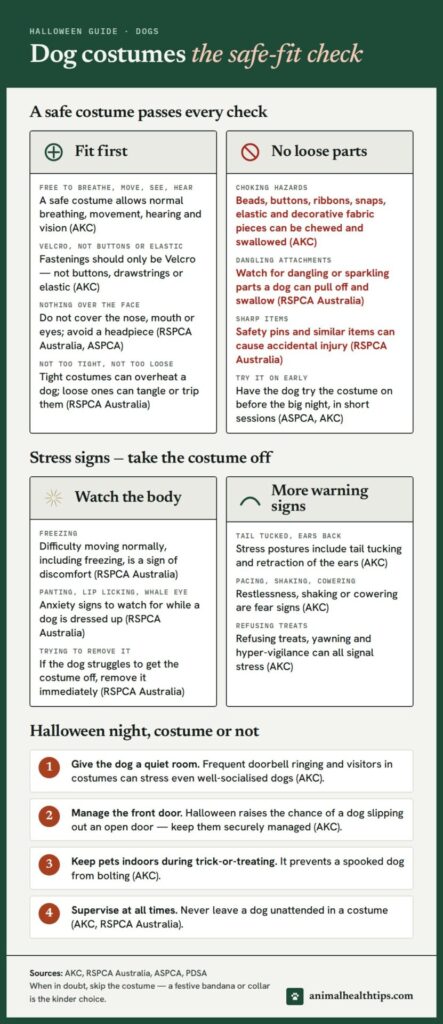
The safe-fit checklist
If your dog is happy to dress up, run through every item below before Halloween night. The AKC’s rule is the simplest version: safe costumes allow normal breathing, movement, hearing and vision, while avoiding loose parts that could be swallowed, and dogs should always be supervised while wearing them and monitored for signs of discomfort.
- Nothing over the face. Avoid costumes that cover the nose or mouth, which restrict breathing, eating and drinking, or the eyes, which obscure vision. The ASPCA also recommends avoiding a costume with a headpiece.
- Velcro fastenings only. The AKC’s chief veterinarian advises that fastenings should only be made of Velcro, not buttons, drawstrings or elastic, and that there should be no dangling parts that are easily chewed and swallowed.
- Not too tight, not too loose. RSPCA Australia warns that costumes that are too tight can cause overheating or distress, while ones that are too loose can cause accidents, tangling or tripping. The AKC adds that a costume that fits too tightly around the neck or chest can impair vision or make breathing difficult.
- No loose or sharp parts. Beads, buttons, ribbons, snaps, elastic and decorative fabric pieces can become choking hazards or cause intestinal blockages if chewed and swallowed, the AKC warns. RSPCA Australia adds dangling or sparkling attachments and sharp items such as safety pins.
- Try it on early, in short sessions. The ASPCA advises having the pet try on the costume before the big night, and the AKC’s guidance is to put it on for short periods leading up to Halloween so the dog grows accustomed to it. If the dog is distressed or shows abnormal behaviour at any trial, stop there.
- Never leave the dog alone in it. RSPCA Australia, the AKC and the ASPCA all say the same thing: supervise closely the whole time, and never leave a pet in a costume unattended, particularly if parts could be ingested or obstruct breathing and movement.
| Costume feature | Safe or avoid? | Why |
|---|---|---|
| Light bandana or festive collar | Safe choice | The ASPCA and RSPCA Australia suggest a bandana or festive collar as the alternative most dogs tolerate |
| Simple, loose-fitting outfit | Safe, if the dog is happy | Must allow normal breathing, movement, hearing and vision (AKC) |
| Velcro fastenings | Safe | The AKC’s chief veterinarian advises Velcro only, not buttons, drawstrings or elastic |
| Headpieces and masks | Avoid | The ASPCA recommends avoiding a headpiece; masks can confuse dogs that read human faces (AKC) |
| Dangling parts, beads, buttons | Avoid | Choking hazards and intestinal blockages if chewed and swallowed (AKC) |
| Tight or heavy costumes | Avoid | Overheating, restricted breathing and distress (RSPCA Australia, AKC) |
Why Halloween night itself is stressful
The costume is only half the story. The AKC notes that frequent doorbell ringing, visitors in costumes and larger-than-normal gatherings can create stress and anxiety even in well-socialised dogs. Masks can be especially unsettling, the AKC adds, because dogs rely heavily on reading human faces and facial expressions — so a parade of strangers in costume can be extremely scary for a dog that is normally confident.
That is why the AKC advises keeping pets indoors during trick-or-treating hours, to prevent them from getting spooked, and keeping any dog that does go out on a lead under the control of a responsible adult. Halloween activities also raise the chance of a dog slipping out an open front door, so the dog should be securely managed whenever you answer the door.
The PDSA’s Halloween-night advice fits the same plan: give pets a quiet room away from all activity to retreat to, close the curtains, and use calm background noise such as radio or TV so they do not notice everything going on outside. If a pet is particularly anxious, the PDSA says, stay in to comfort them rather than leaving them alone. Sweets carry their own risks on the night — our Halloween sweets guide covers which ones are dangerous, and our pumpkin guide explains the other seasonal food to watch.
Better alternatives to a full costume
If your dog does not enjoy dressing up, you lose nothing by skipping it. RSPCA Australia suggests a bandana or festive collar or harness as an alternative that dogs might tolerate, and the ASPCA’s advice is the same: if a dog is distressed or shows abnormal behaviour in a costume, let them wear their birthday suit or a festive bandana instead. The PDSA suggests themed collars or leads for dogs, or Halloween-themed beds and pet-safe toys, as a way to follow the theme without a costume.
A bandana still needs the same supervision check: it must not be tight around the neck, and it should come off if the dog paws at it or seems unhappy. But it leaves the dog free to move, breathe, see, hear and signal to other dogs — the very things a full costume takes away. The PDSA’s point is worth remembering here: costumes can stop pets displaying important body-language signals to other people and animals, which can put them at risk of not being understood, leading to conflict, fear or injury.
And if your dog is one of those that genuinely loves dressing up — relaxed body, loose tail, moving freely, happy to have the outfit put on — then a short, supervised outing in a safe, simple costume is fine. The test is the dog’s behaviour, not the owner’s enthusiasm. If you are unsure, the charities’ answer is unanimous: give it a miss. A calm dog in a bandana has a better Halloween than a stressed dog in a perfect costume.
Key takeaways
- Only dress a dog that is genuinely happy in a costume — and if in doubt, give it a miss (RSPCA Australia, PDSA).
- A safe costume allows normal breathing, movement, hearing and vision, with Velcro fastenings and no loose parts (AKC).
- Freezing, panting, lip licking, whale eye, tail tucking or trying to remove the costume all mean: take it off at once.
- Never leave a dog unattended in a costume, and keep dogs indoors during trick-or-treating hours.
- A festive bandana or collar is the kinder alternative most dogs tolerate — and a calm dog beats a costumed dog every time.
Frequently asked questions
My dog stands still in its costume. Is it enjoying it?
Probably not. RSPCA Australia lists difficulty moving normally, including freezing, as a sign of discomfort in a dressed-up pet. A relaxed dog moves normally; a frozen dog is coping. Take the costume off and watch how quickly the dog relaxes — that tells you what it thought of it.
What makes a dog costume unsafe?
Anything that restricts breathing, movement, sight or hearing, or anything the dog can chew off and swallow. The AKC lists beads, buttons, ribbons, snaps, elastic and decorative fabric pieces as choking and blockage hazards, and advises Velcro fastenings only, with nothing covering the face.
How long can my dog wear a costume?
No approved source gives an exact number of minutes, so do not trust one that does. The verified guidance is short periods only, with close supervision the whole time, and the costume removed at the first sign of stress. A brief photo session is very different from a whole evening out.
Are masks and headpieces safe for dogs?
No — avoid them. The ASPCA recommends avoiding a costume with a headpiece, and RSPCA Australia warns against anything covering the eyes or nose. The AKC adds that masks on people can unsettle dogs too, because dogs read human faces to interpret body language.
My dog hates costumes. What can I do instead?
A festive bandana or themed collar, suggested by the ASPCA, RSPCA Australia and the PDSA, is the usual alternative. If even that bothers your dog, skip dressing up entirely and give them a quiet room, a favourite toy and a calm evening instead — that is a good Halloween for a dog.
Should my dog go trick-or-treating with us?
Only if your dog is calm around crowds, costumes and doorbells, and always on a lead with a responsible adult. The AKC advises keeping pets indoors during trick-or-treating hours to prevent them from getting spooked, and managing the front door carefully so the dog cannot slip out.
Sources
- American Kennel Club — Halloween Safety Tips for Dogs: Avoid Common Holiday Hazards
- American Kennel Club — What Do Dogs Really Think About Halloween?
- RSPCA Australia — Leave the dressing up to the humans this holiday season
- RSPCA Australia — Keeping pets and wildlife safe this Halloween
- PDSA — Spooky pet safety tips: keeping your four-legged friends happy on Halloween
- ASPCA — Don’t Get Tricked by These Pet Hazards This Halloween
This guide is general information, not a diagnosis. If you are worried about your pet, contact your vet.