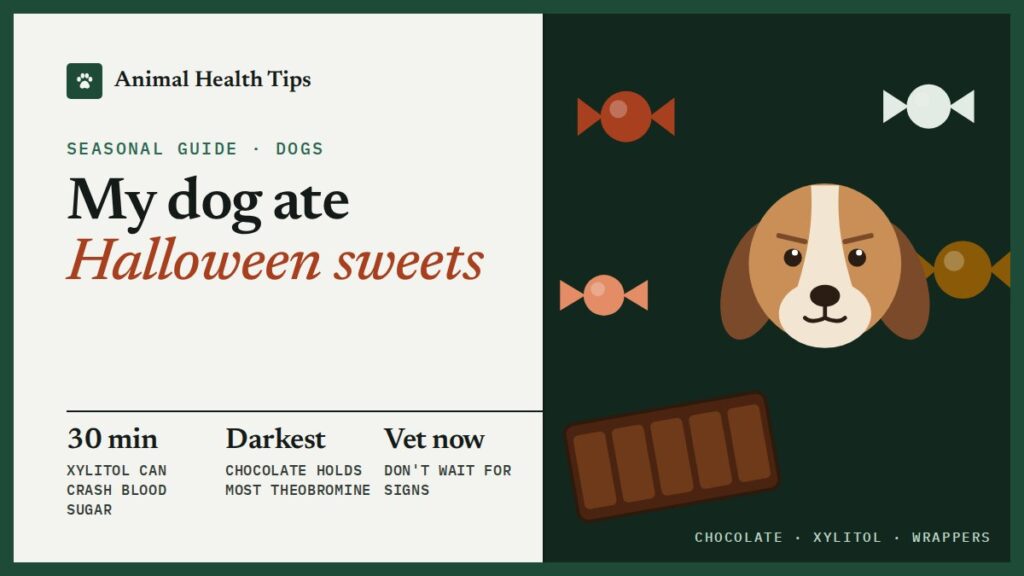
Halloween night: the sweet bowl is on the table, the front door keeps opening for trick-or-treaters, and somehow your dog has got into the stash. Chocolate bars, sugar-free gum, foil-wrapped toffees — a dog’s dream and an owner’s nightmare. Several of the things in that bowl can genuinely harm a dog, and one of them can kill. The good news is that fast action makes all the difference.
In this guide8 sections
- Why are Halloween sweets dangerous to dogs?
- Which chocolate is the most dangerous?
- Xylitol: the sweetener that can act within 30 minutes
- What about the wrappers and foil?
- Signs your dog has been poisoned by sweets
- What to do if your dog ate Halloween sweets
- How to keep your dog safe this Halloween
- Frequently asked questions
Call your vet now if your dog ate sweets
- Don’t wait for symptoms. With chocolate they can take hours to appear, and with xylitol the clock matters even more.
- Keep the wrapper or packaging, so you can say exactly what was eaten and how much.
- UK: Animal PoisonLine, 01202 509000 — open 24 hours, run by the Veterinary Poisons Information Service; a fee applies.
- US: ASPCA Animal Poison Control, (888) 426-4435 — open 24 hours; a consultation fee applies.
Why are Halloween sweets dangerous to dogs?
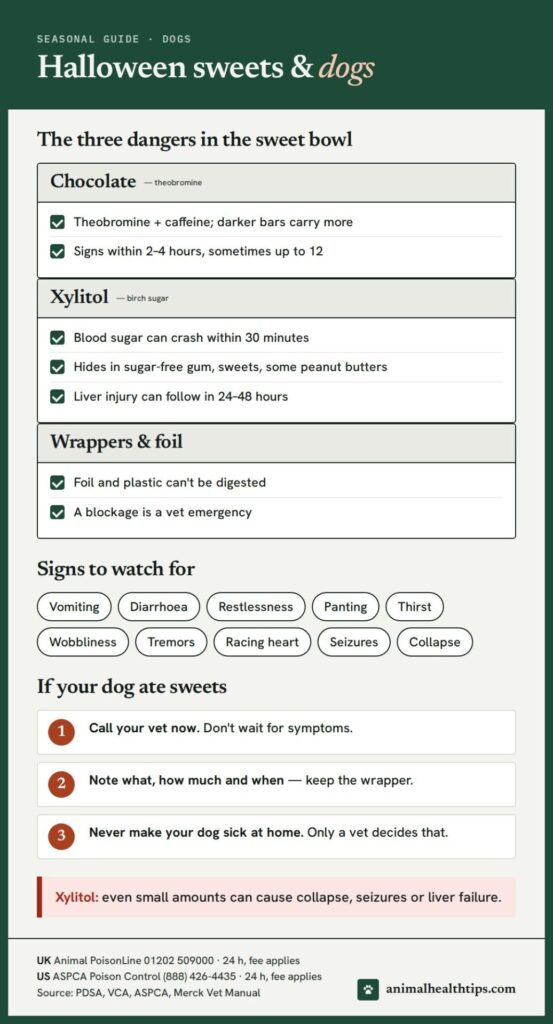
Most Halloween sweets threaten dogs for one of three reasons: chocolate, xylitol or the wrapper. Chocolate contains theobromine, which is harmless to people but toxic to dogs because they struggle to break it down, plus a smaller amount of caffeine (PDSA). Xylitol — also sold as birch sugar — is a sweetener in sugar-free products that sends a dog’s blood sugar crashing (VCA). And foil or plastic wrappers can’t be digested at all.
Which chocolate is the most dangerous?
As a rule, the darker the chocolate, the more theobromine it contains and the more toxic it is likely to be (PDSA). Cocoa powder and baking chocolate sit at the top of the danger list, while white chocolate contains almost no theobromine — though its fat and sugar can still cause stomach upsets and, in severe cases, pancreatitis (VCA). Whether a dose is dangerous depends on three things: the type of chocolate, how much was eaten and the size of your dog (PDSA).
If you’re unsure whether the amount was dangerous, our chocolate toxicity calculator can help you work it out. But when in doubt, call your vet rather than doing maths.
| Chocolate type | Theobromine danger |
|---|---|
| Cocoa powder and baking chocolate | Highest — an extremely high concentration of cocoa solids |
| Dark chocolate | High — more theobromine per ounce than milk chocolate |
| Milk chocolate | Moderate — dangerous if enough is eaten |
| White chocolate | Very low theobromine, but fat and sugar can still cause illness |
Xylitol: the sweetener that can act within 30 minutes
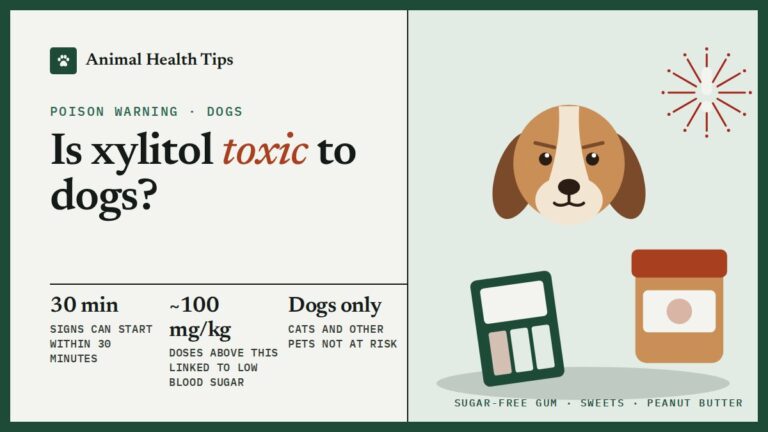
Xylitol is the danger most owners haven’t heard of, and it may be the most urgent. In dogs it is absorbed into the blood very quickly, triggering a surge of insulin that crashes blood sugar — sometimes within 30 minutes, though signs can take up to 12 hours to appear (VCA, ASPCA). Higher doses can injure the liver within a day or two, and even small amounts can cause collapse, seizures or liver failure (VCA).
It hides under other names too: wood sugar, birch sugar and birch bark extract (VCA). At Halloween you’ll find it in sugar-free gum, sweets, mints and baked goods — and it turns up in some peanut butters, which catches owners out when they use them for training treats (VCA).
Blue Cross puts it bluntly for this season: “take extra care at Christmas and Halloween when dogs may be tempted to chew through wrapping.”
What about the wrappers and foil?
Even sweets that aren’t poisonous can cause trouble once the wrapper goes down too. Foil, plastic and cellophane can’t be digested, and a piece too large to pass can block the gut — which vets treat as an emergency (Merck). Watch for vomiting, loss of appetite, tiredness and tummy pain (Merck).
Signs your dog has been poisoned by sweets
Chocolate poisoning signs usually appear within two to four hours, but can take up to 12 (PDSA). Early on you may see restlessness, panting, vomiting, diarrhoea and unusual thirst. Severe cases bring a racing heart, tremors, high temperature and seizures (VCA, PDSA).
Xylitol looks different: weakness, wobbliness, collapse or seizures from low blood sugar, sometimes within half an hour (ASPCA). Signs of liver injury may not show for two to three days — which is why a dog that seems fine still needs a vet urgently (ASPCA).
What to do if your dog ate Halloween sweets
- Call your vet immediately. Don’t wait for symptoms to appear. Tell them the type of sweet or chocolate, how much is missing, your dog’s size and when it happened (PDSA).
- Keep the packaging. The wrapper tells your vet exactly what they’re dealing with, including whether xylitol is listed (PDSA).
- Never try to make your dog sick at home. Your vet may induce vomiting at the clinic with an injection, but doing it yourself can cause harm. With xylitol, don’t give anything by mouth unless your vet tells you to (PDSA, VCA).
- Know the poison lines. UK: Animal PoisonLine, 01202 509000 — open 24 hours, run by the Veterinary Poisons Information Service; a fee applies. US: ASPCA Animal Poison Control, (888) 426-4435 — open 24 hours; a consultation fee applies.
How to keep your dog safe this Halloween
- Keep the sweet bowl out of reach. Store chocolate and sweets in high or locked cupboards, and be extra careful at festive times (PDSA).
- Settle your dog away from the front door while trick-or-treaters are coming and going, with a chew or food toy to keep them busy.
- Check the children’s haul before it lands on a low table — and make sure everyone in the house knows the rule.
- Read labels for xylitol. Check sugar-free products for xylitol, birch sugar or wood sugar, and use only toothpaste made for dogs (VCA).
- Offer dog-safe treats instead. If you want to include your dog in the fun, plain banana pieces are one dog-safe option.
- Remember fireworks too. Halloween kicks off the noisy season for many dogs — if yours is nervous, see how to keep them calm.
Key takeaways
- Chocolate, xylitol and wrappers are the three Halloween dangers for dogs.
- Xylitol can crash blood sugar within 30 minutes. Treat it as urgent.
- Keep the wrapper, note what and how much was eaten, and call your vet now.
- Never make your dog sick at home. Only a vet decides that.
Frequently asked questions
How much chocolate will harm my dog?
It depends on the type of chocolate, how much was eaten and your dog’s size — darker chocolate is more dangerous per bite. Try our chocolate toxicity calculator for a rough guide, but if you’re unsure, call your vet rather than doing maths.
My dog ate a foil wrapper. Should I worry?
Possibly. Foil and plastic can’t be digested and can block the gut, which vets treat as an emergency. Call your vet and watch for vomiting, loss of appetite, tiredness or tummy pain.
How fast does xylitol poisoning happen in dogs?
Blood sugar can crash within 30 minutes, though signs sometimes take up to 12 hours to appear. Liver injury may not show for two to three days, which is why a dog that seems fine still needs a vet urgently.
Which products contain xylitol?
Sugar-free gum, sweets, mints, baked goods and some peanut butters, among others. On labels it can also appear as wood sugar, birch sugar or birch bark extract.
Should I make my dog vomit after eating chocolate?
No. Only a vet should decide that — they may induce vomiting at the clinic with an injection. Trying it at home can cause harm, and with xylitol you shouldn’t give anything by mouth unless your vet says so.
Can dogs have any Halloween sweets at all?
No. Keep every sweet away from your dog and offer dog-safe treats instead. Even one sugary sweet isn’t worth the risk when xylitol can hide in sugar-free varieties.
Sources
- PDSA — Chocolate poisoning in dogs
- VCA Animal Hospitals — Chocolate poisoning in dogs
- VCA Animal Hospitals — Xylitol toxicity in dogs
- ASPCA — Xylitol: the sweetener that’s not so sweet to pets
- Blue Cross — Foods poisonous to dogs
- Merck Veterinary Manual — Gastrointestinal obstruction in small animals
This guide is general information, not a diagnosis. If you are worried about your pet, contact your vet.