Thanksgiving in the United States falls on 26 November this year, and the cranberry sauce is already on the table in many homes: a bowl of something red, sweet and sharp, sitting within reach of a hopeful dog. The question owners ask is fair, because the answer splits in two. The cranberry itself is not the problem. Almost everything that turns cranberries into sauce can be. This guide follows the AKC, Cornell, UC Davis and VCA Animal Hospitals, and it ends with the label check that decides whether a particular sauce is safe at all.
In this guide7 sections
Call your vet or a poison line at once if
- Your dog has eaten sauce containing grapes, raisins, sultanas or currants
- Your dog has eaten a sugar-free sauce that may contain xylitol
- Your dog shows vomiting, weakness, wobbliness, collapse, tremors or seizures
- UK: Animal PoisonLine, 01202 509000 — open 24 hours, run by the Veterinary Poisons Information Service; a fee applies.
- US: ASPCA Animal Poison Control, (888) 426-4435 — open 24 hours; a consultation fee applies.
Can dogs eat cranberries?
Fresh or cooked cranberries, when plain, are not inherently toxic for dogs, the AKC states. When fed in moderation, they are generally safe and may even have some health benefits. Both fresh and dried cranberries are safe to feed to dogs in small quantities, the AKC adds, though whether your dog will like this tart treat is another question. As with any treat, moderation matters: too many can lead to an upset stomach.
Two cautions sit inside that reassurance. Dried cranberries are sometimes mixed with other dried fruits, like raisins, the AKC warns, and grapes and raisins are very toxic to dogs, so a mixed bag is not a safe shortcut. And feeding large amounts of cranberries can lead to the development of calcium oxalate stones in a dog’s bladder, the AKC notes, so cranberries stay a small treat, fed under a vet’s guidance, not a daily habit. One claim to drop: the AKC states there have not been enough studies in dogs to confirm that cranberries help fight or prevent urinary tract infections, so do not feed them as a remedy.
Can dogs eat cranberry sauce?
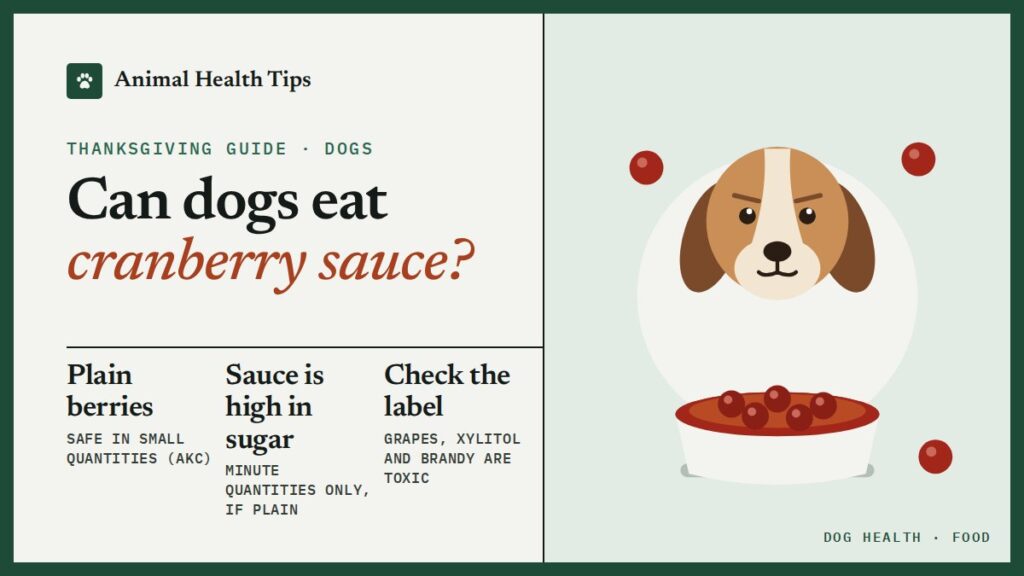
Cranberry sauce may be safe for dogs in small amounts, the AKC states, but there are additional risks. Cranberry sauce is high in sugar, which can cause gastrointestinal upset. Feeding plain cranberry sauce in minute quantities is probably safe, the AKC adds, but it is a good idea to monitor your dog after feeding any new food for signs of intestinal upset or allergic reaction. That is the whole safe case for sauce, and it is a narrow one: plain, minute, and watched.
No approved source opened for this article gives a safe spoon or teaspoon amount for sauce, so none is given here. Use the AKC’s general treats rule instead: treats should make up no more than 10% of a dog’s daily calories, and that 10% refers to calories, not volume, and includes table scraps. A sauce that is mostly sugar spends that allowance fast, and a dog that has already had turkey, trimmings and treats has none left to spend. If the sauce is not plain, the answer is not a smaller portion. It is no sauce at all.
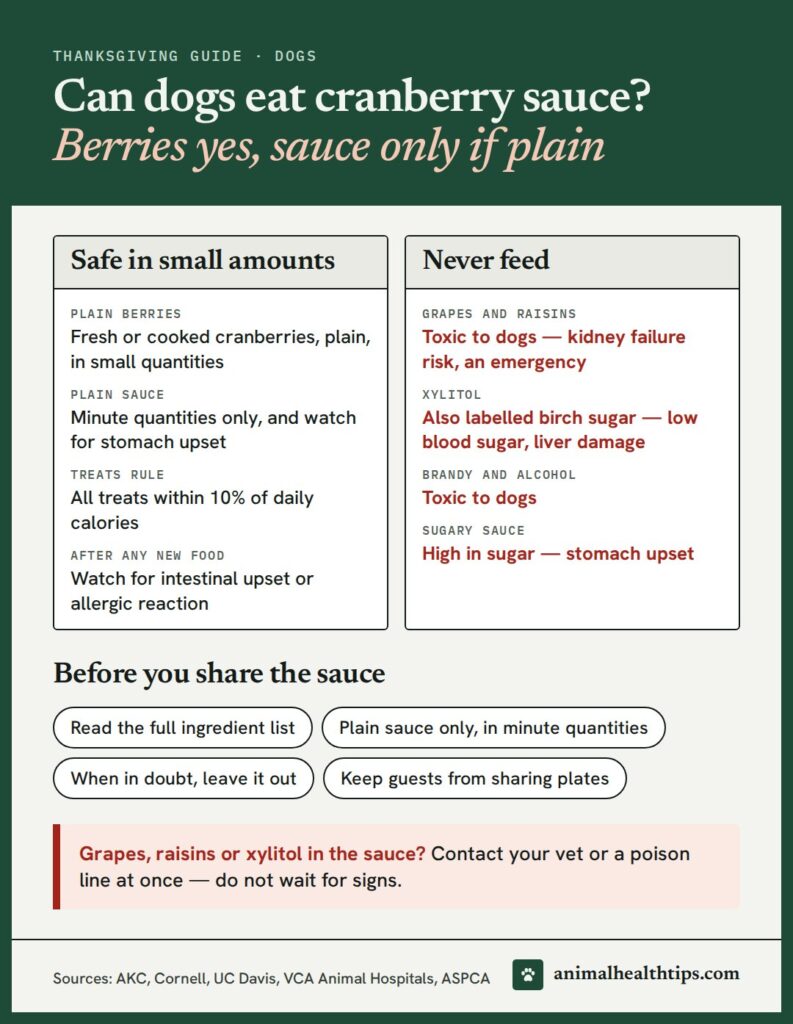
The label check: four ingredients that change the answer
Prepared cranberry dishes are risky, the AKC warns, as are grape and cranberry juice blends and cranberry dishes with sugar or alcohol. Some recipes include grapes, raisins or currants, which are toxic to dogs, and recipes that use brandy are also problematic, because alcohol is toxic to dogs. Sugar-free sauces carry their own trap: xylitol is used as a sugar substitute in foods including syrups, jams and jellies, UC Davis notes, and it may also be labelled as birchwood sugar, VCA adds. No other sugar substitute was verified as safe or toxic on an approved source for this article, so this guide makes no claim about them: if the label lists a sweetener you do not recognise, do not feed the sauce.
| Ingredient in the sauce | What it means for your dog | Source |
|---|---|---|
| Grapes, raisins, sultanas, Zante currants | Toxic: sudden life-threatening kidney failure is possible; an emergency | Cornell |
| Xylitol (birch sugar, birchwood sugar) | Toxic: rapid insulin release, low blood sugar and liver damage | UC Davis, VCA |
| Brandy or other alcohol | Toxic to dogs | AKC |
| Added sugar | High sugar load: stomach upset; minute quantities of plain sauce only | AKC |
| Macadamia nuts | Neurological signs, raised body temperature and pancreatitis | VCA |
Why grapes and xylitol are emergencies, not stomach upsets
Grapes, raisins and related fruits, including sultanas and Zante currants, can cause sudden life-threatening kidney failure in dogs, Cornell states, and any ingestion should be treated as an emergency. If a dog eats grapes, raisins or related fruits, contact your veterinarian or a pet poison control centre immediately, Cornell advises, because prompt veterinary care can be life-saving. Signs will often appear within 6 to 24 hours and may include vomiting, which is the most common sign, diarrhoea, loss of appetite, dehydration, abdominal pain, excessive drooling and lethargy, and signs may progress over 1 to 3 days to increased thirst and urination, weakness, trembling and inability to urinate.
Xylitol works faster and differently. It is quickly absorbed in dogs, resulting in rapid insulin release, which can cause low blood sugar levels and liver damage, UC Davis states, and clinical signs of low blood sugar can range from lethargy to seizures and death. Signs can be seen from 30 minutes to 18 hours after ingestion and can include vomiting, seizures, wobbliness, weakness, depression and coma, with liver damage becoming apparent several hours later. If you suspect a dog has ingested xylitol, consult a veterinarian immediately, UC Davis advises, and vomiting should not be induced unless under veterinary supervision. Only a vet decides that.
What to do if your dog eats cranberry sauce
- Work out what was in it. Read the label or the recipe: plain sauce, sugary sauce, or sauce with grapes, raisins, xylitol or brandy are three different situations. Note roughly how much your dog ate and when.
- Call your vet or a poison line promptly if anything toxic was in it. If you believe your pet has eaten something toxic, VCA advises, work out what was eaten, then contact your veterinarian or the ASPCA Animal Poison Control Center right away.
- Do not try to make your dog vomit at home. UC Davis states vomiting should not be induced unless under veterinary supervision. Only a vet decides that.
- Watch a dog that ate plain sauce. The AKC advises monitoring after any new food for signs of intestinal upset or allergic reaction: vomiting, diarrhoea, or unusual lethargy all earn a vet call.
- Keep the bowl out of reach afterwards. VCA’s Thanksgiving advice warns that dishes can hide ingredients poisonous to pets, and asks owners to remind guests not to share their plates.
A safer Thanksgiving treat
The simplest safe choice is a few plain fresh or cooked cranberries, in moderation, within the 10% treats allowance, and nothing else from the sauce bowl. That keeps the festive taste without the sugar load and without the label gamble. For the main course, the same plain-and-small rule applies: see our guide to can dogs eat turkey for the turkey rules, and our guide to can dogs eat pumpkin for another food that is only safe when served plain. Tell guests before the meal that the dog gets plain food in its own bowl and nothing from a plate, and clear plates promptly: most holiday accidents are a shared scrap, not a deliberate one.
Key takeaways
- Plain fresh or cooked cranberries are safe for dogs in small quantities, the AKC states.
- Plain cranberry sauce in minute quantities is probably safe, but most sauces are high in sugar and cause stomach upset.
- Grapes, raisins, xylitol and brandy in a sauce make it toxic, not just sugary: call a vet at once.
- No safe spoon amount for sauce was verified, so use the 10% treats-calorie rule and keep portions minute.
- When in doubt about any ingredient on the label, leave the sauce out entirely.
Frequently asked questions
Can dogs eat cranberry sauce?
Only plain sauce, in minute quantities, is probably safe, the AKC states, and even then it is high in sugar and can cause stomach upset. Most sauces fail the test: check the label for grapes, raisins, xylitol or brandy, and if any is present, do not feed it at all.
Are fresh cranberries safe for dogs?
Yes, in small quantities. Fresh or cooked cranberries, when plain, are not inherently toxic for dogs, the AKC states, and both fresh and dried cranberries are safe in small quantities. Too many can cause an upset stomach, and large amounts can lead to bladder stones.
What if my dog eats sauce with raisins in it?
Treat it as an emergency. Grapes and raisins can cause sudden life-threatening kidney failure in dogs, Cornell states. Contact your vet or a poison control centre immediately, and do not try to make your dog vomit at home: only a vet decides that.
Is sugar-free cranberry sauce safer for dogs?
Not necessarily. Sugar-free sauces may contain xylitol, which is quickly absorbed in dogs and can cause low blood sugar and liver damage, UC Davis states. Xylitol may also be labelled birch sugar or birchwood sugar, so read the full ingredient list.
How much cranberry sauce can my dog have?
No approved source gives a safe spoon amount for sauce, so this guide gives none. The AKC’s rule is that all treats stay within 10% of daily calories, and plain sauce is limited to minute quantities, with monitoring for stomach upset afterwards.
Can cranberries help my dog’s urinary infection?
There is not enough evidence in dogs to say so. The AKC states there have not been enough studies in dogs to confirm that cranberries fight or prevent urinary tract infections, and cranberry should not replace proven veterinary treatment.
Sources
- AKC — Can Dogs Eat Cranberries?
- AKC — How Many Treats Can Your Dog Have?
- Cornell University Riney Canine Health Center — Grape and Raisin Toxicity
- UC Davis School of Veterinary Medicine — Xylitol Poisoning in Dogs
- VCA Animal Hospitals — Top Safety Tips to Avoid a Pet Emergency This Thanksgiving
This guide is general information, not a diagnosis. If you are worried about your pet, contact your vet.