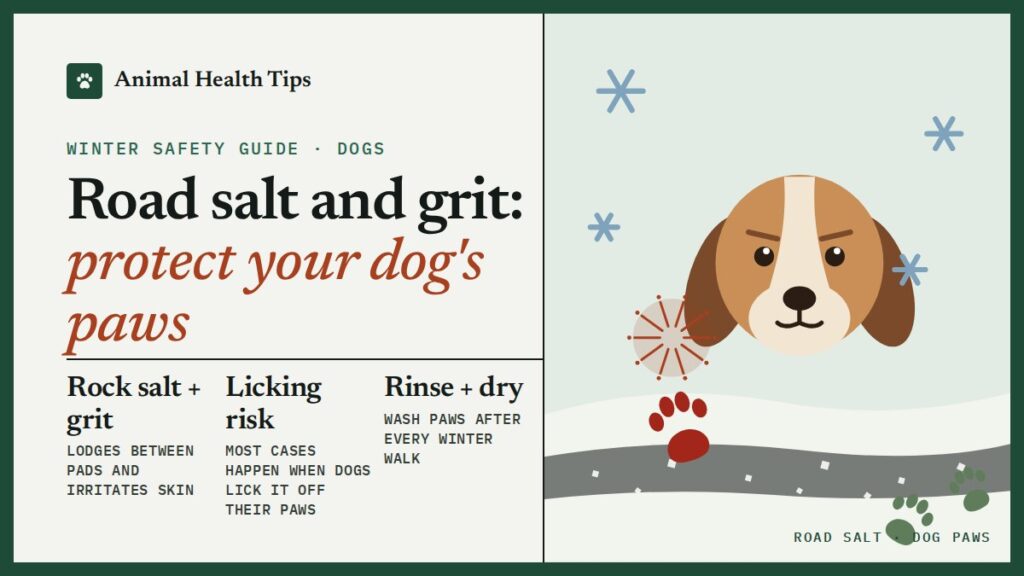
Councils spread rock salt on roads and pavements all winter, and your dog walks through it barefoot every day. Rock salt is a mixture of salt (sodium chloride) and grit, and it lodges between the pads, irritates the skin, and cracks the pads. The bigger danger, though, is what happens afterwards: most cases involve dogs that walk through gritted snow and then lick or chew the salt off their own paws.
In this guide7 sections
- Why are road salt and grit dangerous for dogs’ paws?
- Signs your dog’s paws are suffering, or salt has been eaten
- What to do if your dog eats rock salt
- Antifreeze on winter pavements: the deadlier danger
- The winter paw wash: what to do after every walk
- How to protect your dog’s paws all winter
- Frequently asked questions
Call your vet today if
- Your dog is limping or lifting a paw after a winter walk
- They are licking or chewing their paws constantly
- The pads look red or cracked, or the skin between the toes is sore
- Your dog is unusually thirsty, vomiting or lethargic after being out in gritted snow
Why are road salt and grit dangerous for dogs’ paws?
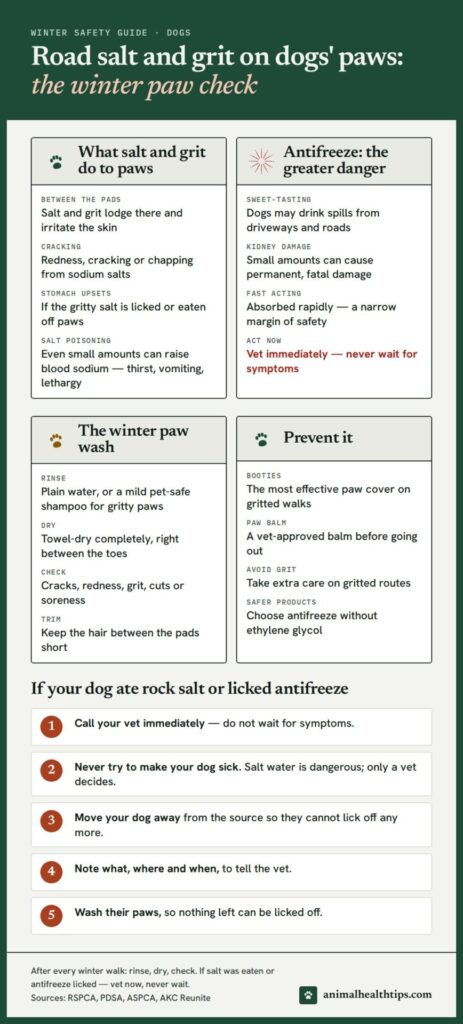
Grit and salt used on pavements and roads can get caught between the pads, cause skin irritation, or lead to stomach upsets if licked or eaten. Most ice melts also contain large amounts of sodium salts, which can damage the paw pads when stepped on, get stuck in the paws, and cause redness, cracking or chapping.
It is the licking that turns an irritation into a poisoning risk. Rock salt can be a danger if pets lick it from their paws or fur, and it is difficult to say how much needs to be eaten for signs to appear, because even a small amount of pure salt can be very dangerous. Ingestion can result in a high blood sodium concentration, which can cause thirst, vomiting and lethargy, and in severe cases convulsions and kidney damage.
Signs your dog’s paws are suffering, or salt has been eaten
Watch for these after winter walks:
- Limping, lifting a paw, or flinching when a paw is touched
- Constant licking or chewing of the paws, which makes irritation worse
- Cracks in the pads or redness between the toes
- Sores, cuts or grit trapped between the pads
If salt has been eaten, the signs look different: unusual thirst, vomiting and lethargy, and in severe cases convulsions and kidney damage. These signs can be non-specific, which is why a vet needs to check. Antifreeze, which is often on the same winter streets, has its own signs: twitching, vomiting, drinking more than usual, seizures (fits) and collapse.
What to do if your dog eats rock salt
- Call your vet immediately. Any animal suspected of eating rock salt must be assessed by a vet at once, because the signs are non-specific and a blood test is needed to check the blood sodium level.
- Never try to make your dog sick. Salt water is extremely dangerous, and inducing vomiting is a job for a vet alone.
- Move your dog away from the source of the salt, so they cannot lick off any more.
- Note what, where and when they ate it, and tell the vet. If it came from a bag of de-icer, take the packaging if you can do so safely.
- Do not try to treat them yourself. At the vet, treatment is aimed at rehydrating the dog and stabilising their sodium levels, and it depends on the blood test results.
The RSPCA also warns never to attempt to medicate dogs yourself: some medicines for humans and other animals are poisonous to dogs.
Antifreeze on winter pavements: the deadlier danger
Antifreeze, de-icing spray and screen wash often contain ethylene glycol, which is toxic to dogs and cats. If ingested, it is likely to cause severe damage to the kidneys, which can be fatal. A dog can come into contact with it by licking a spill on a driveway, or by grooming its paws and fur after walking through it.
Go to a vet now if you think your dog has licked antifreeze
- Do not wait for symptoms. Contact your vet and get your dog to the vet for treatment straight away.
- It is always better to be safe than sorry: the sooner treatment starts, the more hopeful the outlook.
- UK: Animal PoisonLine, 01202 509000 — open 24 hours, run by the Veterinary Poisons Information Service; a fee applies.
- US: ASPCA Animal Poison Control, (888) 426-4435 — open 24 hours; a consultation fee applies.
Ethylene glycol tastes sweet, so if a dog comes across it, they are likely to want to drink it. It is absorbed very rapidly once swallowed, there is a narrow margin of safety, and small amounts can lead to permanent damage to the kidneys. Poisoning is most common in autumn, winter and early spring, when antifreeze is being used and spilt, and antifreeze can be up to 95% ethylene glycol.
The signs change over time. In the first 30 minutes to 12 hours they can look like a dog that is drunk: vomiting, increased thirst and urination, depression and uncoordinated movement. There may then be a brief apparent recovery around 12 hours, before acute kidney failure develops in dogs within 36 to 72 hours, with lethargy, seizures, coma and death. This is exactly why you must never wait to see how things develop.
You can reduce the risk at home: look for antifreeze products that do not contain ethylene glycol, which are much less likely to be toxic to pets. Bittering agents are added to some products, but they are not always effective, so avoiding ethylene glycol completely is the safest choice. Scrape ice off the car by hand when you can, instead of reaching for de-icer.
The winter paw wash: what to do after every walk
This is the single most useful habit of the season. After each walk, wash and dry your pet’s feet and stomach: while out, your pet may step in ice, salt and chemicals, which can be very painful. The RSPCA says to thoroughly wipe your pet’s feet, legs and tummy after any walk or time outside in cold weather when there may be grit on the ground.
- Rinse the paws with plain water when you get home. If they are gritty, wash with a mild, pet-safe shampoo and warm water, then rinse well.
- Dry them completely with a towel, right between the toes. Wet paws stay sore paws.
- Check for damage: cracks in the pads, redness between the toes, cuts, sores or trapped grit.
- Trim the hair between the pads so there is less hair for snow, ice balls and salt crystals to gather on.
- Reward your dog with a treat, especially if they do not enjoy having their paws handled. Be gentle.
- Wash off anything unknown quickly, and contact your vet if you have any concerns.
How to protect your dog’s paws all winter
- Take extra care to avoid gritted areas on your walks. A route through a park can be kinder than a gritted pavement.
- Use booties. Booties can be even more effective than creams in covering and protecting paws on winter walks, and they help against the cold ground itself.
- Apply a vet-approved paw balm before going out. The ASPCA suggests massaging petroleum jelly, or another vet-approved paw cream or balm, into the pads to help protect them from salt and chemical agents.
- Keep walks shorter in extreme cold. In extreme cold the body pulls blood from the extremities to the internal organs, leaving paws exposed to frostbite damage. Know how cold is too cold for your dog.
- Look after older dogs in the cold. Arthritis often flares in winter, and sore arthritic joints make a dog less willing to lift and check sore paws. Cold weather makes arthritis worse in older dogs.
- Know what to do if poison is eaten. Salt is not the only winter poison on the ground. Rat and mouse poison explains the same stay-calm, vet-first steps that apply to any poisoning.
If you are concerned about the composition of rock salt in your area, your local authority can tell you what is being spread.
| The danger | Signs | What to do |
|---|---|---|
| Salt on the paws | Redness, cracking, limping, constant licking | Rinse and dry the paws, check between the toes; vet if it is not improving |
| Salt eaten | Thirst, vomiting, lethargy; severe cases: convulsions, kidney damage | Vet immediately; a blood test will check sodium levels |
| Antifreeze licked | Twitching, vomiting, drinking more, seizures, collapse | Vet now; never wait for symptoms |
Key takeaways
- Road salt lodges between the pads and irritates the skin; most poisoning cases come from dogs licking it off their own paws.
- Rinse and dry your dog’s paws after every winter walk, and check between the toes.
- Booties are the most effective protection; a vet-approved paw balm before walks helps too.
- If salt was eaten or antifreeze licked, see a vet immediately. Never try to make your dog sick yourself.
Frequently asked questions
Is road salt poisonous to dogs?
It can be. Rock salt lodges between the pads and irritates the skin, and most cases happen when dogs lick the salty grit off their paws. Even a small amount of pure salt can be very dangerous: it can raise blood sodium, causing thirst, vomiting and lethargy, and in severe cases convulsions and kidney damage. Call your vet immediately if you suspect your dog has eaten any.
Can I put petroleum jelly on my dog’s paws?
Yes, before a walk. The ASPCA suggests massaging petroleum jelly, or another vet-approved paw cream or balm, into the paw pads to help protect them from salt and chemical agents. Use only pet-safe or vet-approved products, never a random human cream, and still rinse and dry the paws when you get home.
Should I wash my dog’s paws after every walk in winter?
Yes. The RSPCA advises thoroughly wiping your pet’s feet, legs and tummy after any walk in cold weather when there may be grit on the ground. Rinse with plain water, or a mild pet-safe shampoo for gritty paws, then dry completely, including between the toes.
Are ‘pet-safe’ ice melts completely safe?
No. Products labelled pet-friendly may help to minimise the chance of an injury or toxicity, but they are not harmless. Keep chemicals out of your dog’s reach, and always wash your pet’s paws when they come in from outside.
What should I do if my dog licks antifreeze?
Go to a vet immediately, even if your dog looks fine. Antifreeze containing ethylene glycol can cause severe, fatal kidney damage, and signs can briefly improve before the kidneys fail. Take the bottle or label if you can, and never wait for symptoms.
Will dog boots stop salt irritation?
Booties are the most effective protection against salt, grit and de-icing chemicals on walks, and they also help keep paws warm. Get your dog used to them gradually with treats, and still check the paws and between the toes when the boots come off.
Sources
- PDSA — Vet Q&A: How do I keep my pet safe from de-icing products?
- RSPCA — Dog poisoning: rock salt poisoning
- ASPCA — 10 expert tips to keep your pet safe this winter
- AKC Reunite — Winter weather safety
This guide is general information, not a diagnosis. If you are worried about your dog, contact your vet.