
Thanksgiving in the United States falls on 26 November this year, and in Britain the same questions arrive a month later at Christmas dinner. Either way, the scene is identical: a cat staring up at the table while the turkey is carved. Cats are part of the family, Cats Protection notes, so it is natural to want to include them in the feast. The good news is that a cat can have some turkey. The condition is strict, and it covers the whole plate, not just the meat.
In this guide7 sections
Contact your vet as soon as possible if
- Your cat has eaten bones, stuffing, gravy or seasoned meat
- Your cat has eaten onion, garlic or leeks, in any form, even cooked
- Your cat vomits, has diarrhoea, seems lethargic or loses its appetite after the meal
- Your cat strains, passes very little, or shows pain
- UK: Animal PoisonLine, 01202 509000 — open 24 hours, run by the Veterinary Poisons Information Service; a fee applies.
- US: ASPCA Animal Poison Control, (888) 426-4435 — open 24 hours; a consultation fee applies.
Can cats eat turkey? The short answer
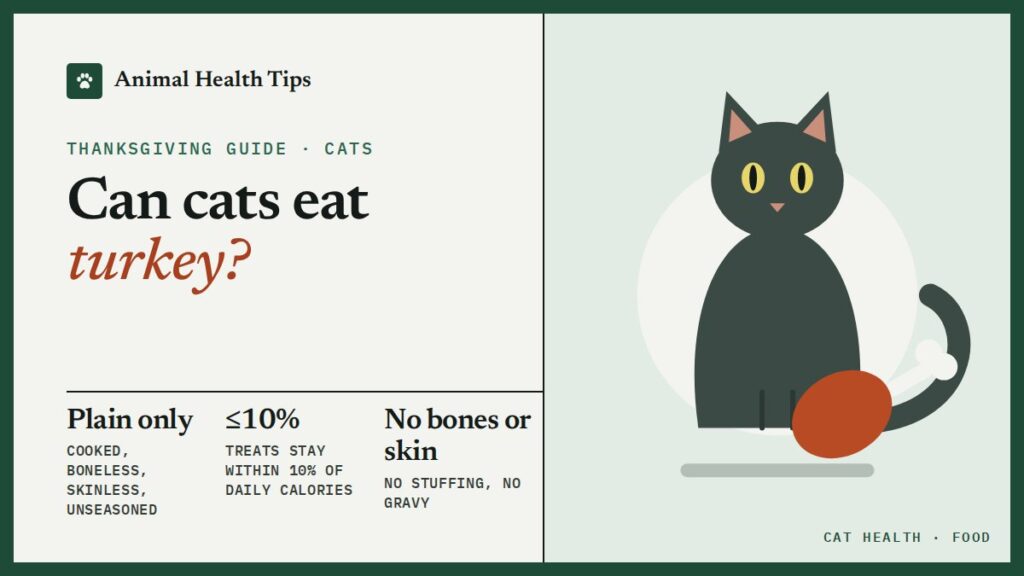
Cats can eat turkey, but it must be cooked, boneless, unseasoned and skinless, Cats Protection states. Raw meat can contain harmful bacteria, which is the charity’s stated reason the turkey must be cooked. Cooked turkey or chicken with no bones, skin or seasoning is listed as a safe festive food for cats. It is OK to feed a cat some plain, cooked turkey as an occasional treat, Cats Protection adds, but avoid giving turkey regularly: a diet of turkey on its own will not contain all the nutrients a cat needs, so the main meal should stay a commercial cat food labelled complete.
That last point is worth holding on to, because it sets the portion as well as the preparation. Cats love a predictable routine, Cats Protection notes, and there is no need to feed a cat a special dinner at a festival: the usual food at the usual time keeps a cat happy. A sudden change in diet could cause digestive upset, especially if it is something rich or unusual, and a taste of something extra tasty may put a cat off its usual food in the hope of more treats. Turkey is a treat, not a second dinner.
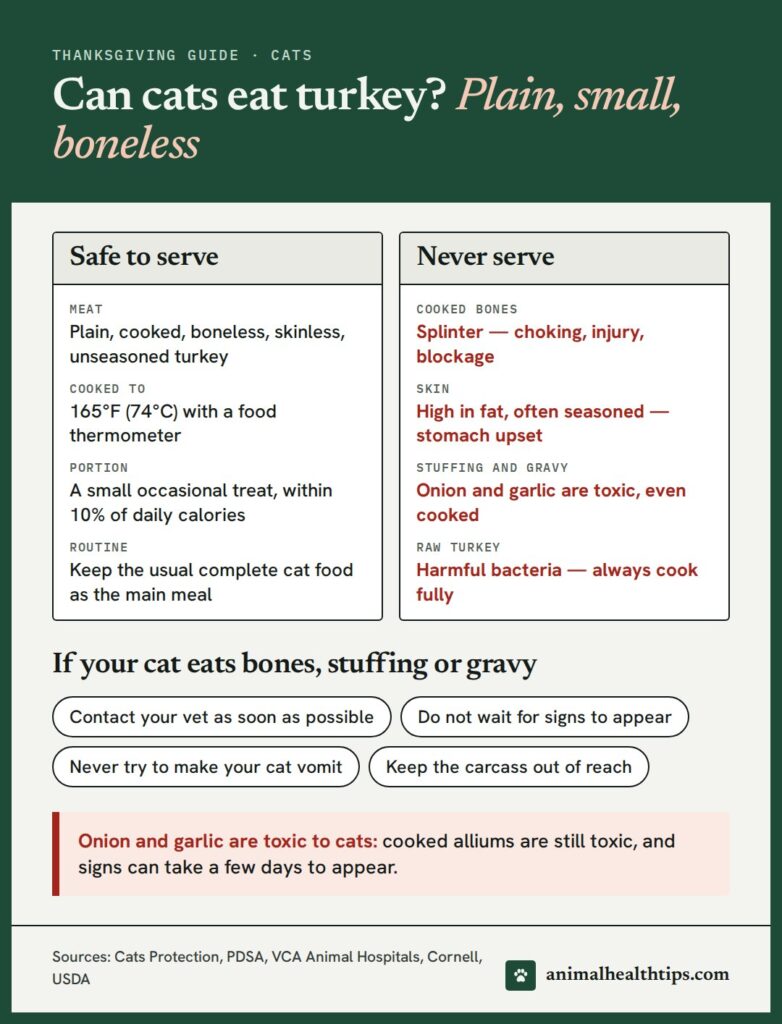
The safe way to serve turkey
- Set the cat’s portion aside first. Carve plain meat before butter, oil, salt or seasoning goes anywhere near it, and check the piece has no skin, bone or roasting aromatics mixed in. If you cannot be sure a piece is plain, do not serve it.
- Cook it fully, to 165°F (74°C). Turkey is ready when it reaches a safe minimum internal temperature of 165 degrees Fahrenheit as measured with a food thermometer, the USDA states, checking the thickest part of the breast, the innermost part of the thigh and the innermost part of the wing.
- Keep it small, and count it. Restrict any turkey given to a cat to a small amount of cooked boneless meat, Cats Protection advises, and take account of treats like this in the cat’s daily food ration. Ideally, calories from treats of any kind should be 10% or less of a cat’s total daily calories, Cornell advises, and a vet should be consulted before feeding new foods.
- Serve it separately, not from your plate. A small bowl of plain meat, served away from the table, stops well-meaning guests adding gravy, skin or a bone on top.
- Keep the carcass out of reach from the moment carving starts. Dispose of the turkey carcass safely out of your cat’s reach, Cats Protection advises, and clear plates promptly.
Why bones, skin and stuffing are out
Bones can splinter and cause choking, internal injuries or blockages, Cats Protection states, and cooked bones are listed as a dangerous festive food for cats because they can splinter and cause injury. A swallowed bone can also cause a blockage in the intestinal tract, VCA notes, which may need surgical removal. Gut blockages can lead to serious illness and even death, PDSA states in the context of swallowed items. There is no safe bone to offer, and no verified timeline for a swallowed bone passing on its own, so a cat that eats a bone earns a vet call, not a wait-and-see.
Turkey skin is high in fat and can cause digestive upset or even pancreatitis in sensitive cats, Cats Protection states, and roasted skin may also have come into contact with seasonings, herbs or garlic, which can be toxic to cats. The pancreatitis wording needs its qualifier kept in: VCA notes that, unlike dogs, cats do not appear to develop pancreatitis as the result of eating a high-fat diet. So the article’s rule is simple rather than medical: skip the skin. It adds fat and often seasoning, and gives the cat nothing it needs.
| From the turkey dinner | Safe for cats? | Why |
|---|---|---|
| Plain cooked turkey meat | Yes, as a small occasional treat | Listed as a safe festive food by Cats Protection |
| Cooked bones | No | Splinter: choking, injury, blockage |
| Skin | No | High in fat, often seasoned; stomach upset |
| Stuffing | No | Contains onion, garlic and herbs, toxic to cats |
| Human gravy | No | Usually salty, contains garlic and seasoning |
| Raw turkey | No | Harmful bacteria; always cook fully |
Onion and garlic: why cooked still counts
Seasonings like garlic and onion can be fatal to cats, Cats Protection states, and salt and certain herbs can be toxic. Even small amounts can cause digestive upset or more serious health issues. Stuffing contains onion, garlic and herbs, which are all toxic to cats, and gravy made for humans is usually salty and contains garlic and seasoning. That is why stuffing and gravy are out entirely, not just in large amounts: they are seasoned by design.
PDSA explains the mechanism. Onions, garlic and leeks are alliums, which are all toxic to dogs and cats, and alliums contain toxins called disulphides and thiosulfinates which can damage red blood cells, causing anaemia. Cooked onions, garlic and leeks are still toxic and should be kept out of reach, PDSA adds, and sauces, baby food and other pre-made foods may contain onions or garlic. Symptoms of onion and garlic poisoning include vomiting, diarrhoea and a reduced appetite, and they may start within 24 hours but more commonly take a few days to appear. Anaemia symptoms, trouble breathing and lethargy, may occur 1 to 5 days after eating onion, garlic or leek. If you think your cat has eaten something harmful, PDSA advises, contact your vet as soon as possible and do not wait for symptoms to appear.
Raw turkey and the bacteria risk
Raw meat can contain harmful bacteria, Cats Protection states, and that is the whole reason the turkey must be cooked. The CDC, the FDA Center for Veterinary Medicine and the Canadian Veterinary Medical Association stand united that feeding raw food to cats is potentially dangerous to the cat, other pets and the owner, VCA reports, with infectious disease, nutritional imbalance and foreign bodies as the three primary concerns. In cats, salmonellosis symptoms may include vomiting, diarrhoea, often bloody, fever, inappetence and lethargy, VCA notes, and cats can also carry Salmonella without showing signs. In a 2011 to 2012 screening of commercially available raw pet foods, nearly 25% of samples tested positive for harmful bacteria including Salmonella and Listeria, VCA adds, though that figure is for commercial raw pet foods, not turkey specifically. The rule stays plain: cook the turkey fully, to 165°F, and never serve it raw.
What to do if your cat eats the wrong thing
- Contact your vet as soon as possible. If you think your cat has eaten something harmful, PDSA advises, contact your vet as soon as possible and do not wait for symptoms to appear. Possible symptoms include vomiting, diarrhoea, lethargy, reduced appetite, pain and constipation or straining.
- Never try to make your cat vomit. PDSA states never to try to make a cat vomit unless a vet specifically tells you to do so. Only a vet decides that.
- Note what was eaten, roughly how much, and when. Bones, stuffing, gravy and seasoned meat are different problems, and the timing matters for onion and garlic, where signs can take days to appear.
- Watch and report back. If your vet advises monitoring, watch for vomiting, diarrhoea, lethargy, reduced appetite or straining, and call back promptly if anything worsens.
- Keep the rest of the dinner out of reach. Clear plates, bin the carcass safely, and tell guests the cat gets plain meat in its own bowl and nothing from a plate.
For the wider festive picture, including trees, lights and decorations, see our guide to Christmas tree safety for cats and dogs, and for another festive food that is only safe when served plain, see our guide to can cats eat pumpkin. The pattern is the same every festival: plain, small, boneless, and nothing seasoned. A cat that keeps its usual complete food as the main meal, with a bite of plain turkey as the treat, gets the celebration without the vet visit.
Key takeaways
- Cats can eat turkey only when it is plain, fully cooked, boneless, skinless and unseasoned.
- Cook to 165°F (74°C) with a food thermometer, and keep the portion small, within the 10% treats allowance.
- Bones can splinter and block the gut; skin is fatty and often seasoned; both stay off the plate.
- Stuffing and gravy hide onion and garlic, which are toxic to cats even when cooked.
- If your cat eats bones, stuffing or seasoned meat, contact your vet as soon as possible and never try to make it vomit.
Frequently asked questions
Can cats eat turkey?
Yes, but only plain, fully cooked, boneless, skinless and unseasoned turkey, as an occasional small treat, Cats Protection states. A diet of turkey on its own will not contain all the nutrients a cat needs, so the main meal should stay a complete cat food.
Can cats eat turkey skin?
No. Turkey skin is high in fat and can cause digestive upset or even pancreatitis in sensitive cats, Cats Protection states, and roasted skin may have come into contact with seasonings, herbs or garlic, which can be toxic to cats.
What happens if my cat eats a cooked bone?
Bones can splinter and cause choking, internal injuries or blockages, Cats Protection states. Contact your vet as soon as possible, note what was eaten and when, and never try to make your cat vomit unless a vet specifically tells you to.
Is stuffing safe for cats?
No. Stuffing contains onion, garlic and herbs, which are all toxic to cats, Cats Protection states. PDSA adds that cooked onions, garlic and leeks are still toxic, and that signs can take a few days to appear.
Can cats eat raw turkey?
No. Raw meat can contain harmful bacteria, Cats Protection states, and the CDC, FDA and Canadian Veterinary Medical Association position, reported by VCA, is that feeding raw food to cats is potentially dangerous. Cook turkey fully, to 165°F (74°C).
How much turkey can my cat have?
Only a small amount of cooked boneless meat, Cats Protection advises, counted in the daily food ration. Cornell’s general rule is that treats of any kind stay at 10% or less of daily calories, and a vet should be consulted before new foods.
Sources
- Cats Protection — Christmas dinner: Can cats eat turkey?
- Cats Protection — Top tips for a cat-friendly Christmas
- PDSA — Onion and garlic poisoning in dogs
- PDSA — My cat has eaten something harmful
- VCA Animal Hospitals — Avoiding raw food in cats
- USDA — Countdown to a Food Safe Thanksgiving Day FAQs
- Cornell University College of Veterinary Medicine — Purrfect Weight FAQ
This guide is general information, not a diagnosis. If you are worried about your pet, contact your vet.
7 comments