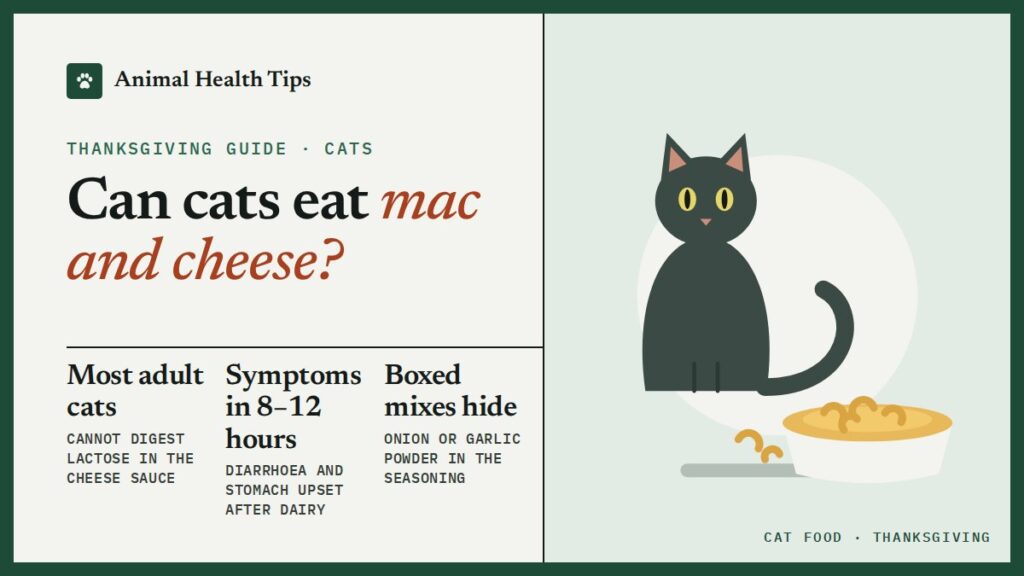
Mac and cheese is on many Thanksgiving tables — Thanksgiving falls on 26 November this year — and a begging cat may get offered a spoonful. The short answer is no: do not feed mac and cheese to a cat. No approved source addresses mac and cheese directly, but the dish combines the risky parts — dairy, a rich, fatty, salty sauce, and pasta a cat does not need.
In this guide6 sections
Call your vet now if the mac and cheese may have had onion or garlic
- Note how much was eaten, whether it was a boxed mix, and when.
- Do not wait for symptoms: poisons can have a delayed effect.
- Never try to make your cat vomit at home. Only a vet should decide that.
- UK: Animal PoisonLine, 01202 509000 — open 24 hours, run by the Veterinary Poisons Information Service; a fee applies.
- US: ASPCA Animal Poison Control, (888) 426-4435 — open 24 hours; a consultation fee applies.
Can cats eat mac and cheese?
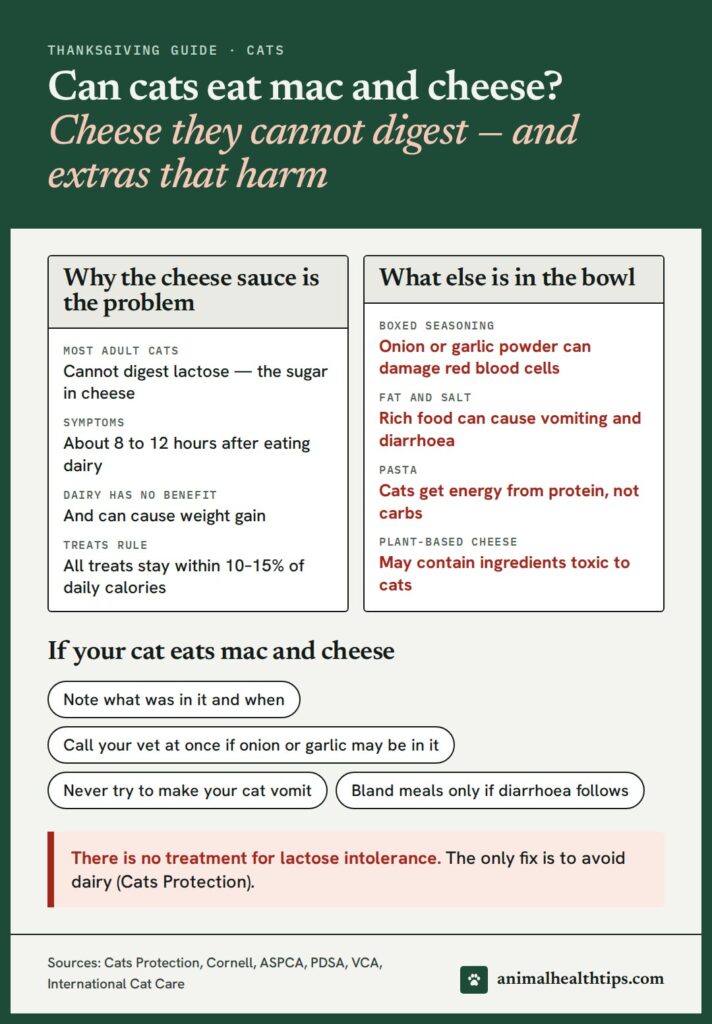
No. The cheese sauce is the problem, and it is a problem for most adult cats. Cats Protection says most adult cats are lactose intolerant: as cats grow and move to solid food, their bodies produce less lactase, the enzyme that digests lactose in milk and dairy. Many adult cats lose the ability to properly digest lactose at all. There is no treatment to stop cats being lactose intolerant — instead, you should avoid feeding your cat dairy products such as milk and cheese.
Dairy has no dietary benefit for a cat: Cats Protection says it can cause them to put on weight, and the best thing for adult cats to drink is water. Cornell agrees that milk is not generally recommended as a treat, because many cats are lactose-intolerant and can develop gastrointestinal problems if fed dairy products. Cats are obligate carnivores: Cornell says they rely on nutrients found only in animal products, and need high protein, moderate fat and minimal carbohydrates.
Cornell says treats should not exceed 10 to 15 percent of a cat’s daily calories — and a spoonful of mac and cheese spends that allowance on sugar, fat and salt a cat cannot use.
Why cheese is the problem: most adult cats cannot digest lactose
Kittens produce plenty of lactase to digest their mother’s milk. But as cats grow and move to solid food, their bodies produce less of it, Cats Protection explains, and by six to eight weeks old and fully weaned, many have already lost the ability to digest lactose properly. The ASPCA says the same in plain terms: pets do not possess significant amounts of lactase, so milk and other dairy-based products can cause diarrhoea or other digestive upset.
When a lactose-intolerant cat eats dairy, the lactose cannot be properly broken down. Instead it moves into the large intestine, where it ferments — and the symptoms appear about eight to 12 hours after the cat first eats the dairy product. Cats Protection lists the symptoms: diarrhoea, which can lead to dehydration, gurgling stomach noises, a bloated tummy, farting, going to the toilet more often, and lethargy. In severe cases a cat may need veterinary attention.
PDSA gives the same warning: most cats are lactose intolerant, and milk can cause vomiting, diarrhoea and stomach pain. Cats do not need milk to stay healthy, and milk is full of fat — PDSA says a saucer of milk for a cat is like a person eating an entire 12-inch pizza, on top of all their usual daily food.
| In the bowl | What it means | Verdict |
|---|---|---|
| Cheese sauce | Lactose most adult cats cannot digest | The main problem |
| Milk, cream, butter | High in fat; more lactose | No benefit, adds weight |
| Pasta | Carbs a cat does not need | Cats get energy from protein, not carbs |
| Salt | Excess salt can cause vomiting and seizures | Keep away |
| Boxed seasoning mix | Can hide onion or garlic powder | Call your vet if eaten |
What else is in the bowl?
The sauce is rich as well as dairy. The ASPCA says high amounts of oils and fats in foods can cause vomiting and diarrhoea, and potentially pancreatitis in some pets. But the pancreatitis link is different in cats: VCA says that unlike dogs, cats do not appear to develop pancreatitis from a high-fat diet, and Merck agrees that dietary fat may not be as important in cats as in dogs — though high-fat diets are usually avoided during treatment. A rich meal can still upset a cat’s stomach; it is just not a proven cause of pancreatitis in cats.
Fat carries another risk. VCA explains that cats are not well adapted to using fat as an energy source: when they lose weight quickly, they can get a fatty liver, a life-threatening condition. Salt adds its own risk: the ASPCA says excessive salt intake can produce increased thirst and urination and abnormal electrolytes, and signs of salt toxicity can include vomiting, diarrhoea, depression, tremors, seizures and even death.
Then there is the pasta. International Cat Care says cats are less able to digest and use carbohydrates, and get most of their blood sugar from the breakdown of protein rather than carbohydrates. No approved source says plain cooked pasta is safe for cats, so this article does not claim it is. The boxed mix is riskier than a plain homemade spoonful, because the seasoning mix can contain onion or garlic powder: Cats Protection says onion and garlic, whether fresh, cooked or dried, can be extremely toxic to cats, potentially leading to anaemia. No approved source gives the amount in a typical boxed mix, or a dose threshold, so this article gives none.
What should I do if my cat eats mac and cheese?
- Work out what was in it: a boxed mix or homemade, and whether onion or garlic may have been in it — and how much was eaten, and when.
- A tiny lick of plain mac and cheese, with no onion or garlic, is most likely to cause stomach upset — vomiting or diarrhoea about 8 to 12 hours later. Watch the cat, and call your vet if symptoms appear.
- If onion or garlic may have been present, call your vet or poison control at once. Do not wait: the ASPCA says many poisons can have a delayed effect, and to contact them even if the pet is acting normally.
- Never try to make your cat vomit at home. Only a vet should decide that.
- If diarrhoea follows, feed small, bland, frequent meals — boiled chicken or white fish, bones and skin removed. Nothing rich or fatty, and nothing else with lactose. If the cat refuses to eat, speak to a vet.
- Once the cat is passing solid poo, gradually reintroduce its normal diet over a few days.
What can I give my cat instead at Thanksgiving?
- A small piece of plain cooked chicken breast or turkey breast. PDSA lists both as healthy treats — cooked, with no skin, bones or seasoning, inside the 10 to 15 percent treat allowance. See our guide to whether cats can eat turkey.
- A spoonful of plain canned pumpkin. Pumpkin should be the only ingredient — see our guide to whether cats can eat plain pumpkin.
- A few plain cooked green beans. Nothing added, mixed into the usual dinner — see our guide to whether cats can eat green beans.
- Tell your guests. Cats Protection says not to feed your cat table scraps, and to advise guests not to do so. Store harmful foods out of your cat’s reach and cover or hide leftovers.
Key takeaways
- Do not feed mac and cheese to a cat: most adult cats cannot digest lactose.
- Symptoms appear about 8 to 12 hours later — diarrhoea, stomach pain and lethargy.
- Dairy has no dietary benefit for cats, and can cause weight gain.
- Boxed mixes can hide onion or garlic powder.
- A rich meal can upset a cat’s stomach, but it is not a proven cause of pancreatitis in cats.
Frequently asked questions
Can cats eat mac and cheese?
No. Most adult cats cannot digest lactose, the sugar in the cheese sauce, so even a small serving can bring on diarrhoea and stomach pain about 8 to 12 hours later. Boxed mixes can also hide onion or garlic powder.
Can cats eat cheese?
It is best not to. Most adult cats are lactose intolerant, and Cats Protection advises avoiding dairy products such as milk and cheese. Even lactose-free or plant-based cheese is best avoided.
What happens if my cat eats mac and cheese?
A tiny lick of plain mac and cheese is most likely to cause stomach upset — vomiting or diarrhoea about 8 to 12 hours later. If the mix may have had onion or garlic, call your vet at once.
Does mac and cheese cause pancreatitis in cats?
Not proven. Unlike dogs, cats do not appear to develop pancreatitis from a high-fat diet, according to VCA and Merck. Rich food can still cause vomiting and diarrhoea.
What can I give my cat instead at Thanksgiving?
A small piece of plain cooked chicken breast or turkey breast, with no skin, bones or seasoning, inside the 10 to 15 percent treat allowance. Plain canned pumpkin or plain green beans work too.
Sources
- Cats Protection — Are Cats Lactose Intolerant?
- Cats Protection — Cats and Human Foods
- Cornell Feline Health Center — Feeding Your Cat
- ASPCA — People Foods to Avoid Feeding Your Pets
- PDSA — Can Cats Drink Milk?
- PDSA — The Best Diet for Your Cat
- VCA Animal Hospitals — Nutrition and Pancreatic Disease in Cats
- International Cat Care — Feeding Your Cat or Kitten
This guide is general information, not a diagnosis. If you are worried about your pet, contact your vet.