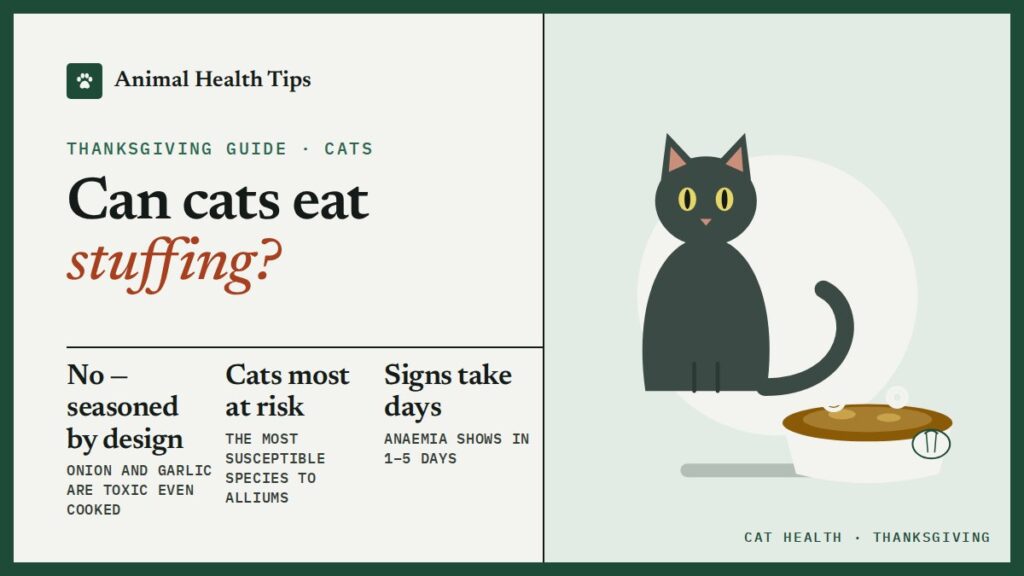
Stuffing is on many Thanksgiving tables — Thanksgiving falls on 26 November this year — and a cat watching the carving may get offered a spoonful. The short answer is no: do not feed stuffing to a cat. Stuffing is seasoned by design, and the onion and garlic in most recipes are toxic to cats even when cooked. The damage they do can also take days to show, so a cat that seems fine at the table may be ill by the weekend.
In this guide6 sections
Call your vet now if your cat ate stuffing
- Note how much was eaten, what was in it, and when.
- Do not wait for symptoms: the damage can take days to show.
- Never try to make your cat vomit at home. Only a vet should decide that.
- UK: Animal PoisonLine, 01202 509000 — open 24 hours, run by the Veterinary Poisons Information Service; a fee applies.
- US: ASPCA Animal Poison Control, (888) 426-4435 — open 24 hours; a consultation fee applies.
Can cats eat stuffing?
No. Cats Protection says onion and garlic, whether fresh, cooked or dried, can be extremely toxic to cats, potentially leading to anaemia — and stuffing is built around them. Cats Protection also says not to feed a cat table scraps, and to advise guests not to do so, storing harmful foods out of reach and covering or hiding leftovers. PDSA adds that sauces, baby food and other pre-made foods may contain onion or garlic, so dirty plates and jars should be kept away from a cat. There is no safe amount of stuffing for a cat, and no approved source gives one, so this article gives none.
Cats are meat eaters, and there is no need to add vegetables to their diet, Cats Protection says — and a cat that eats stuffing gets nothing it needs from the bowl, only the risks in it.
Why onion and garlic are so dangerous for cats
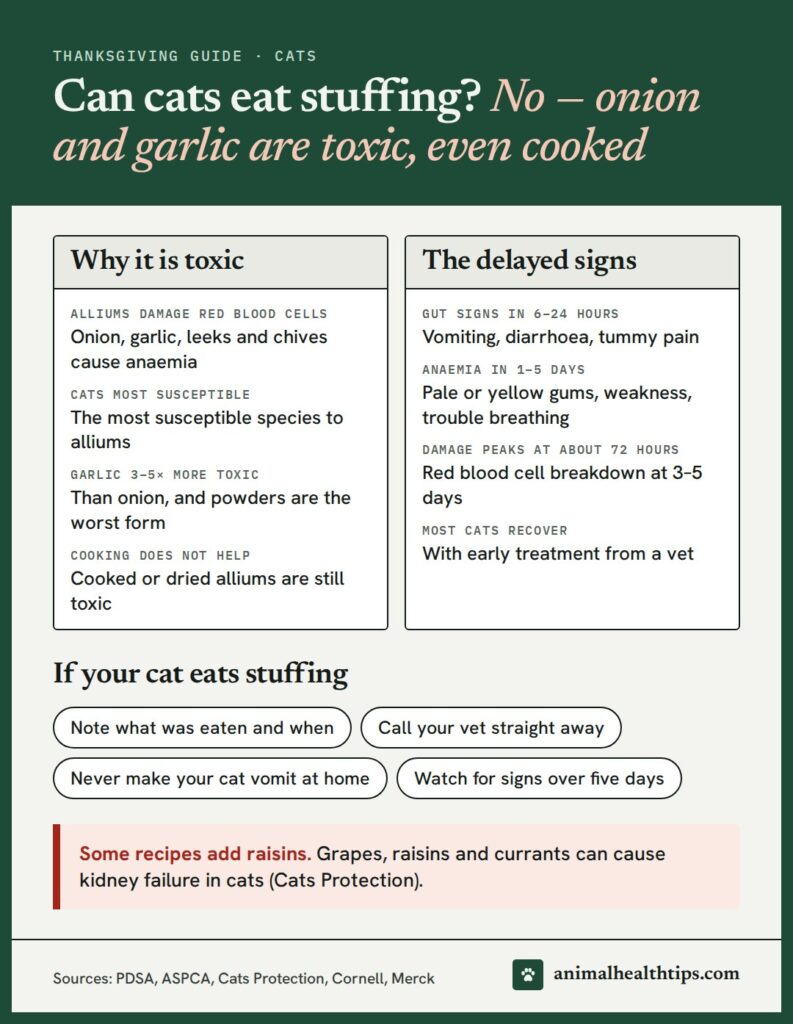
Onions, shallots, leeks, garlic and chives are alliums, and alliums are toxic for cats. PDSA says they cause gut upsets and damage red blood cells, which results in anaemia, and that onions — including spring onions and shallots — are the most toxic allium for cats, though garlic, chives and leeks are also toxic, even when cooked or dried. Alliums are thought to contain toxins called disulphides and thiosulfinates that damage red blood cells, causing anaemia.
Cats are more at risk than dogs. The ASPCA says that although cats are more susceptible, dogs are also at risk depending on the amount ingested, and Merck states plainly that cats are the most susceptible species, followed by dogs. Garlic is three to five times more toxic than onion, Merck adds. Concentrated forms are the worst: Merck says toxicosis in cats and dogs is most commonly associated with concentrated forms of allium, such as dehydrated flakes, powders or dry onion soup mixes — exactly what a stuffing seasoning mix is. Toxicosis has been reported in cats after ingesting less than a teaspoon of cooked onions — a reported case, not a safe threshold, and no amount is safe to offer.
Cooking changes nothing. PDSA is direct: cooked onions, shallots, garlic, chives and leeks are all toxic to cats and should be kept out of their reach. The ASPCA says allium species can cause gastrointestinal irritation and red blood cell damage, which can lead to anaemia. Cats Protection puts it the same way: onion and garlic, and other members of the allium family, whether fresh, cooked or dried, if eaten by cats can be extremely toxic, potentially leading to anaemia.
What happens after a cat eats stuffing
The signs arrive in two waves. Gut symptoms often appear 6 to 24 hours after eating alliums, PDSA says, though they can sometimes take a few days: vomiting, diarrhoea, a reduced appetite and abdominal pain. The anaemia symptoms take longer, usually within one to five days: pale or jaundiced gums, trouble breathing, weakness and lethargy. Very rarely, onion and garlic poisoning can cause seizures. Merck explains the timing: oxidative damage to red blood cells begins within 24 hours and peaks in approximately 72 hours, and haemolysis typically occurs 3 to 5 days after exposure.
With treatment, most cats recover completely, PDSA says, and it is very rare for onion, garlic or leek poisoning to cause ongoing problems or death. That is good news — but it depends on getting the cat to a vet early, before the anaemia sets in.
| In the stuffing | What it does to a cat | Verdict |
|---|---|---|
| Onion, garlic, leeks, chives | Damage red blood cells; anaemia in 1–5 days | Toxic — call your vet |
| Salt | Too much salt can be fatal; vomiting, seizures | Keep away |
| Fat and butter | Can upset the stomach; fat can predispose to pancreatitis | Keep away |
| Raisins, in some recipes | Can cause kidney failure in cats | Toxic — call your vet |
The rest of the bowl adds risk of its own. Cornell says that at Thanksgiving, cats can suffer toxicities from certain foods — onions and garlic are toxic to cats, and eating fat from meats can predispose them to pancreatitis — and that it is generally best to avoid feeding cats human food. The ASPCA says excessive salt intake can produce increased thirst and urination and abnormal electrolytes, and signs of salt toxicity can include vomiting, diarrhoea, depression, tremors, seizures and even death. Cats Protection adds that too much salt can be fatal to a cat. Some stuffing recipes also add raisins: Cats Protection says grapes, raisins and currants can cause kidney failure in cats, and cats with chronic kidney disease may be at greater risk.
What should I do if my cat eats stuffing?
- Work out what was in it: the recipe or the box, how much was eaten, and when.
- Call your vet straight away. PDSA says to contact a vet as soon as possible if a cat has eaten onions, garlic, leeks or chives — even if the cat seems fine, because the damage can take days to show.
- Never try to make your cat vomit at home. Cornell says not to induce vomiting unless specifically directed, and PDSA says a vet will probably advise an injection to make them vomit only if it has been less than four hours.
- Watch for the delayed signs over the next five days: vomiting, diarrhoea, reduced appetite and tummy pain first, then pale or yellow gums, trouble breathing, weakness and lethargy.
- Keep the packaging or the recipe for the vet.
What can I give my cat instead at Thanksgiving?
- A small piece of plain cooked turkey breast. Cornell says a very small piece of lean turkey as a special treat is likely OK — cooked, boneless, skinless and unseasoned. See our guide to whether cats can eat turkey.
- A spoonful of plain canned pumpkin. Pumpkin should be the only ingredient — see our guide to whether cats can eat plain pumpkin.
- A few plain cooked green beans. Nothing added — see our guide to whether cats can eat green beans.
- Tell your guests not to feed the cat from the table, and cover or hide leftovers — Cats Protection’s advice.
Key takeaways
- Do not feed stuffing to a cat: onion and garlic are toxic even when cooked.
- Cats are the most susceptible species to allium poisoning.
- Gut signs appear in 6 to 24 hours; anaemia signs in one to five days.
- Call your vet straight away — do not wait for symptoms.
- Never try to make a cat vomit at home.
Frequently asked questions
Can cats eat stuffing?
No. Stuffing is seasoned by design, and onion and garlic are toxic to cats even when cooked: they damage red blood cells and can cause anaemia. There is no safe amount of stuffing for a cat.
My cat licked a spoonful of stuffing — what should I do?
Call your vet straight away, even if the cat seems fine. Note how much was eaten and what was in the recipe, and never try to make your cat vomit at home.
Can cats eat cooked onions?
No. PDSA says cooked onions, shallots, garlic, chives and leeks are all toxic to cats and should be kept out of their reach. Cooking does not make them safe.
How long does it take for symptoms to appear?
Gut symptoms often appear 6 to 24 hours after eating alliums, and anaemia symptoms usually within one to five days. The damage to red blood cells begins within 24 hours and peaks at about 72 hours.
What can I give my cat instead at Thanksgiving?
A small piece of plain cooked turkey breast, with no skin, bones or seasoning, is likely OK as a special treat. Plain canned pumpkin or plain cooked green beans work too.
Sources
- PDSA — Onion and Garlic Poisoning in Cats
- ASPCA — People Foods to Avoid Feeding Your Pets
- Cats Protection — Cats and Human Foods
- Cats Protection — Poisoning in Cats
- Cornell Feline Health Center — Beware Holiday Hazards
- Cornell Feline Health Center — Common Cat Hazards
- Merck Veterinary Manual — Garlic and Onion (Allium spp.) Toxicosis in Animals
This guide is general information, not a diagnosis. If you are worried about your pet, contact your vet.