Cranberry sauce is on most Thanksgiving tables in the United States — Thanksgiving falls on 26 November this year — and a begging cat may get a lick. The short answer: a tiny lick of plain sauce is unlikely to harm a healthy cat, but sauce is a poor choice, not a treat to offer. It is mostly sugar, cats cannot even taste sweetness, and sauces can hide ingredients that are genuinely dangerous.
In this guide8 sections
Call your vet now if the sauce had raisins, currants, alcohol or xylitol
- Note how much was eaten and what was in it.
- Do not wait for symptoms: signs can take 6 to 12 hours, and kidney failure can follow within 1 to 3 days.
- Never try to make your cat vomit at home. Only a vet should decide that.
- UK: Animal PoisonLine, 01202 509000 — open 24 hours, run by the Veterinary Poisons Information Service; a fee applies.
- US: ASPCA Animal Poison Control, (888) 426-4435 — open 24 hours; a consultation fee applies.
Can cats eat cranberry sauce?
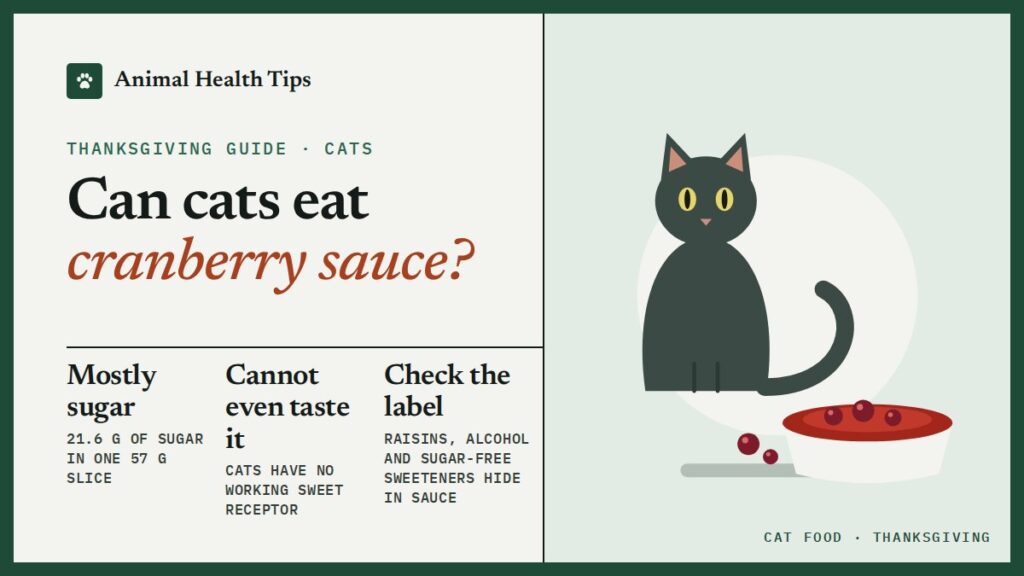
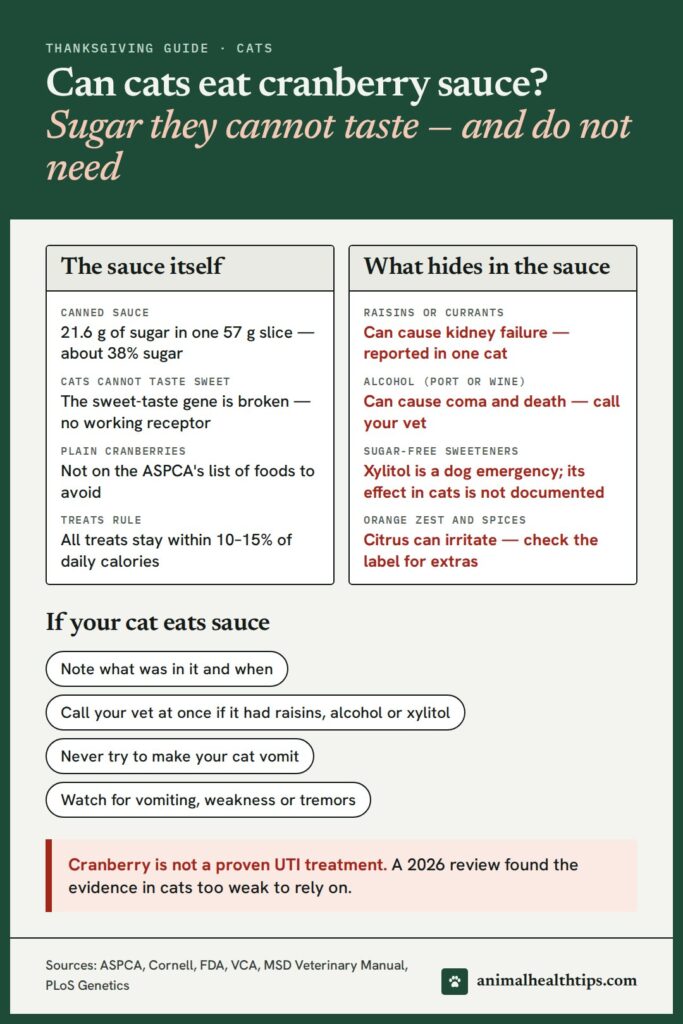
Plain cranberries are not the problem: they do not appear on the ASPCA’s list of people foods to avoid feeding pets, and a published trial even fed cranberry powder to cats. But cranberry sauce is not plain cranberries — canned, sweetened sauce holds 21.6 g of sugars in one 57 g slice, according to the USDA, roughly 38 percent sugar by weight. That is the point of the sauce: it is made to be sweet.
A cat gets nothing from that sugar. Cats are obligate carnivores: Cornell says they rely on nutrients found only in animal products. A sauce of sugar and water adds calories a cat does not need and no nutrient it does. Cornell says obesity is the most common nutrition-related problem in cats, linked to arthritis and diabetes.
No approved source gives a cranberry-specific serving for cats, so this article gives none. The only sourced guidance is Cornell’s treat rule: treats should not exceed 10 to 15 percent of a cat’s daily calories. A lick would sit inside that limit — but a treat should be worth giving, and sauce is not.
Why can cats not taste the sugar?
The sweetness that makes cranberry sauce appealing to people means nothing to a cat: cats cannot taste sweetness at all. Their Tas1r2 gene — one half of the sweet-taste receptor — is an unexpressed pseudogene with a 247-base-pair microdeletion in exon 3 and stop codons in exons 4 and 6, so no functional sweet receptor can form (Li and colleagues, PLoS Genetics, 2005). A cat that licks the sauce tastes the tartness, not the sweetness — and takes in sugar it cannot use.
What hides in cranberry sauce?
Raisins, sultanas and currants are the most dangerous extra: the ASPCA says grapes and raisins can cause kidney damage, and the MSD Veterinary Manual notes grape and raisin ingestion has led to kidney failure in some dogs and has been reported in one cat. A sauce with raisins is an emergency for a cat, not a treat. Alcohol is the second: the ASPCA says foods containing alcohol can cause vomiting, diarrhoea, incoordination, depression, difficulty breathing, tremors, coma and even death, and alcohol is rapidly absorbed. Some sauces are made with port, wine or liqueur.
Orange zest and spices are the milder extras: the ASPCA says citrus can irritate in significant quantities, though small amounts are unlikely to cause more than minor stomach upset. Read the label — and if you do not know what is in the sauce, do not offer it.
| On the table | What’s in it | Safe for a cat? |
|---|---|---|
| Plain cranberries | Berries only | Not listed as toxic |
| Canned sweetened sauce | 21.6 g of sugar per 57 g slice | A poor choice — mostly sugar |
| Sugar-free sauce | Xylitol or other sweeteners | Keep away |
| Sauce with raisins or port | Grapes or alcohol | No — call your vet |
| Homemade, cranberries and water | No extras | Least risky — still no benefit |
What about xylitol in sugar-free sauce?
Sugar-free sauce needs a label check: the sweetener may be xylitol, also labelled birch sugar or wood sugar. In dogs it is a serious poison: the FDA says it triggers a potent insulin release and a rapid, profound drop in blood sugar within 10 to 60 minutes, which untreated can quickly be life-threatening, and higher doses can cause liver failure.
For cats, the position is different — and less certain. The FDA says xylitol does not seem to be as dangerous for cats, and that cats appear to be spared, at least in part, by their disdain for sweets. Its toxicity in cats has not been documented — but that is not the same as safe. Keep sugar-free sauce away from cats, and any sauce listing xylitol, birch sugar or wood sugar out of reach of every pet.
Does cranberry help with urinary problems?
This is the claim that brings many owners to cranberries, and the evidence in cats is weaker than the claim. A 2024 trial fed cranberry powder to six neutered cats and found it significantly reduced E. coli adherence to feline urinary cells in the laboratory — in 60 percent of cats at 0.1 percent powder, and in all cats at 0.3 percent. The authors concluded only that it may offer some protection: a laboratory measure, not proof of UTI prevention.
A small preliminary trial of 21 cats with feline idiopathic cystitis found urinary signs gone by day 60 only in the cranberry group. A 2026 systematic review of three studies and 122 animals (106 dogs, 16 cats) then found no statistically significant effects, rated the evidence low to very low, and concluded it precludes confident assessment of cranberry for urinary tract disease.
Do not give cranberry sauce, or a cranberry supplement, as a urinary treatment: Cornell says supplements can be harmful and should never be given without a vet’s approval. If your cat has urinary signs, the vet is the first call, not the sauce.
What should I do if my cat eats cranberry sauce?
- Work out what was in it: plain sauce, or sauce with raisins, currants, alcohol or xylitol — and how much was eaten.
- Call your vet at once if the sauce had raisins, currants or alcohol. Do not wait: in dogs, signs appear within 6 to 12 hours and kidney failure within 1 to 3 days; cat timing is not established.
- Never try to make your cat vomit at home. Only a vet should decide that — VCA and the MSD Veterinary Manual say at-home attempts to induce vomiting are not recommended after xylitol ingestion.
- Watch for warning signs: vomiting, diarrhoea, lethargy, loss of coordination, loss of appetite, abdominal pain, weakness, thirst, tremors or seizures.
- Keep the packaging or recipe for the vet.
What can I give my cat instead at Thanksgiving?
- A small piece of plain cooked turkey. Cooked, boneless, skinless and unseasoned — see our guide to whether cats can eat turkey.
- A spoonful of plain canned pumpkin. Pumpkin should be the only ingredient — see our guide to whether cats can eat plain pumpkin.
- A few plain cooked green beans. Nothing added, mixed into the usual dinner — see our guide to whether cats can eat green beans.
- Tell your guests. Visitors often share from their plates — make it clear that nothing from a plate is for the cat.
Key takeaways
- A tiny lick of plain sauce is unlikely to harm a healthy cat, but sauce is not a treat.
- One slice of canned sauce holds 21.6 g of sugar, and cats cannot taste sweetness at all.
- Sauces can hide raisins, alcohol and sugar-free sweeteners — read the label.
- Cranberry is not a proven urinary treatment: a 2026 review found the evidence too weak to rely on.
Frequently asked questions
Can cats eat cranberry sauce?
A tiny lick of plain sauce is unlikely to harm a healthy cat, but sauce is not a treat to offer: one slice of canned sauce holds 21.6 g of sugar, cats cannot taste sweetness, and sauces can hide raisins, alcohol or sweeteners.
Can cats eat cranberries?
Plain cranberries do not appear on the ASPCA’s list of foods to avoid feeding pets, and a published trial fed cranberry powder to cats. But no approved source gives a safe serving for cats — and sauce is a different, sugary dish.
Is xylitol dangerous for cats?
Its effect in cats is not documented. The FDA says xylitol does not seem to be as dangerous for cats as for dogs, but that is not proof it is safe. In dogs it is a serious poison — keep sugar-free sauce away from cats and dogs.
Does cranberry help cats with urinary tract infections?
Not proven. A laboratory study showed reduced E. coli adhesion in cats, and one small trial reported fewer signs — but a 2026 review found no significant effects and rated the evidence low to very low. Never give a cranberry supplement without your vet’s approval.
What should I do if my cat eats cranberry sauce with raisins?
Note how much was eaten, then call your vet right away. Raisins can cause kidney failure, and signs can take 6 to 12 hours to appear. Do not wait for symptoms, and never try to make your cat vomit at home.
Sources
- ASPCA — People Foods to Avoid
- Cornell Feline Health Center — Feeding Your Cat
- US FDA — Paws Off Xylitol
- VCA Animal Hospitals — Xylitol Poisoning in Dogs
- MSD Veterinary Manual — Food Hazards
- Carvajal-Campos et al., 2024 — Cranberry and E. coli Adherence in Cats
- Weese & Weese, 2026 — Cranberry for Urinary Tract Disease: A Systematic Review
- Li et al., 2005 — Cats Lack a Functional Sweet-Taste Receptor
- USDA Nutrient Database SR20 — Canned Sweetened Cranberry Sauce
This guide is general information, not a diagnosis. If you are worried about your pet, contact your vet.