Green beans are on many Thanksgiving tables in the United States — Thanksgiving falls on 26 November this year — and a cat that begs may get offered one. The short answer is yes, but only plain beans, in small amounts. The ASPCA names plain green beans as a suitable Thanksgiving treat, mixed into a cat’s usual dinner. The casserole is a different dish, and what is added to it is the problem. This guide follows the ASPCA, the Cornell Feline Health Center, VCA Animal Hospitals and International Cat Care.
In this guide6 sections
Call your vet now if your cat has eaten green bean casserole
- Note how much was eaten and when, and what was in the casserole.
- Do not wait for symptoms: onion can damage red blood cells, and cats are more susceptible than dogs.
- Never try to make your cat vomit at home. Only a vet should decide that.
- UK: Animal PoisonLine, 01202 509000 — open 24 hours, run by the Veterinary Poisons Information Service; a fee applies.
- US: ASPCA Animal Poison Control, (888) 426-4435 — open 24 hours; a consultation fee applies.
Can cats eat green beans?
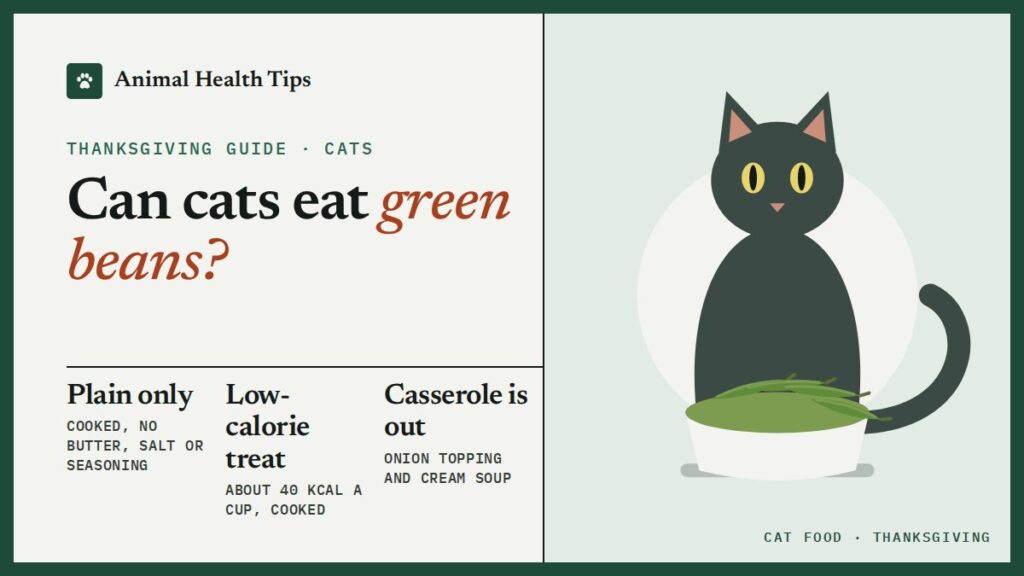
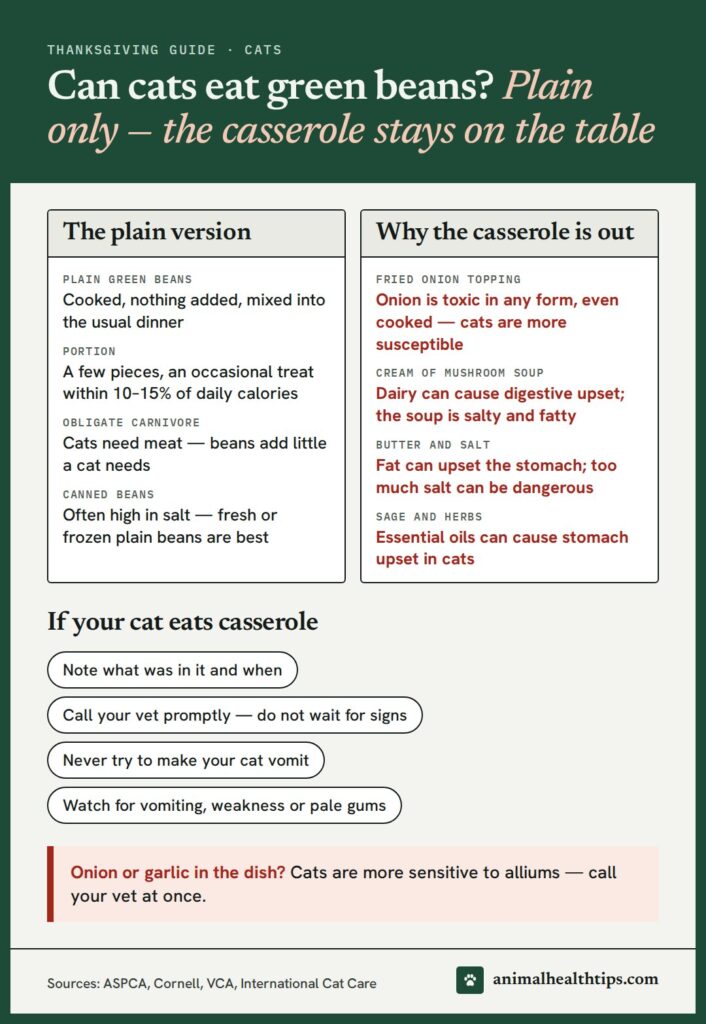
Yes — plain green beans are safe for cats in small amounts. The ASPCA’s Thanksgiving guidance is direct: stick to your pet’s regular diet, but if you want to treat them, try mixing a few pieces of turkey, sweet potatoes and green beans into their usual dinner. A second ASPCA Thanksgiving page repeats the same advice. So the beans themselves are not the problem — the way they are served is.
Cooked green beans are also low in calories: about 40 to 44 kcal a cup, with roughly 3 to 4 g of dietary fibre, according to USDA food data — though the values vary with preparation. A cat does not need green beans at all. They are an occasional treat, not a nutritional staple: a few pieces, mixed into the usual dinner, within the treat limit below.
That treat limit is the number to remember. Cornell says treats should only be fed occasionally, and a good rule of thumb is not to let treats exceed 10 to 15 percent of a cat’s daily caloric intake. VCA gives the same rule more tightly: treats should not make up more than 10% of a cat’s daily calories, and at least 90% of a cat’s calories need to come from well-balanced cat food. A few green beans count inside that limit, as does every other treat your cat gets that day.
Why do cats not need vegetables?
Cats are obligate carnivores, which is the deeper reason green beans are a treat and nothing more. Cornell says cats rely on nutrients found only in animal products, and that they evolved eating prey with high protein, moderate fat and a minimal amount of carbohydrates. VCA says cats require meat in their diet, that they have higher protein requirements than omnivorous animals, and that they need nutrients from meat such as taurine and arachidonic acid.
Taurine shows why a meat diet matters. VCA says cats require taurine from meat, and that a cat without enough of it can develop blindness and weakening of the heart muscles. Green beans provide none of that. They are a low-calorie extra a cat may enjoy, not a food a cat needs — and they must never replace the usual complete cat food.
| On the table | What’s in it | Safe for a cat? |
|---|---|---|
| Plain cooked green beans | Beans, nothing added | Yes — a few pieces, as a treat |
| Green bean casserole | Onion topping, cream soup, butter, salt | No — call your vet |
| Canned green beans | Often high in salt | No — fresh or frozen plain beans are best |
| Beans seasoned with sage | Essential oils in herbs | No — sage can cause stomach upset |
| Plain cooked turkey | Lean meat, no seasoning | Yes — a small piece, see our turkey guide |
Why is green bean casserole out?
Four things in the casserole carry the risk. The fried onion topping is the most serious. The ASPCA says onion, garlic and chives can cause gastrointestinal irritation and red blood cell damage, which can lead to anaemia, and that cats are more susceptible than dogs. VCA says onions, garlic, chives and leeks belong to the Allium genus, that all forms are poisonous, including raw, cooked, dried, powdered and liquid preparations, and that garlic is the most toxic. Never give food seasoned with onions or garlic, VCA says — and the casserole’s topping is exactly that.
Cream of mushroom soup is the second problem. The ASPCA says pets do not possess significant amounts of lactase, so milk and other dairy products can cause diarrhoea, and Cornell says milk is not generally recommended for cats, as many are lactose-intolerant. The soup is also salty and fatty, and the ASPCA says high-fat foods can lead to pancreatitis and high-sodium foods can lead to gastrointestinal problems and even seizures.
Salt is the third problem. The ASPCA says excessive salt intake can cause vomiting, diarrhoea, depression, tremors, seizures and even death. And sage, the herb that seasons many Thanksgiving dishes, is the fourth: the ASPCA says sage and many other herbs contain essential oils and resins that can cause gastrointestinal upset and central nervous system depression in pets, especially cats. So the casserole is not one risk but four, layered in one dish.
What should I do if my cat eats green bean casserole?
- Work out what was in it: whether the casserole had onion topping or garlic, how much was eaten, and when.
- Call your vet at once. VCA says if a pet has ingested any Allium species, call a veterinarian right away — do not wait for symptoms.
- Never try to make your cat vomit at home. Only a vet should decide that.
- Watch for warning signs: vomiting, weakness, pale gums and red-coloured urine can point to red blood cell damage.
- Keep the packaging or recipe. The vet needs it to know exactly what was in the dish.
The same plain-only rule applies to the rest of the table. Our guide to whether cats can eat turkey follows it, and so do our guides to whether cats can eat sweet potatoes and whether cats can eat corn — plain, cooked and unseasoned, or not at all.
What can I give my cat instead at Thanksgiving?
- A few plain cooked green beans. Cooked, nothing added, cut small and mixed into the usual dinner — the ASPCA’s own suggestion.
- Plain cooked turkey meat. Cooked, boneless, skinless and unseasoned, in small amounts — see our guide to whether cats can eat turkey.
- Plain canned pumpkin. Pumpkin should be the only ingredient — see our guide to whether cats can eat plain pumpkin.
- Keep every treat inside the 10–15% rule. Cornell says treats should not exceed 10 to 15 percent of a cat’s daily caloric intake.
- Tell your guests. Children and visitors often share from their own plates — make it clear that nothing from a plate is for the cat.
- Clear up as you go. The ASPCA says bones, chocolate, onions and other holiday fixtures in the trash are all hazardous, so empty the trash frequently and keep the casserole out of reach.
Key takeaways
- Plain green beans are safe for cats in small amounts — the ASPCA names them as a Thanksgiving treat.
- Cats are obligate carnivores: beans are a low-calorie extra, never a replacement for complete cat food.
- Green bean casserole is out — onion topping, cream soup, butter, salt and sage, four risks in one dish.
- Cats are more susceptible than dogs to onion poisoning — if your cat eats casserole, call your vet at once.
- Keep all treats within 10 to 15 percent of a cat’s daily calories, and never try to make your cat vomit at home.
Frequently asked questions
Can cats eat green beans?
Yes, plain cooked green beans are safe for cats in small amounts. The ASPCA names them as a suitable Thanksgiving treat, mixed into a cat’s usual dinner. Green bean casserole is a different dish — its onion topping, cream soup, butter and salt make it a call-the-vet situation.
Can cats eat green bean casserole?
No. The fried onion topping is the main danger — onion can damage red blood cells, and cats are more susceptible than dogs. The cream soup adds dairy, salt and fat, and sage can cause stomach upset. If your cat eats casserole, call your vet at once.
How many green beans can a cat eat?
No approved source gives a safe number of beans per cat, so this article gives none. Offer a few pieces as an occasional treat, and keep all treats within 10 to 15 percent of a cat’s daily calories, as Cornell advises.
Do cats need vegetables like green beans?
No. Cats are obligate carnivores and rely on nutrients found only in animal products, including taurine, which a cat without enough of can go blind or develop heart disease. Green beans are a low-calorie extra, not a food a cat needs.
What should I do if my cat eats green bean casserole?
Note how much was eaten and when, then call your vet right away. Do not wait for symptoms, and never try to make your cat vomit at home.
Sources
- ASPCA — How to Have a Happy, Healthy, and Humane Thanksgiving With Your Pets
- ASPCA — Thanksgiving Safety Tips That Will Keep Your Pets Feeling Thankful This Holiday
- ASPCA — People Foods to Avoid Feeding Your Pets
- Cornell University Feline Health Center — Feeding Your Cat
- VCA Animal Hospitals — Why Your Kitten Can’t Be Vegan Or Vegetarian
- VCA Animal Hospitals — Onion, Garlic, Chive and Leek Toxicity in Dogs
This guide is general information, not a diagnosis. If you are worried about your pet, contact your vet.