Curious pets will not waste any time exploring everything new that appears at Christmas, and a tree full of shiny, dangling, chewable things is irresistible. The PDSA warns that many favourite decorations could put pets at risk of serious illness or even death. The good news: a few changes before you decorate make the tree safe for cats and dogs alike.
In this guide8 sections
- Why are Christmas trees risky for cats and dogs?
- Tinsel and ribbon: the most dangerous decorations
- Baubles, ornaments and lights
- Secure the tree itself
- Edible decorations and festive plants to keep away
- How to pet-proof your Christmas tree
- What to do if your pet eats a decoration
- Frequently asked questions
Call your vet today if
- Your pet has chewed on real-tree needles and now has an irritated mouth, drooling or vomiting
- They have drunk from the tree-water pot, especially if anything was added to it
- They ate a chocolate ornament, a sugar-free sweet, or any decoration and seem off their food or unwell
Why are Christmas trees risky for cats and dogs?
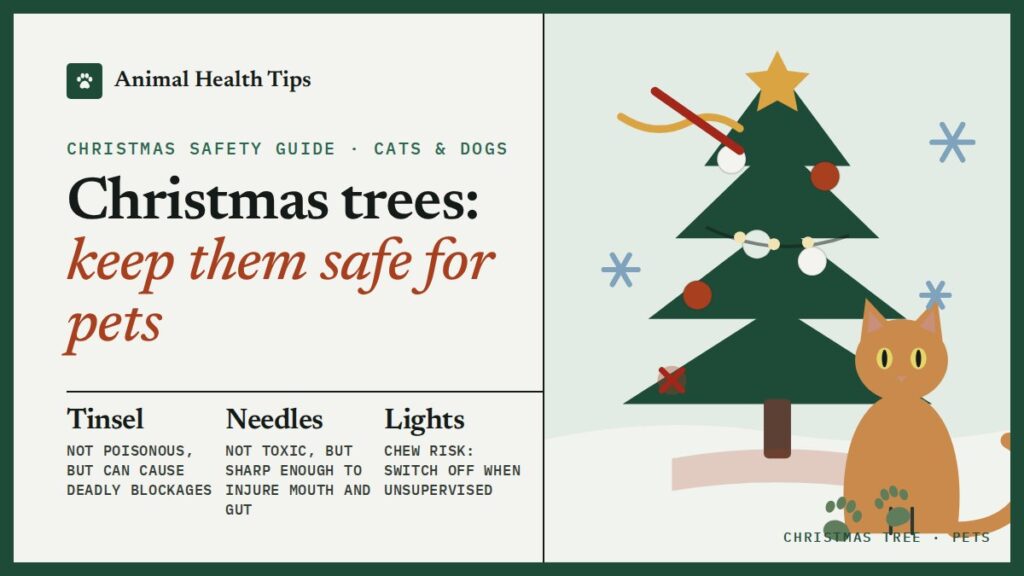
A real Christmas tree brings three separate hazards. First, the needles: they are not toxic, but they can still cause serious harm if swallowed. A pet that snacks on needles can develop an upset stomach and an irritated mouth; needles can get stuck in a cat’s soft palate, and their sharpness can cause irritation or trauma to the intestines. Even so-called non-drop varieties eventually drop needles, so fallen needles need vacuuming regularly.
Second, the tree’s sap and oils are toxic to pets. Ingestion can lead to illness, liver damage or death. Small amounts, from chewing branches and needles, can cause unusual breathing, vomiting and diarrhoea, while a large amount can seriously affect the kidney or liver functions and can be fatal.
Third, the water in the tree stand. Never add chemicals, fertilisers or preservatives to it, as many of these are toxic to pets. Even without anything added, stagnant water is a breeding ground for harmful bacteria and can cause an upset stomach if your pet drinks it. Curious cats are especially tempted by the tree pot, so cover it with netting or a tree skirt and always make sure your pet has clean, fresh water of their own.
Artificial trees are generally safer, but they are not risk-free: a dog may knock one over or a cat may climb it, causing injury. Secure any tree, real or artificial, in a sturdy base.
Tinsel and ribbon: the most dangerous decorations
This is the decoration vets fear most. Ideally, pet owners should skip tinsel entirely, because curious pets mistake it for a shiny new toy. Tinsel is not poisonous, but it is a choking hazard, and if swallowed it can get stuck as it tries to pass through the intestines and cause a deadly blockage. That is a life-threatening situation that requires emergency surgery.
The danger applies to cats and dogs alike. Eaten tinsel can cause severe vomiting, an obstructed digestive tract and dehydration, and in cats it can cause a blockage in the stomach and intestines that is sometimes fatal. One Cornell veterinarian warns that if a piece of tinsel gets wrapped around the base of a cat’s tongue before being fully swallowed, it acts like a piano wire as the cat digests and perforates the intestines, which is life-threatening.
String, ribbon and garland carry the same risk, and dogs are not exempt: tinsel, garland and tree ornaments can all lead to intestinal obstruction in dogs. Avoid long ribbon ties when wrapping presents too, especially under the tree, because cats like to chew novel things.
Go to a vet now if your pet has eaten tinsel, ribbon or string
- Contact your vet immediately. Do not mistake vomiting, diarrhoea, refusing to eat or lack of energy for a simple stomach bug.
- A blockage can be deadly, and waiting can be the difference between life and death.
- UK: Animal PoisonLine, 01202 509000 — open 24 hours, run by the Veterinary Poisons Information Service; a fee applies.
- US: ASPCA Animal Poison Control, (888) 426-4435 — open 24 hours; a consultation fee applies.
Baubles, ornaments and lights
Baubles are generally low toxicity to dogs, but that is not the whole story. If eaten, they can get stuck in the throat and cause an obstruction that can stop breathing, or cause problems in the stomach and intestines. Glass ornaments and baubles shatter when knocked to the floor and can injure a pet that stands on the broken pieces.
The safer route is unbreakable plastic, cloth, straw or wood ornaments, placed higher on the tree to keep them out of the way of wagging tails and playful paws. Hang anything risky near the top, secure decorations as tightly as possible so a cheeky tap of the paw cannot knock them off, and tie ornaments on with cloth loops rather than hooks, which are an added hazard.
Lights are a hazard too, because of the risk of electric shocks from higher-voltage lights. A wire can deliver a potentially lethal electrical shock, and a punctured battery can cause burns to the mouth and oesophagus. Pets chewing on electrical cords can suffer a serious oral burn and significant electric shock injury; fluid can fill the lungs and the pet may need hospitalisation. Always switch lights off at the mains when you are not around to supervise, consider battery-powered LED lights instead, and cover any exposed wires with plastic or cardboard tubes.
Secure the tree itself
Dogs can knock a tree over and cats can climb it, and a falling tree can injure the pet. Make sure the tree is tightly secured so there is no chance of it tipping or falling over. Invest in a good-quality heavy base, or place weights at the bottom, and if your cat is a determined climber, anchoring the tree to a wall or the ceiling with a cup hook and wire or string can prevent real harm.
Where the tree stands matters as well. If possible, restrict your pet’s access to the room or rooms where the Christmas tree or hazardous festive decor can be found. If your cat is playful and mischievous, shut them out of the tree room when you are not around to keep an eye on them. Give playful pets plenty of playtime and enrichment away from the tree, so the tree is not the most interesting thing in the house.
Edible decorations and festive plants to keep away
Edible tree decorations made from chocolate should be avoided entirely in homes with pets. Chocolate contains theobromine, which damages the nervous system in cats and dogs and can be fatal. Any chocolate can potentially harm pets, so keep it entirely out of their reach. If you do hang edible decorations, hang them towards the very top, and read what to do if your dog eats chocolate.
Watch out for sugar-free or low-sugar candy canes and other sweet decorations: they may contain xylitol, sometimes called birch sugar, which is highly toxic to dogs, and a small amount is enough to seriously harm a four-legged friend. Xylitol is toxic to dogs.
Homemade ornaments can be dangerous too. Salt-dough ornaments, even when dry, can cause life-threatening imbalances in electrolytes if eaten. Some snow globes contain ethylene glycol, a highly toxic substance to all pets; if a snow globe breaks, the sweet smell can attract a pet to lick it up, leading to potentially fatal intoxication. Keep snow globes out of paws’ reach and clean up immediately if one breaks.
Artificial snow deserves a check of the label: manufacturers in the UK typically use ingredients with low risks of toxicity, but imported artificial snow can be toxic because safety standards differ. In small amounts it causes drooling, vomiting or diarrhoea; a large amount can build up and cause a blockage.
Festive plants round out the list. Lilies can be fatal to cats, so keep holiday bouquets away. Holly and mistletoe can cause gastrointestinal upset and cardiovascular problems, with the berries the most toxic part. Poinsettias are less worrying, causing mild to moderate gastrointestinal irritation, and amaryllis bulbs, stalks and flowers are all toxic to cats.
How to pet-proof your Christmas tree
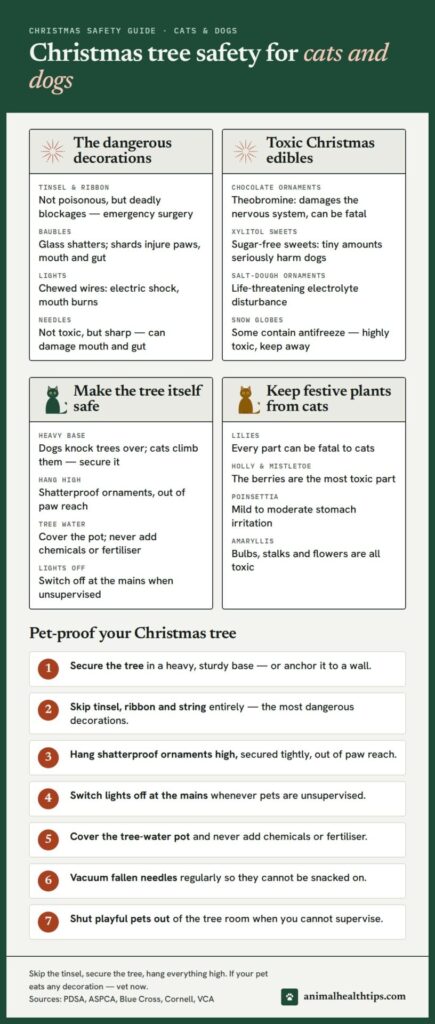
- Secure the tree in a heavy, sturdy base, or anchor it to a wall or the ceiling.
- Skip tinsel, ribbon and string entirely. They are the most dangerous decorations.
- Hang shatterproof ornaments high, secured as tightly as possible, out of reach of playful paws.
- Switch lights off at the mains whenever you cannot supervise your pet. Consider battery-powered LED lights.
- Cover exposed wires with plastic or cardboard tubes.
- Cover the tree-water pot with netting or a tree skirt, and never add chemicals, fertilisers or preservatives.
- Vacuum fallen needles regularly, and keep pets away from the tree so they cannot snack on them.
- Shut playful pets out of the tree room when unsupervised, and give them enrichment elsewhere.
- Keep wrapped food and treats up and away, not under the tree. Pets can smell the contents through the wrapping.
What to do if your pet eats a decoration
- Contact your vet immediately. If your pet has eaten tinsel, or shows signs such as vomiting, diarrhoea, refusing to eat or lack of energy, do not wait to see if it passes.
- Have any packaging to hand so you can tell the vet exactly what was eaten, and take samples along if you saw your pet chewing something.
- Do not try to treat them yourself. Never attempt to make your pet sick, and do not give any medicine at home.
- Remember that vet help is always there. All vet practices must have an emergency service available over Christmas, though you may need to drive there.
| The danger | What it does | What to do |
|---|---|---|
| Tinsel, ribbon, string | Not poisonous, but deadly intestinal blockages; may need emergency surgery | Skip them entirely; vet now if any is eaten |
| Real-tree needles | Sharp: irritated mouth, gut damage (not poisoning); sap is toxic | Vacuum fallen needles; vet if eaten |
| Tree water | Added chemicals are toxic; stagnant water breeds bacteria | Cover the pot; plain water only; vet if drunk |
| Baubles and lights | Shattered glass shards; electric shock and mouth burns | Shatterproof ornaments hung high; lights off at the mains |
| Edibles and plants | Chocolate, xylitol, salt dough, snow-globe antifreeze, lilies | Keep away; vet immediately if eaten |
Key takeaways
- Skip tinsel, ribbon and string entirely. They are the decorations most likely to kill.
- Secure the tree in a heavy base, hang shatterproof ornaments high, and switch lights off at the mains when unsupervised.
- Real-tree needles are not poisonous but can injure the mouth and gut; the sap is toxic. Cover the tree water and never add chemicals.
- If your pet eats any decoration, contact your vet immediately. Do not wait to see if symptoms pass.
Frequently asked questions
Are Christmas trees poisonous to cats?
The needles themselves are not toxic, but they can still cause serious harm if swallowed: an upset stomach, an irritated mouth, or needles stuck in the soft palate, and intestinal trauma from their sharpness. The tree’s oils are toxic to pets, and tree water with added chemicals can poison. Keep cats away from the tree and vacuum fallen needles regularly.
Is tinsel dangerous for cats?
Yes. Tinsel is not poisonous, but it is a choking hazard and can get stuck in the intestines, causing a deadly blockage that needs emergency surgery. In some cases it is fatal. The safest choice is to skip tinsel entirely, along with ribbon and string.
Can my dog chew on Christmas tree branches?
No. Chewing branches means chewing needles and sap: needles can irritate the mouth and cause vomiting and diarrhoea, and in dogs they can even cause intestinal obstruction or perforation. Keep your dog away from the tree and give them their own chews instead.
Should I put anything in my Christmas tree water?
No. Do not add chemicals, fertilisers or preservatives to tree water, as many are toxic to pets. Even plain stagnant water breeds bacteria that can upset your pet’s stomach. Cover the water pot with netting or a tree skirt so pets cannot drink from it.
Are poinsettias poisonous to cats?
Poinsettia poisoning is mild, causing stomach irritation. The bigger plant worries are lilies, which can be fatal to cats, and holly and mistletoe, whose berries are the most toxic part. Amaryllis bulbs, stalks and flowers are toxic too. Keep all festive plants out of your cat’s reach.
My cat keeps climbing the Christmas tree. What should I do?
Secure the tree in a heavy, sturdy base or anchor it to a wall, hang decorations high and out of paw reach, and shut your cat out of the tree room when you are not around to supervise. Extra playtime and enrichment away from the tree also help.
Sources
- PDSA — Dangerous Christmas decorations to be aware of if you’re a pet owner
- ASPCA — Top ten holiday dangers for pets: what you should know
- Blue Cross — Keep your cat safe at Christmas
- Cornell Feline Health Center — Beware holiday hazards
- Cornell Riney Canine Health Center — Holiday hazards for dogs
- VCA Animal Hospitals — Holiday pet dangers
This guide is general information, not a diagnosis. If you are worried about your cat or dog, contact your vet.