
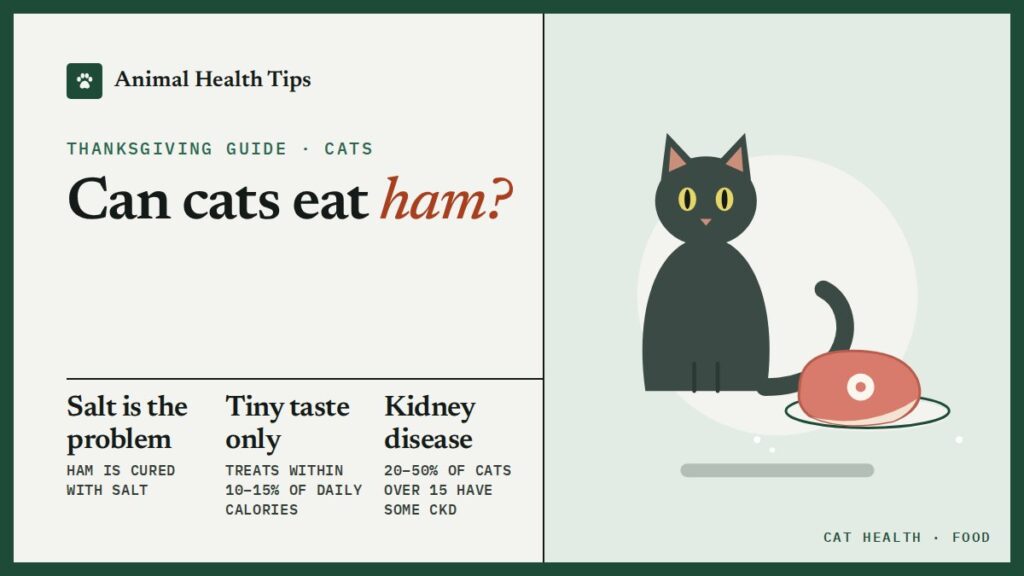
Ham is the second meat on many Thanksgiving tables in the United States — Thanksgiving falls on 26 November this year — and a cat that begs at the table may get offered a slice. Ham is not listed as a toxic food for cats, the way chocolate or lilies are. But ham is a salty, processed and often fatty meat, and that is what makes it a poor choice. A tiny piece of plain cooked ham is at most an occasional taste for a healthy cat, never a regular treat. This guide follows PDSA, Cats Protection, VCA Animal Hospitals, the ASPCA, the Merck Veterinary Manual and International Cat Care.
In this guide7 sections
Call your vet today if your cat has eaten a lot of ham
- Note how much was eaten and when.
- Watch for vomiting, diarrhoea, extra thirst and tremors.
- Never try to make your cat vomit at home. Only a vet should decide that.
- UK: Animal PoisonLine, 01202 509000 — open 24 hours, run by the Veterinary Poisons Information Service; a fee applies.
- US: ASPCA Animal Poison Control, (888) 426-4435 — open 24 hours; a consultation fee applies.
Can cats eat ham?
A tiny piece, as an occasional taste, is the most any healthy cat should have. Cats are obligate carnivores: PDSA says they need to eat meat to get nutrients such as taurine and arginine, without which they risk severe health problems including heart disease and blindness. But ham is not the meat to choose. PDSA recommends healthy cat treats such as cooked white fish, cooked chicken breast and cooked turkey breast — ham is not on its recommended list.
The difference is what ham is. Ham is pork that has been cured, which means it has been preserved with salt, and often smoked as well. That curing is the problem, not the pork itself. A small taste of plain cooked ham is unlikely to harm a healthy cat that has fresh water to drink, but regular or large amounts are a real risk, and there is no reason to make ham a habit when plain cooked turkey or chicken is the safer choice.
Keep any taste tiny. PDSA says treats should not exceed 10 to 15 percent of a cat’s daily calorie allowance, or the cat may not get enough of its normal food to receive all the nutrients it needs, and VCA says to keep treats small and limited to less than 10 percent of a cat’s daily diet. A taste of ham means a tiny piece, not a slice, and it counts inside that treats limit. Cats Protection adds that you should not feed cats table scraps, and should advise guests not to either.
Why salt is the main problem
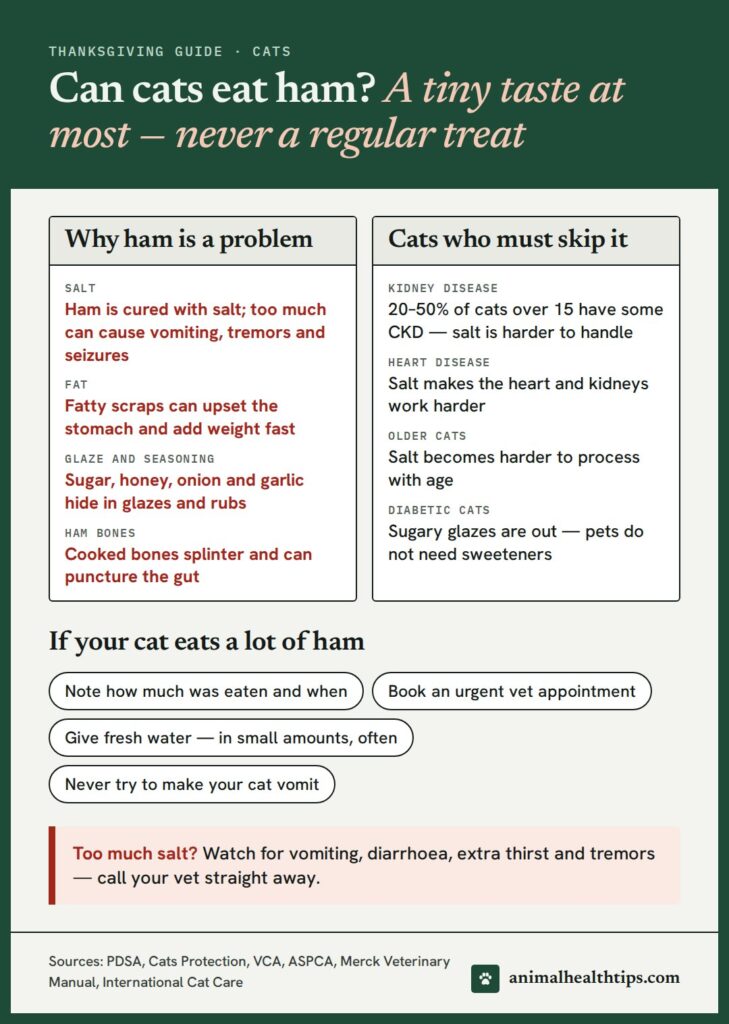
Salt is the main, well-supported risk in ham. The Merck Veterinary Manual says salt toxicity can result when animals eat too much salt and do not have enough water to drink, and that the signs generally involve the gastrointestinal tract and the central nervous system. There is no specific treatment: the offending feed or water must be removed immediately and fresh water provided, initially in small amounts at frequent intervals. The ASPCA warns that too much salt could lead to excess thirst, more frequent urination and sodium toxicity, and that an overdose of salt can be potentially fatal for a pet.
Cats Protection gives the same warning in a smaller example: canned tuna made for humans should not be fed to cats regularly, partly because it can be high in salt, which can be harmful to a cat if eaten in large amounts. The ASPCA makes the same point about stocks and gravy: bouillon cubes used for stocks and gravy contain high amounts of sodium, which can lead to gastrointestinal problems and even seizures.
Salt is a particular problem for older cats. PDSA says that as cats get older, some parts of their diet become harder to process, such as salt, and that senior cat food is formulated to support organs such as the kidneys. International Cat Care explains why: the kidneys maintain salt balance, water balance and normal blood pressure, and chronic kidney disease is one of the most common conditions affecting older cats — an estimated 20 to 50 percent of cats over 15 have some degree of it. Cats with kidney disease are more likely to become dehydrated, and they are at risk of high blood pressure, which can lead to blindness and worsening of their kidney disease.
Fat, glaze and bones
Fat is the next problem, though the risk is different for cats than for dogs. VCA says added fat can lead to pancreatitis, a painful condition, and that fatty foods like turkey skin or bacon can also lead to it. But VCA is explicit that, unlike dogs, cats do not appear to develop pancreatitis as the result of eating a high-fat diet. So this article does not claim that fatty ham causes pancreatitis in cats. What fatty ham can do is cause stomach upset, vomiting and diarrhoea, and add weight fast — and PDSA says to avoid high-fat treats and to reduce main meals on days treats are given.
The glaze is the next risk. Honey and brown sugar add sugar that a cat does not need: VCA says pets do not need sweeteners, because sugar just adds unnecessary calories, and that diets, treats and people foods containing sugars or sweeteners should be avoided for diabetic cats. Glazes and seasoned hams can also carry onion or garlic. Cats Protection says onion and garlic, whether fresh, cooked or dried, can be extremely toxic to cats, potentially leading to anaemia, and VCA says onions and garlic damage the red blood cells of pets, especially in cats.
The bone is the last risk, and it is the most mechanical. VCA says bones can fracture teeth and lead to obstructions in a pet’s gut, and that cooked bones are more likely to shatter or splinter, potentially puncturing the oesophagus, stomach or intestines. The ASPCA says that if you feed a pet a small bite of meat, you should make sure it is boneless and fully cooked, because raw or undercooked meat may contain salmonella bacteria and bones can be a major choking hazard.
| Ham on the table | What’s in it | Safe for a cat? |
|---|---|---|
| Plain cooked ham | A tiny piece, no seasoning, no bone | A taste at most, for a healthy cat |
| Glazed ham | Honey or brown sugar, sometimes cloves | No — sugar cats do not need |
| Seasoned or studded ham | Onion, garlic or other rubs | No — onion and garlic are toxic to cats |
| Ham bone | Cooked bone, often with fat | No — it can splinter and block the gut |
| Deli ham | Cured, often extra salty and seasoned | No — the salt and seasoning are the problem |
Cats who should never have ham
Some cats should skip ham entirely, even as a taste. Cats with kidney disease are the clearest case: their kidneys already struggle to maintain salt balance, and International Cat Care says a specific veterinary therapeutic diet is recommended to help improve quality of life and slow the disease. Cats with heart disease should also skip it, because salt makes the heart and kidneys work harder. Older cats fall into the same group, because salt becomes harder to process with age.
Diabetic cats should skip glazed ham, because VCA says diets and treats containing sugars or sweeteners should be avoided for them. Cats with a sensitive stomach should skip it too: even a small taste of something outside their usual diet can cause vomiting or diarrhoea. If your cat has any of these conditions, the safest choice is to skip human food entirely and stick to their regular food and treats.
The same plain-only rule applies to the rest of the table. Our guides to whether cats can eat turkey and whether cats can eat pumpkin follow the same pattern, and our guide to whether cats can eat mashed potatoes explains why buttered mash is out for cats too.
What to do if your cat eats a lot of ham
- Note what was eaten, how much and when. The ASPCA asks owners to note the amount ingested before calling.
- Book an urgent appointment with your vet. Cats Protection says to book an urgent appointment with your vet or contact them for advice if your cat has eaten food that can be harmful.
- Give fresh water, in small amounts and often. The Merck Veterinary Manual says fresh water should be provided initially in small amounts at frequent intervals after too much salt.
- Watch for warning signs: vomiting, diarrhoea, extra thirst and urination, and in severe cases tremors and seizures.
- Never try to make your cat vomit at home. Only a vet should decide that.
Thanksgiving table rules for cats
Thanksgiving is a risky time for cats in general. VCA warns that vomiting and diarrhoea are common problems veterinarians see during holiday periods, especially between Thanksgiving and New Year’s Day, and that even small amounts of different foods can cause weight gain or digestive upset, sometimes so serious that it requires hospitalisation and intensive medical treatment. If you wish to feed your cat a special holiday treat, VCA says to give only a small amount of lean meat.
- Do not feed table scraps, and advise guests not to either — Cats Protection’s advice for any meal with visitors.
- Feed your cat before your mealtimes, or use a puzzle feeder, so they are less likely to beg at the table.
- Store harmful foods out of reach and cover or hide leftovers.
- Use a sealed bin for bones, string and packaging, so your cat cannot dig them out.
Key takeaways
- Ham is not listed as toxic to cats, but it is salty, processed and often fatty — a tiny taste at most, never a regular treat.
- Salt is the main risk: too much can cause vomiting, diarrhoea, extra thirst and, in severe cases, tremors and seizures.
- Glazed and seasoned ham add sugar, onion and garlic, which are all problems for cats.
- Cats with kidney or heart disease, older cats and diabetic cats should skip ham entirely.
Frequently asked questions
Is ham toxic to cats?
No approved source lists ham as a toxic food for cats. The risk is not the pork itself but what comes with it: the salt it is cured with, the fat, and the sugar, onion or garlic in glazes and seasonings. That is why ham is best avoided rather than treated as a safe treat.
Can cats eat a small piece of ham?
A tiny piece of plain cooked ham, with no seasoning and no bone, is at most an occasional taste for a healthy cat. Keep it inside the treats limit — PDSA says treats should not exceed 10 to 15 percent of daily calories — and never make it a slice or a regular treat.
Can cats eat glazed ham?
No. Honey and brown-sugar glazes add sugar that cats do not need, and VCA says diets and treats containing sugars should be avoided for diabetic cats. Glazes and rubs can also carry onion or garlic, which can be extremely toxic to cats.
Can cats eat ham bones?
No. VCA says bones can fracture teeth and lead to obstructions in a pet’s gut, and that cooked bones are more likely to shatter or splinter, potentially puncturing the gut. The ASPCA says any meat you share should be boneless and fully cooked.
What about deli ham or cured ham?
The same rules apply, and deli ham is often worse: it is cured, often extra salty, and often seasoned. The salt and seasoning are the problem, so deli ham is not a safer option than plain cooked ham.
My cat ate a lot of ham. What should I do?
Note how much was eaten and when, then book an urgent appointment with your vet. Give fresh water in small amounts and often, and watch for vomiting, diarrhoea, extra thirst and tremors. Never try to make your cat vomit at home.
Sources
- PDSA — The Best Diet for Your Cat
- Cats Protection — Cats and Human Foods
- VCA Animal Hospitals — Safe and Toxic Holiday Foods for Pets
- VCA Animal Hospitals — Nutrition and Pancreatic Disease in Cats
- ASPCA — Thanksgiving Safety Tips
- Merck Veterinary Manual — Salt Poisoning
- International Cat Care — Chronic Kidney Disease (CKD) in Cats
This guide is general information, not a diagnosis. If you are worried about your pet, contact your vet.
1 comment