Corn is one of the dishes that sits on almost every Thanksgiving table in the United States — Thanksgiving falls on 26 November this year — and a cat that begs at the table may get offered a taste. The answer depends on which corn you mean. A few plain, cooked kernels are fine as an occasional treat: Cats Protection lists corn among the few vegetables you can feed a cat. Corn on the cob is a different matter, and buttered, salted or creamed corn is different again. This guide follows Cats Protection, the Cornell Feline Health Center, the ASPCA and VCA Animal Hospitals.
In this guide7 sections
Call your vet now if your cat has chewed or swallowed any part of a corn cob
- Note how much was eaten and when.
- Do not wait for signs — book an urgent appointment with your vet.
- Never try to make your cat vomit at home. Only a vet should decide that.
- UK: Animal PoisonLine, 01202 509000 — open 24 hours, run by the Veterinary Poisons Information Service; a fee applies.
- US: ASPCA Animal Poison Control, (888) 426-4435 — open 24 hours; a consultation fee applies.
Can cats eat corn?
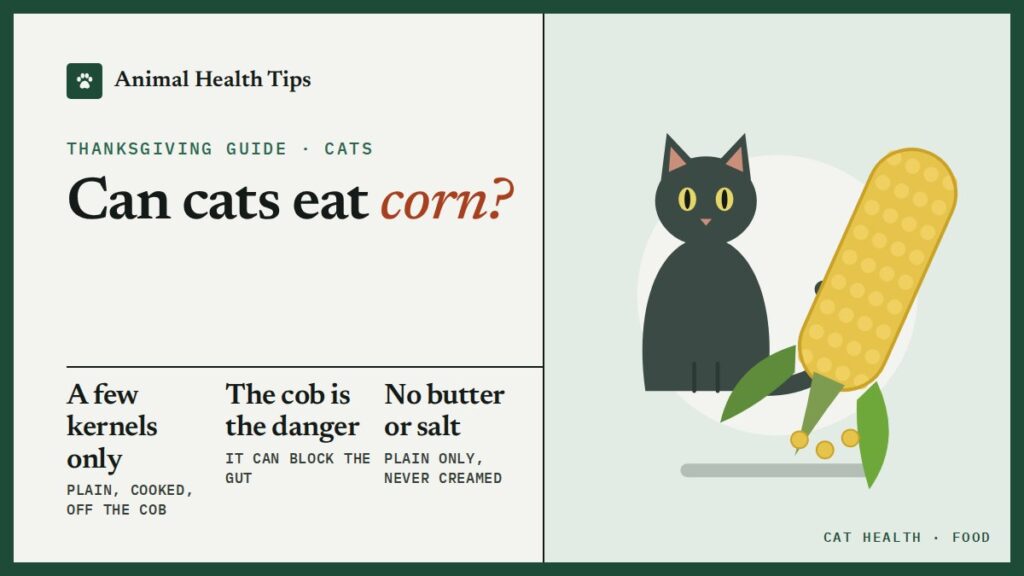
Yes, a few kernels, as an occasional treat. Cats Protection lists corn among the few vegetables you can feed a cat, alongside carrots, peas, broccoli and spinach — but only if your cat is keen. Cats rarely eat vegetables naturally, and there is no need to add them to a cat’s diet.
That is because cats are obligate carnivores. Cornell explains that cats rely on nutrients found only in animal products: they evolved as hunters eating prey with high amounts of protein, moderate amounts of fat and a minimal amount of carbohydrates, and their diet still requires these proportions. The ASPCA adds that cats are not good at digesting carbohydrates and do not get much energy from them, and that taurine, which is essential for cats, is found only in animal sources — a deficiency can cause a heart condition and severe eye problems, including blindness. Corn gives a cat almost nothing it needs, so it is a treat, never a food.
How to serve corn to your cat
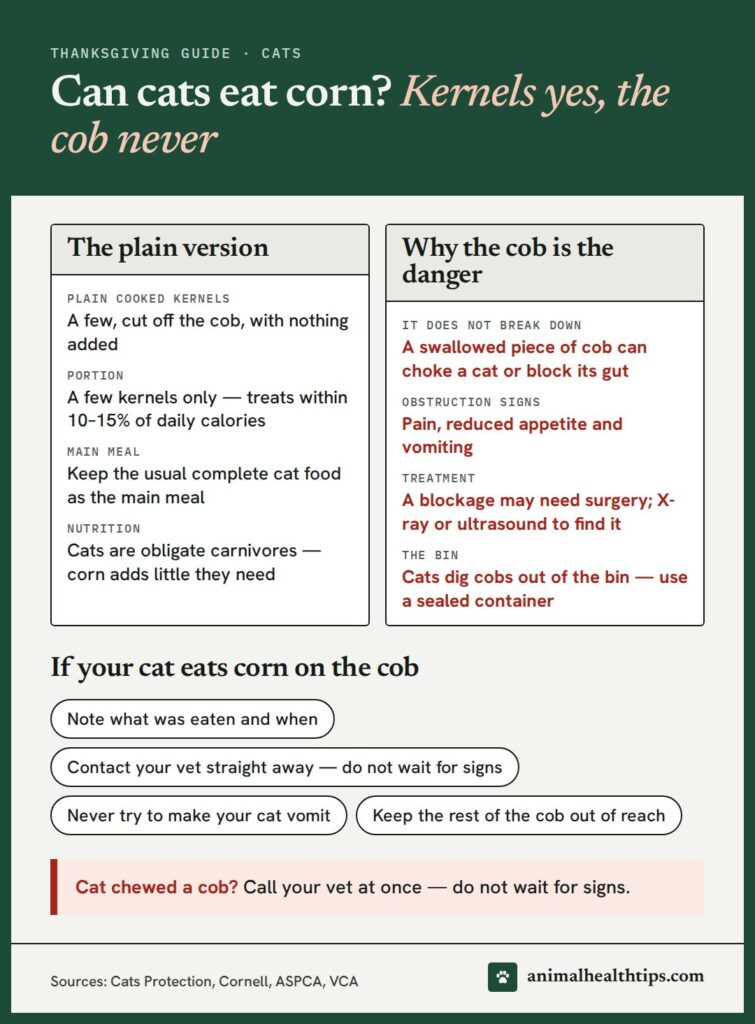
- Cut a few kernels off the cob. Never serve corn still on the cob, and never give your cat the cob to chew.
- Cook them plain. Serve cooked kernels with nothing added — no butter, salt or seasoning.
- Keep it tiny. A few kernels only, counted in the treats rule: Cornell says treats should not exceed 10 to 15 percent of a cat’s daily calories.
- Keep the usual food as the main meal. Cats Protection advises offering a treat as part of the usual food, without exceeding the normal daily allowance, and not feeding table scraps.
- Do not make it a habit. Corn is an occasional extra, not part of a cat’s diet — Cats Protection says there is no need to add vegetables to it.
Why corn on the cob is the real danger
The cob is the problem, not the kernel. The ASPCA warns that corn cobs can be a risk for foreign body obstruction if ingested, a complication that often requires surgery to correct, and advises disposing of them carefully and keeping rubbish receptacles securely closed. A piece of cob is a non-digestible object: once swallowed it does not break down, and it can get stuck in the oesophagus, stomach or intestines.
VCA explains what happens then in a cat. The most common problem caused by a cat persistently ingesting non-food items is gastrointestinal obstruction: a non-digestible object getting stuck, which can cause pain, reduced appetite and vomiting. If the object is sharp it can damage the intestine, leading to ulcers or perforations, and a perforation may cause life-threatening peritonitis if intestinal contents leak into the abdomen. Diagnosing an obstruction can be challenging — regular X-rays may show it, but more commonly contrast X-rays or an abdominal ultrasound are needed — and the consequences may need surgical treatment.
The bin is part of the risk. VCA warns that most cats cannot resist digging well-flavoured items out of the rubbish and eating them, potentially causing an intestinal obstruction, and advises disposing of string and packaging in a sealed rubbish container. The same applies to discarded cobs: they go straight into a sealed bin, not an open one.
| Corn on the table | What’s in it | Safe for a cat? |
|---|---|---|
| Plain cooked kernels | A few, cut off the cob, nothing added | Yes, as an occasional treat |
| Corn on the cob | The cob, whole or in pieces | No — obstruction risk |
| Buttered or salted corn | Butter, salt and seasonings | No — fat, salt and seasoning |
| Creamed corn or casserole | Milk, cream, butter, salt, onion or garlic | No — the ingredients are the problem |
Buttered, salted and creamed corn
No approved source judges creamed corn or corn casserole as a dish. The judgement comes from what goes into them, and each ingredient carries its own verified warning. Butter and cream are dairy, and Cats Protection says most cats are lactose intolerant, so dairy products such as cheese can upset a cat’s stomach. The ASPCA explains why: pets do not possess significant amounts of lactase, the enzyme that breaks down lactose in milk, so milk and other dairy-based products can cause diarrhoea or other digestive upset.
Salt is the next problem. The ASPCA warns that excessive salt intake can produce increased thirst and urination and sometimes abnormal electrolytes, and that signs of salt toxicity can include vomiting, diarrhoea, depression, tremors, seizures and even death. Onion and garlic are the most serious: Cats Protection says to steer clear of garlic and onion, as they can be difficult to digest and can make cats very ill, and the ASPCA notes that cats are more susceptible than dogs to the red blood cell damage they cause. The ASPCA also warns that fatty foods can lead to pancreatitis, a painful and potentially serious condition.
The same plain-only rule applies to the rest of the table. Our guides to whether cats can eat turkey and whether cats can eat pumpkin follow the same pattern, and our guide to whether cats can eat mashed potatoes explains why buttered mash is out for cats too.
What to do if your cat eats corn on the cob
- Note what was eaten, how much and when. The ASPCA asks owners to note the amount ingested before calling.
- Contact your vet straight away. Cats Protection says to book an urgent appointment with your vet if your cat has eaten food that can be harmful. Do not wait for signs.
- Watch for warning signs: pain, reduced appetite and vomiting are the signs VCA lists for an obstruction in a cat.
- Never try to make your cat vomit at home. Only a vet should decide that.
- Keep the rest of the cob out of reach and clear the table as soon as the meal is over, so your cat cannot help themselves later.
Thanksgiving table rules for cats
Thanksgiving is a risky time for cats in general. VCA warns that vomiting and diarrhoea are common problems veterinarians see during holiday periods, especially between Thanksgiving and New Year’s Day, and that even small amounts of different foods can cause weight gain or digestive upset, sometimes so serious that it requires hospitalisation and intensive medical treatment. If you wish to feed your cat a special holiday treat, VCA says to give only a small amount of lean meat.
- Do not feed table scraps, and advise guests not to either — Cats Protection’s advice for any meal with visitors.
- Feed your cat before your mealtimes, or use a puzzle feeder, so they are less likely to beg at the table.
- Store harmful foods out of reach and cover or hide leftovers.
- Use a sealed bin for cobs, string, packaging and bones, so your cat cannot dig them out.
Key takeaways
- A few plain, cooked corn kernels are fine as an occasional treat — Cats Protection lists corn among the few vegetables you can feed a cat.
- Cats are obligate carnivores, so corn gives them almost nothing they need.
- Never give a cat corn on the cob: it can choke a cat or block its gut, and a blockage may need surgery.
- Buttered, salted and creamed corn are out because of what is added to them; call your vet straight away if your cat eats cob.
Frequently asked questions
Can cats eat corn kernels?
Yes, a few plain, cooked kernels as an occasional treat. Cats Protection lists corn among the few vegetables you can feed a cat, but only if your cat is keen — cats rarely eat vegetables naturally, and there is no need to add them to the diet.
Can cats eat corn on the cob?
No. The cob is the danger, not the kernel. The ASPCA warns that corn cobs are a foreign-body obstruction risk that often requires surgery, and VCA explains that a swallowed non-digestible object can get stuck in a cat’s gut and cause pain, reduced appetite and vomiting.
Is corn toxic to cats?
Corn does not appear on the ASPCA’s list of people foods to avoid feeding pets, and Cats Protection lists corn among the few vegetables you can feed a cat. But that is not a reason to feed it often: cats are obligate carnivores and get almost nothing from it.
Can cats eat buttered or creamed corn?
No. The corn is not the problem — the butter, cream, salt, onion and garlic are. Most cats are lactose intolerant, too much salt can be harmful, and onion and garlic can make cats very ill. Serve kernels plain, with nothing added.
How much corn can a cat have?
No approved source gives an exact amount for a cat, so keep it to a few kernels occasionally, within Cornell’s treats ceiling of 10 to 15 percent of daily calories for all treats combined. The usual complete cat food should still be the main meal.
My cat ate part of a corn cob. What should I do?
Note how much was eaten and when, then contact your vet straight away — Cats Protection says to book an urgent appointment. Watch for pain, reduced appetite and vomiting, and never try to make your cat vomit at home.
Sources
- Cats Protection — Cats and Human Foods
- Cornell Feline Health Center — Feeding Your Cat
- ASPCA — Why Can’t My Cat Be Vegan?
- ASPCA — What BBQ Staples Are Dangerous for My Pet?
- ASPCA — People Foods to Avoid Feeding Your Pets
- VCA Animal Hospitals — Pica in Cats
- VCA Animal Hospitals — Household Hazards: Holiday Safety Tips for Cat Owners
This guide is general information, not a diagnosis. If you are worried about your pet, contact your vet.