
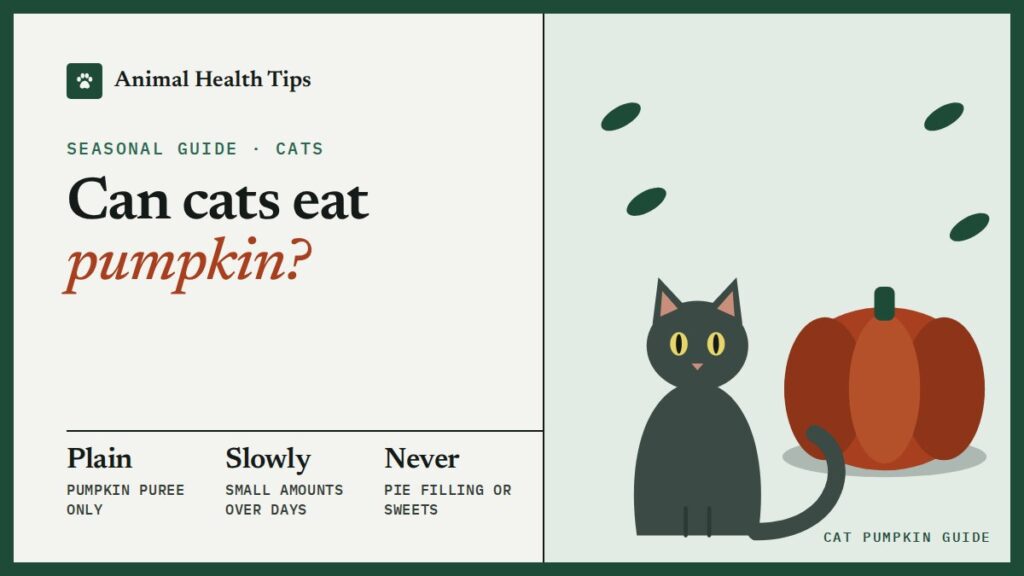
Pumpkin is everywhere at the end of October, and cats are curious about new things in the house. If your cat has sniffed a pumpkin or stolen a taste, the short answer is reassuring — but the form matters a great deal. Plain pumpkin and pumpkin pie filling are not the same thing, and Halloween sweets are a separate danger altogether.
In this guide7 sections
This is the cat version of a question many dog owners are already asking: our guide to can dogs eat pumpkin covers the dog side. For cats, the charities’ advice is consistent: a small amount of plain pumpkin as a treat is fine for most cats, introduced slowly. Anything sweetened, seasoned or made for humans is not.
Call your vet today if
- Your cat has eaten pumpkin pie filling, a seasoned pumpkin dessert, or any sweets
- Your cat has eaten a large amount of pumpkin, or you do not know what kind it was
- Your cat is vomiting, has diarrhoea, or seems lethargic or unsteady
- Your cat may have eaten sweets containing xylitol — do not wait for symptoms
- UK: Animal PoisonLine, 01202 509000 — open 24 hours, run by the Veterinary Poisons Information Service; a fee applies.
- US: ASPCA Animal Poison Control, (888) 426-4435 — open 24 hours; a consultation fee applies.
Can cats eat pumpkin?
Yes, as a treat. The ASPCA notes that pumpkins themselves are relatively non-toxic to pets, but could cause upset stomachs in pets that nibble on them. That is the whole story in one sentence: pumpkin is not poisonous to cats, but it is not part of a cat’s normal diet either, so a large amount can upset the stomach.
PDSA describes pumpkin treats that both dogs and cats can enjoy, and advises introducing new foods slowly and in small amounts so as not to upset pets’ tummies. Blue Cross gives the same advice for cats specifically: its Halloween treat recipe for cats uses pumpkin puree, and it advises that when feeding a cat any new food not part of its usual diet, you should introduce it slowly in small amounts over a number of days, because of the upset-stomach risk, and feed it in moderation. No approved source found for this article gives a specific portion for cats, so this article gives none: small amounts, introduced slowly, is the advice as the charities state it.
Which pumpkin is safe — and which is not?
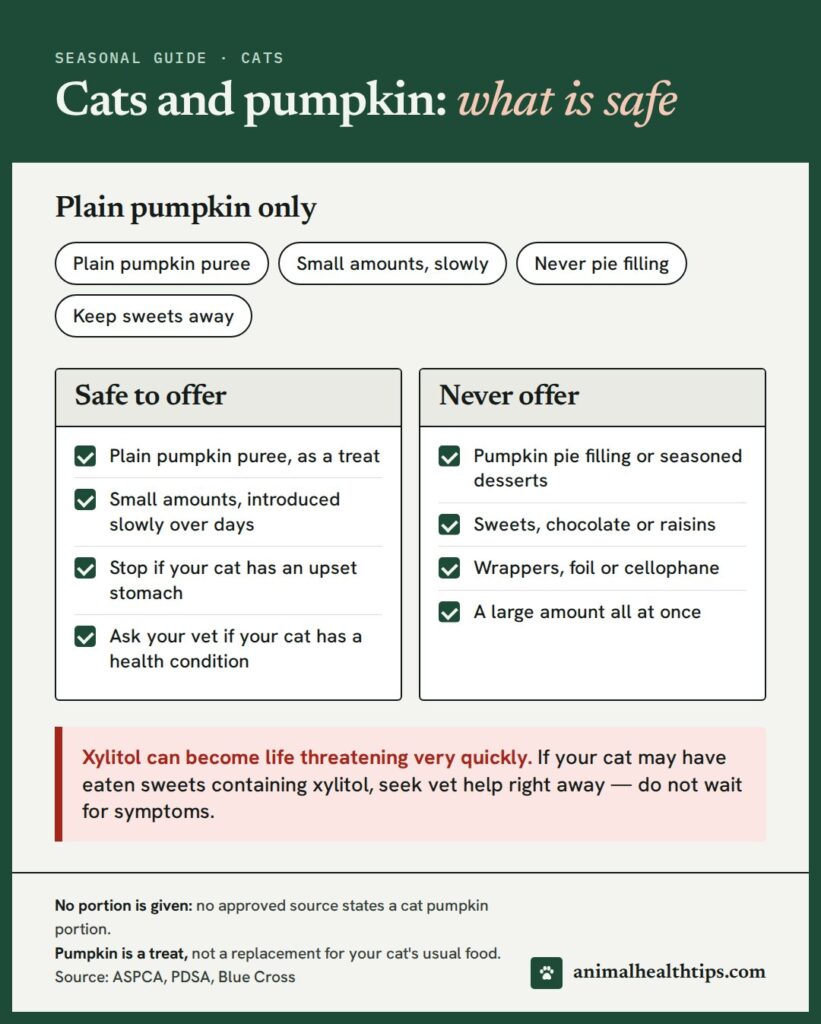
Safe means plain. Plain pumpkin puree — a tin that lists only pumpkin — is the form the charities describe. ASPCA Pet Insurance puts it plainly: a dollop of plain pumpkin, not pie filling, can make a festive and safe pet meal. PDSA’s pumpkin treats for dogs and cats follow the same rule. If you are offering pumpkin for the first time, keep the amount small, watch for an upset stomach, and build up only gradually over several days.
Pumpkin is a treat, not a meal. The charities describe it as something to offer in moderation, not as a replacement for your cat’s usual food. A cat that fills up on pumpkin is missing the balanced food it needs, and a cat with a sensitive stomach may react even to a small amount. If your cat has a health condition or is on a special diet, ask your vet before offering any new food.
The same upset-stomach warning applies to a decorative pumpkin your cat nibbles. The ASPCA’s point is about nibbling pumpkins generally: relatively non-toxic, but liable to upset the stomach. A nibble is not an emergency on its own, but take the pumpkin away, and call your vet if your cat vomits, has diarrhoea, or seems unwell.
Pumpkin pie filling and Halloween sweets
Pumpkin pie filling is not pumpkin. It is a sweetened, seasoned product made for human desserts, and the approved sources draw a clear line between it and plain pumpkin. ASPCA Pet Insurance contrasts the two directly: plain pumpkin, not pie filling, is the safe form. Human desserts and dishes containing chocolate, artificial sweeteners such as xylitol, or raisins should be kept away from pets.
Xylitol is the most urgent of those dangers. PDSA advises never giving pets sweets, as they may include xylitol, also called birch sugar: xylitol is extremely dangerous for pets and can very quickly become life threatening, and if a pet may have eaten xylitol, you should seek vet help right away and not wait for symptoms. ASPCA Pro notes that xylitol can cause insulin release in most species, which can lead to liver failure and low blood sugar, with initial signs including vomiting, lethargy and loss of coordination, progressing to recumbency and seizures. That warning is general, not cat-specific, but the PDSA advice for pets is unambiguous: do not wait.
Chocolate is a separate Halloween danger for cats, covered in our guide to can cats eat chocolate. And the wrappers matter too: the ASPCA notes that cats love to play with candy wrappers, but ingesting aluminium foil or cellophane can cause intestinal blockage and vomiting. Keep the sweet bowl out of reach, and clear up wrappers, foil and cellophane promptly.
Will pumpkin help with hairballs or constipation?
There is no verified evidence that pumpkin itself treats either problem, and this article does not claim that it does. Blog claims about pumpkin for constipation, diarrhoea or hairballs were checked and could not be verified on an approved source, so they are left out.
What the approved sources do say is useful on its own. Cornell’s Feline Health Center notes that most swallowed hair eventually passes through the digestive tract and is excreted in the faeces, though some accumulates in the stomach as a hairball. A hairball once every week or two is nothing to worry about, but if a cat is lethargic and refuses to eat for more than a day or so, or has repeated unproductive retching, you should consult a vet without delay, because a hairball that has passed into the intestine can create a potentially life-threatening blockage.
For constipation, VCA notes that high-fibre diets are part of the medical approach tried for megacolon and constipation in cats, alongside fluids, laxatives and stool softeners under veterinary care. That is a veterinary decision, not a home remedy: if your cat is straining, not passing stools, losing weight, lethargic, vomiting or off its food — the signs VCA lists — call your vet rather than reaching for pumpkin.
What to do if your cat eats the wrong kind
- Take it away. Remove the pie filling, dessert or sweets, and keep your cat away from the rest of it.
- Work out what and how much. Note whether it was pie filling, a dessert or sweets, and roughly how much your cat ate. Keep the packaging if there is any, so your vet can see the ingredients.
- Call your vet right away if your cat ate pie filling, sweets, or a large amount of pumpkin — and at once, without waiting for symptoms, if xylitol may be involved. PDSA advises contacting a vet right away if a dog or cat has eaten something harmful, as it could be poisonous or cause a blockage, both of which can be fatal if left untreated.
- Do not try to make your cat sick at home. Only a vet should decide that.
- Watch for vomiting, diarrhoea, lethargy or unsteadiness, and tell your vet if any of these appear.
- Keep sweets, wrappers and desserts out of reach from now on, and remind visitors not to share food with your cat.
How to offer pumpkin safely
| Do | Avoid |
|---|---|
| Offer plain pumpkin puree only, as a treat | Pumpkin pie filling and seasoned pumpkin desserts |
| Introduce it slowly, in small amounts, over several days | Giving a large amount all at once |
| Stop if your cat has an upset stomach | Replacing part of your cat’s usual food with pumpkin |
| Keep sweets, chocolate and wrappers out of reach | Sharing human desserts or sweets with your cat |
| Call your vet if your cat eats pie filling or sweets | Waiting for symptoms if xylitol may be involved |
Key takeaways
- Plain pumpkin, in small amounts and introduced slowly, is a safe treat for most cats.
- Pumpkin pie filling is not the same as plain pumpkin — never offer it.
- Keep Halloween sweets, chocolate and wrappers away from cats; xylitol can become life threatening very quickly.
- No approved source gives a cat pumpkin portion, and none shows pumpkin treating hairballs or constipation — call your vet instead.
Frequently asked questions
Can cats eat pumpkin?
Yes, in small amounts. Plain pumpkin is relatively non-toxic to pets, according to the ASPCA, though nibbling can upset the stomach. Offer it as a treat, introduced slowly, and stop if your cat has an upset stomach.
Can cats eat pumpkin pie filling?
No. Pie filling is a sweetened, seasoned product made for human desserts, and the approved sources draw a clear line between it and plain pumpkin. ASPCA Pet Insurance describes plain pumpkin, not pie filling, as the safe form.
How much pumpkin can I give my cat?
No approved source found for this article gives a specific portion for cats, so this article gives none. PDSA and Blue Cross advise small amounts, introduced slowly over a number of days, and fed in moderation. If your cat has a health condition or special diet, ask your vet.
My cat nibbled our decorative pumpkin. Should I worry?
A nibble on its own is not an emergency: the ASPCA notes pumpkins are relatively non-toxic but can upset the stomach. Take the pumpkin away and call your vet if your cat vomits, has diarrhoea, or seems unwell.
Will pumpkin help my cat’s hairballs?
There is no verified evidence that pumpkin itself helps with hairballs. Cornell notes a hairball once every week or two is nothing to worry about, but lethargy with refusal to eat for more than a day, or repeated unproductive retching, means consulting a vet without delay.
My cat ate sweets containing xylitol. What should I do?
Contact a vet right away and do not wait for symptoms. PDSA warns xylitol is extremely dangerous for pets and can very quickly become life threatening.
Sources
- ASPCA — ASPCA’s top 5 tips for a safe Howl-o-ween
- ASPCA Pet Insurance — Thanksgiving safety for pets
- PDSA — Spooky pet safety tips: keeping your four-legged friends happy on Halloween
- Blue Cross — Halloween treats for cats
- ASPCA Pro — People foods pets should never eat
- Cornell Feline Health Center — The hairy dilemma
- VCA Animal Hospitals — Megacolon in cats
This guide is general information, not a diagnosis. If you are worried about your pet, contact your vet.
2 comments