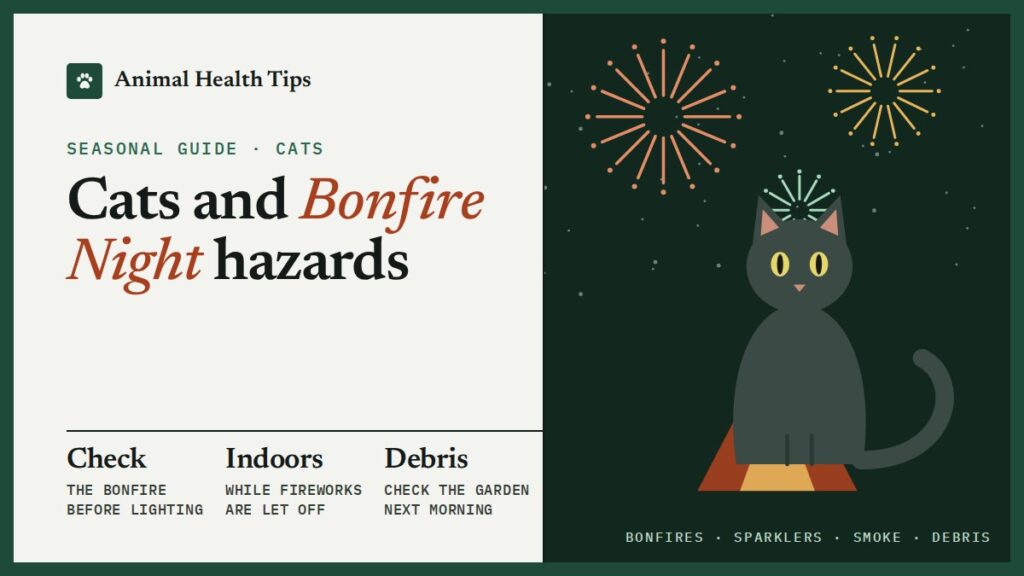
Bonfire Night is 5 November, and the risk to cats starts well before the night itself. Fireworks are on sale from mid-October, and Cats Protection puts peak firework activity in the last week of October and the first week of November. That means cats face several weeks of bonfires, sparklers, smoke and debris — not just one evening of noise.
In this guide8 sections
This guide is about the physical hazards, not the fear. Fear and calming are covered in our guide to cats and fireworks for Bonfire Night. Here the dangers are the ones you can check for: an animal sheltering in an unlit bonfire, a sparkler a cat walks through, smoke drifting over the garden, and the debris left behind in the morning. Each one has a simple check, and each one matters.
Go to a vet now if
- Your cat has a burn, or has been near a bonfire or firework
- Your cat has difficulty breathing, especially open-mouth breathing or panting
- Your cat collapses, or has persistent vomiting or diarrhoea
- Your cat may have licked firework debris — do not wait for symptoms
- UK: Animal PoisonLine, 01202 509000 — open 24 hours, run by the Veterinary Poisons Information Service; a fee applies.
- US: ASPCA Animal Poison Control, (888) 426-4435 — open 24 hours; a consultation fee applies.
Why is Bonfire Night risky for cats?
Cats are curious, they use sheltered spots, and they roam at dusk — the same time bonfires are built and fireworks are lit. A frightened cat may also bolt in any direction, and Cats Protection notes that a cat can be totally terrified and disorientated by the time quiet returns. Keeping a cat indoors after dark through fireworks season, with windows shut, the cat flap locked, curtains drawn and a litter tray indoors, is the single precaution that covers most of these hazards at once.
The British Veterinary Association (BVA) urges owners to start preparing now, ahead of Bonfire Night and Diwali, and notes that each year vets treat animals with injuries from stress and fright, as well as burns. The loud whizzes, bangs and whistles of rockets, Roman candles and sparklers can be extremely traumatic for animals. Burns, smoke and debris are less talked about than fear, but they are the injuries that need a vet the same night.
Check the bonfire before you light it
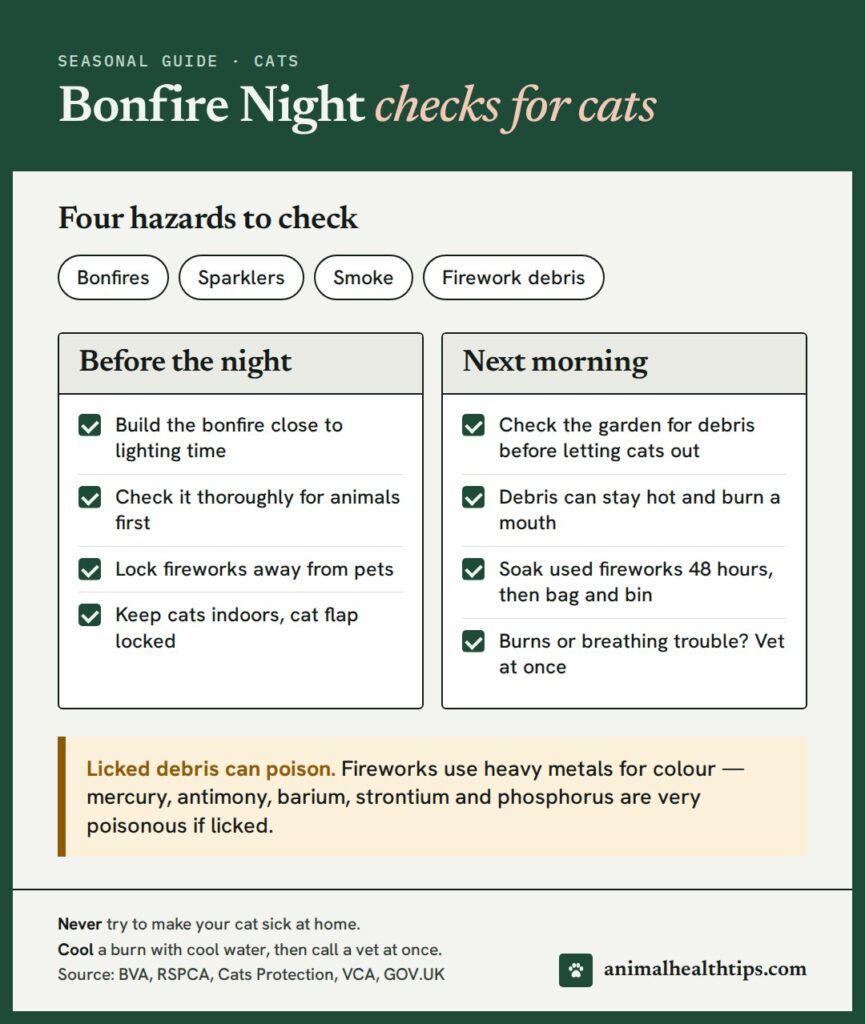
Before lighting a bonfire, check it for any animals that may be hiding in it. That is the BVA’s advice, and the RSPCA says the same: if possible, build bonfires close to the time of lighting and check them thoroughly for animals before lighting, because animals such as hedgehogs might be sheltering inside. A bonfire is a warm, dry, sheltered pile — exactly the kind of place an animal chooses on a cold night.
Do not rely on a quick glance. Check the pile thoroughly, including the base and the middle, and check again just before lighting if the pile has stood for a while. If you are not the one lighting the bonfire, ask the person who is whether it has been checked. Cats are not the animals the charities name here — the wording is about wildlife and animals in general — but the check protects any animal that could be sheltering there, including a neighbour’s cat. A related habit is worth keeping all winter: cats also seek warm, sheltered spots around cars, as our guide to cats sleeping in car engines explains, so tap the bonnet before starting the car too.
Sparklers, bonfires and burns
Sparklers are fireworks, and the same indoor rule applies to them as to rockets: Blue Cross advises always keeping dogs and cats inside when fireworks are being let off, and GOV.UK treats sparklers as fireworks in its rules for streets and public places. Keep cats indoors while any fireworks — including sparklers — are being let off, and keep them away from lit sparklers and from sparklers cooling down afterwards. Vets treat animals for burns each year, and a burn from a sparkler or a bonfire ember is a same-night vet visit, not a wait-and-see injury.
If your cat is burned, VCA advises cooling the burned area by running cool water over it or covering it with wet towels. If skin has been lost, cover the area with the cleanest material available. In all cases, contact your vet immediately. Do not put creams, ointments, butter or ice on a burn, and do not try to treat it at home beyond cooling it and getting to a vet. Burns around the face and muzzle need particular care: after smoke exposure they may blister or appear as reddened, inflamed areas, and burned nostrils may show discharge or visible blisters.
What does smoke do to a cat?
Smoke inhalation injuries can occur with exposure to smoke in large or small quantities, and fires produce substances that can affect a pet’s airways, lungs and overall well-being. VCA lists the most common signs in cats as respiratory: coughing, gagging, standing with the neck extended as if struggling to take in air, laboured breathing, shortness of breath, an increased breathing rate and wheezing. Heat and irritants in smoke can also damage the eyes, causing squinting, a raised third eyelid, redness or conjunctivitis.
More serious smoke exposure can affect the brain if it is deprived of oxygen: weakness, impaired coordination, seizures or coma, and cats may drool excessively or vomit. Smoke inhalation injuries often progress over 48 to 72 hours, which is why a vet may want to monitor a cat that has breathed smoke, rather than sending it straight home. If your cat is having difficulty breathing, especially open-mouth breathing or panting, get to a vet immediately. Keep the cat indoors, calm and away from further smoke while you arrange the visit, and offer water once the situation is stable.
Check the garden for firework debris
The morning after is when the debris hazard appears. Cats Protection advises checking your garden for firework debris carefully before letting your cat out in the morning, or opening the cat flap. Fireworks can stay hot enough to burn a cat’s mouth for a long time, and a lot of fireworks rely on heavy metals for their colour effects, which can be toxic if your cat licks them. The metals Cats Protection names are mercury, antimony, barium, strontium and phosphorus, all described there as very poisonous.
The same clean-up rule applies whether the display was yours or a neighbour’s. The ASPCA advises keeping fireworks securely locked away until you are ready to light them, keeping pets out of the area while you set them off, and cleaning up all trash and materials before letting pets back in. The RSPCA advises picking up firework litter after it has cooled, and disposing of used, misfired or unwanted fireworks safely: submerge them in water for 48 hours, then put them in a bag and throw them in a bin. Check paths, lawns and flowerbeds, not just the spot where fireworks were lit — debris scatters.
| Hazard | Check |
|---|---|
| Unlit bonfire | Build close to lighting time; check thoroughly for animals before lighting |
| Sparklers and bonfires | Cats indoors while fireworks are let off; vet at once for any burn |
| Smoke | Watch for coughing, gagging, laboured or open-mouth breathing |
| Morning-after debris | Check the garden before opening the cat flap; debris can burn and poison |
| Used fireworks | Soak in water for 48 hours, then bag and bin (RSPCA) |
What should I do if my cat is affected?
- For a burn: cool it with cool running water or wet towels, cover any loss of skin with the cleanest material available, and contact your vet immediately.
- For breathing difficulty: get to a vet immediately, especially for open-mouth breathing or panting. Keep your cat calm and away from further smoke.
- For suspected licked debris: contact your vet immediately, even if your cat seems normal. Do not try to make your cat sick at home — VCA warns against inducing vomiting if a cat has ingested foreign objects, and only a vet should decide that.
- For collapse: treat it as a medical emergency and go to a vet at once.
- Keep your cat indoors with food, water and a litter tray while you get advice, and keep the cat flap locked until the garden has been checked.
- Check the microchip details are up to date. Blue Cross, PDSA and Cats Protection all stress this: a frightened cat that slips out is far more likely to be reunited if its details are current.
What does the law say about fireworks?
The law does not remove the hazards, but it sets the hours and places owners should expect fireworks. GOV.UK states that you must not set off fireworks between 11pm and 7am, except on Bonfire Night, when the cut-off is midnight, and on New Year’s Eve, Diwali and Chinese New Year, when it is 1am. You must not set off or throw fireworks, including sparklers, in the street or other public places. Fireworks, including sparklers, can only be bought from registered sellers for private use from 15 October to 10 November, and at other times only from licensed shops. Category 4 fireworks can only be used by professionals, and you cannot buy adult fireworks if you are under 18.
In practice, that means the riskiest nights are predictable: plan to keep cats indoors after dark from late October into early November, check the garden every morning in that period, and expect displays to continue for several nights around 5 November rather than on one night only. If a neighbour is planning a display, a polite word about checking the bonfire and clearing debris afterwards protects their pets and yours.
Key takeaways
- Check the bonfire thoroughly for animals before lighting — build it close to lighting time if you can.
- Keep cats indoors while any fireworks, including sparklers, are being let off.
- Check the garden for debris before opening the cat flap the next morning.
- Burns, breathing difficulty, collapse or licked debris all mean a vet at once.
Frequently asked questions
Should I check my bonfire even if I built it yesterday?
Yes, and check it again just before lighting. The RSPCA advises building bonfires close to lighting time and checking them thoroughly for animals, because animals such as hedgehogs might be sheltering inside. A pile left standing overnight can gain a new occupant.
Can my cat go out while sparklers are being used?
No. Blue Cross advises keeping dogs and cats inside when fireworks are being let off, and GOV.UK treats sparklers as fireworks. Keep cats indoors while any fireworks are being let off, and away from lit and cooling sparklers.
Why is firework debris dangerous the next morning?
Two reasons. Cats Protection warns that fireworks can stay hot enough to burn a cat’s mouth for a long time, and that the heavy metals used for colour effects — mercury, antimony, barium, strontium and phosphorus — are very poisonous if licked. Check the garden before letting your cat out.
What should I do with used fireworks?
Pick them up after they have cooled. The RSPCA advises submerging used, misfired or unwanted fireworks in water for 48 hours, then putting them in a bag and throwing them in a bin. Clear the whole garden, not just the launch spot.
My cat was near bonfire smoke and is coughing. What now?
Watch for laboured breathing, gagging, wheezing or open-mouth breathing, and get to a vet immediately if breathing is difficult. Smoke injuries can progress over 48 to 72 hours, so a vet may want to monitor your cat even if it seems better at first.
Can I treat a small burn at home?
Cool it with cool running water or wet towels, cover any loss of skin with the cleanest material available, and contact your vet immediately. Do not use creams, butter or ice, and do not delay the vet visit to see if it improves.
Sources
- BVA — Vets urge owners to create safe spaces for pets ahead of Bonfire Night and Diwali
- Cats Protection — Cats and fireworks
- RSPCA — Fireworks alternatives and disposal
- Blue Cross — Fireworks and pets
- VCA Animal Hospitals — Smoke inhalation in cats
- VCA Animal Hospitals — Emergencies in cats
- GOV.UK — Fireworks: the law
This guide is general information, not a diagnosis. If you are worried about your pet, contact your vet.