Thanksgiving in the United States falls on 26 November this year, and mashed potatoes are on almost every table: a soft, warm mound that a cat will happily investigate. Plain mashed potato is one thing. The mash most people actually serve is another. This guide follows Cats Protection, the ASPCA, the Merck Veterinary Manual, PDSA and Cornell.
In this guide7 sections
Contact your vet as soon as possible if
- Your cat has eaten mash containing onion, garlic, leeks or chives, in any form
- Your cat has eaten a large amount of seasoned, fatty or salty mash
- Your cat vomits, has diarrhoea, seems lethargic, loses its appetite, or shows pale or yellow gums or red or dark urine
- UK: Animal PoisonLine, 01202 509000 — open 24 hours, run by the Veterinary Poisons Information Service; a fee applies.
- US: ASPCA Animal Poison Control, (888) 426-4435 — open 24 hours; a consultation fee applies.
Can cats eat mashed potatoes?
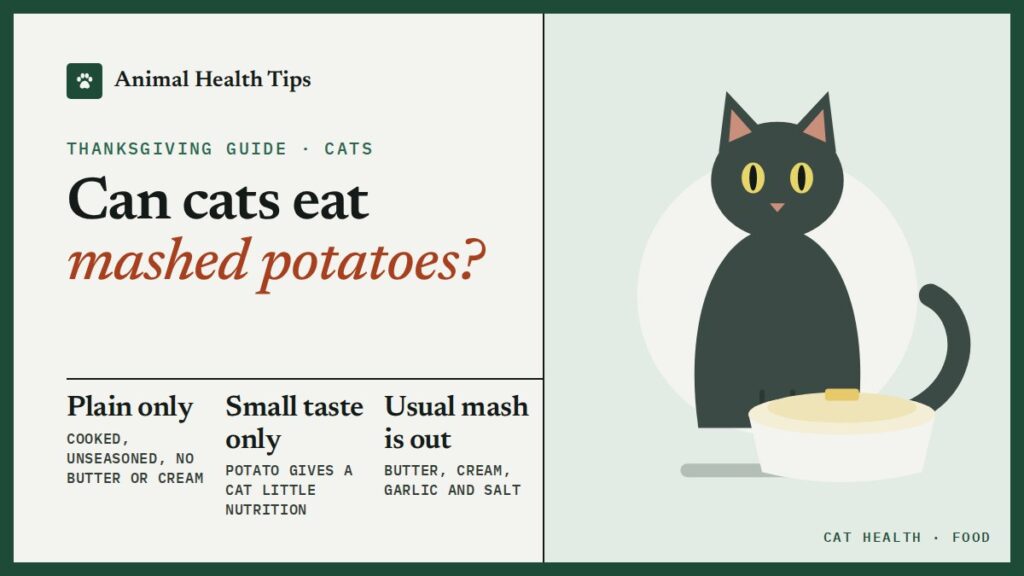
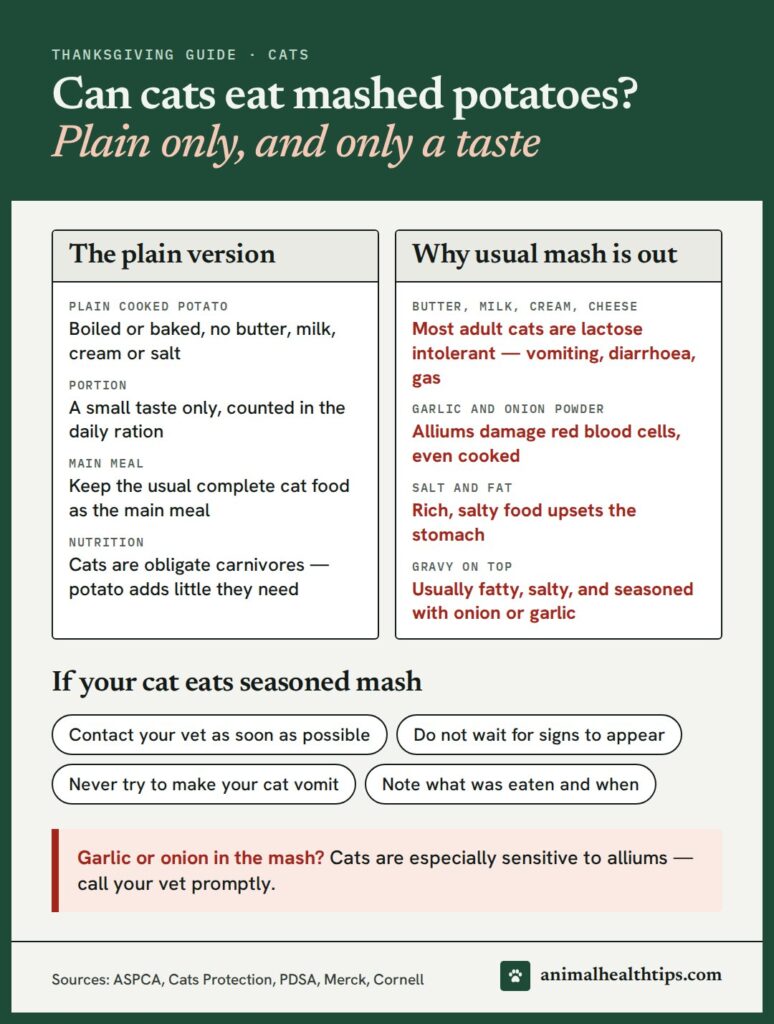
Yes, but only the plain version, and only as a small taste. Plain mashed potato with no butter, cream or garlic is listed by Cats Protection among safe Christmas foods for cats, and steamed or boiled vegetables on the same list must also have no butter, salt or seasoning. That is the whole safe case, and it is a narrow one: plain, cooked, unseasoned, and small. It is not a food cats need, and it is not a reason to change the cat’s main meal.
Usual Thanksgiving mash fails that test on every count. It is made with butter, milk or cream, salt, and often garlic or onion powder, and it is commonly served with gravy. Each of those additions is a separate problem for cats, and together they turn a safe-list food into one that should stay off the cat’s plate. If you cannot be sure a serving is plain, do not serve it at all.
What is in usual mashed potatoes?
The potato itself is not the problem when it is plain and cooked. The problem is everything that turns potatoes into mash. Butter, milk, cream and cheese add fat and dairy. Salt is added for taste. Garlic powder, onion powder, chives or leeks are added for flavour, and gravy poured on top is usually salty and seasoned. Cats Protection lists gravy made for humans among dangerous Christmas foods for cats, because it is usually salty and contains garlic and seasoning, and lists stuffing as dangerous because it contains onion, garlic and herbs, which are all toxic to cats. The same alliums hide in seasoned mash.
| In the mash | What it means for your cat | Source |
|---|---|---|
| Plain cooked potato | Safe as a small taste, with no butter, cream or garlic | Cats Protection |
| Butter, milk, cream, cheese | Most adult cats are lactose intolerant; dairy causes stomach upset | PDSA, ASPCA |
| Garlic or onion powder | Toxic: damage to red blood cells, even when cooked; cats are especially sensitive | ASPCA, Merck |
| Salt | Large amounts can cause sodium ion poisoning | ASPCA |
| Human gravy | Usually salty, and contains garlic and seasoning | Cats Protection |
Why the usual mash is a problem
Dairy is the first problem, and it affects most cats. Most cats are lactose intolerant because they do not have the enzyme lactase in their intestines to digest the sugar in milk, PDSA states, and milk containing lactose can make them poorly, with vomiting, diarrhoea and stomach pain. Cream and dairy products are also high in fat, PDSA notes, and giving a cat milk can seriously unbalance its diet.
Alliums are the more serious problem. Onions and garlic are prevalent in holiday casseroles, stuffing, mashed potatoes and many other items, and can be toxic to pets, the ASPCA states, and cats are much more sensitive than dogs. Garlic is three to five times more toxic than onion, according to the Merck Veterinary Manual. Dogs and cats have been affected after ingesting raw, cooked, dehydrated or granulated onions and garlic, so garlic powder in mash counts.
The delay matters here too. Haemolysis typically occurs three to five days after exposure, the Merck Veterinary Manual states, and signs are generally not noted until substantial haemolysis has occurred. Signs may include lethargy, weakness, pale or yellow gums, rapid breathing, dark or red urine and collapse. A cat that seems fine after eating seasoned mash on the day is not in the clear.
Raw, green and sprouted potatoes
Plain and cooked is the rule, and it has a second half: never serve raw, green or sprouted potato. Solanine and chaconine are glycoalkaloids found in potatoes, and their concentration is highest in potato sprouts and green potato skins, Cornell states. These alkaloids are not destroyed by cooking or drying at high temperatures, Cornell adds, so a green or sprouted potato cannot be made safe by cooking it. Peel the potato and discard any green, sprouted or damaged parts.
What to do if your cat eats seasoned mash
- Work out what was in it. Butter, cream, garlic powder, onion powder, salt and gravy are the details that matter. Note roughly how much your cat ate and when.
- Contact your vet as soon as possible. Do not wait for symptoms to appear, because allium signs can take days to appear. Possible symptoms include vomiting, diarrhoea, lethargy, reduced appetite, pain and constipation or straining.
- Never try to make your cat vomit. Only a vet decides that, and only a vet decides what treatment or monitoring is needed.
- Watch and report back. If your vet advises monitoring, watch for vomiting, diarrhoea, lethargy, weakness, pale or yellow gums, fast breathing, red or dark urine, and loss of appetite, and call back promptly if anything worsens.
- Keep the rest of the dinner out of reach. Clear plates, bin leftovers safely, and tell guests the cat gets plain food in its own bowl and nothing from a plate.
A safer festive taste
If you want to include your cat, serve a small taste of plain, cooked, unseasoned mashed potato, cooled and soft, with no butter, cream, cheese, milk, salt, garlic, onion or gravy. PDSA advises that treats should not exceed 10 to 15% of daily calories, and that on treat days the main meals should be reduced accordingly. Cats do not need fruit or vegetables as part of their diet, PDSA adds, but many can be given in very small quantities as an occasional treat.
Cats are obligate carnivores, PDSA states: they need to eat meat to get all the nutrients they require, such as taurine and arginine. There is no need to feed a cat a special dinner at a festival, Cats Protection notes: their usual food at the usual time will keep a cat happy, while a sudden change in diet could cause digestive upset. See also our guide to can cats eat turkey and our guide to can cats eat pumpkin.
Key takeaways
- Plain mashed potato with no butter, cream or garlic is listed as safe for cats, as a small occasional taste.
- Usual Thanksgiving mash is out: butter, milk and cream, salt, garlic or onion powder, and gravy each make it unsafe.
- Cats are especially sensitive to alliums, and signs of red blood cell damage can take days to appear.
- Never serve raw, green or sprouted potato: the glycoalkaloids are highest in sprouts and green skins and are not destroyed by cooking.
- If your cat eats seasoned mash, contact your vet as soon as possible and never try to make it vomit.
Frequently asked questions
Can cats eat mashed potatoes?
Only plain, cooked, unseasoned mashed potato, with no butter, cream, milk, cheese, salt, garlic, onion or gravy, and only as a small occasional taste, Cats Protection states. Usual Thanksgiving mash, with butter, cream, salt and garlic or onion powder, is not safe.
Why is butter and cream a problem for cats?
Most cats are lactose intolerant because they do not have the enzyme lactase to digest the sugar in milk, PDSA states, and milk containing lactose can cause vomiting, diarrhoea and stomach pain. Cream and dairy products are also high in fat.
Is garlic powder in mash really dangerous?
Yes. Dogs and cats have been affected after ingesting raw, cooked, dehydrated or granulated onions and garlic, the Merck Veterinary Manual states, and cats are the most susceptible species. Garlic is three to five times more toxic than onion.
My cat ate seasoned mash but seems fine. Should I call the vet?
Yes, as soon as possible. Clinical signs of allium poisoning are generally not noted until substantial haemolysis has occurred, usually a few days after exposure, so seeming fine on the day does not rule out harm.
Can cats eat raw potatoes?
No. Only plain, cooked potato is on the safe list, and solanine and chaconine are highest in sprouts and green skins and are not destroyed by cooking, Cornell states. Discard green, sprouted or damaged potatoes.
How much plain mashed potato can my cat have?
Only a small taste, as an occasional treat. PDSA advises treats should not exceed 10 to 15% of daily calories, and the main meal should stay a complete cat food. No approved source gives a gram amount for potato, so none is given here.
Sources
- Cats Protection — Christmas dinner: Can cats eat turkey?
- ASPCA — 4 Harmful Thanksgiving Foods for Pets
- ASPCA — People Foods Pets Should Never Eat
- Merck Veterinary Manual — Garlic and Onion (Allium spp) Toxicosis in Animals
- PDSA — Vet Q&A: Can cats drink milk?
- PDSA — The best diet for your cat
- Cornell University — Steroid Alkaloids (Solanum-type / potato glycoalkaloids)
This guide is general information, not a diagnosis. If you are worried about your pet, contact your vet.