Thanksgiving in the United States falls on 26 November this year, and green bean casserole is one of the dishes that appears on almost every table. If your dog is watching you cook, it is natural to wonder whether they can have some. The answer depends on which green beans you mean. Plain green beans are safe for dogs in moderation, raw or cooked. The casserole is a different dish, and the American Kennel Club lists casseroles among the foods not to feed a dog at Thanksgiving. This guide follows the AKC, the ASPCA, VCA Animal Hospitals, the Merck Veterinary Manual and UC Davis.
In this guide7 sections
Call your vet now if your dog has eaten green bean casserole
- Note what was in it, especially onion or garlic, and how much your dog ate.
- Do not wait for symptoms: onion and garlic damage can take three to five days to show.
- Never try to make your dog vomit at home. Only a vet should decide that.
- UK: Animal PoisonLine, 01202 509000 — open 24 hours, run by the Veterinary Poisons Information Service; a fee applies.
- US: ASPCA Animal Poison Control, (888) 426-4435 — open 24 hours; a consultation fee applies.
Can dogs eat green beans?
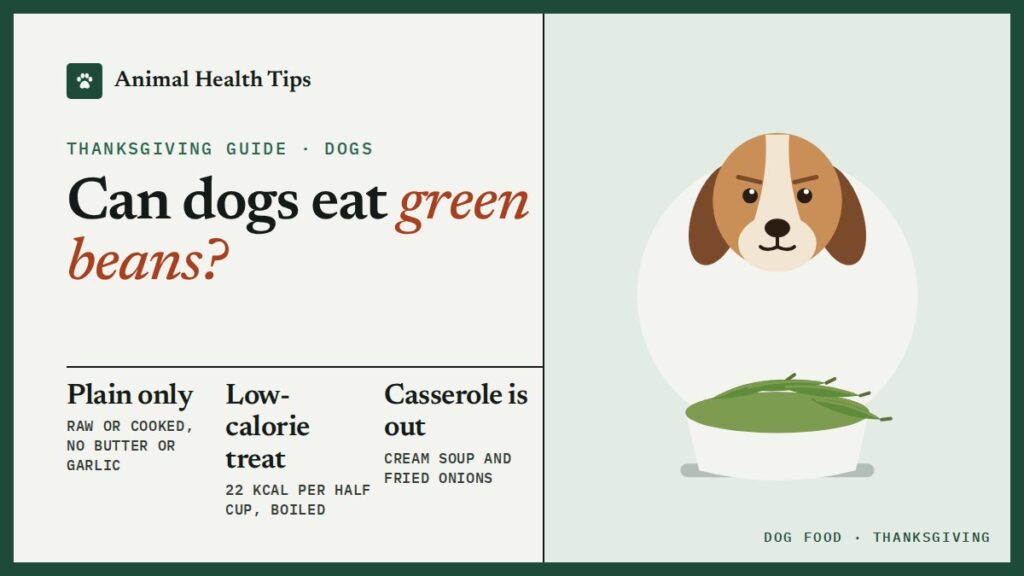
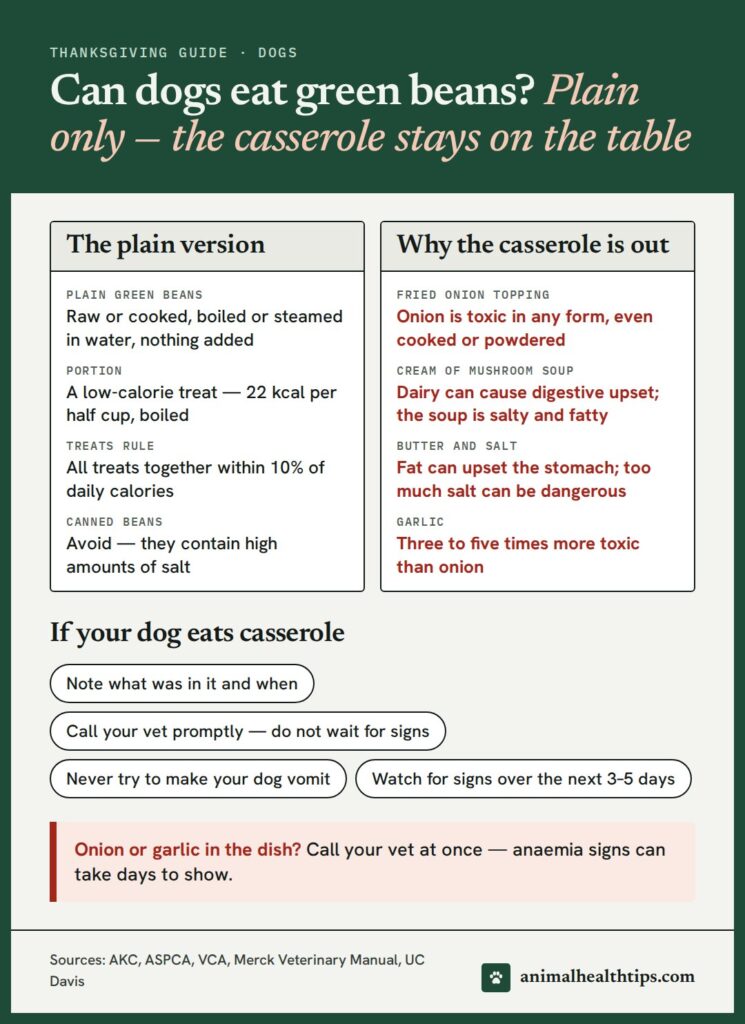
Yes, in moderation. The AKC says green beans are safe for dogs to eat in moderation, and that they can be served cooked or raw. Fresh, raw green beans are rich in vitamins A, C and K, and in the minerals iron and magnesium. They are a low-calorie treat: the AKC notes that the added bulk and fibre help a dog feel full while adding few calories, and that green beans can be used instead of treats for the same reason. UC Davis puts a number on it: 63 grams (half a cup) of boiled green beans provide 22 kcal.
Treats and extra food should still stay within the rules. UC Davis says treats and additional food items should not exceed 10% of a dog’s daily calories, with at least 90% coming from a complete and balanced food. The AKC adds that you should consult a vet before adding a new food or making significant changes to a dog’s diet, and that when you offer a new food you should monitor closely for laboured breathing, upset stomach, vomiting and any other abnormal changes in behaviour.
How to serve green beans to your dog
- Set plain beans aside first. The AKC’s Thanksgiving advice is to set aside a plain portion of green beans for your dog before adding butter, salt or other toppings.
- Boil or steam them in water. Keep them plain: no salt, butter, garlic or garlic salt.
- Avoid canned beans. The AKC warns against canned green beans because they contain high amounts of salt.
- Keep it a treat, not a meal. Count the beans in the 10% treats rule, and keep your dog’s normal food as the main meal.
- Introduce them slowly. Offer a small amount first and watch for an upset stomach or any abnormal change in behaviour.
Green beans can also help a dog that needs to lose weight: the AKC says the fibre and bulk in green beans may help some dogs feel fuller while adding relatively few calories, and that green beans are sometimes used as part of a veterinarian-supervised weight-management plan. That is a plan to agree with your vet, not a home diet.
Why is green bean casserole different?
The casserole is not green beans. It is green beans plus cream of mushroom soup, butter, salt and a fried onion topping, and each of those is a separate problem. The AKC lists casseroles on its Thanksgiving do-not-feed list, alongside onions, scallions and garlic, and notes that rich vegetable dishes such as creamed peas may contain fats that can upset a dog’s stomach or contribute to pancreatitis.
The fried onion topping is the most serious part. VCA says all forms of onion, garlic, chive and leek are poisonous to dogs, including raw, cooked, dried, powdered and liquid preparations, and that dried and powdered forms contain a higher concentration because the water has been removed: one teaspoon of garlic powder is equivalent to eight cloves of fresh garlic. Garlic is the most toxic of the Allium plants, and the Merck Veterinary Manual says garlic is three to five times more toxic than onion, and that concentrated forms such as dehydrated flakes, powders or dry onion soup mixes are the most common cause of toxicosis.
The cream soup brings its own problems. The ASPCA says pets do not possess significant amounts of lactase, the enzyme that breaks down lactose in milk, so milk and other dairy-based products can cause diarrhoea or other digestive upset. The soup is also salty, and the ASPCA warns that excessive salt intake can produce increased thirst and urination, and that signs of salt toxicity can include vomiting, diarrhoea, depression, tremors, seizures and even death. The soup is rich and fatty too, and the AKC notes that rich vegetable dishes may contain fats that can upset a dog’s stomach or contribute to pancreatitis.
Onion and garlic turn up in most of the Thanksgiving dishes, not just the casserole. Our guides to whether dogs can eat stuffing and whether dogs can eat turkey explain where else they hide, and our guide to whether dogs can eat gravy covers the other dish that is mostly fat and salt.
| Dish | What’s in it | Safe for a dog? |
|---|---|---|
| Plain green beans | Raw or cooked, nothing added | Yes, in moderation |
| Green bean casserole | Cream soup, fried onions, butter, salt | No — AKC do-not-feed list |
| Canned green beans | Often high in added salt | Avoid |
| Fried onion topping | Onion, in any form | No — toxic to dogs |
What are the signs of onion poisoning?
The danger with onion and garlic is that the signs are slow. The Merck Veterinary Manual says dogs and cats have been affected after eating raw, cooked, dehydrated or granulated onion and garlic, and that signs of acute haemolytic anaemia develop several days after eating them, including weakness, pale gums, yellowing and collapse. The damage to red blood cells begins within 24 hours and peaks at about 72 hours, with red blood cell breakdown typically occurring three to five days after exposure.
VCA lists the signs to watch for: mouth irritation, drooling, nausea, vomiting, abdominal pain and diarrhoea at first, and with larger amounts, weakness, elevated heart rate, increased breathing rate and effort, pale gums and red-coloured urine. Kidney damage can occur in dogs that have red blood cell destruction. Because the signs are delayed, a dog that looks fine on the day is not necessarily in the clear.
What to do if your dog eats casserole
- Work out what was in it: onion, garlic, cream soup, butter or salt, how much your dog ate, and when.
- Call your vet promptly. The AKC says to contact your veterinarian promptly if your dog eats a potentially toxic Thanksgiving food, and not to wait for symptoms.
- Never try to make your dog vomit at home. Only a vet should decide that.
- Watch for signs over the next few days. Vomiting, diarrhoea, a painful tummy or weakness are the signs to watch for, and onion and garlic damage is slow: red blood cell breakdown typically occurs three to five days after exposure.
- Keep treats within the 10% rule. The beans — and anything else shared — should stay within 10% of daily calories, with the normal complete food making up the rest.
Keeping the casserole off your dog’s plate
- Serve your dog’s plate first, before the butter, salt and toppings go on the table. Plain food set aside early is safe food.
- Tell your guests. Children and visitors often share from their own plates, so make it clear that nothing from a plate is for the dog.
- Clear up as you go. Put the casserole dish and leftovers away promptly, so a curious dog cannot help themselves later.
- Keep your dog out of the kitchen while the meal is being served and cleared, when spills and dropped food are most likely.
Key takeaways
- Plain green beans are safe for dogs in moderation, raw or cooked.
- Green bean casserole is on the AKC’s do-not-feed list: cream soup, fried onions, butter and salt.
- Onion and garlic are toxic in every form, and the damage can take three to five days to show.
- Call your vet promptly if your dog eats casserole — never wait for signs, and never try to make your dog vomit at home.
Frequently asked questions
Can dogs eat raw green beans?
Yes. Fresh, raw green beans are safe for most dogs in moderation, and they provide vitamins, minerals and fibre. Serve them plain, with nothing added, and introduce them slowly the first time, watching for an upset stomach or any abnormal change in behaviour.
Can dogs eat canned green beans?
It is best not to. The AKC warns against canned green beans because they contain high amounts of salt. Plain fresh or cooked green beans are the better option, served with nothing added.
Can dogs eat green bean casserole?
No. The AKC lists casseroles among the foods not to feed a dog at Thanksgiving. The cream of mushroom soup, butter, salt and fried onion topping each carry a risk, and onion is toxic to dogs in every form, including cooked and powdered.
My dog ate some casserole. What should I do?
Note what was in it and how much your dog ate, then call your vet promptly and do not wait for symptoms. Onion and garlic damage can take three to five days to show. Never try to make your dog vomit at home — only a vet should decide that.
How many green beans can a dog have?
No approved source gives a per-dog amount, so keep them within the treats rule: treats and extra food should not exceed 10% of daily calories. UC Davis gives 22 kcal per half cup of boiled green beans, which shows how little they add.
Can dogs eat green beans every day?
They can have them as a regular treat, within the 10% rule, but they are not needed when a dog is fed a balanced diet. If you want to change your dog’s diet in a bigger way, consult your vet first.
Sources
- American Kennel Club — Can Dogs Have Green Beans?
- American Kennel Club — Which Thanksgiving Foods Can Dogs Eat?
- ASPCA — People Foods to Avoid Feeding Your Pets
- VCA Animal Hospitals — Onion, Garlic, Chive, and Leek Toxicity in Dogs
- Merck Veterinary Manual — Garlic and Onion (Allium spp.) Toxicosis in Animals
- UC Davis School of Veterinary Medicine — Treat Guidelines for Dogs
This guide is general information, not a diagnosis. If you are worried about your pet, contact your vet.