
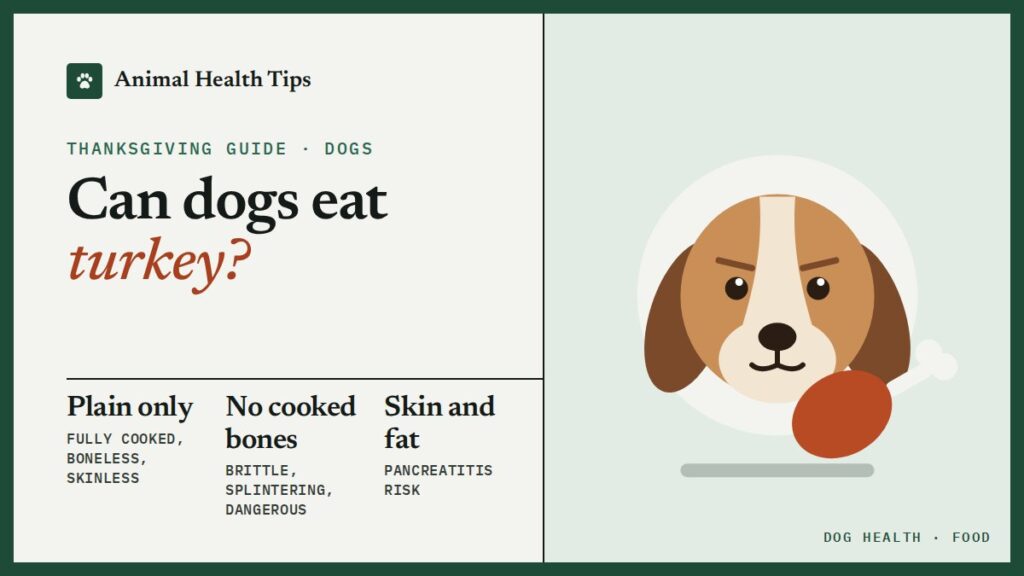
Thanksgiving in the United States falls on 26 November this year, and the same questions come up in kitchens on both sides of the Atlantic: can the dog have some turkey, and if so, how much? The short answer is reassuring, but it comes with a firm boundary. The meat itself is fine. Almost everything that makes a roast turkey taste like a roast turkey — the skin, the butter, the seasoning, the bones, the gravy and the stuffing — is not.
In this guide8 sections
This guide follows the AKC, the ASPCA and VCA Animal Hospitals, with onion and garlic poisoning advice from PDSA. It covers the safe portion, the three hazards to keep away from your dog, and what to do if your dog gets hold of a cooked bone. The same rules apply to the Christmas bird in the UK, so keep this guide for December too.
Call your vet promptly if
- Your dog has eaten a cooked bone, even if it seems fine
- Your dog vomits, has diarrhoea, or shows abdominal pain or lethargy after a fatty meal
- Your dog has eaten onion, garlic or leeks, in any form, even cooked
- Your dog strains to defecate, passes very little, or loses its appetite
- UK: Animal PoisonLine, 01202 509000 — open 24 hours, run by the Veterinary Poisons Information Service; a fee applies.
- US: ASPCA Animal Poison Control, (888) 426-4435 — open 24 hours; a consultation fee applies.
Can dogs eat turkey? The short answer
Whether or not dogs can eat turkey depends on how the turkey is cooked, the AKC states. Turkey is not inherently toxic to dogs: it is used as an ingredient in many dog foods and is rich in protein, riboflavin and phosphorous. When turkey is cooked plain — without added salt, fat or seasonings — it can be a wholesome part of a homemade dog food diet under the guidance of a veterinarian.
The problem is that the turkey people eat at Thanksgiving is rarely cooked plain. Birds are commonly rubbed with butter or oil and seasoned with salt, pepper, herbs and spices, the AKC notes. The ASPCA’s Thanksgiving advice takes the cautious line: stick to your pet’s normal diet on Thanksgiving, and if a small bite of turkey is given, it must be boneless and fully cooked. Raw or undercooked turkey may contain salmonella bacteria, the ASPCA adds, so fully cooked is not a detail to skip.
The safe way to serve turkey
- Set the dog’s portion aside first. Take plain meat from the bird before butter, oil, salt or seasoning goes on it, or carve a plain piece from the inside of the breast where seasonings have not reached. If you cannot be sure a piece is plain, do not serve it.
- Remove the skin and every bone. Serve meat only, with no skin, no bones and no drippings. Pick through the portion to check no roasting aromatics are mixed in, the AKC advises.
- Keep it small, more like a treat. Keeping portions small helps healthy dogs avoid stomach upset from eating different foods than they are used to, the AKC notes. A few bites, not a plate.
- Ask your vet first if your dog has a health condition. The AKC advises talking to your vet about adding occasional food scraps such as turkey to the diet, especially if the dog has a pre-existing health condition such as diabetes.
- Serve it separately, not from your plate. A bowl of plain meat, served away from the table, stops well-meaning guests adding gravy, skin or a bone on top.
Why cooked bones are never a treat
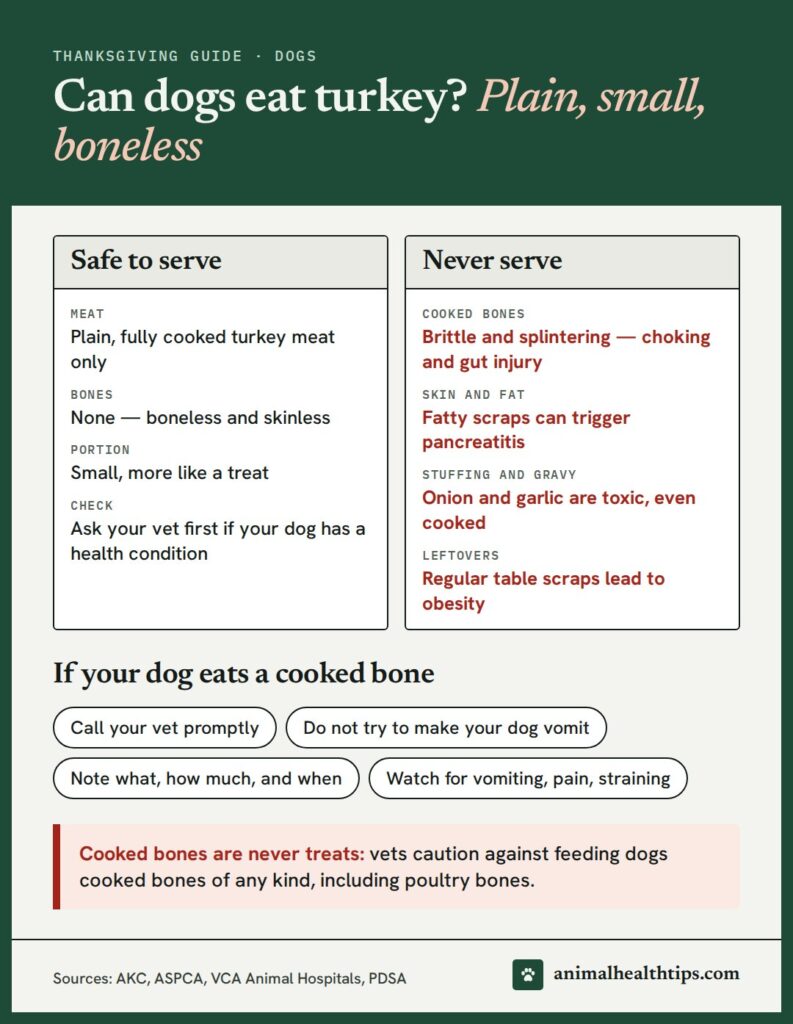
Cooked poultry bones are brittle, the AKC states, and this, combined with their smaller size, makes them very dangerous for dogs. Veterinarians caution against feeding dogs cooked bones of any kind, including poultry bones. The list of possible harm is long: mouth and tongue injuries, obstruction of the throat or intestinal tract, choking, possibly piercing the stomach and intestine lining, constipation, rectal bleeding from sharp bone fragments, and blockages that require emergency surgery.
VCA Animal Hospitals adds the context that keeps owners calm without making them careless: dogs are notorious for swallowing bones and other foreign objects, and some pass through without problem, but not all do. Foreign body obstruction is one of the more common and potentially life-threatening conditions seen in veterinary practice, VCA states, and if an obstruction occurs, surgical removal of the blocked object is the only treatment. The ASPCA’s Thanksgiving guidance is blunt about the same point: poultry bones can be a major choking hazard. Keep the carcass out of reach from the moment carving starts.
Skin, fat and pancreatitis
Remove the turkey skin, the AKC advises: too much fat, from the skin itself plus any butter or oil used for roasting or frying, and seasonings are dangerous for dogs. High fat content can cause pancreatitis, while extra spices and seasonings can irritate a dog’s stomach. VCA’s holiday guidance agrees in plainer terms: leftover fatty meat scraps can cause severe stomach upset and pancreatitis.
Pancreatitis is inflammation of the pancreas, VCA explains. It may be triggered in some cases by a fatty meal, and in many cases it appears to occur spontaneously. Its most common clinical signs include nausea, vomiting, fever, lethargy, abdominal pain, diarrhoea and decreased appetite. During an attack, dogs may take a praying position, with their rear end up in the air and their front legs and head lowered onto the floor. If an attack is severe, acute shock, severe depression and even death may occur. That is why a plate of skin and drippings is not a kindness, even on a feast day.
Stuffing, gravy and the hidden onion problem
Stuffing and gravy are where the quiet danger sits. Onions, garlic and leeks are alliums, and all are toxic to dogs, PDSA states. All parts of allium plants are toxic, even when cooked or dried, so cooked onions, garlic and leeks in stuffing or gravy are still toxic and should be kept out of dogs’ reach. The toxins, disulphides and thiosulfinates, can damage red blood cells, causing anaemia.
The timing makes this hazard easy to miss. Symptoms of onion and garlic poisoning include vomiting, diarrhoea and a reduced appetite, PDSA states, and they may start within 24 hours but more commonly take a few days to appear. Anaemia symptoms — trouble breathing and lethargy — may occur 1 to 5 days after eating onion, garlic or leek. The ASPCA adds a second gravy warning: bouillon cubes used for stocks and gravy contain high amounts of sodium, which can lead to gastrointestinal problems and even seizures. If your dog has eaten onions, garlic or leeks, contact a vet as soon as possible, PDSA advises, and do not attempt to make the dog vomit at home — only a vet decides that.
| From the roast | Safe or not | Why |
|---|---|---|
| Plain cooked turkey meat | Yes, small portion | Not inherently toxic; serve boneless, skinless, unseasoned |
| Turkey skin and drippings | No | High fat; can cause stomach upset and pancreatitis |
| Cooked bones | Never | Brittle and splintering; choking, blockage, gut injury |
| Gravy and stuffing | No | Onion and garlic are toxic even cooked; bouillon is very salty |
| Fatty leftover scraps | No | Severe stomach upset and pancreatitis risk |
What to do if your dog eats a cooked bone
- Stay calm and do not try to make your dog vomit. The ASPCA notes cooked bones can splinter, so there is a risk of oesophageal damage if vomiting is induced. That decision belongs to a vet, never to a home remedy.
- Call your vet or a poison line promptly. Use the numbers in the box above. Tell them what your dog ate, roughly how much, and when.
- Watch for the warning signs. VCA lists vomiting, diarrhoea, abdominal tenderness or pain, decreased appetite, straining to defecate or producing small amounts of faeces, lethargy, and changes in behaviour such as biting or growling when picked up or handled around the abdomen.
- Follow your vet’s advice on monitoring. Your vet will take a history and examine the dog, VCA notes, and abdominal X-rays will be performed if a foreign body is suspected. If a blockage develops, surgery is the treatment.
- Secure the rest of the bones. Take the carcass and the bin out of reach before anything else is eaten, and tell guests the rule: no bones, ever.
Thanksgiving table rules: guests, plates and the bin
Most holiday accidents are not deliberate. A guest slips the dog a bone under the table, a child shares a plate, or the dog raids the bin while everyone is in the next room. Tell guests before the meal that the dog gets a plain portion in its own bowl and nothing else. Serve the dog separately, clear plates promptly, and keep the dog out of the kitchen while the carcass is being dealt with. The same plain-and-small rule works for other seasonal foods: see our guide to can dogs eat pumpkin for another example of a food that is only safe when served plain.
The bin deserves the same attention as the table. The ASPCA warns that a garbage bin can fill up with bones, chocolate, onions and other holiday hazards, and advises emptying trash through the day and keeping pets out of the area where the trash is. Chocolate desserts are another bin hazard at this time of year: if your dog gets chocolate, our dog chocolate toxicity calculator can help you judge the risk while you call your vet. Finally, the AKC warns that feeding table scraps to dogs on a regular basis can lead to obesity, which can cause problems including diabetes, hypertension and joint stress. A feast day is not a new diet.
Key takeaways
- Plain, fully cooked, boneless and skinless turkey meat, in a small treat-sized portion, is safe for dogs.
- Cooked bones are never treats: they are brittle, splinter, and can choke, block or pierce the gut.
- Skin, fat and drippings can trigger pancreatitis; seasonings irritate the stomach.
- Onion, garlic and leeks are toxic even cooked, and symptoms can take days to appear.
- If your dog eats a cooked bone, call your vet promptly and never try to make it vomit at home.
Frequently asked questions
Can dogs eat turkey?
Yes, in the plain form only. Turkey is not inherently toxic to dogs, the AKC states, but it must be fully cooked, boneless, skinless and unseasoned, and served in a small, treat-sized portion. The bird served at Thanksgiving is rarely plain, so set the dog’s portion aside before seasoning.
Can dogs eat turkey bones?
No, never cooked bones. Cooked poultry bones are brittle and can cause mouth injuries, choking, obstruction of the throat or gut, piercing of the stomach or intestine lining, and blockages that require emergency surgery, the AKC warns. Keep the carcass out of reach.
Is turkey skin bad for dogs?
Yes. The AKC advises removing turkey skin, because too much fat from the skin plus butter or oil used for roasting, and seasonings, are dangerous for dogs. High fat content can cause pancreatitis, and leftover fatty meat scraps can cause severe stomach upset, VCA adds.
What happens if a dog eats stuffing with onion?
Onions, garlic and leeks are toxic to dogs even when cooked, PDSA states, and can damage red blood cells, causing anaemia. Symptoms such as vomiting, diarrhoea and reduced appetite may start within 24 hours but more commonly take a few days, and anaemia signs may occur 1 to 5 days later. Contact a vet as soon as possible.
What should I do if my dog eats a cooked bone?
Call your vet or a poison line promptly, and do not try to make your dog vomit at home: the ASPCA notes cooked bones can splinter, risking oesophageal damage if vomiting is induced. Note what was eaten, how much and when, watch for vomiting, pain, straining or lethargy, and follow your vet’s advice.
Can dogs eat turkey every day?
Turkey can be part of a dog’s diet when cooked plain, the AKC notes, but it should stay a small, occasional addition, not a replacement for complete dog food. The AKC also warns that regular table scraps can lead to obesity, with problems including diabetes, hypertension and joint stress.
Sources
- AKC — Can dogs eat turkey?
- ASPCA — Thanksgiving safety tips
- ASPCApro — 4 harmful Thanksgiving foods for pets
- PDSA — Onion and garlic poisoning in dogs
- VCA Animal Hospitals — Pancreatitis in dogs
- VCA Animal Hospitals — Ingestion of foreign bodies in dogs
- VCA Animal Hospitals — Holiday toxins for pets
This guide is general information, not a diagnosis. If you are worried about your pet, contact your vet.
2 comments