
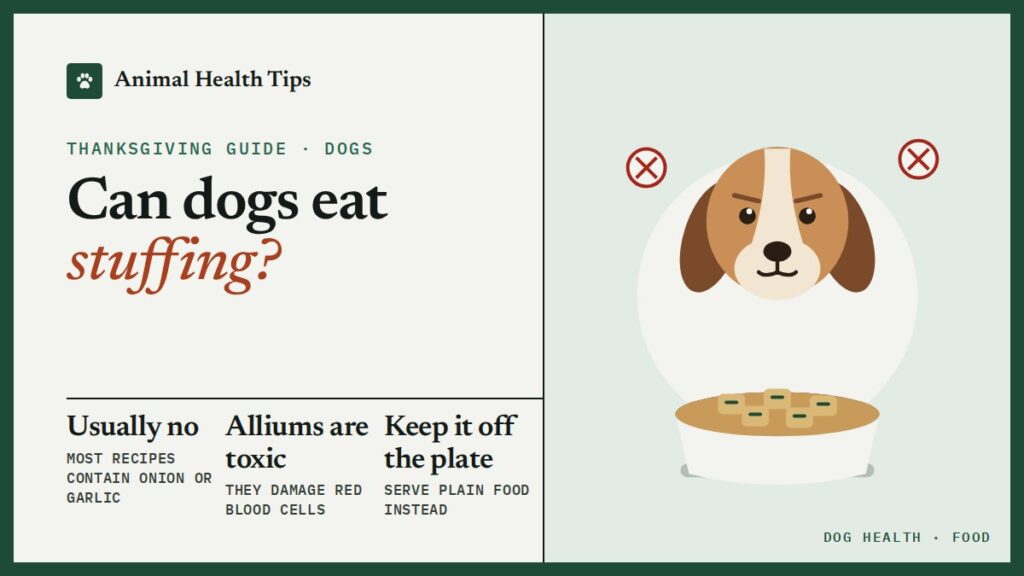
Thanksgiving in the United States falls on 26 November this year, and stuffing is the dish that causes the most confusion at the table. It looks harmless: bread and herbs, served in a spoonful from a family bowl. For a dog, that spoonful is a gamble, because the ingredients that make stuffing taste like stuffing are the ones that make it unsafe. This guide follows the ASPCA, the Merck Veterinary Manual, VCA Animal Hospitals, PDSA and UC Davis.
In this guide7 sections
Call your vet or a poison line at once if
- Your dog has eaten stuffing containing onion, garlic, leeks or chives, in any form
- Your dog has eaten stuffing containing raisins, grapes or currants
- Your dog shows vomiting, diarrhoea, weakness, pale or yellow gums, rapid breathing, dark or red urine, or collapse
- UK: Animal PoisonLine, 01202 509000 — open 24 hours, run by the Veterinary Poisons Information Service; a fee applies.
- US: ASPCA Animal Poison Control, (888) 426-4435 — open 24 hours; a consultation fee applies.
Can dogs eat stuffing?
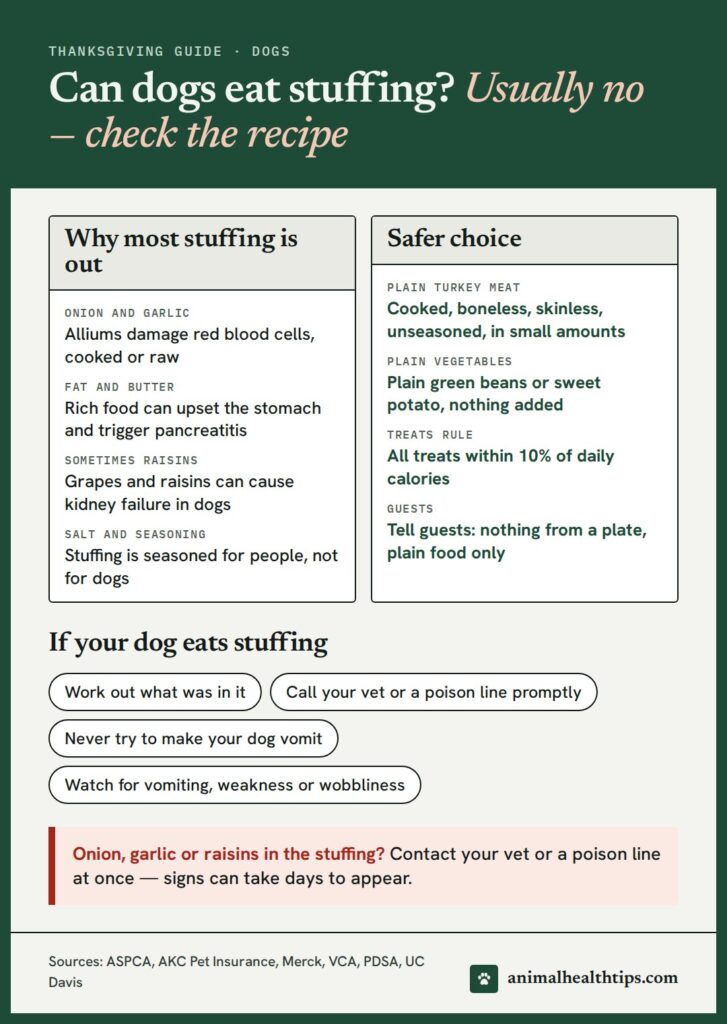
No, ordinary stuffing as normally served is not safe for dogs. Stuffing, or turkey dressing, typically contains onions, garlic, salt and other spices that can be harmful to dogs, and onions and garlic should be avoided at all costs, since both are toxic for pets. Onions and garlic are prevalent in holiday casseroles, stuffing, mashed potatoes and many other items, and can be toxic to pets, the ASPCA notes. That prevalence is the point: stuffing is not a dish that sometimes contains alliums by accident. It is built around them.
There is no safe spoonful of ordinary stuffing, and no verified way to make it safe by picking the onion pieces out. The onion and garlic content of a serving of stuffing is unknown, and concentrated forms such as powders, flakes and soup mixes are the most common route of allium poisoning in dogs and cats, according to the Merck Veterinary Manual. If you cannot be sure a serving is free of onion, garlic and their relatives, do not serve it at all.
What is actually in stuffing?
Recipes vary, but the risky pattern is consistent. The base is bread, and the flavour comes from onion and garlic, cooked in butter or fat, seasoned with salt, and often made with stock or bouillon. Some recipes add sausage meat, which adds fat and salt, and some add raisins. No approved source verified the safety of sage or other stuffing herbs for dogs, so this guide makes no claim about them.
| Ingredient in stuffing | What it means for your dog | Source |
|---|---|---|
| Onion, garlic, leeks, chives | Toxic: oxidative damage to red blood cells, leading to anaemia | ASPCA, Merck |
| Raisins, grapes, currants | Toxic: kidney failure possible, with no safe dose established | VCA |
| Butter and fat | Rich food: stomach upset, and higher risk of pancreatitis | PDSA |
| Salt and stock or bouillon | Large amounts of salt can cause sodium ion poisoning | ASPCA |
| Bread base | Not the main risk, but it does not make the rest safe | ASPCA |
Why onion and garlic are dangerous, even when cooked
Onion, garlic and chives belong to the allium family and can cause oxidative damage to the red blood cells in cats and dogs, leading to anaemia and methemoglobinaemia, the ASPCA states. Allium species include garlic, onions, chives and leeks, although garlic and onions are most commonly associated with toxicosis, and garlic is three to five times more toxic than onion, according to the Merck Veterinary Manual. Dogs and cats have been affected after ingesting raw, cooked, dehydrated or granulated onions and garlic, so cooking the stuffing does not remove the risk.
The delay is what makes allium poisoning easy to miss. Haemolysis typically occurs three to five days after exposure, the Merck Veterinary Manual states, and clinical signs are generally not noted until substantial haemolysis has occurred, usually a few days after exposure. Signs may include lethargy, weakness, pale gums, yellowing, rapid breathing, dark or red urine, collapse and death. A dog that seems fine on Thanksgiving evening is not in the clear.
The other risks: fat, salt and raisins
Fat is a separate problem from toxicity. Pancreatitis is inflammation of the pancreas, which causes pain and vomiting and ranges from mild to very severe, PDSA states, and a dog is at higher risk if it has recently eaten high-fat foods, with PDSA giving pork, cheese and butter as examples. Stuffing cooked in butter, or made with sausage meat, sits squarely in that rich-food category.
Salt adds a third risk. Large amounts of salt can produce excessive thirst and urination, or even sodium ion poisoning in pets, the ASPCA states. Bouillon contains a very high amount of sodium, the ASPCA adds. Stuffing made with stock or bouillon carries that salt load with it.
Raisins are the most urgent of the three. Grapes, raisins and Zante currants can cause kidney failure in dogs, VCA states. There is no well-established toxic dose, and some dogs may have individual sensitivities, causing poisoning even from a small amount. The most common early symptom is vomiting or diarrhoea within 12 to 24 hours, VCA adds, and more severe signs are not seen until 24 to 48 hours after ingestion.
What to do if your dog eats stuffing
- Work out what was in it. Read the recipe or the packet: onion, garlic, leeks, chives, raisins, butter and stock are the details that matter. Note roughly how much your dog ate and when.
- Call your vet or a poison line promptly, even if your dog seems fine. Allium signs usually appear days later, and grape and raisin kidney signs may appear 24 to 48 hours after ingestion, so do not wait for symptoms.
- Do not try to make your dog vomit at home. Only a vet decides that, and only a vet decides what treatment or monitoring is needed.
- Watch over the following days. Watch for vomiting, diarrhoea, lethargy, weakness, pale or yellow gums, rapid breathing, dark or red urine, loss of appetite, a painful tummy, excessive thirst or urination, and collapse, and seek veterinary care urgently if any appear.
- Keep the rest out of reach. Clear plates promptly, bin leftovers safely, and tell guests the dog gets plain food in its own bowl and nothing from a plate.
A safer Thanksgiving plate
The simplest safe choice is plain food, set aside before seasoning. Boneless and skinless white turkey meat, a dollop of canned pumpkin before anything else is added, steamed or boiled sweet potatoes shared before butter and brown sugar are mixed in, raw green beans set aside, and apple slices with seeds removed are all verified safe alternatives on the AKC Pet Insurance Thanksgiving guide. Treats and additional food items should not exceed 10% of daily caloric intake, UC Davis advises, and 90% or more of calories should come from a complete and balanced food.
For the main course, see our guide to can dogs eat turkey and our guide to can dogs eat cranberry sauce. Tell guests before the meal that the dog gets plain food in its own bowl and nothing from a plate, and clear plates promptly.
Key takeaways
- Ordinary stuffing is not safe for dogs: most recipes contain onion or garlic, which are toxic even when cooked.
- Allium damage to red blood cells is delayed: haemolysis typically occurs three to five days after exposure.
- Fat raises the risk of pancreatitis, salt in large amounts can poison, and raisins can cause kidney failure with no safe dose.
- There is no safe spoonful of ordinary stuffing and no verified way to make it safe by picking pieces out.
- If your dog eats stuffing, call your vet or a poison line promptly, even if your dog seems fine.
Frequently asked questions
Can dogs eat stuffing?
No, ordinary stuffing as normally served is not safe for dogs. Most recipes contain onion or garlic, which are toxic to dogs even when cooked, plus butter, fat and salt, and some add raisins. There is no safe spoonful of ordinary stuffing.
Does cooking remove the onion and garlic risk?
No. Dogs and cats have been affected after ingesting raw, cooked, dehydrated or granulated onions and garlic, the Merck Veterinary Manual states. Cooking the stuffing does not make the alliums safe.
My dog ate stuffing but seems fine. Should I still call the vet?
Yes, promptly. Allium signs are generally not noted until substantial haemolysis has occurred, usually a few days after exposure, and grape and raisin kidney signs may appear 24 to 48 hours after ingestion.
What if the stuffing contained raisins?
Treat it as an emergency. Grapes, raisins and currants can cause kidney failure in dogs, VCA states, and there is no well-established toxic dose. Contact your vet or a poison centre immediately.
Can I just pick the onion out of the stuffing?
No verified source supports that. The onion and garlic content of a serving is unknown, and concentrated forms such as powders and flakes are the most common route of poisoning.
What can my dog have instead at Thanksgiving?
Plain, boneless, skinless turkey meat, plain canned pumpkin, plain sweet potato, plain green beans set aside, and apple slices with seeds removed, all in small amounts within the 10% treats rule.
Sources
- ASPCA — 4 Harmful Thanksgiving Foods for Pets
- ASPCA — People Foods Pets Should Never Eat
- Merck Veterinary Manual — Garlic and Onion (Allium spp) Toxicosis in Animals
- VCA Animal Hospitals — Grape, Raisin and Currant Poisoning in Dogs
- PDSA — Pancreatitis in dogs
- UC Davis School of Veterinary Medicine — Treat Guidelines for Dogs
This guide is general information, not a diagnosis. If you are worried about your pet, contact your vet.
1 comment