Brussels sprouts are on many Thanksgiving tables in the United States — Thanksgiving falls on 26 November this year — and a cat that begs at the table may get offered one. The honest answer is less simple than a yes or no. Brussels sprouts are not listed as toxic to cats on any approved list, but no approved source lists them as safe either. Cats do not need vegetables at all, so a tiny plain cooked taste is the most to offer, and only occasionally. This guide follows PDSA, the Cornell Feline Health Center, the ASPCA, VCA Animal Hospitals, Cats Protection and the Merck Veterinary Manual, and it says plainly where the evidence stops.
In this guide7 sections
Call your vet today if your cat ate a sprout dish with onion or garlic
- Note how much was eaten and when.
- Watch for vomiting, diarrhoea, lethargy and weakness.
- Never try to make your cat vomit at home. Only a vet should decide that.
- UK: Animal PoisonLine, 01202 509000 — open 24 hours, run by the Veterinary Poisons Information Service; a fee applies.
- US: ASPCA Animal Poison Control, (888) 426-4435 — open 24 hours; a consultation fee applies.
Can cats eat Brussels sprouts?
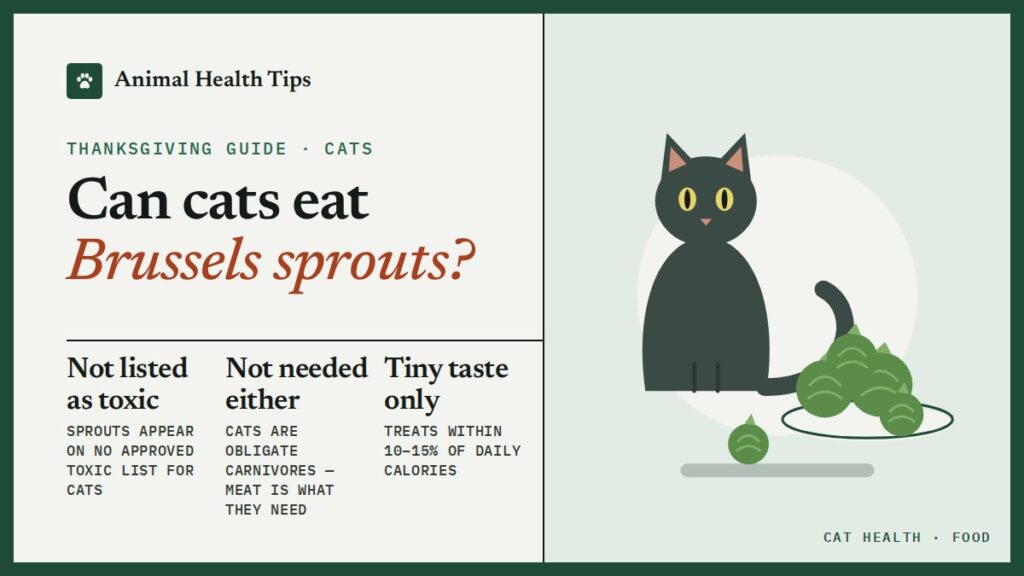
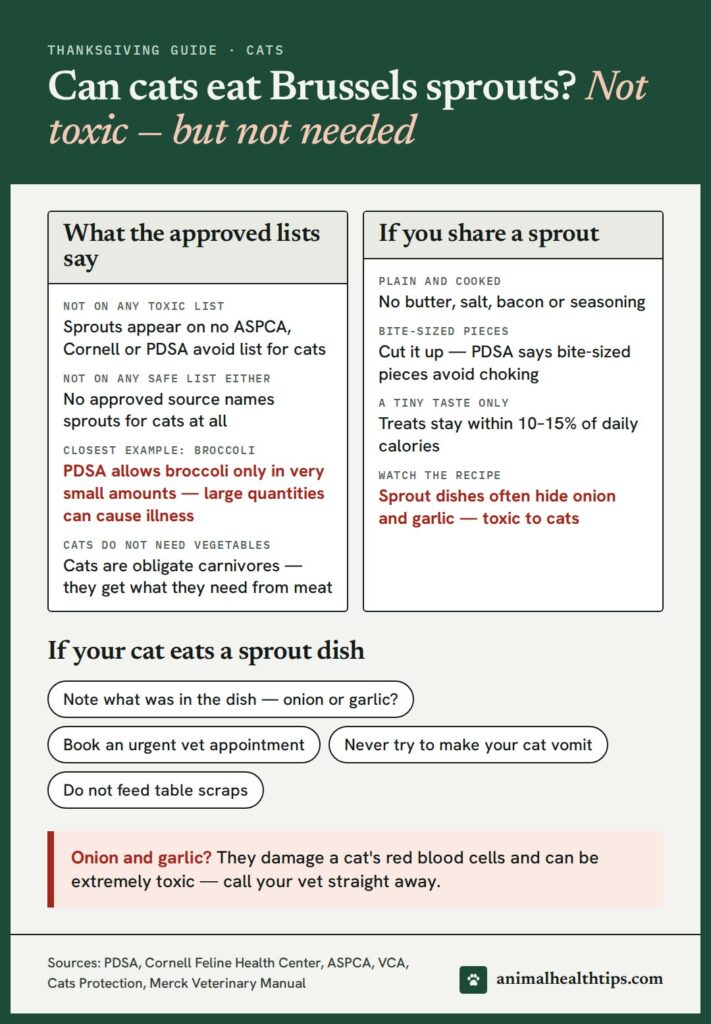
A tiny plain cooked taste, occasionally, is the most any cat should have — and there is no reason to make it a habit. No approved source names Brussels sprouts for cats specifically, neither on a safe list nor on a toxic list. That is the first thing to say plainly, because it shapes everything else in this guide. The answer below rests on three verified anchors instead: sprouts appear on no toxic list, the closest listed vegetable is allowed only in very small amounts, and every approved source agrees that cats do not need vegetables at all.
The ASPCA’s list of people foods to avoid feeding pets names avocado, citrus, grapes and raisins, and onion, garlic and chives, under fruits and vegetables. Brussels sprouts do not appear anywhere on that page. Cornell’s list of toxic foods for cats is grapes, onions, raisins, avocados, anything containing xylitol, and chocolate. Brussels sprouts do not appear on that list either. PDSA’s list of fruit and vegetables to avoid for cats names grapes, raisins, garlic, onions, chives, leeks, shallots and scallions. Again, sprouts are not on it.
But not being on a toxic list is not the same as being safe. PDSA does not list Brussels sprouts by name at all, and neither does Cats Protection, VCA or Cornell. So this article does not claim sprouts are safe for cats. It says only what the evidence supports: sprouts are not listed as toxic, they are not needed, and a tiny plain cooked taste is the most to offer.
Why cats don’t need vegetables
Cats are obligate carnivores. Cornell says they rely on nutrients found only in animal products, and that they evolved eating prey high in protein, moderate in fat and minimal in carbohydrates, and their diet still requires these general proportions. PDSA says the same in plain terms: cats are carnivores because they require specific nutrients found in meat such as taurine and arginine, and without these nutrients they are at risk of severe health problems such as heart disease and blindness.
VCA explains what happens without those nutrients. Cats require taurine from meat sources, and taurine is important for a cat’s vision and heart function. A cat without enough taurine can develop blindness — feline central retinal degeneration — and weakening of the heart muscles, leading to dilated cardiomyopathy. Cats Protection adds that cats rarely eat vegetables naturally and there is no need to add vegetables to their diet, and that vegetarian and vegan diets are unsuitable for them.
That is why a sprout can only ever be a treat, never a food. PDSA says cats do not need fruit or vegetables as part of their diet, but many can be given in very small quantities as an occasional treat. Cornell says an occasional treat is not generally harmful, but treats are not a nutritionally complete source of nutrition and should only be fed occasionally. PDSA and Cornell both put the same limit on treats: they should not exceed 10 to 15 percent of a cat’s daily calorie allowance.
What the approved lists actually say
The closest verified example is broccoli, which is in the same cruciferous family as Brussels sprouts. PDSA lists broccoli as safe for cats in very small amounts, and warns that large quantities can cause illness. Cats Protection names a few vegetables that can be fed to a cat if it is keen — carrots, peas, corn, broccoli and spinach — and Brussels sprouts are not among them. VCA says most fresh vegetables and fruits can be given to a pet, and that vegetables can be cooked without any seasoning, butter or oil, with cores, seeds, stems and peels removed first. Its examples are asparagus, broccoli, celery, cucumber and green beans. Brussels sprouts are not named.
| On the table | What the lists say | Safe for a cat? |
|---|---|---|
| Plain Brussels sprout | On no toxic list — and on no safe list either | A tiny plain cooked taste at most |
| Broccoli | PDSA: very small amounts only; large quantities can cause illness | The closest verified example |
| Sprouts with butter and bacon | Fat and salt a cat does not need | No — serve it plain or not at all |
| Sprouts with onion or garlic | Onion and garlic are extremely toxic to cats | No — call your vet |
| Raw sprout | No approved source covers raw sprouts for cats | Cooked is the safer choice |
What is not in this guide matters too. No approved source gives a cat-specific portion for Brussels sprouts, so this article gives none: no number of sprouts, no spoonfuls, no times per week. No approved source says sprouts cause gas or bloating in cats, or that they offer any nutritional benefit to cats, so neither claim appears here. And no approved source says raw sprouts carry a poisoning risk for cats, so this article does not claim one — it recommends cooked only because cooked is the safer, easier-to-digest choice.
How to serve a sprout safely, if you do
- Serve it plain and cooked. No butter, no salt, no bacon, no seasoning, and no oil.
- Cut it into bite-sized pieces. PDSA says to give fruit and vegetables in bite-sized pieces and to remove any seeds to avoid choking.
- Keep it tiny and occasional. Treats should not exceed 10 to 15 percent of your cat’s daily calorie allowance, and VCA says to keep treats small and limited to less than 10 percent of their daily diet.
- Reduce the main meal that day. PDSA says to reduce main meals on days treats are given, so your cat does not gain weight.
- Watch how your cat reacts. If the new food causes vomiting or diarrhoea, stop offering it and speak to your vet.
- Skip it entirely if your cat is unwell or on a special diet. PDSA says that if your cat is struggling with its weight or has a medical condition that requires a specific diet, it is best to avoid feeding extra food treats altogether.
The recipes to watch: butter, bacon, onion and garlic
The sprout itself is the least of the risk at Thanksgiving. The recipes are the problem. Sprouts are often roasted with bacon, tossed in butter, or cooked with onion and garlic — and each of those additions is a problem for a cat. VCA says added fat is not only unnecessary but can lead to pancreatitis, and that fatty foods like turkey skin or bacon can also lead to this condition. The ASPCA says onion, garlic and chives can cause gastrointestinal irritation and red blood cell damage, which can lead to anaemia, and that cats are more susceptible than dogs.
Cats Protection says onion and garlic, whether fresh, cooked or dried, can be extremely toxic to cats, potentially leading to anaemia, and that if a cat is noticed or suspected to have eaten food that can be harmful, you should book an urgent appointment with a vet. The Merck Veterinary Manual puts a number on the risk: garlic is three to five times more toxic than onion, cats are the most susceptible species, and toxicosis has been reported in cats after ingesting less than a teaspoon of cooked onions. The damage begins within 24 hours and peaks at about 72 hours, and haemolysis typically occurs three to five days after exposure — so a cat that seems fine on the day can become ill days later.
The same plain-only rule applies to the rest of the table. Our guides to whether cats can eat ham and whether cats can eat turkey follow the same pattern, and our guide to whether cats can eat pumpkin explains why plain pumpkin is the safer seasonal treat.
What to do if your cat eats a sprout dish
- Note what was in the dish, how much was eaten and when. The ASPCA asks owners to note the amount ingested before calling.
- Book an urgent appointment with your vet. Cats Protection says to book an urgent appointment if your cat has eaten food that can be harmful.
- Do not wait if onion or garlic was in the dish. Signs of allium poisoning can take days to appear, so early advice matters.
- Never try to make your cat vomit at home. Cornell says not to induce vomiting unless specifically directed to do so by a vet.
- Watch for warning signs: vomiting, diarrhoea, lethargy, loss of appetite, weakness, rapid breathing and pale gums can point to red blood cell damage.
VCA warns that vomiting and diarrhoea are common problems veterinarians see during holiday periods, especially between Thanksgiving and New Year’s Day, and that even small amounts of different foods can cause digestive upset. Cats Protection’s advice for any meal with visitors is simple: do not feed table scraps, and advise guests not to either. If you want to give your cat a holiday treat, a small piece of plain cooked turkey or chicken is the safer choice.
Key takeaways
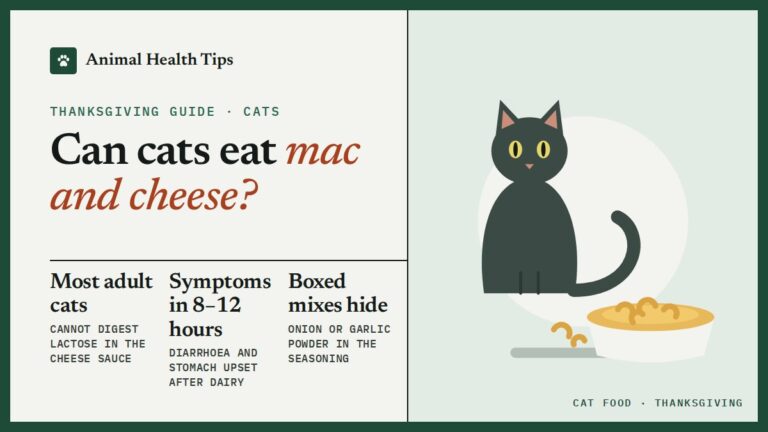
- Brussels sprouts are not listed as toxic to cats — but no approved source lists them as safe either.
- Cats are obligate carnivores and do not need vegetables at all; a sprout can only ever be a tiny occasional taste.
- Broccoli, the closest verified example, is allowed only in very small amounts — large quantities can cause illness.
- Sprout dishes cooked with onion or garlic are out: alliums damage a cat’s red blood cells and can be extremely toxic.
Frequently asked questions
Are Brussels sprouts toxic to cats?
No approved source lists Brussels sprouts as toxic to cats: they appear on no ASPCA, Cornell or PDSA avoid list. But no approved source lists them as safe either, so this article does not call them safe — only that a tiny plain cooked taste is the most to offer.
Can cats eat raw Brussels sprouts?
No approved source covers raw sprouts for cats, so no raw-sprout risk is claimed here. Cooked is the safer choice, and VCA says vegetables can be cooked without any seasoning, butter or oil. Serve it plain, cooked and cut into bite-sized pieces.
How much Brussels sprout can a cat eat?
No verified portion exists — no approved source gives a cat-specific amount for sprouts. Keep it to a tiny taste, occasionally, inside the treats limit: PDSA and Cornell say treats should not exceed 10 to 15 percent of a cat’s daily calories.
Can cats eat broccoli?
Yes, in very small amounts. PDSA lists broccoli as safe for cats in very small amounts and warns that large quantities can cause illness. Broccoli is the closest verified example to Brussels sprouts, which are in the same family.
Why can’t cats eat sprouts cooked with onion or garlic?
Onion and garlic damage the red blood cells of pets, especially in cats, and can lead to anaemia. The Merck Veterinary Manual says garlic is three to five times more toxic than onion, and that cats are the most susceptible species.
My cat ate a sprout dish with onion in it. What should I do?
Note how much was eaten and when, then book an urgent appointment with your vet. Do not wait for symptoms: allium damage can take days to appear. Never try to make your cat vomit at home.
Sources
- Cornell University Feline Health Center — Feeding Your Cat
- Cornell University Feline Health Center — Common Cat Hazards
- PDSA — The Best Diet for Your Cat
- ASPCA — People Foods to Avoid Feeding Your Pets
- VCA Animal Hospitals — Safe and Toxic Holiday Foods for Pets
- Cats Protection — Cats and Human Foods
- Merck Veterinary Manual — Garlic and Onion (Allium spp.) Toxicosis in Animals
This guide is general information, not a diagnosis. If you are worried about your pet, contact your vet.