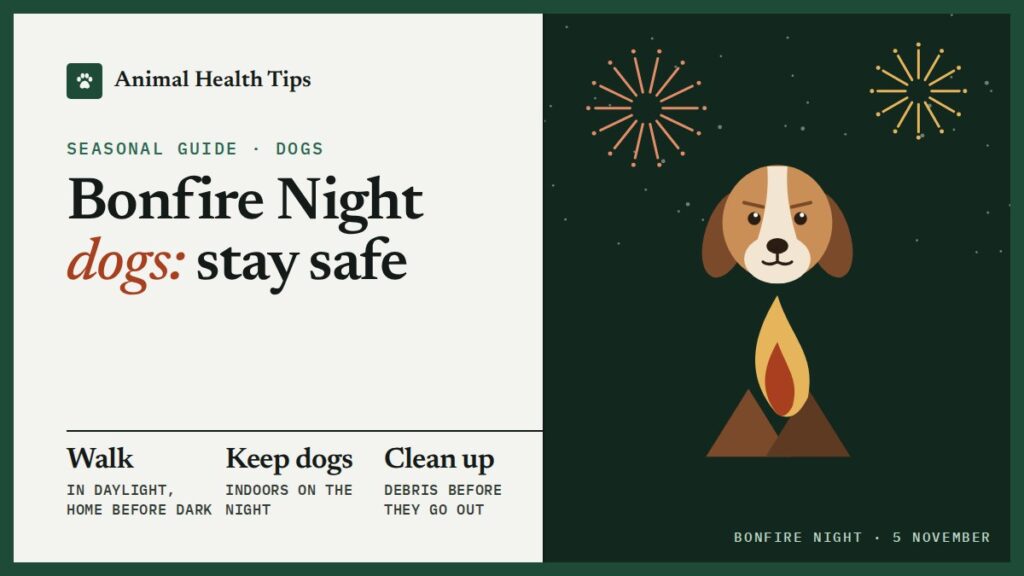
Bonfire Night is on Thursday 5 November, but for dogs the season is already here. Fireworks have been going off for days, and gardens are filling with bonfire wood, sparklers and party food. Most Bonfire Night advice for dogs focuses on the noise, and the noise matters — but the fire itself brings hazards that a fireworks plan alone does not cover.
In this guide7 sections
A bonfire is a pile of heat, smoke, sharp wood and food waste, and a dog that gets loose near one can be hurt in seconds. Sparklers burn in a child’s hand and are then dropped, still dangerous, on the ground. After the party, the garden is littered with firework casings, skewers, bones and charcoal. This guide covers those hazards, the plan for the night itself, and what to do if your dog eats debris or breathes in smoke. For the cat side of Bonfire Night, see our guide to cats and Bonfire Night.
Call your vet right away if
- Your dog has eaten firework debris, sparklers, matches or lighter fluid
- Your dog has vomited, has bloody vomiting or diarrhoea, or seems lethargic
- Your dog has burns, or is coughing, gagging or struggling to breathe after smoke
- Your dog has swallowed a skewer, bone or other sharp object
- UK: Animal PoisonLine, 01202 509000 — open 24 hours, run by the Veterinary Poisons Information Service; a fee applies.
- US: ASPCA Animal Poison Control, (888) 426-4435 — open 24 hours; a consultation fee applies.
Why Bonfire Night is risky beyond the fireworks
Dogs hear far more than we do, and unexpected loud noises can cause considerable fear and anxiety even in pets that are usually calm and confident. PDSA reports that 41% of dog owners in its Animal Wellbeing Report said their dog is afraid of fireworks, stated on the page as 4.1 million dogs across the UK. A frightened dog is also a dog more likely to bolt, slip a lead or squeeze through a garden gap — which is how a dog ends up near a bonfire or a pile of debris in the first place.
The signs of fear are not always dramatic. PDSA lists trembling and shaking, panting, barking, pacing, cowering and hiding behind furniture, clinginess, trying to run away, destructive behaviour, toileting in the house, refusing to eat, and small changes in normal behaviour, and adds that some dogs do not show obvious signs. Blue Cross lists panting excessively, drooling, shaking, yawning and putting the tail between the legs. If your dog shows any of these on fireworks nights, treat the night as a risk night, not just a noisy one.
Bonfires, sparklers and hot ash
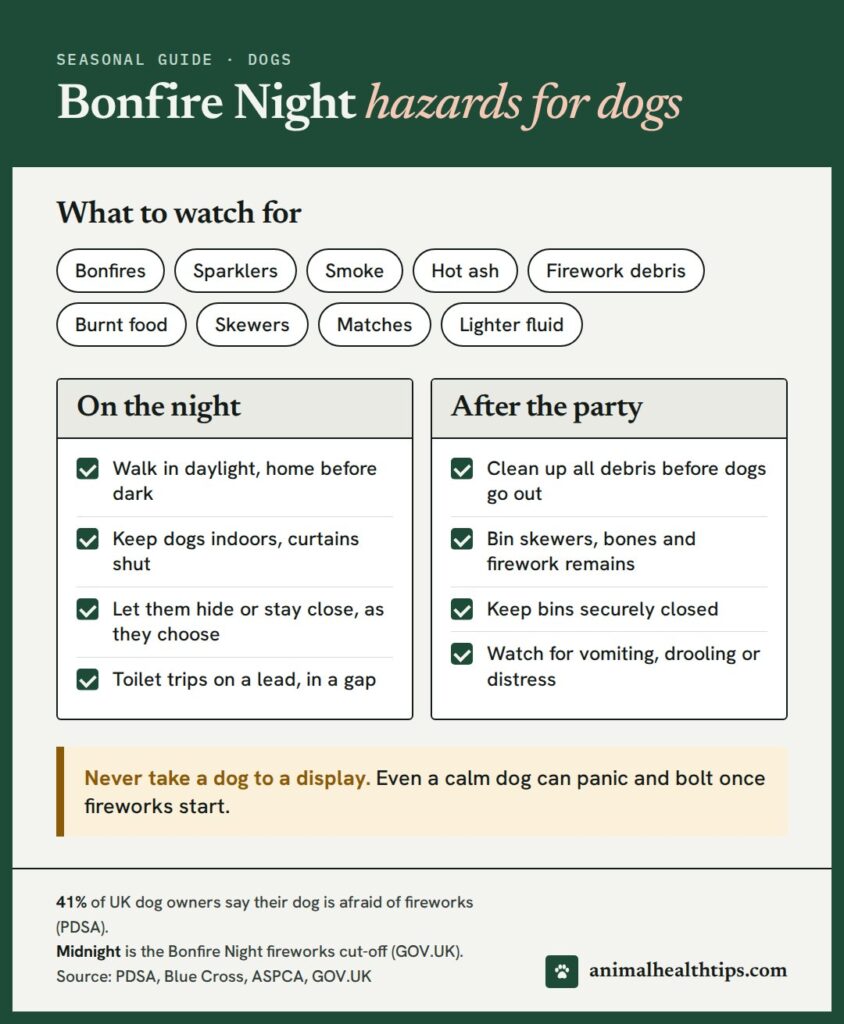
Keep dogs well away from a lit bonfire, and never leave a dog unsupervised near one. A bonfire is not just flames: it is falling wood, sparks, hot ash and smoke, and a dog that runs at it out of excitement or fear can be burned before anyone can react. Do not tie a dog up outside while fireworks are being let off, Blue Cross advises, and do not leave a dog in the garden or alone in the car on fireworks nights. The same applies to a bonfire party: a tied-up dog cannot move away from heat, smoke or a falling ember.
Sparklers deserve the same caution. They are fireworks, and GOV.UK states that you must not set off or throw fireworks, including sparklers, in the street or other public places. A used sparkler dropped on the ground is still a sharp, hot object a dog can step on, chew or swallow, and the chemicals in fireworks are a separate risk covered below. No temperature or cooling-time figure is given here, because none was verified on an approved source for this article — treat every sparkler and every patch of ash as hot until you are sure it is not, and keep dogs out of the area until it has been cleaned.
Smoke: what to watch for
Smoke is the hazard most owners underestimate. The MSD Veterinary Manual’s summary on smoke inhalation injury in animals notes that signs can include coughing, gagging, drooling, rapid breathing, difficulty breathing, increased respiratory effort, changes in alertness, skin burns and pain — and that signs may not be apparent at first, with breathing difficulty possibly getting progressively worse, especially during the first 24 hours after exposure. That summary, rather than the full manual page, is the source here, so treat this section as a warning to act early, not as a diagnosis.
If your dog has been near a bonfire or in smoke, move them into fresh air, keep them calm and indoors, and contact your vet promptly — especially if they are coughing, gagging, breathing fast or with effort, or seem drowsy or uncoordinated. Do not wait to see whether it passes, and do not try a home treatment for burns or breathing difficulty: no burn-cooling or home-treatment protocol was verified on an approved source for this article, so prompt veterinary care is the safe instruction. Keep dogs indoors when fireworks are being let off, Blue Cross advises, with windows and doors closed and curtains drawn.
Firework debris, food waste and sharp objects
The morning after is when many dogs get into trouble. The ASPCA advises keeping pets far away from fireworks, keeping fireworks securely locked away until ready to light them, and keeping pets out of the area while setting them off. After setting off fireworks at home, the ASPCA adds, thoroughly clean up the area, gathering any trash or remaining materials, before letting a dog have access again. Fireworks contain chemicals and heavy metals, and the ASPCA’s Animal Poison Control Center list, seen in summary, notes that after eating fireworks the most common problems are vomiting and diarrhoea, and that some fireworks contain chemicals that can be corrosive to the lining of the digestive tract.
Party food waste is just as risky. The ASPCA warns that charcoal briquettes, wooden or metal skewers, corn cobs and bones can all be a risk for foreign-body obstruction if ingested, a complication that often requires surgery, and that sharp objects can be an additional risk for injury — so dispose of these items carefully and keep bins securely closed. Fatty foods such as burgers or steak trimmings can lead to pancreatitis, causing vomiting, stomach pain and depression, with some cases requiring hospital treatment, and any change from a dog’s normal diet can cause severe indigestion and diarrhoea. Matches and lighter fluid belong in the same locked-away category: the ASPCA notes certain matches contain chlorates which could potentially damage blood cells, and lighter fluid can irritate skin and, if ingested, produce gastrointestinal irritation and nervous-system depression.
The night plan: before dark and on the night
- Walk your dog while it is still light and get home well before dark, before fireworks are likely to start. PDSA notes a longer walk with plenty of opportunity to sniff and explore will tire the dog and help them relax.
- Feed earlier so your dog has time to eat and go to the toilet before dark, as Dogs Trust advises, and arrange for someone your dog knows well to be at home.
- Close curtains before dark and leave lights on to hide flashes, play music to help drown out fireworks noises at a volume your dog is comfortable with, and make a den for your dog to hide in if they wish.
- Comfort your dog if they come for reassurance. PDSA advises not to ignore them, but if they want to be alone, let them. Never punish a dog for anything they do when scared.
- Keep toilet trips short, on a lead, in a gap in the fireworks. PDSA advises never letting a dog out on its own during fireworks season, as it is common for dogs to bolt from their garden after being startled.
- Check ID before the night. Dogs Trust advises checking doors, windows and fences are secure and making sure microchip details are up to date; Blue Cross adds that a dog should wear a collar and tag even indoors.
| Hazard | Main risk | Prevention |
|---|---|---|
| Lit bonfire | Burns, sparks, falling wood | Keep dogs indoors; never tie up outside |
| Sparklers | Burns, swallowed chemicals and metal | Keep away; clean up every used sparkler |
| Smoke | Breathing difficulty, worsening over hours | Fresh air, indoors, vet promptly |
| Firework debris | Vomiting, diarrhoea, chemical injury | Clean the garden before dogs go out |
| Skewers, bones, corn cobs | Obstruction or injury, often needing surgery | Bin carefully; keep bins closed |
| Fatty party food | Pancreatitis, vomiting, stomach pain | Keep to the normal diet |
| Matches, lighter fluid | Blood-cell damage, gut and breathing effects | Lock away out of reach |
The law, and the days around the fifth
GOV.UK states that it is against the law to set off fireworks between 11pm and 7am, except on certain occasions: on Bonfire Night the cut-off is midnight, and on New Year’s Eve, Diwali and Chinese New Year it is 1am. Fireworks can only be bought from registered sellers for private use between 15 October and 10 November, 26 to 31 December, and three days before Diwali and Chinese New Year, and you must not set off fireworks in the street or other public places. Knowing the dates helps with planning, but do not rely on the clock: Dogs Trust notes fireworks are unlikely to be limited to one night, so plan for several noisy evenings across the season.
That long view matters for training too. PDSA notes desensitisation to firework noises needs to start several months before fireworks season and must be taken very slowly, and Blue Cross notes training will have to start three to six months in advance, and should never be started during fireworks season as it may make the problem much worse. With Bonfire Night days away, it is too late to finish that work for this year — but it is not too late to start for next year, and a vet can check for medical problems adding to the fear and refer to a clinical behaviourist. For a dog-specific plan for the noise itself, see our guide to keeping a dog calm during fireworks.
Key takeaways
- Bonfire Night hazards go beyond noise: bonfires, sparklers, smoke, hot ash and debris can all hurt dogs.
- Walk in daylight, keep dogs indoors, and let them hide or stay close as they choose — never punish fear.
- Clean the garden thoroughly before dogs go out again, and bin skewers, bones and firework remains securely.
- If your dog eats debris or breathes smoke, contact your vet promptly — smoke effects can worsen over the first day.
- Fireworks must stop by midnight on Bonfire Night, but plan for several noisy evenings, not one.
Frequently asked questions
Can my dog go to a bonfire party?
No, not near the fire. Keep dogs indoors on Bonfire Night, with windows and doors closed and curtains drawn. Blue Cross advises never taking a dog to a fireworks display, even if they seem comfortable with crowds and noise, because of the risk of panicking and fleeing.
What if my dog eats firework debris?
Contact your vet immediately. The ASPCA advises contacting a veterinarian right away if there is any reason to suspect a pet has ingested something toxic. Watch for vomiting, diarrhoea, lethargy, rapid breathing or unusual gum colour, and tell the vet what your dog may have eaten.
Is bonfire smoke dangerous for dogs?
Yes, it can be. The MSD Veterinary Manual summary lists coughing, gagging, drooling, rapid or difficult breathing and changes in alertness among smoke-inhalation signs, and notes breathing difficulty may worsen during the first 24 hours. Move your dog to fresh air and contact your vet promptly.
What time must fireworks stop on Bonfire Night?
Midnight, according to GOV.UK. The general rule is no fireworks between 11pm and 7am, with midnight as the Bonfire Night exception and 1am on New Year’s Eve, Diwali and Chinese New Year. Fireworks are still unlikely to be limited to one night, so plan for several evenings.
Can my dog eat leftover barbecue food?
Keep your dog on their normal diet. The ASPCA warns fatty foods can lead to pancreatitis, and that skewers, bones, corn cobs and charcoal can cause obstruction or injury that often requires surgery. Dispose of party waste carefully and keep bins securely closed.
My dog is scared of fireworks. Can I train them now?
Not during fireworks season. PDSA notes desensitisation needs to start several months before fireworks season and be taken very slowly, and Blue Cross warns against starting during the season. For this year, use the night plan above, and ask your vet about help for next year.
Sources
- PDSA — Dogs and fireworks
- Blue Cross — Fireworks and pets
- Dogs Trust — Preparing for fireworks
- ASPCA — Fourth of July safety tips: fireworks, BBQs and more
- GOV.UK — Fireworks: the law
- MSD Veterinary Manual — Smoke inhalation injury in animals
This guide is general information, not a diagnosis. If you are worried about your pet, contact your vet.