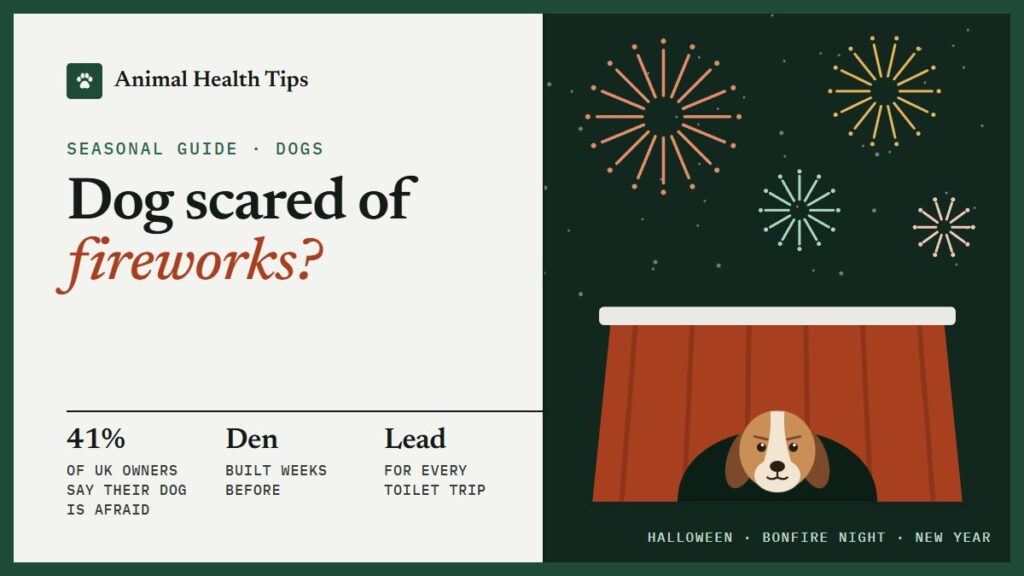
For a lot of dogs, the run from Halloween through Bonfire Night, Diwali and New Year is the hardest time of the year. In a PDSA survey, 41% of UK dog owners said their dog is afraid of fireworks. That is about 4.1 million dogs. The good news is that a little planning makes a real difference, and most of it costs nothing.
In this guide7 sections
Why are dogs so scared of fireworks?
Fireworks are loud, sudden and unpredictable, and they come with bright flashes. A dog cannot understand that the bangs are not a threat. Their hearing is also much sharper than ours, so they experience fireworks far more intensely than we do.
Signs your dog is frightened
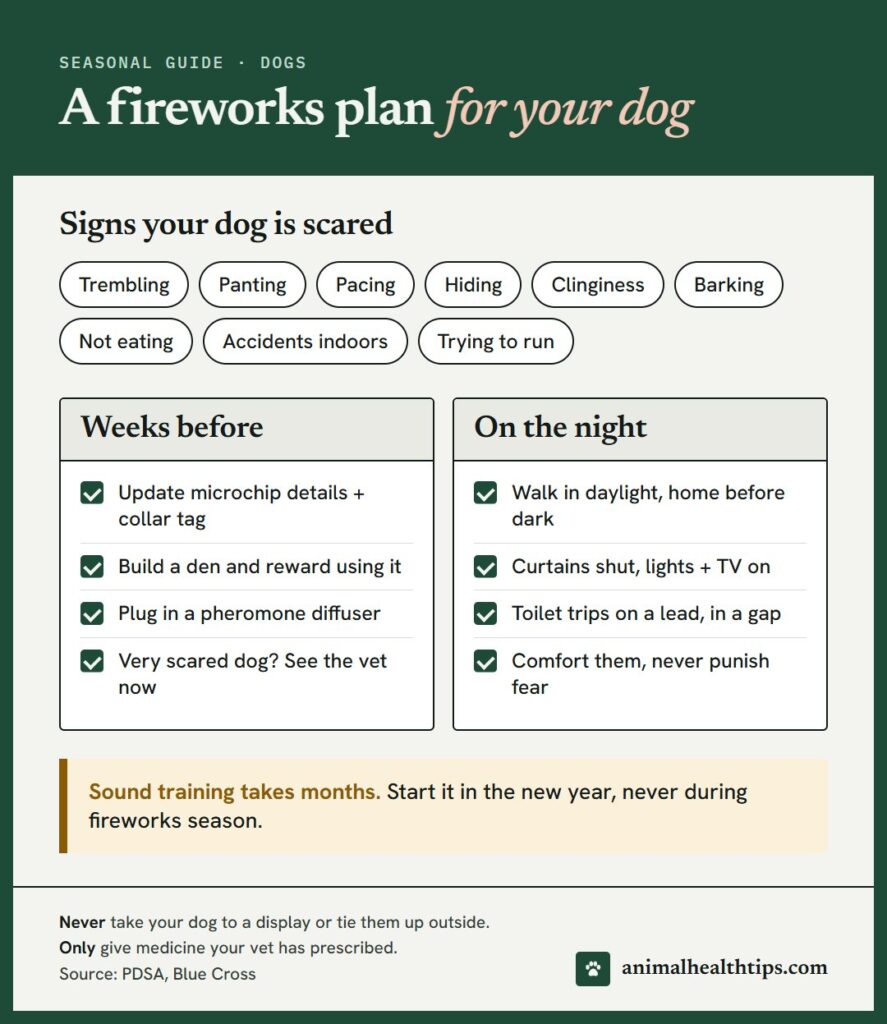
Some dogs make their fear obvious. Others show only small changes, so it helps to know what to look for:
- Trembling, shaking or panting
- Barking, whining or pacing
- Cowering, hiding behind furniture, or putting their tail between their legs
- Being clingy, or trying to run away
- Chewing furniture or having accidents in the house
- Refusing food
- Small changes from their normal behaviour, which is all some dogs show
In the weeks before: what to set up now
- Check your dog’s microchip details are up to date, and make sure they wear a collar and tag with a readable phone number, even indoors. Frightened dogs do bolt, and this is what gets them home.
- Find out the dates of displays near you, so the big nights don’t take you by surprise.
- Build a den (see below) a few weeks ahead, so your dog already sees it as a nice place.
- Try a pheromone diffuser. PDSA suggests plugging it in a few weeks before the season and keeping it topped up until the season ends.
- Get them used to background music or TV at a comfortable volume, so it feels normal on the night.
- Talk to your vet now if your dog is very frightened. They may be able to prescribe medication, but it takes time to find the right one, so don’t leave it until the week of the fireworks.
How to make a firework den
- Choose a spot your dog already goes to when worried: behind the sofa, under a table, in a crate, or in a large, safe, empty cupboard.
- Drape blankets over it to make it as enclosed as possible, and put their bed or plenty of cushions inside.
- Add a favourite toy and some treats, and an item of your clothing, which can help them settle.
- Keep a bowl of water close by. Worried dogs often drink more.
- Let them use it whenever they like, but never force them in, shut them inside, or pull them out.
Don’t worry if your dog ignores the den and chooses somewhere else to hide. That’s fine. Let them stay wherever they feel safe.
On the night: a calm plan
- Walk your dog while it’s still light and be home well before dark. A longer walk with plenty of sniffing helps them relax later.
- Close the curtains and switch the lights on before dark, to hide the flashes.
- Put the TV or music on to muffle the bangs, at a volume your dog is comfortable with. Deep bass can help cover the booms.
- Keep your usual routine and act normally. A chew or a food-stuffed toy can help distract them.
- Comfort them if they come to you. It’s fine to cuddle and stroke a scared dog. If they would rather hide alone, let them.
- For toilet breaks, wait for a gap in the fireworks, keep your dog on a lead, go out with them and be quick. Never leave them alone in the garden.
- Never tie your dog up outside a shop, or leave them in the car, while fireworks might go off.
- Never shout at or punish a scared dog, even if they chew something or have an accident. It makes the fear worse.
Speak to your vet if
- You have tried these steps and your dog is still very frightened
- Your dog has suddenly become afraid of fireworks when they weren’t before, because pain or illness can be the cause
- You are thinking about calming medication. Never give your dog any medicine your vet hasn’t prescribed.
Can you train a dog not to fear fireworks?
Often, yes, but not quickly. The method is called desensitisation: you play firework sounds at a very low volume and raise it gradually over many sessions, stopping whenever your dog reacts. Then comes counterconditioning, where the sound is paired with a treat until it starts to mean something good.
This takes months. Blue Cross advises starting three to six months before the season and never starting during it, because training while real fireworks are going off can make things worse. If your dog struggles this year, use the plan above for now, then start the training in the new year with help from your vet or an accredited behaviourist.
Watch for small signs of worry during sessions, such as looking at the speaker, twitching ears, lip licking, yawning repeatedly or moving away. If you see any of them, the volume is too high.
Key takeaways
- Update microchip details and build a den now, weeks before the big nights.
- On the night: daylight walk, curtains closed, lights and TV on, and a lead for every toilet trip.
- Comfort your dog if they want it; never punish fear.
- Very frightened dogs should see a vet well before the season.
Frequently asked questions
Should I comfort my dog during fireworks?
Yes, if they come to you for it. Cuddling and stroking a frightened dog is fine and won’t make the fear worse. Stay calm and act normally, and if your dog would rather hide alone, let them.
Can I take my dog to a fireworks display?
No. Even dogs that are fine with crowds can panic and try to run once the fireworks start. Leave your dog at home, indoors, with someone they know if possible.
Can I give my dog something to calm them down?
Only medicine your vet has prescribed. Your vet can talk you through options, but speak to them weeks before the season so there is time to find what suits your dog. Pheromone diffusers and calming supplements are other options to discuss.
How long before fireworks season should I start preparing?
Den, microchip check and diffuser: a few weeks before. Sound training: several months before, as Blue Cross says three to six months, and never during the season itself.
Will a puppy born in autumn be fine with fireworks?
Not automatically. Puppies are most open to new experiences between about 4 and 12 weeks old, but if their first experience of fireworks is frightening, they can still develop a fear. Introduce the sounds slowly and gently.
My dog ran off during fireworks. What should I do?
Contact your microchip database, local vets, dog wardens and nearby rescue centres straight away, and share a photo locally. This is why up-to-date microchip details and a collar tag matter so much.
Sources
- PDSA — Dogs and fireworks
- Blue Cross — Dogs and fireworks
This guide is general information, not a diagnosis. If you are worried about your dog, contact your vet.