The bangs start, the door is open for a second, and your dog is gone. It happens every fireworks season, and it happens to careful owners: a frightened dog does not think about roads, fences or how far it has run. It just runs. Bonfire Night is on Thursday 5 November, and fireworks are already going off in the days around it, so this is the week to have a plan — both for the night your dog bolts, and for making sure it does not happen again.
In this guide7 sections
The good news is that most of the recovery plan is a list of phone calls and places, and it works best when done in the first hour. This guide follows Dogs Trust’s lost-dog guidance, with prevention advice from Blue Cross and the RSPCA and the UK microchip and fireworks rules from GOV.UK. For the plan for the noise itself, see our guide to keeping a dog calm during fireworks, and for the wider hazards of the night, see our guide to dogs and Bonfire Night.
Act in the first hour if
- Your dog has bolted during fireworks and is not back within minutes
- Your dog could be on or near a road, or in an unfamiliar area
- Your dog is elderly, unwell, on medication, or a puppy
- You are not sure your microchip details are up to date
Why dogs bolt during fireworks
Loud or unexpected noises, like fireworks, can be really scary for dogs, Dogs Trust notes, and almost half of owners say their dog reacts to loud noises with signs of fear and anxiety. Dogs Trust lists pulling or running away among the ways a dog may respond to fireworks and loud noises, alongside hiding, pacing, panting, drooling and holding the tail down between the legs. The RSPCA describes the extreme end of the same response: many animals find fireworks scary, and owners will often see pets either frozen with fear or, in the most dangerous circumstances, bolting, rearing up or charging fences.
Blue Cross adds a reason that is easy to overlook: animals have very acute hearing, and loud bangs and whistles may cause them actual pain in their ears. A dog in pain or panic is not choosing to disobey. Blue Cross warns that even if a dog is comfortable with crowds and noise, once fireworks start there is a high risk that they may panic and try to flee — which is why you should never take a dog to a fireworks display. Do not blame the dog, and do not blame yourself for a single open gate: focus on the search, and fix the escape route afterwards.
The first hour: what to do now
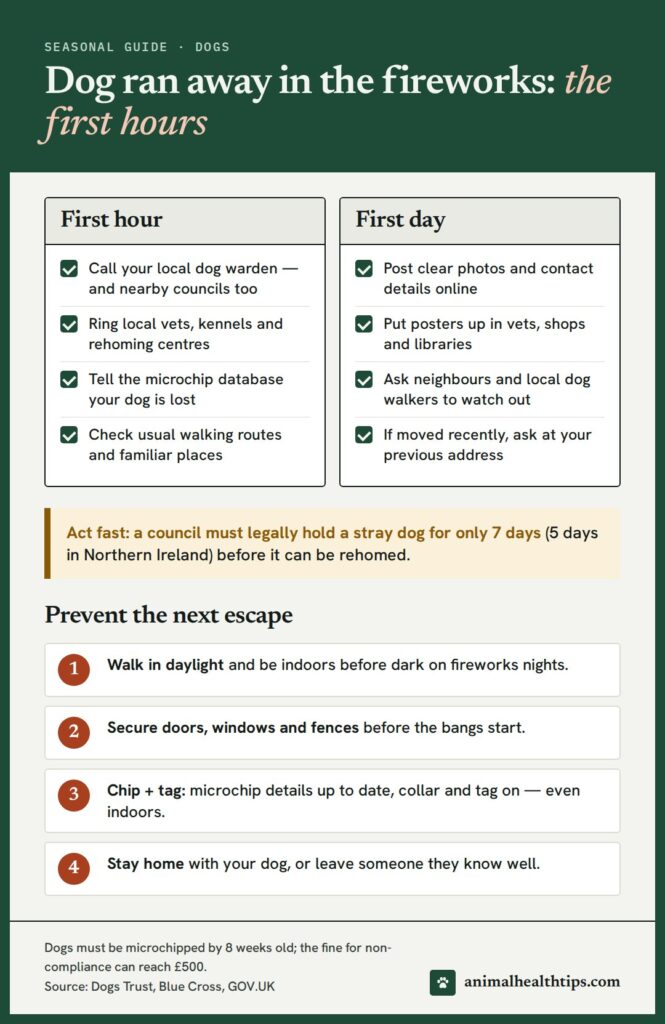
- Call your local authority dog warden first. The dog or animal warden for your local council is legally responsible for stray dogs and is most likely to have picked up a dog found wandering the street, Dogs Trust notes. Contact surrounding local authority areas too, as dogs can travel quite a long way.
- Call local kennels, rehoming centres and vets. A member of the public may have handed your dog to local kennels, the council or a vet practice, or contacted a rehoming centre such as Dogs Trust, the RSPCA, Blue Cross or Battersea. Contact all of them in your area and surrounding areas, and ask vet practices if you can put a lost-dog poster up in the surgery.
- Tell your microchip database your dog is lost. The database can notify you if someone tries to change your dog’s chip details, Dogs Trust notes, and it is also important to notify the database when your dog is found.
- Check the places your dog knows. Visit the places where you usually walk your dog: they may have decided to walk themselves and could be sticking to familiar places. If you have moved house recently, ask around at your previous address, and tell neighbours how to contact you if they spot your dog.
- Post online straight away. Social media is free and can be very effective, Dogs Trust notes: post clear photos, descriptions and your contact details, use Facebook groups devoted to helping lost dogs be reunited, and search for found dogs that could be yours.
Why speed matters: the seven-day rule
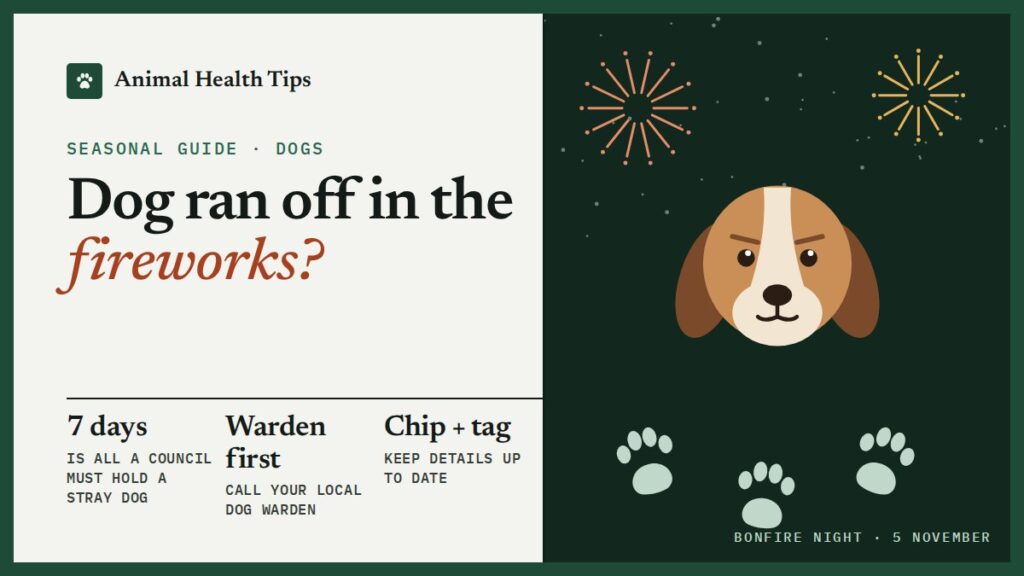
This is the fact that turns a lost dog from worrying into urgent. The council must legally hold on to a stray dog for only seven days — five days in Northern Ireland — before they can rehome the dog, pass it to a rehoming organisation or have it humanely put to sleep, Dogs Trust states. That is why the warden call comes first, and why surrounding councils matter: a dog that has run for an hour may already be in the next authority’s area.
It is also why your microchip details matter so much. If the finder or the warden scans a chip with an old phone number or an old address, the reunion stalls. GOV.UK states that the owner is responsible for keeping the pet’s microchip information up to date, for example if they move house, and that you should contact the database company your dog is registered with to update details. If you do not have the microchip number, GOV.UK adds, you can ask a vet, a dog warden or a rescue centre to scan the dog for it. Check the number now, before the next fireworks night, not during it.
The first day: widening the search
If the first hour brings no news, widen the net rather than repeating the same calls. Ask local supermarkets, shops, libraries and newsagents if you can put a lost-dog poster on their noticeboard, Dogs Trust advises, and contact local dog walkers in your area and ask them to keep an eye out. If there are building sites or workers in your area, ask around in case your dog has become trapped somewhere on site. If you live within the M25, Dogs Trust notes you can also try the Battersea Lost Dogs and Cats Line. Keep the poster simple: a clear photo, a description, where and when the dog was last seen, and a phone number that will be answered.
If you think your dog has been stolen, call the police, Dogs Trust advises. Keep calling the warden and the database back: a dog handed in a day later still needs your details to be current and your phone to be on.
| Who to contact | Why | When |
|---|---|---|
| Local authority dog warden | Legally responsible for stray dogs | First, plus surrounding areas |
| Local vets, kennels, rehoming centres | Finders hand dogs in here | First hour |
| Microchip database | Flags the chip; alerts on detail changes | First hour; again when found |
| Local dog walkers and neighbours | Eyes on usual routes | First day |
| Shops, libraries, noticeboards | Poster coverage | First day |
| Social media lost-dog groups | Photos reach many people fast | First hour, then updates |
| Police | If you think the dog was stolen | As soon as you suspect it |
Microchip and collar tag: what the law requires
GOV.UK states that all dogs in the UK must be microchipped and registered by the time they are 8 weeks old, and that the owner can be fined up to £500 if the dog is not microchipped when it needs to be, or not registered on a government-standard database. A microchip is not a tracker: it only helps if someone scans the dog and your details are current. That is the single most useful check you can do before Bonfire Night.
The collar tag matters just as much, and it is a separate legal duty. GOV.UK states that if you have a dog, it must still wear a collar and tag with your name and address when in a public place, even though it is microchipped. Blue Cross goes further for fireworks season: make sure the dog is wearing a collar and tag, even indoors, in case of an escape, and that a phone number is easily readable for a quicker reunion. A tag lets a finder call you directly, without waiting for a scan.
Preventing the next escape
- Walk in daylight and be indoors before dark. Dogs Trust advises planning walks so the dog is indoors before dark when fireworks are likely, and Blue Cross advises timing walks earlier in the day before fireworks start, and keeping the dog on-lead if fireworks may be let off.
- Secure the house and garden before the bangs. Dogs Trust warns that your dog could try to run away if scared, so check your doors, windows and fences are secure. Blue Cross adds: close all windows and doors and block off cat flaps to stop pets escaping and to keep noise to a minimum.
- Be at home, or leave someone familiar. On key fireworks dates such as Bonfire Night and Diwali, Dogs Trust advises making sure the owner or someone the dog knows well will be at home with them. Never tie a dog up outside while fireworks are being let off, Blue Cross warns, and do not leave a dog in the garden or alone in the car.
- Make a safe space in advance. Give your dog its own safe space, a snug, comfy space it can retreat to if scared, introduced ahead of fireworks so it learns it is a positive place to be, Dogs Trust advises. Blue Cross adds: let the pet pace, whine or hide if it wants to, and do not try to coax it out — it is trying to find safety.
- Stay calm and act normally. Blue Cross advises staying calm, cuddling and stroking the pet if it helps them relax, but letting them hide if they prefer, and never shouting at a frightened pet. If your dog shows signs of fireworks fear, Dogs Trust advises seeing a vet as soon as possible: the vet can check for medical problems adding to the fear and may refer you to a clinical behaviourist.
- Know the fireworks hours, but do not rely on them. GOV.UK states no fireworks between 11pm and 7am, except midnight on Bonfire Night and 1am on New Year’s Eve, Diwali and Chinese New Year. Fireworks still go off outside those hours, so plan for the whole evening.
Key takeaways
- A frightened dog bolts: loud bangs can be painful to acute dog hearing, and running away is a fear response.
- Call the dog warden first, then local vets and kennels, and tell the microchip database — in the first hour.
- A council must legally hold a stray dog for only seven days, so speed and surrounding councils matter.
- Microchip by 8 weeks old, details kept up to date, and a collar tag with name and address even indoors.
- Prevent the next escape: daylight walks, secure doors and fences, indoors before dark, someone familiar at home.
Frequently asked questions
My dog ran away during fireworks. Who do I call first?
Your local authority dog warden, Dogs Trust advises: the warden is legally responsible for stray dogs and is most likely to have picked up a dog found wandering the street. Contact surrounding local authority areas too, as dogs can travel quite a long way, then call local vets, kennels and rehoming centres.
How long will the council keep a stray dog?
The council must legally hold on to a stray dog for only seven days, Dogs Trust states — five days in Northern Ireland — before it can rehome the dog, pass it to a rehoming organisation or have it humanely put to sleep. That is why the first-hour calls matter so much.
Should I tell the microchip company my dog is lost?
Yes, straight away. Dogs Trust advises contacting your microchip database to tell them your dog is lost: they can notify you if someone tries to change the chip details. Notify the database again when your dog is found, and keep the details up to date if you move house.
Does my dog still need a collar tag if it is microchipped?
Yes. GOV.UK states a dog must still wear a collar and tag with your name and address when in a public place, even though it is microchipped. Blue Cross advises a collar and tag even indoors during fireworks season, with a phone number easily readable for a quicker reunion.
What time must fireworks stop on Bonfire Night?
Midnight, according to GOV.UK. The general rule is no fireworks between 11pm and 7am, with midnight as the Bonfire Night exception and 1am on New Year’s Eve, Diwali and Chinese New Year. Plan for the whole evening anyway, as displays are not limited to one night.
How do I stop my dog bolting next time?
Walk in daylight, be indoors before dark, secure doors, windows and fences, and stay home with your dog or leave someone they know well. Make a safe space in advance, keep the dog on-lead for toilet trips if fireworks may be let off, and never tie a dog up outside or leave it in the garden or car during fireworks.
Sources
- Dogs Trust — What to do if you’ve lost your dog
- Dogs Trust — Fireworks are coming, prepare ahead
- Blue Cross — Dogs and fireworks
- Blue Cross — Fireworks and pets
- RSPCA — Pets and fireworks
- GOV.UK — Get your dog or cat microchipped
- GOV.UK — Fireworks: the law
This guide is general information, not a diagnosis. If you are worried about your pet, contact your vet.