Brussels sprouts are on many Thanksgiving tables in the United States — Thanksgiving falls on 26 November this year — and a dog that begs at the table may get offered one. The short answer is yes, but only plain, cooked and in small amounts: a sprout or two, steamed and unseasoned. The sprouts on the table are usually cooked with butter, salt or onion, and those extras are the real problem.
In this guide7 sections
Call your vet now if your dog ate sprouts cooked with onion or garlic
- Note how much was eaten and what was in the dish.
- Do not wait for symptoms: onion and garlic can damage red blood cells.
- Never try to make your dog vomit at home. Only a vet should decide that.
- UK: Animal PoisonLine, 01202 509000 — open 24 hours, run by the Veterinary Poisons Information Service; a fee applies.
- US: ASPCA Animal Poison Control, (888) 426-4435 — open 24 hours; a consultation fee applies.
Can dogs eat Brussels sprouts?
Yes — plain, cooked Brussels sprouts are safe for dogs in moderation. The AKC’s answer is direct: yes, with a few precautions — the vegetable has no toxins or poisons for dogs, and a temporary stomach upset or flatulence is no immediate cause for alarm. PDSA lists sprouts as dog-friendly, steamed or boiled, only in very small quantities, and Blue Cross agrees that a little is safe for a healthy dog that is not allergic.
They are a genuinely nutritious vegetable: the AKC says they are loaded with vitamins, fibre and antioxidants — vitamin K, which helps blood clot properly, builds bones and protects the heart, plus vitamins C, A, B1 and B6. USDA food data puts cooked sprouts at about 36 calories per 100 g, with about 2.6 g of fibre, 62 mg of vitamin C and 140.3 mcg of vitamin K; one sprout is about 21 g, or about 8 calories.
That does not make them a food a dog needs: PDSA says dogs do not need fruit or vegetables, but can have a small amount as an occasional treat, in bite-sized pieces, with no oil, butter, salt or flavourings. Sprouts are a treat, not a meal.
Why do Brussels sprouts make dogs gassy?
This is the best-known downside, and the AKC does not soften it: gas, lots and lots of gas. Sprouts contain a high level of isothiocyanate, which speeds the intestinal muscles that push food and waste through the gut, building up gas. A moderate amount, the AKC says, clears the pipes; too much can cause stomach upset and diarrhoea, and even small amounts can cause flatulence.
Fibre adds to the same effect: VCA explains that gut bacteria ferment carbohydrates and certain fibres, and that fibre may play a significant role in excessive flatulence. Belching, rumbling and flatus can occur normally, VCA says, but if they become excessive there may be an underlying issue — and gas with weight loss or diarrhoea warrants a vet visit.
The gas itself is not dangerous — the AKC says there is no immediate cause for alarm — but it is why the serving stays tiny, and why you should consult your vet if symptoms last longer than a few days.
| On the table | What’s in it | Safe for a dog? |
|---|---|---|
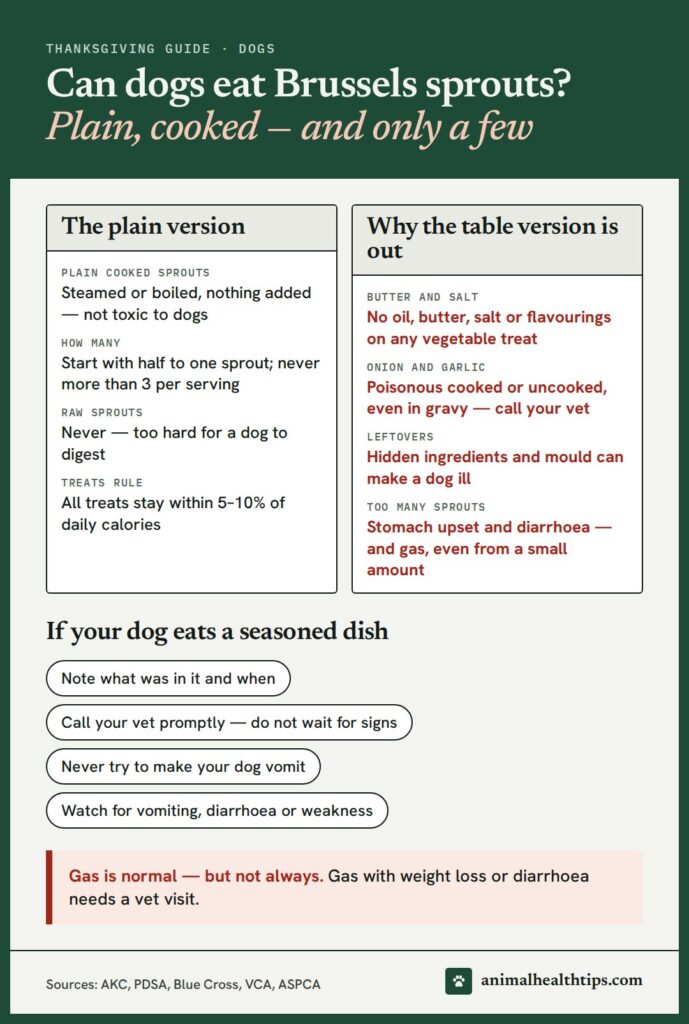
| Plain steamed sprouts | Cooked sprouts, nothing added | Yes — half to one first, max 3 |
| Raw sprouts | Hard, uncooked vegetable | No — too hard to digest |
| Sprouts with butter and salt | Fat, salt and seasoning | No — no oil, butter, salt or flavourings |
| Sprouts with onion or garlic | Alliums, poisonous cooked or raw | No — call your vet |
| Leftover sprouts | Hidden ingredients, possible mould | No — leftovers can make a dog ill |
How many Brussels sprouts can a dog have?
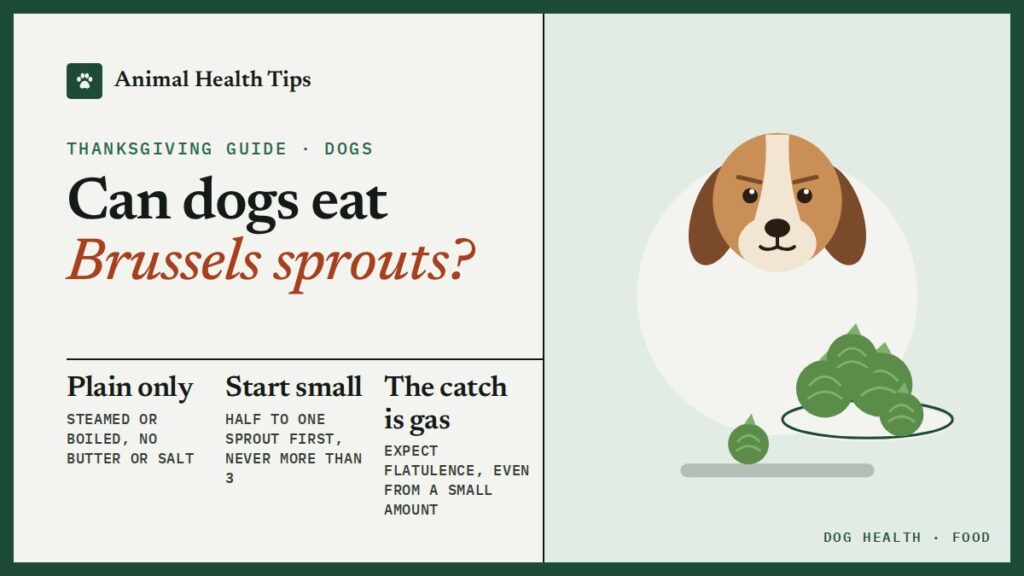
The AKC gives a specific answer, and it is small: start with half to one sprout, depending on your dog’s size, and once that goes well, offer no more than three per serving, from time to time. PDSA gives the same rule in general terms — only in very small quantities. No approved source gives a number of sprouts per day, so this article gives none.
The wider treats rule still applies: the ASPCA says treats should not make up more than 5 to 10 percent of a pet’s daily calories. Three sprouts are few calories, but they sit alongside every other treat — so a sprout is an occasional extra, not a daily habit.
One more check comes first: the AKC says that if your dog has any dietary issues or allergies, do not feed Brussels sprouts without first consulting your veterinarian.
How to serve Brussels sprouts to a dog
- Wash them thoroughly, cut off most of the stem and leave the leaves intact. Start with sprouts that are green and firm.
- Steam, boil or microwave them. Steaming preserves the most nutrients: steam for five minutes, microwave in water for up to eight minutes, or boil for about 10 minutes.
- Cut them into bite-sized pieces. PDSA says every fruit and vegetable treat must be in bite-sized pieces.
- Skip the herbs and spices. The AKC is direct: serve them plain, with no seasoning at all.
- Never serve them raw. Raw sprouts are too hard for a dog to digest.
- Set the dog’s portion aside before seasoning. Once butter, salt or onion goes in, the dish is no longer for the dog.
The same plain-only rule runs through the rest of the table: our guides to whether dogs can eat turkey, whether dogs can eat green beans and whether dogs can eat mashed potatoes all follow it.
What about the sprouts on the Thanksgiving table?
The sprouts on the table are rarely plain: the usual recipe adds butter and salt, and PDSA’s rule covers that directly — no oil, butter, salt or flavourings on any vegetable treat. The ASPCA adds that large amounts of salt can cause sodium ion poisoning: vomiting, diarrhoea, depression, tremors, seizures and even death.
Onion and garlic are the more serious extras: Blue Cross says onions — and garlic, leeks, shallots and chives — are poisonous to dogs whether cooked or uncooked, even in gravy. PDSA says they can cause severe, life-threatening anaemia, and the ASPCA says they can cause gastrointestinal irritation and red blood cell damage. A sprout dish cooked with onion or garlic is not a treat — it is a call to the vet.
Leftovers are the third risk: Blue Cross says not to give dogs leftover festive food, which can include hidden toxic ingredients, and mould in leftovers can make them ill. Keep the sprouts in a container the dog cannot reach, and tell your guests that nothing from a plate is for the dog.
What should I do if my dog eats too many sprouts?
- Work out what was in them: plain or seasoned, how many were eaten, and when.
- Call your vet at once if the dish had onion or garlic, or if your dog ate a large amount. Do not wait for symptoms.
- Never try to make your dog vomit at home. Only a vet should decide that.
- Watch for warning signs: vomiting, diarrhoea, weakness and pale gums can point to red blood cell damage, while gas with weight loss or diarrhoea warrants a vet visit.
- Call your vet if symptoms last longer than a few days. A short bout of gas is expected.
For the rest of the table, the same check applies — see our guide to whether dogs can eat gravy.
Key takeaways
- Plain, cooked Brussels sprouts are safe for dogs — but only in small amounts.
- Start with half to one sprout; never more than three per serving.
- The catch is gas: isothiocyanate speeds the gut, so expect flatulence even from a small amount.
- Never serve sprouts raw, and never with butter, salt, onion or garlic.
- Gas with weight loss or diarrhoea, or symptoms lasting more than a few days, needs a vet visit.
Frequently asked questions
Can dogs eat Brussels sprouts?
Yes, plain cooked Brussels sprouts are safe for dogs in small amounts: start with half to one sprout, never more than three per serving. They are not toxic, but they cause gas — even a small amount can lead to flatulence.
Why do Brussels sprouts make dogs gassy?
Sprouts contain a high level of isothiocyanate, which speeds food and waste through the gut and builds up gas, and fibre fermented by gut bacteria adds to it. The gas itself is not dangerous, but too many sprouts can cause stomach upset and diarrhoea.
How many Brussels sprouts can a dog eat?
The AKC says to start with half to one sprout and offer no more than three per serving, from time to time. No approved source gives a daily number, so this article gives none. Keep all treats within 5 to 10 percent of daily calories.
Can dogs eat raw Brussels sprouts?
No. Raw sprouts are too hard for a dog to digest. Steam them for five minutes, microwave them in water for up to eight minutes, or boil them for about 10 minutes — and serve them plain, with no herbs, spices, butter or salt.
What should I do if my dog eats sprouts with onion or garlic?
Note how much was eaten and when, then call your vet right away. Do not wait for symptoms, and never try to make your dog vomit at home.
Sources
- American Kennel Club — Can Dogs Eat Brussels Sprouts?
- PDSA — Safe Fruit and Veg for Dogs
- Blue Cross — Christmas Dangers for Dogs
- VCA Animal Hospitals — Dogs and Gas
- ASPCA — People Foods to Avoid Feeding Your Pets
This guide is general information, not a diagnosis. If you are worried about your pet, contact your vet.