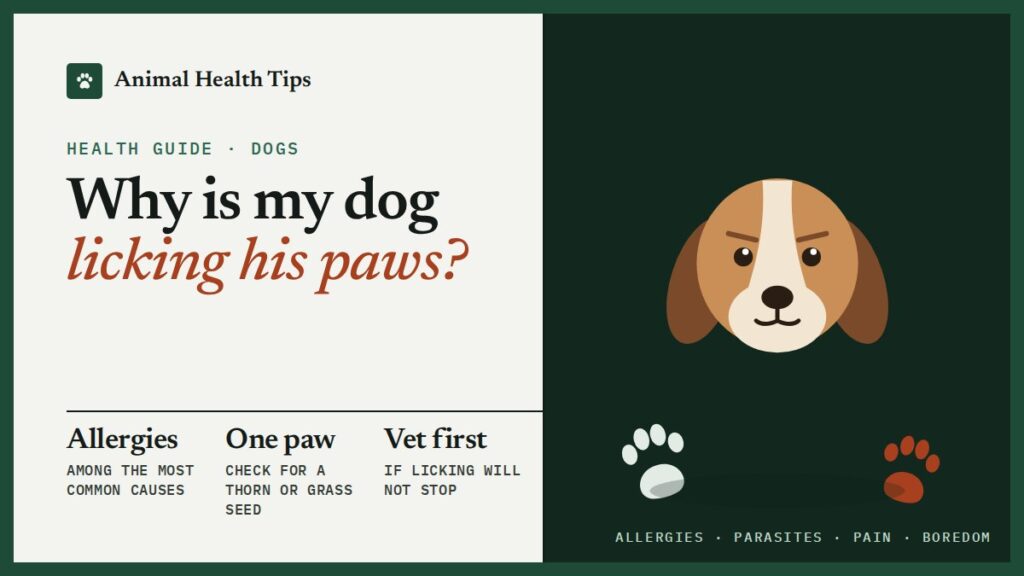
A dog that licks its paws now and then is simply grooming. A dog that licks constantly, chews at its feet, or suddenly starts licking when it never did before is telling you something. The AKC draws that line clearly: occasional paw licking is normal grooming behaviour, but when licking becomes excessive or persistent it often signals an underlying problem.
In this guide7 sections
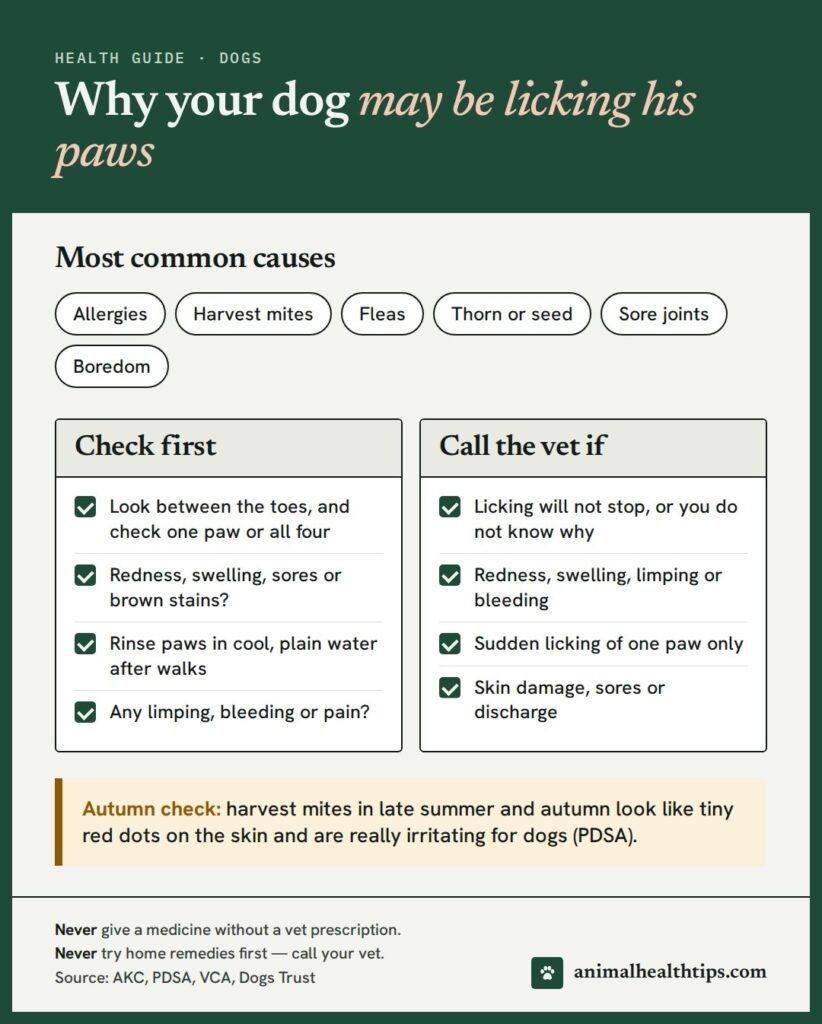
The problem can be in the skin, in the paw itself, or in the dog’s state of mind, and the pattern is your best clue. Allergies are among the most common causes, and this time of year has one seasonal suspect of its own: PDSA notes that parasites like harvest mites could be the problem if paw licking is happening in late summer or autumn, when the larvae look like tiny red dots on the skin and are really irritating for dogs. If your dog’s licking has started or worsened on autumn walks, start there — with your vet, not with a home remedy.
Call your vet if
- The licking is persistent, intense, or suddenly much worse
- There is redness, swelling, limping, bleeding, sores or discharge
- Only one paw is affected, or your dog is in pain when walking
- The skin is damaged, hair is lost, or the paws smell unusual
What counts as excessive licking?
Think in terms of change and damage, not minutes. A brief lick after a walk is grooming. Licking for long stretches, returning to the paws again and again, or licking hard enough to redden the skin, lose hair or cause sores has crossed into excessive territory. The AKC lists persistent licking and chewing of the paws as the most common sign of paw inflammation, often indicating itchiness, irritation or discomfort.
Paw inflammation is called pododermatitis, a broad term the AKC uses for inflammation of the paw skin. It can affect one or more paws, and part of a paw or the entire foot. Early inflammation can be missed, the AKC warns, because owners may not think to separate and look between the toes; left alone, it can worsen to bleeding, ulcerated, crusty, cracking and swollen paws, and pain when walking. Other signs alongside the licking can include hair loss, brown saliva stains, thickened skin or pads, scaling, lameness, poor appetite and lethargy. Any one of these, plus persistent licking, is enough reason to call your vet.
Allergies: the most common cause
Allergies are among the most common causes of paw inflammation, according to the AKC, and they come in more than one form. Environmental allergies, known as atopy, involve allergens such as pollen from trees, grasses and weeds, as well as moulds and dust mites. VCA Canada notes that dogs with atopy are often allergic to the same allergens that tend to affect humans, but while those cause watery eyes and a runny nose in people, dogs often develop skin inflammation instead. Food allergies are another form: VCA notes that in dogs the signs are usually itchy skin, paws or ears, or digestive disturbances such as vomiting or diarrhoea.
PDSA makes a point that surprises many owners: a skin allergy can cause a reaction even if the dog’s paws have not actually touched whatever it is allergic to. Sometimes, though, the dog will react to something its paws have come into contact with, which is why PDSA advises rinsing paws in cool, plain water after every walk if a dog is nibbling excessively. Do not assume the cause is allergies, and do not try to treat it yourself: PDSA warns against home remedies or medication without a prescription, as this can be dangerous in the wrong doses or for certain species. A vet will usually work through a step-by-step evaluation, the AKC notes, starting with when the problem began and whether it started in one or several paws.
Parasites: harvest mites, fleas and other mites
Autumn is the season for one particular parasite. PDSA states that harvest mites could be the problem if paw licking is happening in late summer or autumn, because the larvae look like tiny red dots on the skin and are really irritating for dogs. If your dog has been walking through long grass or vegetation and is now licking its paws, look closely for those tiny red dots, and tell your vet what you find. Other mites can also make a dog really itchy, PDSA notes, including Sarcoptes, which causes mange, and Demodex.
Fleas are the most common cause of making dogs itch in general, PDSA adds, although they do not often live on the feet: if a dog is not able to scratch the fleas, it might start licking its paws instead as a distraction. Infection often follows itching: the AKC explains that secondary infections commonly develop because inflamed paws create an environment that allows bacteria or yeast to thrive, and frequent licking further damages the skin barrier. Licking does not just signal the problem; it can make it worse, which is another reason not to wait. For a different paw irritant that matters as the weather turns colder, see our guide to road salt and grit on dogs’ paws.
Injury, pain and the one-paw clue
When only one paw is affected, vets may be especially suspicious of a foreign-body injury. The AKC notes that single-paw cases may be investigated for foreign bodies such as splinters, grass awns or glass, and lists foxtail grass seed heads among the primary causes of paw inflammation. A grass seed head picked up on an autumn walk, a splinter from a stick, or a small cut can all drive a dog to lick one foot obsessively while the others are untouched.
Pain elsewhere can show up in the paws too. PDSA notes that sometimes dogs will lick their feet or joints because they are stiff and sore, just as a person might rub a sore patch. Dogs Trust adds that pain, injuries and allergies can all be behind destructive behaviour, and that chewing and licking can be stress-relieving when a dog is ill or in pain. Check the paws yourself, gently, before the appointment: separate the toes, look between them, and check the pads for cuts or swelling. Do not pull out anything embedded, and do not try to treat a wound yourself.
Anxiety, boredom and habit
Not every paw licker is itchy. PDSA notes that boredom and stress can cause a dog to lick and bite its front paws out of frustration, which can then become habit, and that some dogs chew or lick their feet due to anxiety because it makes them feel better. In some cases the licking may have started because the paws were itchy, and because it made the dog feel better, it has continued even when the itch is gone. That kind of habit can be hard to break, PDSA warns, and it is worth seeking advice from your vet or a behaviourist.
Dogs Trust makes the same connection: when a dog is stressed, it seeks ways to relieve stress and relax, and chewing and licking are known to be self-soothing. If a dog only shows the behaviour when left alone, Dogs Trust adds, this is likely separation-related behaviour caused by fear, frustration or boredom, and a vet should give a thorough health check. If boredom is the driver, PDSA suggests an interactive toy such as a destruction box, puzzle feeders, and possibly a few extra walks or more playtime in the garden. Those steps help a bored dog, but they are not a substitute for a vet check.
What to do, and when to call the vet
- Contact your vet first. PDSA puts this first: so many things could be causing the licking, and a call to the vet should be first on your list.
- Check the paws, including between the toes. Note which paws are affected, and whether there is redness, swelling, sores, hair loss or brown staining.
- Rinse paws in cool, plain water after every walk, as PDSA advises, and wipe paws and muzzle after walks to remove pollen.
- Wash bedding weekly, so your dog does not end up covered in pollen again after every sleep, as PDSA’s pollen advice notes.
- Keep up flea control and watch for harvest mites — tiny red dots on the skin in late summer and autumn.
- Do not give medication or try home remedies without a vet prescription.
- Offer enrichment if boredom is part of the picture: puzzle feeders, interactive toys, extra walks and playtime.
| Clue | What it may point to |
|---|---|
| All four paws, itchy skin elsewhere | Environmental or food allergy |
| Licking worse in late summer or autumn | Harvest mites — tiny red dots on the skin |
| Only one paw affected | Thorn, grass seed head, glass or another injury |
| Licking a foot or joint that is stiff | Pain or soreness in that area |
| Licking mainly when left alone | Separation-related anxiety or boredom |
| Red, swollen, sore or damaged skin | Inflammation, possibly with secondary infection |
The AKC’s advice is worth keeping in full: contact the veterinarian promptly if a dog suddenly begins excessive licking or chewing of the paws, or if there is redness, swelling, limping, bleeding or signs of pain, because early treatment may help prevent chronic complications. Getting help early makes paw nibbling easier to fix, as PDSA puts it. For more on keeping paws comfortable as the seasons change, see our guide to how cold is too cold for dogs.
Key takeaways
- Occasional licking is normal grooming; persistent, intense or sudden licking is a reason to call your vet.
- Allergies are among the most common causes, and harvest mites are a real autumn suspect.
- One affected paw points more to a thorn, grass seed or injury than to an allergy.
- Licking damages the skin barrier and lets bacteria and yeast thrive, so waiting can make it worse.
- Never give medication or try home remedies without a vet prescription.
Frequently asked questions
Why is my dog licking his paws all the time?
Persistent licking usually signals an underlying problem. The AKC lists allergies, foreign bodies, parasites, infection, pain and behavioural causes among the possibilities. Contact your vet first, so the cause can be worked out step by step.
Is paw licking worse in autumn?
One autumn cause is verified: PDSA notes harvest mites could be the problem if licking is happening in late summer or autumn, when the larvae look like tiny red dots. No measured autumn increase in paw licking was verified for this article, so do not assume autumn alone explains it.
What if only one paw is affected?
That points more to a local cause. The AKC notes that when only one paw is affected, vets may be especially suspicious of a foreign body such as a splinter, grass awn or glass. Check gently between the toes, and call your vet promptly, especially if there is limping or bleeding.
Can I rinse my dog’s paws at home?
Yes, as a supportive step. PDSA advises rinsing paws in cool, plain water after every walk when a dog is nibbling excessively. This does not replace a vet visit, and PDSA warns against home remedies or unprescribed medication.
Could my dog be licking from boredom or anxiety?
Yes. PDSA notes boredom and stress can cause licking of the front paws out of frustration, which can become habit, and Dogs Trust notes chewing and licking are self-soothing. Puzzle feeders, interactive toys and extra walks can help, once medical causes are ruled out.
When should I call the vet urgently?
Promptly, if licking suddenly becomes excessive, or if there is redness, swelling, limping, bleeding or signs of pain. The AKC notes early treatment may help prevent chronic complications. Also call if the skin is damaged or your dog seems unwell.
Sources
- PDSA — Vet Q&A: Why is my dog biting/licking their paws?
- AKC — Pododermatitis in dogs
- VCA Canada — Allergies — atopy in dogs
- VCA Animal Hospitals — Food allergies in dogs
- PDSA — Summer allergies: how to protect your pets from pollen
- Dogs Trust — Destructive behaviour
This guide is general information, not a diagnosis. If you are worried about your pet, contact your vet.