Mashed potatoes are on most Thanksgiving tables in the United States — Thanksgiving falls on 26 November this year — and a dog that begs at the table may get offered a spoonful. Plain mashed potatoes are fine in small amounts, but the mash on the table usually is not plain: the butter and cream make it fatty, and many recipes add garlic or onion powder, which can damage a dog’s red blood cells. This guide follows the AKC, PDSA, the ASPCA, VCA Animal Hospitals and the Merck Veterinary Manual.
In this guide7 sections
Call your vet now if your dog ate a seasoned or buttery bowl
- Note how much was eaten, when, and whether the mash contained garlic or onion powder.
- Do not wait for symptoms: red blood cell damage can take three to five days to appear.
- Never try to make your dog vomit at home. Only a vet should decide that.
- UK: Animal PoisonLine, 01202 509000 — open 24 hours, run by the Veterinary Poisons Information Service; a fee applies.
- US: ASPCA Animal Poison Control, (888) 426-4435 — open 24 hours; a consultation fee applies.
Can dogs eat mashed potatoes?
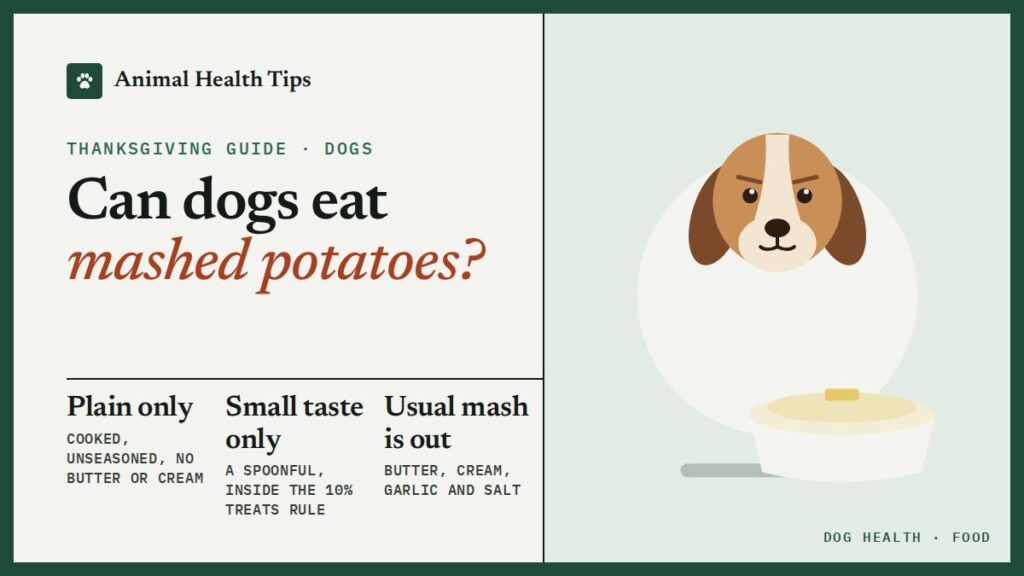
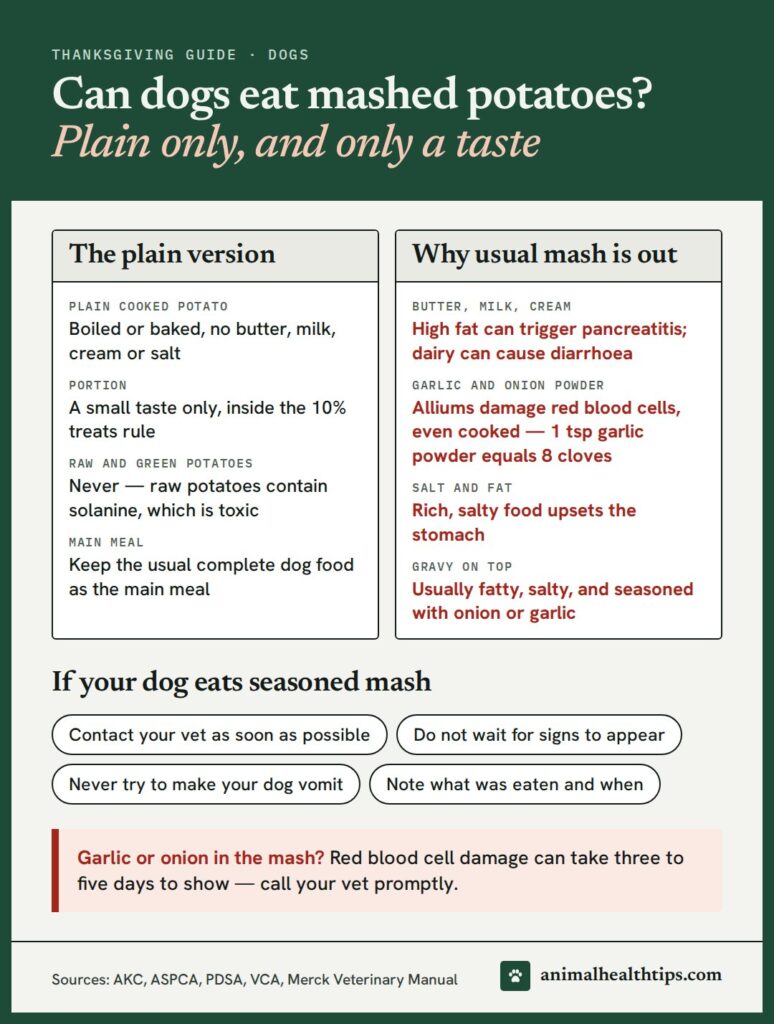
Yes — plain mashed potatoes are fine in small amounts. The AKC quotes vet Dr. Patricia Kennedy: cooked potatoes are fine, but not with tons of butter, which can trigger pancreatitis, and plain mashed potatoes are fine in small amounts without the butter and spices. The AKC’s own answer is the same: safe only when plain, with no butter, milk, salt or seasonings — and only as a treat, never a meal replacement.
PDSA gives the same rule: raw potatoes contain solanine, which is toxic to dogs, so never give them, and cooked potatoes should only ever be given in small quantities, without any oil, butter, salt or seasoning. Remove the skin, which can cause tummy upsets, and feed bite-sized pieces to avoid choking.
One more limit applies to every treat: the World Small Animal Veterinary Association and the American Animal Hospital Association recommend treats stay within 10% of daily energy intake, per a peer-reviewed 2025 paper. A spoonful of plain mash counts inside that limit.
Why is the usual mash a problem for dogs?
Butter and cream are the first problem. The ASPCA says foods high in oils and fats can cause vomiting and diarrhoea, and potentially pancreatitis, and that pets lack significant amounts of lactase, so milk and other dairy products can cause digestive upset. Mashed potatoes from the bowl are mostly butter, milk and cream by the time they reach the table.
Pancreatitis is the serious end of that risk. VCA says it may be triggered by a fatty meal, and its signs are nausea, vomiting, fever, lethargy, abdominal pain, diarrhoea and decreased appetite; during an attack a dog may take a praying position. Severe attacks can cause shock and death — if any of those signs appear, call your vet at once.
Salt is the second problem. The ASPCA says excessive salt intake can cause vomiting, diarrhoea, depression, tremors, seizures and even death, and bouillon cubes used for stocks and gravy contain high amounts of sodium. A salty bowl of mash is not a small extra — it is a rich, salty dish.
| On the table | What’s in it | Safe for a dog? |
|---|---|---|
| Plain mashed potatoes | Cooked potato, nothing added | Yes — a small taste only |
| Mashed potatoes from the bowl | Butter, milk, cream, salt | No — too fatty and salty |
| Mash with garlic or onion powder | Concentrated allium seasoning | No — call your vet |
| Mash with gravy | Extra fat, salt and seasoning | No — extra fat, extra risk |
| Raw or green potatoes | Solanine, a natural toxin | No — never feed raw or green potatoes |
What about garlic and onion powder in the mash?
This is the part of the recipe that can turn a rich dish into a poisoning. Some recipes season the mash with garlic or onion powder — check the label, because ingredients vary. VCA says all forms of onion, garlic, chives and leeks are poisonous to dogs, and garlic is the most toxic. PDSA says they can cause severe, life-threatening anaemia.
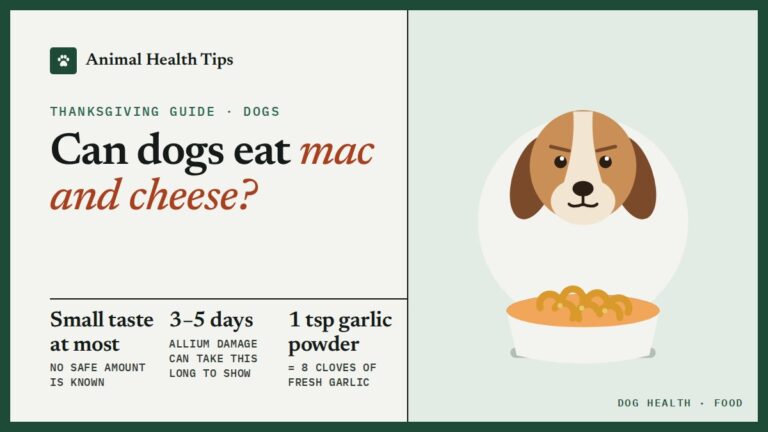
Powdered forms are the most dangerous of all. The Merck Veterinary Manual says toxicosis is most commonly associated with concentrated forms such as dehydrated flakes, powders or dry onion soup mixes, and garlic is three to five times more toxic than onion. VCA explains why: one teaspoon of garlic powder is equivalent to eight cloves of fresh garlic. That is why a seasoned mash is riskier than a plain potato.
The delay is the key point. The Merck Veterinary Manual says damage to red blood cells begins within 24 hours and haemolysis typically occurs three to five days after exposure. A dog that ate seasoned mash and seems fine on the day still needs a vet’s advice — the blood damage is slow, and waiting for it to show is the mistake to avoid.
What about raw and green potatoes?
Raw potatoes are never for dogs: PDSA says they contain solanine, which is toxic, and cooking destroys much of the toxicity — but green potatoes must still be avoided. The AKC says potatoes with green spots should be avoided altogether, as green indicates an increase in solanine, and skins are fine only if cooked and not green. If a dog eats a green potato and shows vomiting, diarrhoea, lethargy or muscle weakness, find a veterinarian immediately. Cooked potatoes must also be cooked sufficiently to be mashed, so the dog does not choke on a piece of raw or half-cooked potato.
What should I do if my dog eats mashed potatoes?
- Work out what was in it: butter, cream, garlic or onion powder, how much was eaten, and when.
- Call your vet at once if it was a whole bowl or a seasoned mash. VCA says to call right away if you suspect any Allium ingestion.
- Do not wait for symptoms. Merck says red blood cell damage can take three to five days to show — so a dog can look fine at first and become ill days later.
- Never try to make your dog vomit at home. Only a vet should decide that.
- Watch for warning signs: vomiting, a sore tummy and loss of appetite can point to pancreatitis; weakness, pale gums and red-coloured urine can point to red blood cell damage.
The same warnings apply to the rest of the table — see our guides to gravy, stuffing, turkey and green beans.
What can I give my dog instead at Thanksgiving?
- A spoonful of plain mashed potato. Set it aside before the butter, milk, salt and seasoning go in.
- Plain cooked turkey meat. Cooked, boneless, skinless and unseasoned — see our guide to whether dogs can eat turkey.
- Plain green beans. The ASPCA suggests a dog’s own Thanksgiving feast of turkey, sweet potatoes and green beans mixed into their usual dinner — see our guide to whether dogs can eat green beans.
- Keep every treat inside the 10% rule. All treats together stay within 10% of daily energy.
- Tell your guests. Make it clear that nothing from a plate is for the dog.
- Clear up as you go. Put the dish and leftovers away promptly, and keep raw and green potatoes out of reach.
Key takeaways
- Plain mashed potatoes are fine in small amounts — but no approved source gives a safe amount, so this article gives none.
- Butter and cream make the usual mash fatty enough to trigger pancreatitis.
- Garlic and onion powder are the real danger: one teaspoon of garlic powder is equivalent to eight cloves of fresh garlic.
- Red blood cell damage can take three to five days to appear — call your vet at once if your dog ate seasoned mash.
- Raw and green potatoes are never for dogs: they contain solanine, a natural toxin.
Frequently asked questions
Can dogs eat mashed potatoes?
Yes, plain mashed potatoes are fine in small amounts. The mash on the table is usually buttery, creamy and seasoned — that version is not safe, and a seasoned or whole bowl is a call-the-vet situation.
Can dogs eat mashed potatoes with garlic?
No — call your vet. All forms of garlic are poisonous to dogs, and one teaspoon of garlic powder equals eight cloves of fresh garlic. Red blood cell damage can take three to five days to appear, so do not wait for symptoms.
Can dogs eat raw potatoes?
No. Raw potatoes contain solanine, which is toxic to dogs, and green potatoes should be avoided altogether. Cooked potatoes must be cooked enough to mash, so the dog does not choke on a raw or half-cooked piece.
What should I do if my dog eats mashed potatoes with onion powder?
Note how much was eaten and when, then call your vet right away. Do not wait for symptoms, and never try to make your dog vomit at home.
How much mashed potato can a dog eat?
No approved source gives a safe amount, so this article gives none. Plain mash is an occasional treat in a small amount, within the 10% treats rule. If in doubt, ask your vet.
Sources
- American Kennel Club — Can Dogs Eat Potatoes?
- PDSA — Your Dog’s Diet
- ASPCA — People Foods to Avoid Feeding Your Pets
- ASPCA — Thanksgiving Safety Tips
- VCA Animal Hospitals — Pancreatitis in Dogs
- VCA Animal Hospitals — Onion, Garlic, Chive and Leek Toxicity in Dogs
- Merck Veterinary Manual — Garlic and Onion (Allium spp.) Toxicosis in Animals
- Veterinary Sciences, 2025 — Assessment of the Nutritional Impact of the 10% Snack Recommendation in Pet Diets (PMID 40266981)
This guide is general information, not a diagnosis. If you are worried about your pet, contact your vet.