Mac and cheese is on many Thanksgiving tables in the United States — Thanksgiving falls on 26 November this year — and a dog that begs at the table may get offered a spoonful. A small taste of the plain dish is unlikely to poison a healthy dog, but it is not a food dogs should eat: the cheese is high in fat, the dish is salty, and some boxed mixes include onion or garlic powder, which damage a dog’s red blood cells. This guide follows the AKC, the ASPCA, PDSA, VCA Animal Hospitals and the Merck Veterinary Manual.
In this guide8 sections
- Can dogs eat mac and cheese?
- Why is the cheese in mac and cheese a problem for dogs?
- What about onion and garlic powder in boxed mac and cheese?
- Can mac and cheese cause pancreatitis in dogs?
- What should I do if my dog eats mac and cheese?
- Which dogs should never have mac and cheese?
- What can I give my dog instead at Thanksgiving?
- Frequently asked questions
Call your vet now if your dog ate a seasoned mix or a whole bowl
- Note how much was eaten, when, and whether the mix contained onion or garlic powder.
- Do not wait for symptoms: red blood cell damage can take three to five days to appear.
- Never try to make your dog vomit at home. Only a vet should decide that.
- UK: Animal PoisonLine, 01202 509000 — open 24 hours, run by the Veterinary Poisons Information Service; a fee applies.
- US: ASPCA Animal Poison Control, (888) 426-4435 — open 24 hours; a consultation fee applies.
Can dogs eat mac and cheese?
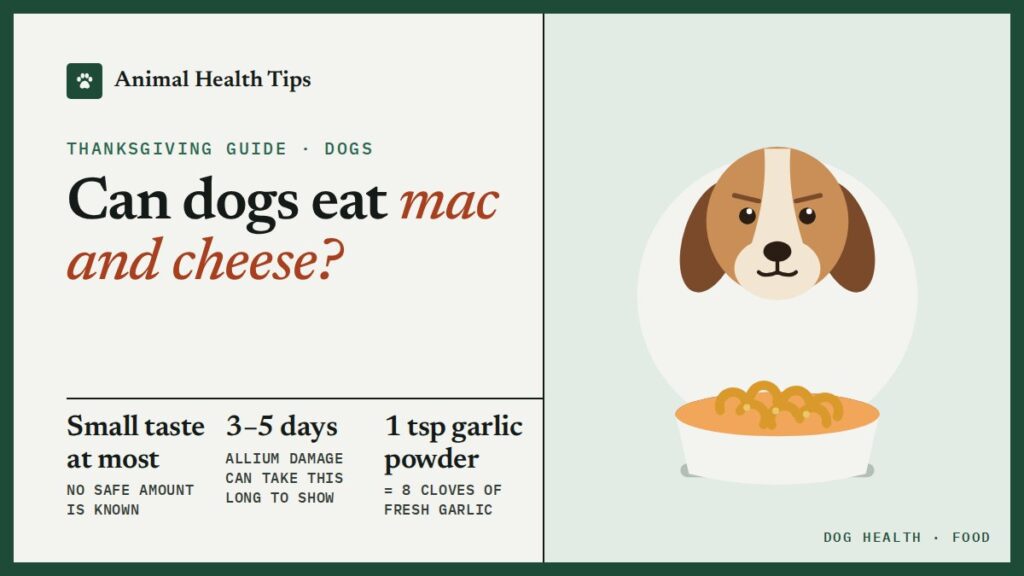
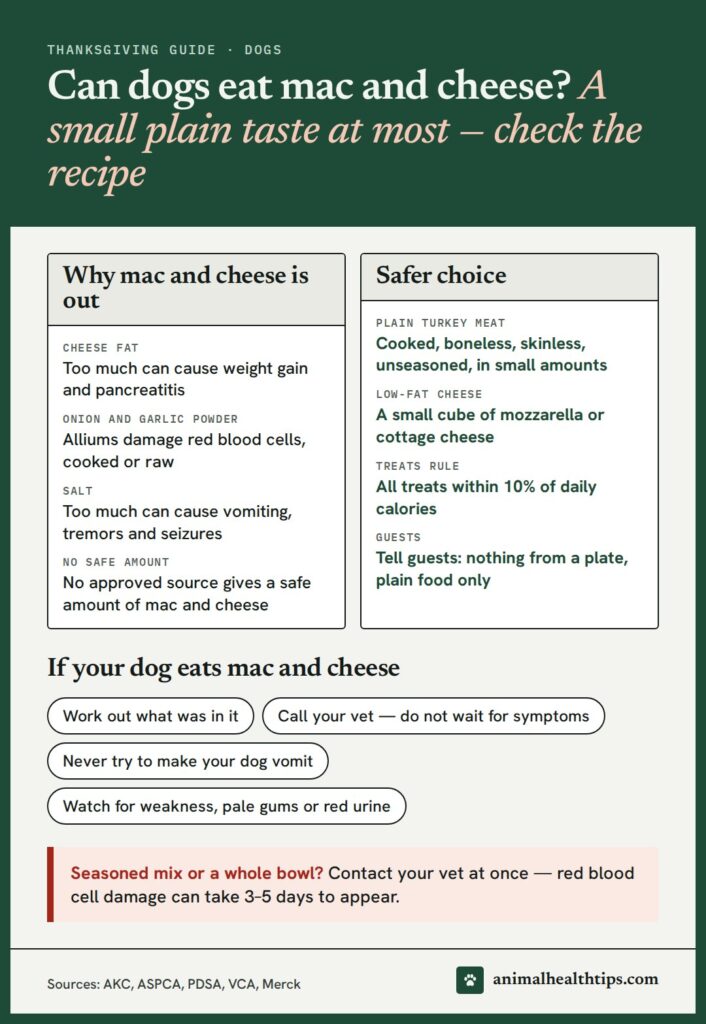
A lick or a small spoonful of plain mac and cheese is unlikely to poison a healthy dog, but no approved source gives a safe amount, so this article gives none. The AKC says dogs can eat cheese in small to moderate quantities, but that it is probably best fed in moderation, and only as an occasional treat — a small cube or a few shreds is usually enough. Any human food offered to a dog should be prepared appropriately, served in moderation, and treated as an occasional extra rather than a replacement for complete and balanced dog food.
The dairy itself is the first problem. The ASPCA says pets do not possess significant amounts of lactase, the enzyme that breaks down lactose in milk, so milk and other dairy-based products can cause diarrhoea or other digestive upset. The AKC says cheese contains little lactose when compared to whole milk, but that dogs with severe lactose intolerance may have adverse reactions to cheese, even in small quantities. Cottage cheese is lower in lactose, which reduces the likelihood of upset — but mac and cheese is not made with cottage cheese. So a small plain taste may be tolerated, or it may bring on vomiting or diarrhoea — call your vet if either appears.
Why is the cheese in mac and cheese a problem for dogs?
Cheese is high in fat — the main problem with the dish. The AKC says feeding too much cheese to a dog regularly can cause weight gain and lead to obesity, and that even more problematic, it could lead to pancreatitis, a serious and potentially fatal illness in dogs. Mac and cheese is cheese plus butter, milk or cream and pasta — richer than cheese on its own.
PDSA explains what pancreatitis is: inflammation of the pancreas, which causes pain and vomiting, and which ranges from mild to very severe. A dog is at higher risk after eating high-fat foods — PDSA names pork, cheese and butter. The symptoms often start suddenly: vomiting, eating less or not at all, a painful tummy (a dog may stretch into a prayer position), diarrhoea and weight loss. Not all dogs will have every symptom. Book a vet appointment as soon as possible if a dog has any pancreatitis symptoms, especially if they have had it before — pancreatitis can cause severe illness and even death if left untreated.
One more limit: VCA says treats and toppers should be no more than 10% of a dog’s daily calories, because they may unbalance the diet. A spoonful of mac and cheese counts inside that limit, as does every other treat your dog gets that day. PDSA says that for dogs with pancreatitis, only low-fat treats should be given — pieces of chicken breast or small bits of carrot are perfect — and to avoid high-fat treats like cheese. If a dog is struggling with obesity or has food sensitivities, check with a vet before introducing cheese, the AKC says.
What about onion and garlic powder in boxed mac and cheese?
This is the part of the recipe that can turn a rich dish into a poisoning. Some boxed mixes and recipes include onion or garlic powder — check the label, because ingredients vary, and no brand is named here as containing it. The AKC says some cheeses contain herbs or other products that are toxic to dogs, such as garlic, onions and chives. VCA says never to give food seasoned with onions or garlic to your dog: all forms are poisonous, including raw, cooked, dried, powdered and liquid preparations.
Powdered forms are the most dangerous form of allium for a dog. The Merck Veterinary Manual says toxicosis is most commonly associated with concentrated forms of Allium, such as dehydrated flakes, powders or dry onion soup mixes, and that garlic is three to five times more toxic than onion. VCA explains why: dried and powdered forms contain a higher concentration because the water has been removed — one teaspoon of garlic powder is equivalent to eight cloves of fresh garlic. That is why a boxed mix is riskier than a plain cheese sauce: the seasoning is concentrated.
| On the table | What’s in it | Safe for a dog? |
|---|---|---|
| Plain mac and cheese | Cheese, butter, milk, pasta | A small taste at most |
| Boxed mac and cheese | May include onion or garlic powder | No — check the label, call the vet |
| Mac and cheese with bacon | Extra fat and salt | No — extra fat, extra risk |
| Plain cheese (small cube) | Cheese only, no seasoning | An occasional treat, in moderation |
| Cottage cheese | Lower in fat, sodium and lactose | The safest cheese, in small amounts |
Can mac and cheese cause pancreatitis in dogs?
Yes — the fat in the dish can trigger it, though the cause is often unclear. VCA says pancreatitis has a variety of causes, and often it is not possible to identify the exact trigger, but the underlying cause may be related to a recent fatty meal. Fat requires more pancreatic secretions to be digested and delays digestion, which is why a low-fat veterinary therapeutic diet is usually the best initial option.
The signs to watch for are the ones PDSA lists: vomiting, eating less or not at all, a painful tummy, diarrhoea and weight loss. If any of those appear after your dog has eaten mac and cheese, book a vet appointment as soon as possible. Do not wait to see whether it settles — PDSA says pancreatitis can cause severe illness and even death if left untreated, and a whole bowl is far beyond the 10% treats limit VCA gives.
The same fat warning applies to the rest of the table. Our guides to whether dogs can eat gravy and whether dogs can eat stuffing follow the same pattern, and our guide to whether dogs can eat turkey explains how to serve the main course safely.
What should I do if my dog eats mac and cheese?
- Work out what was in it: whether the mix contained onion or garlic powder, how much was eaten, and when.
- Call your vet at once if it was a whole bowl or a seasoned mix. VCA says to call your veterinarian right away if you suspect your pet has ingested any Allium species.
- Do not wait for symptoms. Merck says red blood cell damage begins within 24 hours, peaks in about 72 hours, and haemolysis typically occurs three to five days after exposure — so a dog can look fine at first and become ill days later.
- Never try to make your dog vomit at home. Only a vet should decide that.
- Watch for warning signs: vomiting, diarrhoea, a sore tummy and loss of appetite can point to pancreatitis; weakness, pale gums, a fast heart rate and red-coloured urine can point to red blood cell damage.
The delay is the key point. Merck says the signs of Allium toxicosis are generally not noted until substantial haemolysis has occurred, usually a few days after exposure — lethargy, weakness, rapid breathing, a fast heart rate, collapse and death. VCA adds that stomach upset commonly occurs with potentially any amount of Allium ingested. A dog that ate seasoned mac and cheese and seems fine on the day still needs a vet’s advice — the blood damage is slow, and waiting for it to show is the mistake to avoid.
Which dogs should never have mac and cheese?
Some dogs should not have even a small taste. The AKC says that if a dog is struggling with obesity or has a history of food sensitivities, check with a vet before introducing cheese. PDSA says dogs with pancreatitis should only be given low-fat treats, not high-fat treats like cheese. A dog that has had pancreatitis before is at particular risk — book a vet appointment as soon as possible if any symptoms appear.
What can I give my dog instead at Thanksgiving?
- Plain cooked turkey meat. Cooked, boneless, skinless and unseasoned, in small amounts — see our guide to whether dogs can eat turkey.
- Small bits of carrot or chicken breast. PDSA says these are perfect low-fat treats, and VCA gives cottage cheese and cooked, skinless chicken breast as examples of low-fat toppers.
- A small cube of low-fat cheese. The AKC says low-fat cheeses like mozzarella, cottage cheese or soft goat cheese are best, and cottage cheese is lower in fat and sodium than other cheeses.
- Keep every treat inside the 10% rule. VCA says treats and toppers should be no more than 10% of a dog’s daily calories.
- Tell your guests. Children and visitors often share from their own plates — make it clear that nothing from a plate is for the dog.
- Clear up as you go. Put the dish and leftovers away promptly, so a curious dog cannot help themselves.
Key takeaways
- A small taste of plain mac and cheese is unlikely to poison a healthy dog — but no approved source gives a safe amount, so this article gives none.
- Cheese is high in fat: too much can cause weight gain and pancreatitis, which can be fatal untreated.
- Some boxed mixes and recipes include onion or garlic powder. One teaspoon of garlic powder is equivalent to eight cloves of fresh garlic.
- Red blood cell damage can take three to five days to appear — if your dog ate a seasoned mix, call your vet at once.
Frequently asked questions
Can dogs eat mac and cheese?
A small taste of plain mac and cheese is unlikely to poison a healthy dog, but it is not a food dogs should eat. Cheese is high in fat and can trigger pancreatitis, and some mixes include onion or garlic powder, which damage red blood cells. Call your vet if your dog ate a whole bowl or a seasoned mix.
Is mac and cheese toxic to dogs?
Plain mac and cheese is not a poison in itself, but it is not safe either. The fat can trigger pancreatitis, and onion or garlic powder in a mix is genuinely toxic: all forms of onion and garlic are poisonous to dogs, and the damage to red blood cells can take three to five days to appear.
Can mac and cheese cause pancreatitis in dogs?
Yes. The AKC says too much cheese can lead to pancreatitis, and PDSA says a dog is at higher risk after eating high-fat foods such as cheese and butter. Watch for vomiting, a painful tummy, loss of appetite and diarrhoea, and book a vet appointment as soon as possible.
What should I do if my dog eats mac and cheese with onion powder?
Note how much was eaten and when, then call your vet right away — VCA says to call immediately if you suspect any Allium ingestion. Do not wait for symptoms: red blood cell damage can take three to five days to appear. Never try to make your dog vomit at home.
Can dogs eat cheese at all?
Yes, in small amounts. The AKC says dogs can eat cheese in small to moderate quantities, but best in moderation and only as an occasional treat — a small cube or a few shreds is usually enough. Low-fat cheeses like mozzarella or cottage cheese are the best choice.
What can I give my dog instead of mac and cheese?
Plain cooked turkey meat, small bits of carrot or chicken breast, or a small cube of low-fat cheese. Keep all treats within 10% of your dog’s daily calories, as VCA advises, and tell guests that nothing from a plate is for the dog.
Sources
- American Kennel Club — Can Dogs Eat Cheese?
- American Kennel Club — Human Foods Dogs Can and Can’t Eat
- ASPCA — People Foods to Avoid Feeding Your Pets
- PDSA — Pancreatitis in Dogs
- VCA Animal Hospitals — Nutrition and Pancreatic Disease in Dogs
- VCA Animal Hospitals — Onion, Garlic, Chive and Leek Toxicity in Dogs
- Merck Veterinary Manual — Garlic and Onion (Allium spp.) Toxicosis in Animals
This guide is general information, not a diagnosis. If you are worried about your pet, contact your vet.