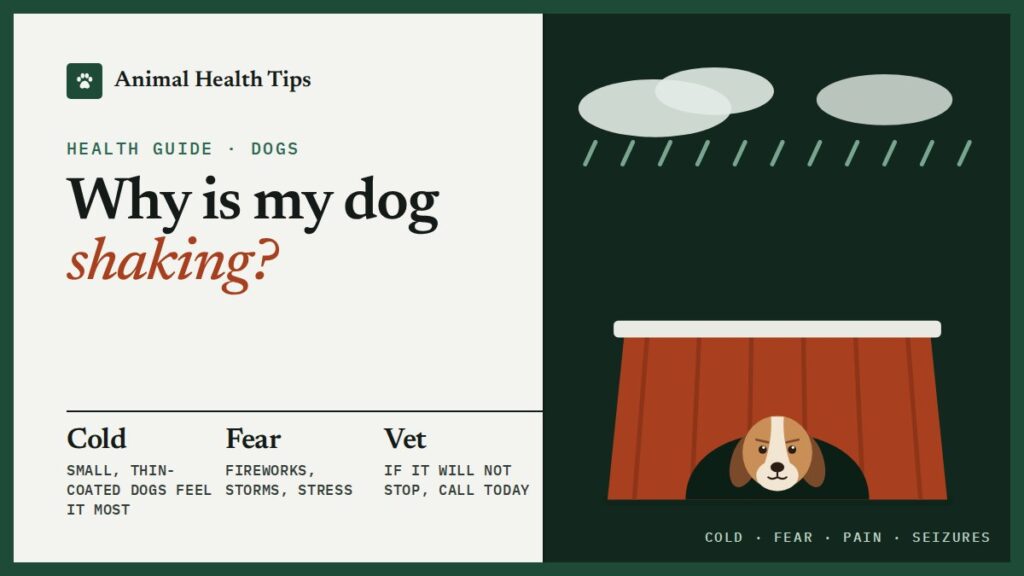
A dog that suddenly starts shaking can be alarming, especially when you cannot see why. Shaking is not one condition. It is a sign with several very different causes, from a cold coat after a walk to fear, pain or a seizure. The good news is that the context usually gives you the first clue: where your dog is, what has just happened, and whether the shaking stops on its own.
In this guide8 sections
This is also a useful question in late October. Nights are colder, dogs come home wet, and fireworks season is under way, with peak activity in the last week of October and the first week of November. Cold, wet and frightened dogs all shake — but so do dogs in pain or having a seizure, and those need a vet.
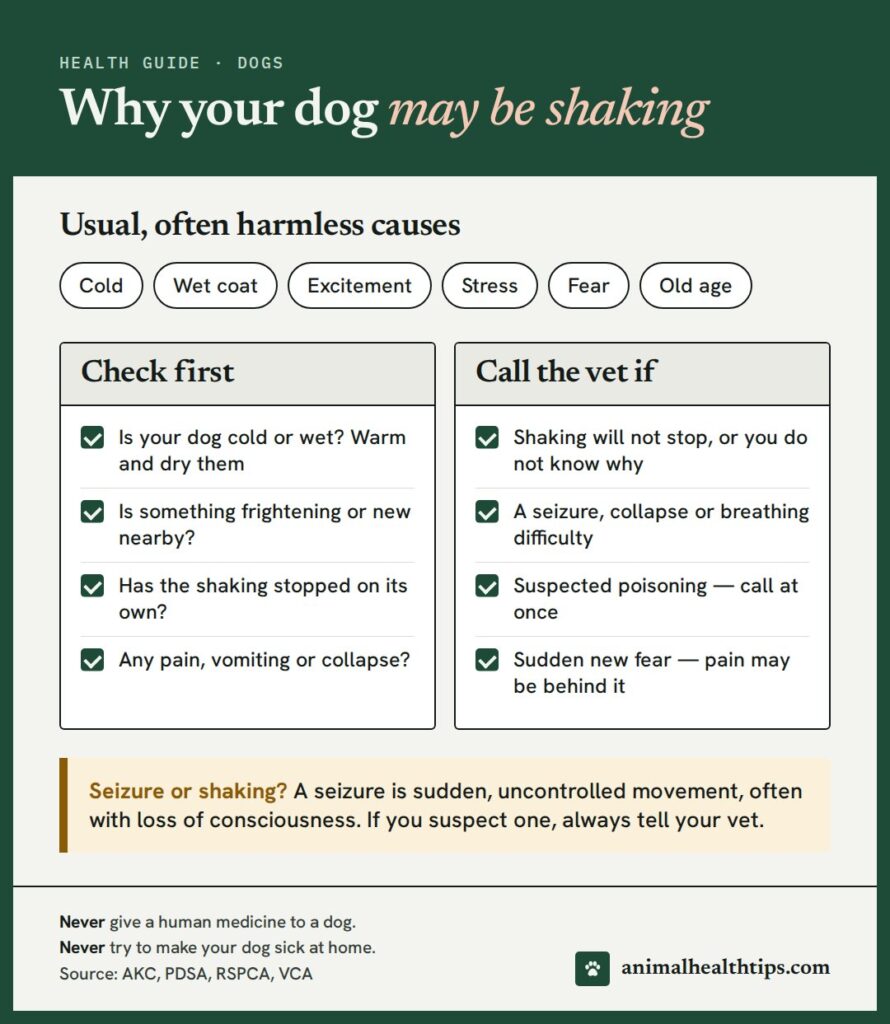
Go to a vet now if
- Your dog collapses, loses consciousness, or has difficulty breathing
- You suspect a seizure, or the shaking is violent and uncontrolled
- Your dog may have eaten something toxic — chocolate, cigarette butts or a product containing xylitol, for example
- The shaking will not stop, or your dog is also vomiting repeatedly
- UK: Animal PoisonLine, 01202 509000 — open 24 hours, run by the Veterinary Poisons Information Service; a fee applies.
- US: ASPCA Animal Poison Control, (888) 426-4435 — open 24 hours; a consultation fee applies.
What does shaking mean in a dog?
Shaking, shivering and trembling are used for the same thing in most vet guidance: rapid, involuntary muscle movement. A dog may shake its whole body, just its legs, or just its head, and each pattern points somewhere different. A whole-body shake after a bath is usually about drying off. Shaking in the legs of an older dog may be about age or pain. Head shaking again and again is more often an ear problem.
Ask first: is your dog cold or wet? Has something frightening or exciting just happened? Is your dog in pain? And does the shaking stop? A shake that stops when the cause goes away is less worrying than one that carries on with no clear cause. The AKC advises that if your dog has started to shake and you do not know why, you should contact your vet to make sure there is not a more serious issue.
Is my dog just cold or wet?
Cold is one of the most straightforward causes, and it is the one to check first on a late-autumn walk. Dogs feel the cold, and the RSPCA notes that dogs with no fur or a thin or short coat are more susceptible, smaller dogs lose body heat faster than larger dogs, and puppies, elderly dogs, sick dogs and dogs not used to the cold also struggle. Dry your dog off after a walk to warm them up, and wipe paws and tummy to remove grit, antifreeze and rock salt, which are poisonous to dogs.
A wet dog shakes for a different reason: to dry off. The AKC notes that wet dogs can shake off 70 percent of the water on their fur in just four seconds. That full-body shake is efficient and normal, though it is less welcome indoors. If warming with blankets and drying stops the shaking, cold was almost certainly the cause. If it does not stop, or the dog is also drowsy, confused, uncoordinated or has pale gums, treat it as urgent: the RSPCA lists those as hypothermia signs and advises contacting a vet immediately, warming the dog slowly.
Can fear, stress or excitement cause shaking?
Yes, and in fireworks season this is the cause owners see most. PDSA lists trembling and shaking among the signs of fear in dogs during fireworks, alongside panting, pacing, hiding, clinginess and trying to run away. Our guide to dogs scared of fireworks and our guide to dogs scared of thunderstorms both work through the same calming plan: indoors, curtains shut, background noise on, and a safe place to hide.
Stress can cause shaking even without a loud noise. The AKC describes a whole-body shake after a stressful experience — leaving a vet examination table, for example, or meeting a stranger — as a classic symptom of stress in dogs, a way of relieving tension. Excitement works the same way in reverse: a dog may tremble in anticipation of going outside or greeting someone, and the shaking resolves when the dog gets what it is excited about. In both cases the shaking is short-lived and tied to the moment. PDSA advises comforting a frightened dog if it comes for reassurance, and never punishing it for anything it does when scared.
Could pain or illness be behind it?
Sometimes shaking is the only sign that something hurts. The AKC notes that shivering and trembling can be a sign of pain, and that a nauseous dog may also shake. Certain toy and small terrier breeds shiver more than others, so a small dog that trembles is not automatically ill — but a change in a dog that does not usually shake deserves attention. A sudden new fear is a similar warning: PDSA advises a vet check if a dog suddenly becomes fearful of fireworks, as there may be a medical reason such as pain or illness.
Two other AKC causes are worth knowing. Low blood sugar can cause shaking, most in toy and small-breed dogs and young puppies; a well-balanced diet fed on a routine schedule can help prevent it. Canine distemper, a virus that may cause shaking and trembling, is most risky for unvaccinated dogs and puppies, is very contagious, and an infected dog should be separated from other dogs. Head shaking is a separate pattern: after a bath or swim, repeated head shaking may indicate an ear infection, so check whether the ears look red, inflamed or dirty or have an unusual smell, and call your vet.
Poisoning must be ruled out quickly. The AKC warns that chocolate, cigarette butts and human products containing xylitol are very toxic to dogs and may cause trembling, seizures, vomiting and diarrhoea, and may be fatal. If you suspect your dog has eaten any of these, call your vet immediately, even if your dog seems normal — many poisons have a delayed effect.
What about old age and tremor conditions?
Older dogs shake more, for two reasons. Senior dogs sometimes develop tremors in their legs, especially the hind legs, as they lose muscle mass. An older dog’s body may also no longer regulate temperature effectively: the AKC describes a 13-year-old dog that shook for several hours after a swim on a chilly day, and warming with blankets stopped the shaking. If your older dog shakes after cold or wet outings, warmth and a shorter, drier walk are the first steps — and a vet check if it keeps happening.
There is also a recognised condition called generalised tremor syndrome, sometimes called white dog shaker syndrome. It manifests as full-body shaking, was first noticed in small white dogs but has been seen in dogs of all colours and sizes, and its cause is unknown. VCA notes that its tremors are rhythmic, repetitive and involuntary, may be localised or whole-body, often worsen with excitement and exercise, and may improve or resolve when the dog is resting or sleeping. It is a diagnosis of exclusion: a vet rules out other medical causes first. No medicine is named here, because treatment is a veterinary decision only.
Is it a seizure — or something else?
A seizure can look like violent shaking. VCA defines it as a sudden, uncontrolled movement caused by abnormal brain activity; a generalised seizure involves the whole body and a loss of consciousness. Typically the dog suddenly falls on its side, the legs go stiff then paddle rhythmically, the head is often held back, and the dog may vocalise, chew its jaw, salivate and urinate or defecate. Seizures typically last about one to two minutes, followed by a confused recovery period of up to 24 hours. Prolonged seizures require treatment, and if you suspect a seizure, always notify your vet.
| What you see | More likely to be |
|---|---|
| Whole-body shake after a bath or swim | Drying off — normal, and very efficient |
| Shaking that stops once the dog is warm and dry | Cold |
| Shaking tied to a noise, a stranger or a vet visit | Fear or stress |
| Trembling before a walk or a greeting, then it stops | Excitement |
| Leg tremors in an older dog, worse after cold outings | Age, muscle loss or temperature control |
| Sudden fall, stiff then paddling legs, loss of consciousness | Seizure — tell your vet |
| Sudden limp collapse, rapid recovery | Fainting — still tell your vet |
Fainting, or syncope, is different from a seizure, and VCA notes that telling them apart matters. A dog that faints goes suddenly limp on collapse, typically will not show jaw-chewing or increased salivation, and recovers rapidly with no confused recovery period. Videos of episodes can be very useful for your vet in telling seizures and fainting apart, so if it is safe to do so, film the episode rather than trying to hold your dog still.
What should I do when my dog shakes?
- Stay calm and watch first. Note when it started, what had just happened, and whether it is stopping. Film it if you can do so safely.
- Warm and dry your dog if they are cold or wet: towel them dry, add a blanket, and bring them indoors.
- Remove the frightening trigger if you can, and let a scared dog hide. Comfort them if they come to you, and never punish fear.
- Check for pain, injury and anything they may have eaten. Look for tenderness, vomiting, or wrappers nearby.
- Keep your dog safe and indoors while the shaking lasts, away from stairs, water and roads.
- Call your vet the same day if the shaking will not stop, you do not know why it started, or it is new for your dog. Go now, or call an emergency clinic, for collapse, a suspected seizure, breathing difficulty or suspected poisoning.
- Do not give any medicine yourself. Never give a dog a human medicine, and never try to make your dog sick at home.
Key takeaways
- Context is the first clue: cold, wet, frightened and excited dogs all shake.
- A shake that stops when the cause goes away is less worrying than one with no clear cause.
- Warm and dry a cold dog, comfort a frightened one, and never punish fear.
- Call your vet the same day if shaking will not stop, is new, or comes with collapse, a seizure or suspected poisoning.
Frequently asked questions
My dog shakes every time it rains. Is that normal?
It can be. Dogs shake to dry off after getting wet, and the AKC notes wet dogs can shake off 70 percent of the water on their fur in four seconds. If your dog is also cold, dry and warm them indoors. If the shaking carries on after they are warm and dry, or it is new, call your vet.
Why does my dog shake when fireworks start?
PDSA lists trembling and shaking among the signs of fear in dogs during fireworks. Dogs experience fireworks much more intensely than we do, because their senses are better. Keep your dog indoors, shut the curtains, put background noise on, and let them hide. Comfort them if they come to you.
Can excitement really make a dog shake?
Yes. The AKC notes that shaking can simply be happy excitement — trembling in anticipation of going outside or greeting someone — and it resolves when the dog gets what it is excited about. It is short-lived and tied to the moment, unlike shaking with no clear cause.
How do I know if it is a seizure?
A generalised seizure is sudden and uncontrolled: the dog usually falls on its side, the legs go stiff then paddle, and the dog loses consciousness, followed by confusion. Fainting is a sudden limp collapse with rapid recovery. If you suspect either, tell your vet.
My older dog’s back legs tremble. Should I worry?
Senior dogs sometimes develop tremors in their legs, especially the hind legs, as they lose muscle mass, and older dogs may also struggle to regulate temperature. Warmth and shorter, drier walks help, but a vet check is wise if it keeps happening, because pain can also cause shaking.
When should I call the vet about shaking?
The same day if the shaking will not stop, you do not know why it started, or it is new for your dog. Go now for collapse, a suspected seizure, difficulty breathing or suspected poisoning. The AKC advises contacting your vet if your dog has started to shake and you do not know why.
Sources
- AKC — Why is my dog shaking? Causes and solutions
- PDSA — Dogs and fireworks
- RSPCA — Keeping dogs safe in winter
- VCA Animal Hospitals — Seizures and syncope
- VCA Canada — Shaker syndrome in dogs
This guide is general information, not a diagnosis. If you are worried about your pet, contact your vet.