
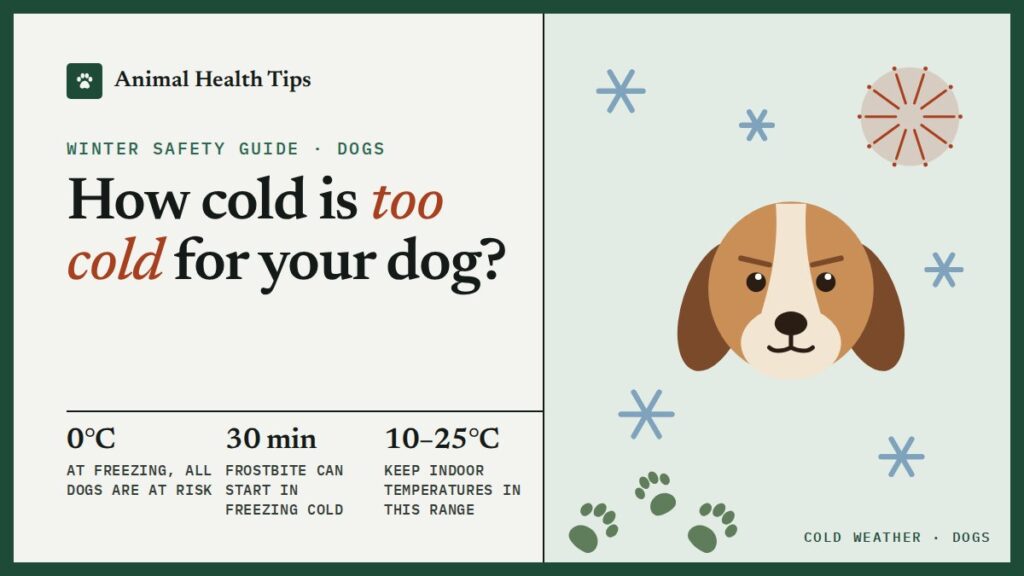
As the nights turn colder, many owners ask the same question on the evening walk: is it too cold for my dog? The honest answer is that it depends on the dog. A husky in a snow shower is having the time of his life, while a greyhound on the same pavement is already shivering. The ASPCA puts it simply: if it is too cold for you, it is probably too cold for your pet. This guide lays out the temperatures that matter, which dogs feel the cold first, and what to do if your dog gets dangerously cold.
In this guide8 sections
Act fast: suspected hypothermia or frostbite
- If your dog is shivering hard, drowsy, clumsy or has pale gums, get them somewhere warm and dry and call your vet immediately.
- Warm them slowly with blankets, never with direct heat, and never rub frostbitten skin or use a hairdryer or heating pad.
- Treat hypothermia first: it can be fatal, while frostbite is often found alongside it.
Which dogs feel the cold first?
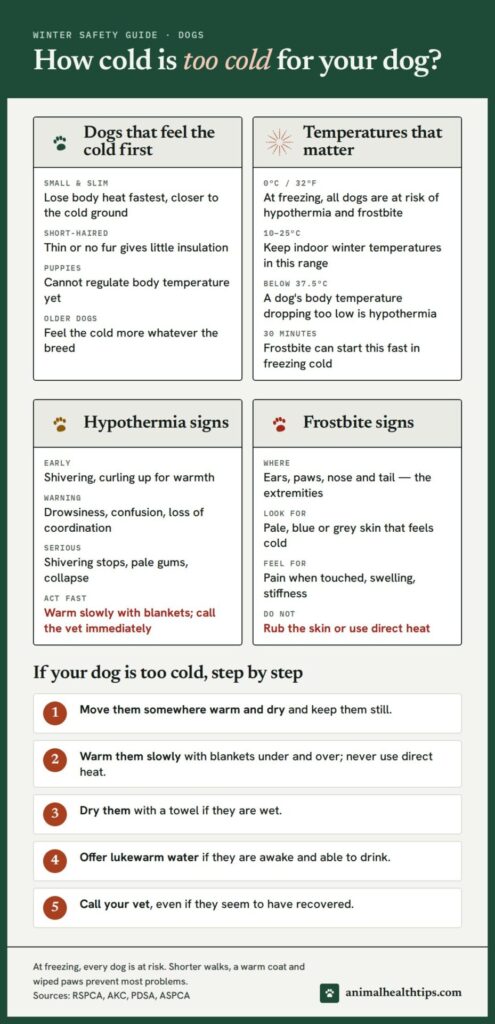
Some dogs are built for winter and some are not. Double-coated breeds cope with cold far better than dogs with thin, short or no fur. Small dogs lose body heat faster than large ones, because they are less insulated and closer to the cold ground. Puppies are not built for cold weather at all: their ability to regulate body temperature has not fully developed, and newborn puppies can become hypothermic even at normal temperatures.
Age and health matter too. The PDSA lists young, old, frail, small and newborn pets as the groups most at risk of hypothermia, and Blue Cross notes that older dogs feel the cold more whatever their breed. As a rough guide, Blue Cross says greyhounds, dobermans and Staffordshire bull terriers find cold weather more challenging and may benefit from a coat, while Labradors, huskies and German shepherds have the thick coats to stay warm.
The temperatures that actually matter
There is one temperature every dog owner should know. When the thermometer reaches freezing, the RSPCA says all dogs are at risk of hypothermia and frostbite, with small, slim, young and old dogs and those with little or no fur in danger first. The AKC agrees: dogs are at risk of frostbite once the temperature falls below 32°F (0°C), and frostbite can begin in as little as 30 minutes outdoors in freezing cold.
Indoors, the RSPCA advises keeping winter temperatures between 10°C and 25°C, with your dog’s sleeping area above 10°C. A healthy dog’s normal body temperature is 37.5°C to 39.2°C. Hypothermia sets in when it drops too low, usually after exposure to freezing temperatures or from having wet fur. The AKC’s body-temperature bands are worth knowing:
| Body temperature | What it means |
|---|---|
| 37.5–39.2°C (99.5–102.5°F) | Normal range for a healthy dog |
| 32.2–37.2°C (90–99°F) | Mild hypothermia: shivering, sluggishness |
| 27.8–32.2°C (82–90°F) | Moderate hypothermia: slowing heart and breathing |
| Below 27.8°C (82°F) | Severe hypothermia: risk of collapse and death |
Signs of hypothermia in dogs
The first signs are the ones you would expect: shivering, and curling up to keep warm. The RSPCA warns that the shivering can stop if the dog becomes severely cold, so its absence is not reassuring. Other signs include drowsiness and confusion, loss of coordination, pale gums, and collapse or loss of consciousness.
The AKC describes the progression in more detail. Early on, the heart rate increases and breathing becomes rapid as the body fights to stay warm. Then everything slows: the heart rate and breathing become slower and shallower, reflexes are delayed, the dog grows sluggish and depressed, the pupils dilate, and consciousness fades. Left untreated, hypothermia can lead to cardiac and respiratory failure, brain damage, coma and death.
Frostbite: where it strikes and what it looks like
Frostbite hits the extremities first: the ears, feet, nose and tail have less fur or none at all. In the cold, the body redirects blood from these areas to the vital organs, and the parts furthest from the heart lose blood flow and suffer tissue damage. The AKC says the paws, ears and tail are the areas most commonly affected.
Watch for pain or tenderness when the area is touched, swelling, and skin that looks pale, blue or grey and feels cold. Stiffness or clumsiness in the paws is another clue, and in serious cases blisters or skin ulcers appear, or the skin blackens and dies. The RSPCA adds that dogs may lick or chew the painful area. Frostbite is often followed by hypothermia, which is the more dangerous of the two: treat the hypothermia first.
What to do if your dog is too cold
- Move them somewhere warm and dry, and minimise their movement while you warm them.
- Warm them slowly. Wrap them in blankets, with blankets under them as well as over them. A hot water bottle filled with warm (not boiling) water, wrapped in a thick towel, is safe; never put anything hot directly on the skin, and never try to warm a dog quickly.
- Dry them with a towel if they are wet, because wet fur loses heat fast.
- Offer lukewarm (not hot) water if your dog is awake and able to drink.
- Call your vet immediately. The PDSA advises seeing a vet even if your pet seems to have recovered, in case of long-term damage.
- For frostbite, do not rub the skin and do not use direct heat such as a hairdryer or heating pad. Your vet may prescribe pain medication or antibiotics.
Keeping your dog warm all winter
A coat is not just fashion. The RSPCA says elderly dogs, young dogs, dogs with thin or short fur and dogs with pre-existing medical conditions are the ones that need a winter coat, and it should fit snugly without restricting movement. The ASPCA adds that a short-haired dog’s coat or sweater should have a high collar or turtleneck and run from the base of the tail to the belly. And never shave a dog down to the skin in winter: a longer coat provides more warmth.
Paws deserve as much attention as the body. Dog boots protect paws from cold ground and from poisons like rock salt, grit and antifreeze, but Blue Cross advises introducing them slowly indoors and never forcing the issue. After every walk, wipe the pads, paws and tummy to remove ice, salt and chemicals, which irritate the pads and are poisonous if licked. Trim the fur around the paws and ears so painful ice balls cannot freeze into it, and check for cracks in the pads or redness between the toes.
Keep winter walks shorter in severe cold, and keep your dog dry before setting out: the AKC notes that wet areas of skin are more vulnerable to frostbite. On the coldest days, swap the long walk for indoor games such as hide and seek or a treasure hunt with treats. Two winter rules are absolute: never leave a dog alone in a car, hot or cold, and keep dogs away from frozen ponds and lakes, where thin ice can break under their weight.
Cold-weather habits worth building
Small daily habits add up. Give your dog a warm sleeping place off the floor and away from drafts, with a cosy bed and a warm blanket. Bathe as little as possible during cold spells, because washing strips the essential oils from the skin and leaves it dry and flaky. The ASPCA suggests feeding a little extra in winter, since pets burn extra energy staying warm, while keeping fresh water freely available so the skin stays less dry. Our dog calorie calculator can help you work out the right amount for your dog.
If your dog is older, watch them especially closely: the RSPCA notes that cold weather can make arthritis worse, leaving joints stiffer and more painful. Read our guide on arthritis in older dogs in cold weather for what helps.
Key takeaways
- At freezing (0°C/32°F), every dog is at risk of hypothermia and frostbite; small, short-haired, young, old and slim dogs are in danger sooner.
- Keep indoor temperatures between 10°C and 25°C, with sleeping areas above 10°C.
- Shivering that stops, drowsiness, clumsiness and pale gums are emergency signs: warm slowly and call the vet.
- Coats, booties, wiped paws and shorter walks are the winter basics that prevent most problems.
Frequently asked questions
At what temperature should I start worrying about my dog outside?
At freezing (0°C/32°F), the RSPCA says all dogs are at risk of hypothermia and frostbite. Small, short-haired, very young, elderly and slim dogs will struggle sooner, so judge by your dog as well as the thermometer. If it is too cold for you, the ASPCA says it is probably too cold for your pet.
Does my dog really need a winter coat?
Many do. The RSPCA recommends coats for elderly dogs, young dogs, dogs with thin or short fur and dogs with health conditions. Blue Cross adds that greyhounds, dobermans and Staffordshire bull terriers find cold weather more challenging. The coat should be snug but never restrict movement.
How long can my dog safely stay out in freezing weather?
Keep walks short in severe cold. The AKC warns that frostbite can begin in as little as 30 minutes outdoors in freezing cold, and wet fur makes heat loss faster. Watch for lifted paws, whining or stopping on walks, which can mean the feet are too cold.
Can I warm my dog up quickly with hot water or a heating pad?
No. Warm your dog slowly with blankets, and never put anything hot directly on the skin or use a hairdryer or heating pad, especially on frostbitten areas. Rapid warming and rubbing can cause burns and further tissue damage.
Are dog boots worth the trouble?
Yes, for many dogs. Boots protect paws from cold ground and from rock salt, grit and antifreeze, which are poisonous. Introduce them gradually indoors and never force them, as Blue Cross advises. Wiping the paws after every walk is the minimum.
Can I leave my dog in the car in winter if I am quick?
No. The RSPCA says never leave a dog alone in a car: even with the heating on, a dog can develop hypothermia, or overheat. Dogs Trust calls it dangerous in any weather.
Does cold weather make my dog’s arthritis worse?
It can. The RSPCA notes that cold makes arthritic joints stiffer and more painful, especially in older dogs. Keeping them warm with blankets and supportive resting places helps, and our arthritis guide covers the rest.
Sources
- RSPCA — How to keep your dog safe in winter
- AKC — Hypothermia in dogs: how cold is too cold?
- AKC — Can dogs get frostbite?
- ASPCA — Cold weather safety tips
- PDSA — Hypothermia in pets
- Blue Cross — Dogs in winter
- Dogs Trust — Cold weather advice for dogs
This guide is general information, not a diagnosis. If you are worried about your pet, contact your vet.

1 comment