If you walk your dog in woods and fields through autumn and winter, you may have heard of Alabama rot. It is a rare but serious dog disease that usually begins with a small skin sore and can lead to sudden kidney failure within days. The cause is still unknown, which makes the muddy season a worrying time for some owners. The reassuring part is that it is genuinely uncommon, and knowing what to look for puts you ahead.
In this guide9 sections
See your vet straight away if your dog has an unexplained sore
- Go promptly, especially between November and May and after muddy woodland walks.
- Do not wait for tiredness, vomiting or other kidney signs. The days between the sore and the kidneys failing are when treatment has its best chance.
- Do not panic: the disease is rare, and most skin sores turn out to be something else entirely.
What is Alabama rot?
Alabama rot is the common name for cutaneous and renal glomerular vasculopathy, or CRGV. It damages the small blood vessels in the skin and kidneys, which is why skin sores are followed in some dogs by kidney failure. The name comes from a similar illness first recognised in greyhounds in Alabama, USA, in the 1980s.
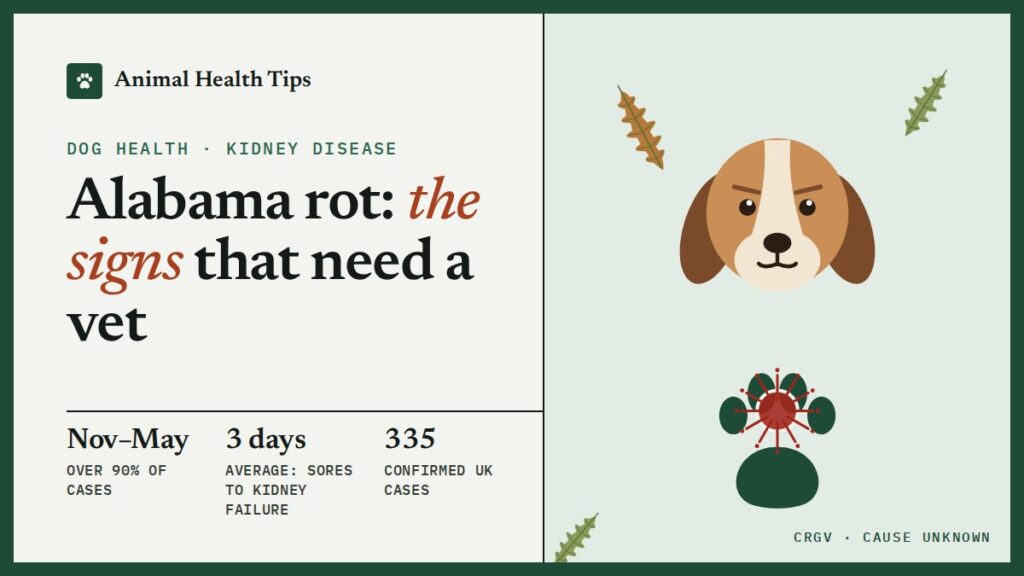
In the UK, cases have been confirmed since November 2012. Anderson Moores Veterinary Specialists, which leads the research here, has recorded 335 confirmed UK cases, one of them in 2026. That number shows how rare it is — but the consequences for affected dogs are severe enough that every owner of a muddy-walk dog should know the signs.
Why does it happen in autumn and winter?
Nobody knows what causes CRGV, and that is the honest answer on every official page. What is clear is the pattern: more than 90% of UK cases are identified between November and May, and the disease is more common in winter and spring in dogs that walk in muddy, woodland areas. Researchers suspect an environmental trigger, and work at the University of Bristol has found promising early results around a bacterium of interest, though confirmatory work is still going on.
It is not the only autumn woodland worry. Seasonal canine illness is another little-understood disease that appears in dogs after autumn walks in woods, so a muddy autumn walk is worth a little extra attention all round.
Which dogs are at risk?
Any dog, of any breed, age or size, can develop CRGV. The breeds most reported so far are Labradors, spaniels and Hungarian vizslas, but vets stress this is a reporting pattern, not proof that other breeds are safe. The more useful question is where and when your dog walks: dogs on muddy paths through woods between November and May are the ones vets watch.
The signs: what the sores look like
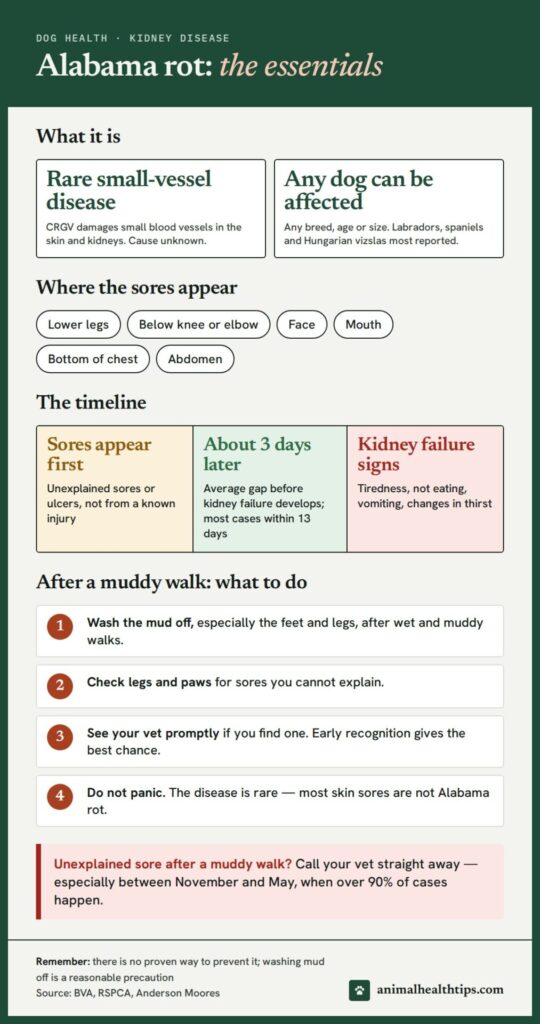
The first sign is usually a skin sore that you cannot explain — not from a cut, a thorn or any known injury. The sores appear most often on the lower legs, below the knee or elbow, and sometimes on the face, in the mouth, at the bottom of the chest or on the abdomen. The RSPCA describes them as visible swelling, a red patch or a skin defect.
Some dogs only ever get the skin sores and recover from them. It is the dogs that go on to develop kidney failure — tiredness, loss of appetite, vomiting and changes in how much they drink — that are in real danger. The BVA is clear about the outlook: sadly, many dogs that develop kidney failure do not survive. Rarely, neurological problems are seen too.
From sores to kidney failure: the timeline
| Time | What the research shows |
|---|---|
| Sores appear | Unexplained sores or ulcers, usually on the lower legs |
| About 3 days later (on average) | Kidney failure begins; the vast majority of cases develop within 13 days |
| Kidney failure signs | Tiredness, not eating, vomiting, a change in thirst |
| Afterwards | Some dogs recover from sores alone; many dogs with kidney failure do not survive |
This gap is what matters. The days between the sore appearing and the kidneys failing are when treatment has its best chance, so a sore that appears out of nowhere after a muddy walk should never be a wait-and-see.
What will the vet do?
Your vet will examine the sore and run blood tests. A high index of suspicion comes from the combination of unexplained skin lesions and blood changes — but vets are honest that a definite diagnosis is only possible after death, by examining kidney tissue under a microscope. Do not let that put you off going: suspected cases get intensive treatment at the practice or a referral centre, and early, aggressive management gives the best results.
There is no specific cure. One small study at the Queen Mother Hospital for Small Animals looked at plasma exchange in six dogs with CRGV between 2014 and 2016: two survived to go home and four did not, and the researchers said the study could not show what role the treatment played. It remains experimental.
What to do if you spot a sore
- Do not panic. Alabama rot is rare, and most unexplained skin sores turn out to be something else.
- Note when and where. Were recent walks muddy, through woods, in the last few days? Tell the vet.
- Call your vet promptly. Do not wait for tiredness, vomiting or other kidney signs to appear.
- Keep the sore clean and stop your dog licking it, but do not apply creams or home remedies.
- Watch for kidney signs — going off food, vomiting, drinking much more or less than usual — and report them fast.
Can you prevent Alabama rot?
Honestly: there is no scientifically proven way to prevent it. The BVA says it is hard to give any preventative advice backed by research. The reasonable precaution vets suggest is washing the mud off your dog, especially the feet, after wet and muddy walks — the RSPCA recommends this particularly after walks through woodland.
Muddy winter walks bring other risks worth knowing about: lungworm, another wet-weather hazard, and how cold is too cold for your dog before long winter outings.
Key takeaways
- Alabama rot is rare — 335 confirmed UK cases — but serious: sores can lead to kidney failure.
- Cases peak between November and May, especially after muddy woodland walks.
- Sores appear on average 3 days before kidney failure; most cases happen within 13 days.
- There is no proven prevention. Wash mud off after walks and get any unexplained sore checked promptly.
Frequently asked questions
How will I know if my dog has Alabama rot?
You cannot tell at home. A vet becomes suspicious from unexplained skin sores plus blood test changes, but a definite diagnosis is only possible after death, by examining kidney tissue. If your dog has an unexplained sore, especially after muddy woodland walks between November and May, see your vet promptly.
How common is Alabama rot?
It is rare. Anderson Moores Veterinary Specialists has recorded 335 confirmed UK cases since the disease emerged here, one of them in 2026. The vast majority of skin sores vets see are not Alabama rot, and most kidney failure has another cause.
What should I do if I find a sore on my dog’s leg?
Do not panic, but do not wait either. Note when the sore appeared and whether recent walks were muddy, then call your vet. Keep the sore clean, stop your dog licking it, and watch for tiredness, loss of appetite, vomiting or changes in thirst.
Is there a cure for Alabama rot?
No proven cure exists. Suspected cases receive intensive veterinary care, and early, aggressive management gives the best results. Plasma exchange has been tried in a very small study and remains experimental.
Can I prevent my dog getting Alabama rot?
There is no scientifically proven prevention. The reasonable precaution vets suggest is washing mud off your dog, especially the feet, after wet and muddy walks. The RSPCA particularly recommends this after walks through woodland.
When is Alabama rot season?
More than 90% of UK cases are identified between November and May. The disease is more common in winter and spring, especially in dogs walked in muddy, woodland areas.
Sources
- BVA — Alabama rot: what dog owners need to know
- RSPCA — Alabama rot
- Anderson Moores Veterinary Specialists — About CRGV
- Journal of Veterinary Internal Medicine (via PMC) — Plasma exchange in dogs with CRGV
This guide is general information, not a diagnosis. If you are worried about your dog, contact your vet.
This guide is general information, not a diagnosis. If you are worried about your pet, contact your vet.