Autumn brings damp mornings, and damp mornings bring slugs and snails. If your dog likes rummaging through undergrowth, hoovering up grass or drinking from puddles, you have probably never thought twice about it. But slugs and snails can carry lungworm, a parasite that is now a risk to dogs across much of the UK. Severe infections can be fatal, so it is worth knowing how it spreads, and how simple it is to stop.
In this guide7 sections
Call your vet straight away if your dog shows these signs
- A cough that won’t shift, or fast, heavy or noisy breathing
- Weight loss or going off food with no clear cause
- Bruising, nosebleeds, or a small cut that bleeds for longer than it should
- Wobbliness, seizures or collapse
- UK: Animal PoisonLine, 01202 509000 — open 24 hours, run by the Veterinary Poisons Information Service; a fee applies.
- US: ASPCA Animal Poison Control, (888) 426-4435 — open 24 hours; a consultation fee applies.
What is lungworm in dogs?
Lungworm is the name for the parasitic worm Angiostrongylus vasorum, sometimes called French heartworm. The adult worms live in the dog’s heart and in the major blood vessels that supply the lungs. From there they travel around the body in the blood, so the infection can affect the lungs, the heart and other organs too.
Foxes are a natural reservoir of the parasite and are often implicated in spreading it. The disease is on the move: PDSA says lungworm is becoming much more common and is now a risk to dogs across much of the UK, and the Kennel Club notes it has spread out of its old southern hot spots into new parts of the country.
How do dogs catch lungworm?
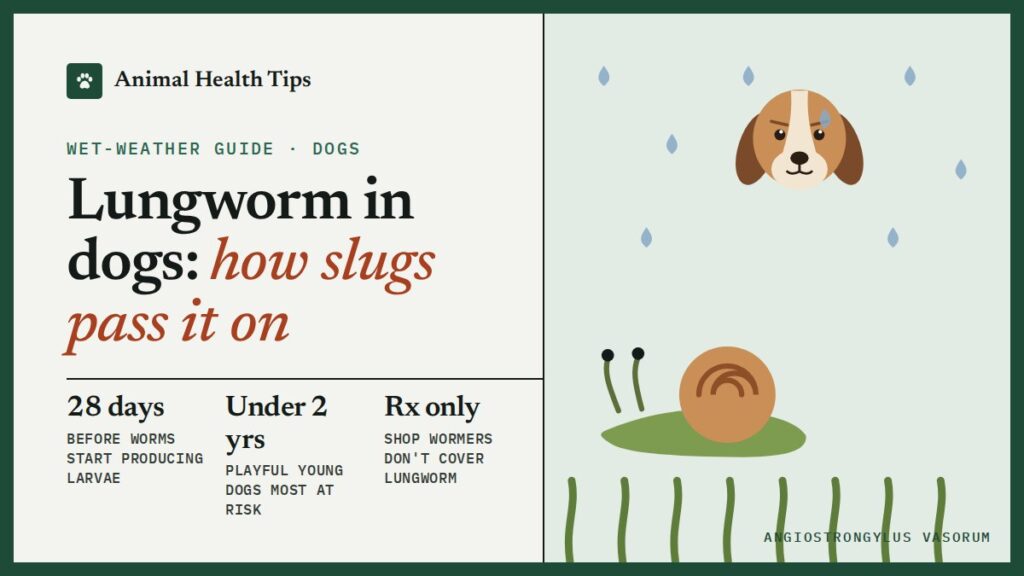
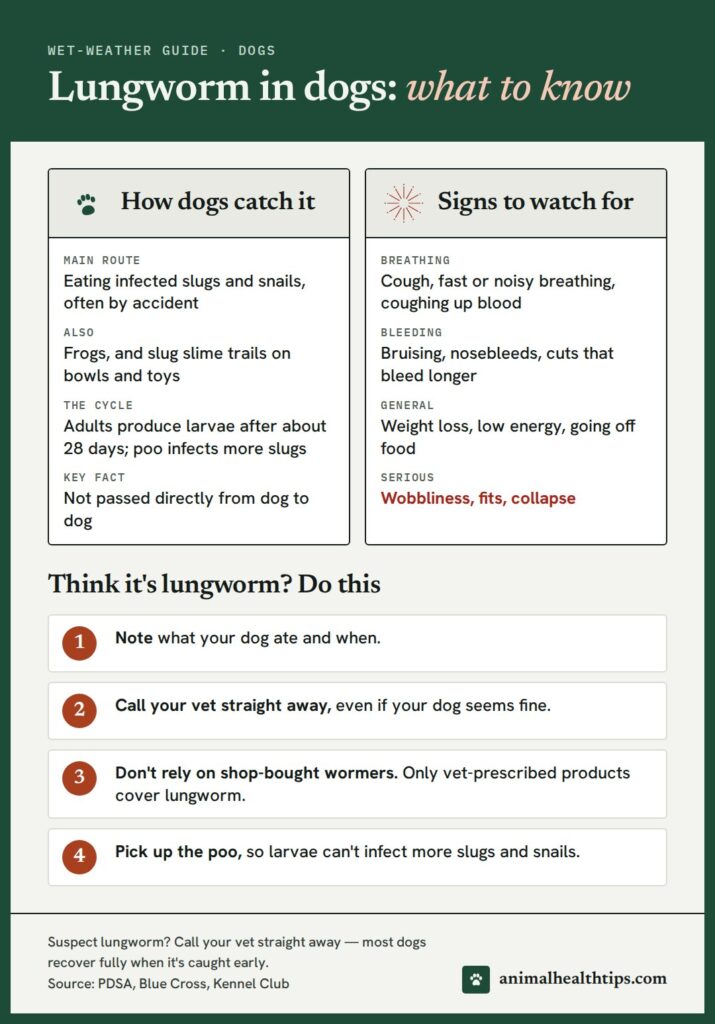
Dogs catch lungworm by eating infected slugs and snails. That sounds unlikely until you remember how dogs explore the world: rummaging through undergrowth, eating grass, drinking from puddles or sniffing around the park. PDSA notes that dogs often swallow slugs by accident this way.
There are other routes too. Blue Cross warns that dogs can catch lungworm from frogs, and from slug slime trails on outdoor food and water bowls, on toys left out in the garden, on their own fur, or on scraps of food found in the park. That is why changing outdoor water bowl water regularly matters.
Once inside the dog, the worms grow, and after about 28 days the adults start producing larvae of their own. Dogs pass these larvae in their faeces, which infect more slugs and snails, which are eaten by more dogs, so the disease spreads quickly in the environment. It cannot be passed directly from dog to dog: slugs and snails are always needed for the parasite to grow and develop.
Dogs of any age or breed can catch lungworm, but the Kennel Club says playful younger dogs, under two years old, are more prone, as are dogs that deliberately eat slugs and snails. Wet weather raises the risk because slugs and snails are more active, and warmer, wetter conditions favour the parasite’s development.
What are the signs of lungworm?
This is the difficult part. The signs are often vague and varied, and they can be hard to spot. PDSA says they vary with the number of worms and which organs they reach, so lungworm is easily confused with other illnesses. A mild infection can even go unnoticed for months. Watch for:
- A persistent cough, fast, heavy or noisy breathing, or coughing up blood
- Weight loss, going off food, or not wanting to exercise
- Bruising, nosebleeds, or a small cut that bleeds for longer than it should
- Vomiting or diarrhoea
- Neurological signs such as a wobbly or abnormal gait, or fits
- Collapse or shock — an emergency
| What you might see | What it can mean |
|---|---|
| Cough, fast or noisy breathing | The lungs are affected; this can progress to pneumonia |
| Bruising, nosebleeds, slow-bleeding cuts | The parasite interferes with blood clotting |
| Weight loss, low energy, going off food | Common in longer, milder infections |
| Wobbliness, fits, collapse | Severe infection; get help straight away |
How do vets diagnose and treat lungworm?
Tell your vet about your dog’s symptoms and habits. The Kennel Club notes that diagnosis often rests on the history, compatible clinical signs and how the dog responds to treatment. No single test is totally reliable. Most vets use a blood test, and a poo sample examined under the microscope can help, though neither is perfect.
Treatment depends on how severe the infection is. The vet kills the lungworm with a deworming product, and the dog is monitored during treatment because killing many worms at once can trigger a dangerous allergic reaction. Mild cases may need nothing more than that and medication to take home. Seriously ill dogs may need hospital care: oxygen, a fluid drip, an emergency blood transfusion, and other medicines such as anti-seizure drugs.
The reassuring part is that most dogs recover if lungworm is caught and treated early. Blue Cross says most dogs make a full recovery with early action, although a small number are left with some lung scarring. Treatment can be expensive, especially with intensive care, which is one more reason to prevent the infection rather than treat it.
How to prevent lungworm
Prevention is simpler than treatment. The single most important step is this: standard wormers bought in pet shops and supermarkets do not cover lungworm. PDSA says these products are not veterinary licensed and often contain less effective ingredients. Use only what your vet recommends.
- Ask your vet about prescription lungworm cover. Make sure your dog’s worming routine includes lungworm protection, and use only a vet-prescribed product.
- Don’t let your dog eat slugs, snails or frogs. Supervise rummaging in the garden, and be extra vigilant on walks in wet weather.
- Change outdoor water bowl water regularly and bring in bowls and toys overnight, so slug slime trails can’t reach them.
- Always pick up your dog’s poo and dispose of it safely, so the larvae in it can’t infect more slugs and snails.
Wet-weather walks carry other risks too. Conkers and acorns (are conkers and acorns poisonous to dogs) and wild mushrooms (are wild mushrooms toxic to dogs) are in season on many of the same paths where slugs are out after rain.
Can humans catch lungworm?
No. Blue Cross confirms that lungworm is not known to infect humans. It is a dog and fox problem, not a family health worry, so you can care for a dog with lungworm without any special precautions for yourself.
Key takeaways
- Lungworm is a parasite of the heart and lung blood vessels, now found across much of the UK.
- Dogs catch it by eating slugs and snails, often by accident, and from frogs and slug slime trails.
- Cough, breathing problems, unexplained bruising and bleeding are the warning signs.
- Only vet-prescribed products cover lungworm; standard shop-bought wormers do not.
- Most dogs recover fully if it is caught and treated early.
Frequently asked questions
Can dogs catch lungworm in winter?
Slugs and snails are most active in mild, wet weather, so the risk never fully vanishes, though it is lower in hard frosts. Wet weather in general is the risk period: the Kennel Club links the spread of lungworm to warmer, wetter conditions that favour slugs and snails. Keep up the prevention routine all year.
Can lungworm kill a dog?
Yes. PDSA says lungworm can cause severe illness and even death, with severe infections sometimes leading to pneumonia, internal bleeding and organ failure. Early treatment makes all the difference, which is why symptoms should never be waited out.
How will I know if my dog has lungworm?
The signs are often vague: coughing, breathing problems, weight loss, going off food, bruising or cuts that bleed longer than they should. Diagnosis usually needs a vet visit, including a blood test and sometimes a poo sample. Tell your vet if your dog eats slugs or snails.
Can my dog catch lungworm from another dog?
No. Blue Cross and the Kennel Club confirm that lungworm cannot be passed directly from dog to dog. Slugs and snails are always needed for the parasite to grow and develop, so another dog’s infection is not a direct risk to yours.
Will a regular wormer prevent lungworm?
Only a vet-prescribed one. Standard wormers bought in pet shops and supermarkets do not cover lungworm and are not veterinary licensed, according to PDSA. Ask your vet which prescription product includes lungworm cover.
Are puppies more at risk from lungworm?
Dogs of all ages and breeds can catch it, but the Kennel Club says playful younger dogs, under two years old, are more prone, especially ones that eat slugs and snails on purpose. Young, curious dogs deserve the closest watching.
Sources
- PDSA — Lungworm in dogs
- Blue Cross — Lungworm in dogs
- The Kennel Club — Lungworm
- Merck Veterinary Manual — Lungworm infection in dogs
This guide is general information, not a diagnosis. If you are worried about your dog, contact your vet.