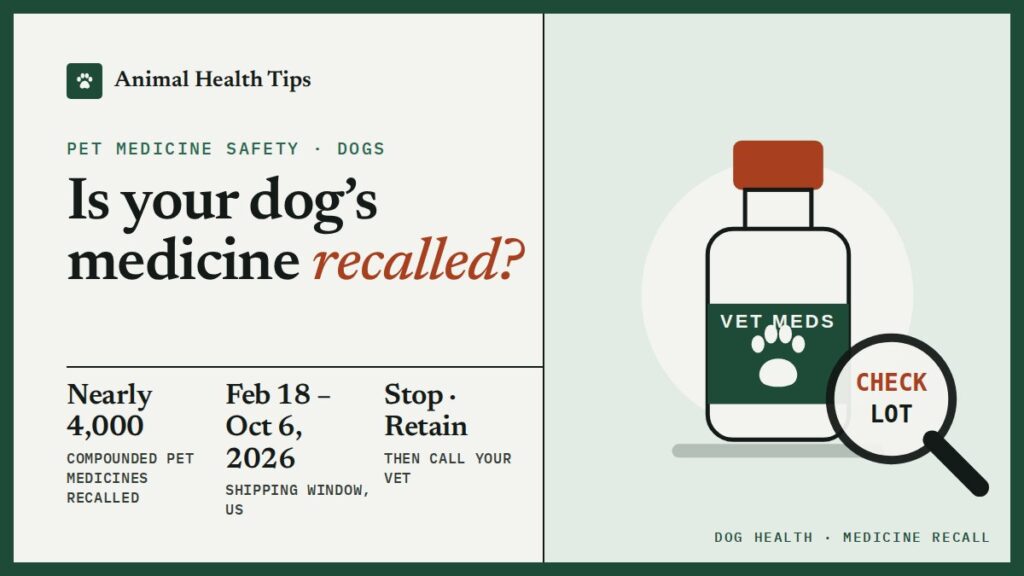
Wedgewood Pharmacy, a US compounding pharmacy, announced on 21 October 2026 that it is voluntarily recalling certain compounded veterinary medicines still within expiry. The FDA-published announcement puts nearly 4,000 medicines in scope — shipped 18 February – 6 October 2026 to practices, pharmacies and customers across the US — over inconsistencies in the company’s own laboratory testing data, which could leave products too weak or too strong.
In this guide7 sections
The AVMA has posted its own recall alert with the shipping window and a link to the company’s lookup. If your dog takes a medicine that was mixed specially for them, check the label this week — this guide covers what the recall includes, how to check, and exactly what to do if it matches.
Call your vet promptly if
- Your dog’s medicine matches the recall notice
- Your dog seems unwell while taking a compounded medicine — vomiting, diarrhoea, seizures or unusual drowsiness
- A medicine does not seem to be working at all
- You are unsure whether the bottle in your cupboard is affected
What the recall covers
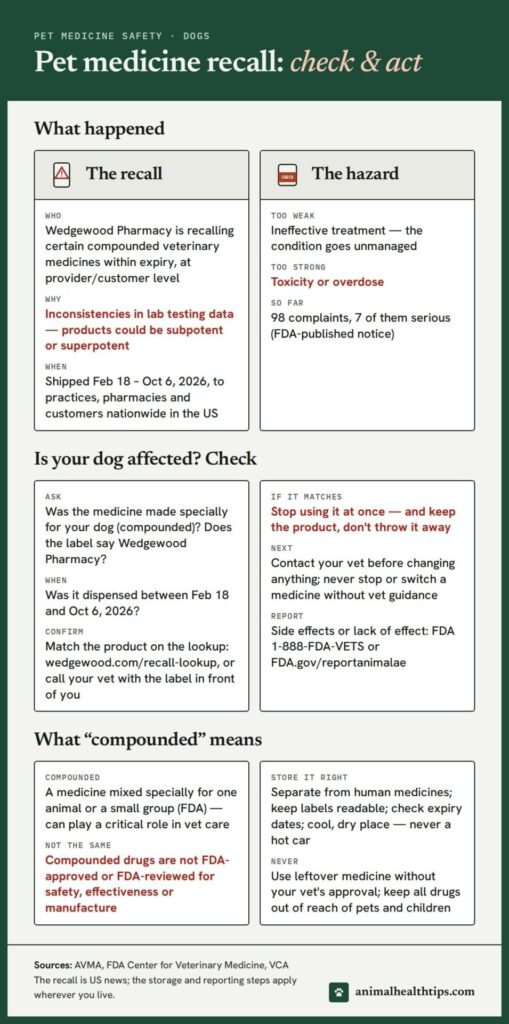
The AVMA’s recall alert confirms it: Wedgewood Pharmacy LLC is recalling certain compounded veterinary medicines within expiry at provider and customer level, shipped 18 February – 6 October 2026 to practices, pharmacies and customers nationwide in the US, after the issue was found through the company’s own quality processes.
The medicines come in many forms — powders, pastes, oral suspensions, injectables, eye and ear preparations, and topical sprays and gels — made for companion, equine, exotic, zoo, wildlife and aquatic animals, not food-producing animals. The FDA-published announcement puts the scope at nearly 4,000 compounded veterinary medicines and says 98 complaints have been received, 7 of them serious; it gives no clinical detail beyond that.
For UK and EU readers: this recall is US news — compounded medicines from a US pharmacy rarely reach pets in Britain or Europe. Check the label only if your dog’s medicine was ordered online from a US source — the checking and storage habits here still apply wherever you live.
Is your dog affected? How to check
Keep the label and packaging to hand — they hold the product name, lot code and expiry date — and work through these steps:
- Look at the label. A compounded medicine was mixed specially for your dog — the label often says “compounded” or names the pharmacy. Check whether it says Wedgewood Pharmacy.
- Check the date. The recall covers medicines shipped between 18 February and 6 October 2026. Your dispensing date or invoice will tell you when yours left the pharmacy.
- Use the official lookup. The full list of affected products, lot numbers and expiry dates is on the company’s recall lookup page, which the AVMA alert points to as well. Match the exact product name and lot code on your label.
- Call your vet or the dispensing pharmacy with the label in front of you if anything is unclear — they can confirm whether the medicine was compounded and where it came from.
What to do if your dog’s medicine is recalled
If the product and lot code on your label match the recall list, the FDA-published notice gives clear instructions for owners:
- Stop using it at once — do not give any more doses, and do not pass it on to another pet.
- Keep the product — do not throw it away; your vet or the recall team may need it.
- Contact your vet before changing anything. Never stop, switch or adjust a medicine without guidance — the condition still needs managing, and your vet will arrange a suitable alternative.
- Ask about a refund or replacement. A recall coordinator is notifying affected customers by email and post, and arranging refunds or, where possible, replacements.
The notice adds that the recall is being conducted with the knowledge of the FDA. If your dog has had side effects — or a medicine simply did not work — report it: the FDA encourages vets and owners to report side effects, defects, medication errors and lack of effectiveness, on 1-888-FDA-VETS or at FDA.gov/reportanimalae.
The two risks: too weak or too strong
A wrong-strength medicine fails in two opposite ways — and both matter for a dog on treatment:
| Too weak (subpotent) | Too strong (superpotent) | |
|---|---|---|
| What it means | Less active ingredient than the label says | More active ingredient than the label says |
| The danger | Ineffective treatment — the condition goes unmanaged while you believe it is treated | Toxicity or overdose |
| What to watch | The medicine does not seem to be working at all | New side effects after starting the medicine — tell your vet |
What “compounded” actually means
Compounded medicines exist for good reasons. The FDA describes compounding as combining, mixing or altering ingredients to create a medication tailored to an individual animal or a small group — typically by pharmacists or veterinarians. For a dog that needs an unusual dose, a flavour it will accept, or an unlicensed product, a compounded preparation can play a critical role.
But they are not the same as licensed medicines. Compounded animal medicines are not FDA-approved, and the FDA has not reviewed them for safety, effectiveness, manufacture, labelling or packaging. They also lack post-market controls: unlike makers of approved animal drugs, compounders are not required to report adverse events and defects to the FDA, or to demonstrate stability and product quality.
The AVMA’s policy is plain: compounding can affect potency, stability and behaviour in the body — and ultimately safety and effectiveness. It should be reserved for patients whose needs cannot be met with an approved medicine, where no other practical route exists and the compounded form is reasonably expected to be safe and effective. The decision should always be the vet’s.
Recalls are not only about medicines. If the worry is the food bowl rather than the medicine cabinet, our guide to checking dog food recalls explains the same check-the-label habit for food.
Storing and handling your dog’s medicines safely
For everyday handling, VCA’s guidance for medicines at home:
- Keep human and pet medicines separate — many are dangerous to the wrong species — and label everything clearly.
- Keep labels readable, and highlight the patient’s name — in a multi-pet home, this stops the wrong animal getting the wrong drug.
- Check expiry dates — medicines may not be safe or effective beyond expiry, and most eye drops expire 28 days after opening.
- Store at the right temperature in a dry place. Heat and humidity can change how a medicine works, so never leave medicines in a hot car and bring deliveries inside at once.
- Never use leftover medicine without your vet’s approval. Treating with the wrong or an expired drug can make things worse.
- Keep every drug out of reach of pets and children — a chewy pill can look like a treat. For disposal, many pharmacies take back unused or expired pet medicines; remove pills from their containers and mix them with something undesirable, like used coffee grounds.
Key takeaways
- Wedgewood Pharmacy is recalling certain compounded veterinary medicines shipped in the US between 18 February and 6 October 2026 over possible potency problems.
- Check the label for the pharmacy name and dispensing date, then match the exact product and lot code on the official recall lookup.
- If it matches: stop using it, keep the product, and call your vet before changing anything — never adjust a medicine without guidance.
- Report side effects, or a medicine that did not work, to the FDA on 1-888-FDA-VETS — owners’ reports are part of post-market safety.
Frequently asked questions
My dog’s medicine is a normal licensed product. Am I affected?
No — this recall covers only compounded medicines from Wedgewood. Licensed, FDA-approved products are not part of it; if your dog’s medicine was not mixed specially for them, this recall does not apply.
Should I stop the medicine straight away?
The notice tells owners to stop using an affected product and retain it, then contact their vet. Do not switch products or adjust the dose yourself — the condition still needs managing, and your vet will arrange an alternative.
Can I get a refund or a replacement?
Yes, in principle. Wedgewood has engaged a recall coordinator that is notifying affected customers by email and post, and arranging a refund or, where possible, a replacement of the recalled products.
I live in the UK. Does this recall affect my dog?
Almost certainly not — the recall covers products shipped nationwide in the US, and compounded US medicines rarely reach UK or EU pets. Check only if the medicine was ordered online from a US source.
Are compounded medicines always risky?
Not always — the FDA says they can play a critical role when no licensed product suits the animal. But they are not FDA-reviewed for safety, effectiveness or manufacture, so they should only ever be used on a vet’s decision.
What is worth reporting to the FDA?
Side effects such as vomiting, diarrhoea or seizures, product defects, medication errors — and lack of effectiveness, where a medicine does not work as expected. Owners as well as vets can report, on 1-888-FDA-VETS or at FDA.gov/reportanimalae.
Sources
- American Veterinary Medical Association — Compounded veterinary medications — recall alert
- U.S. Food and Drug Administration — Animal Drug Compounding
- U.S. Food and Drug Administration — How to Report an Animal Drug Side Effect or Product Problem
- VCA Animal Hospitals — Safe Handling of Medications at Home
This guide is general information, not a diagnosis. If you are worried about your pet, contact your vet.