Autumn is the riskiest time of year for this particular poisoning. Grapes are being harvested, raisin snack boxes come out for lunchboxes, and mince pies and Christmas puddings are already on the shelves. Dogs are brilliant at finding food we meant to keep to ourselves, so it is worth knowing — before anything happens — exactly which fruits are dangerous and what to do if your dog eats any.
In this guide8 sections
- Which fruits are dangerous to dogs?
- Why are grapes and raisins so dangerous?
- Signs of grape or raisin poisoning in dogs
- My dog ate grapes or raisins — what do I do now?
- How do vets treat grape poisoning?
- Where grapes and raisins hide at this time of year
- How to keep your dog safe
- Frequently asked questions
If your dog has already eaten something they shouldn’t, our Halloween sweets guide covers the other autumn dangers, from chocolate to xylitol.
Go to a vet now if your dog has eaten grapes or raisins
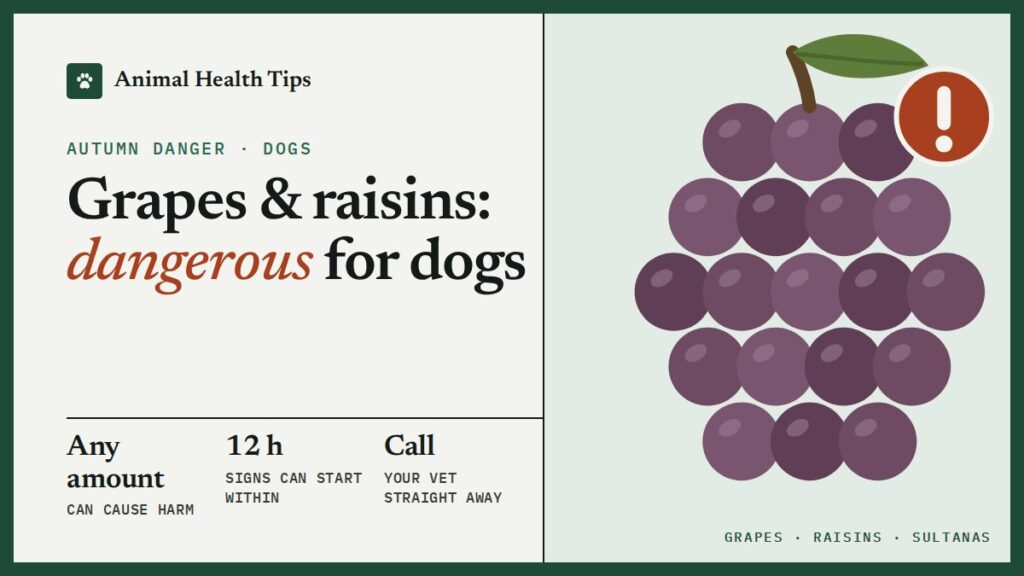
- Do not wait for symptoms. Call your vet straight away, even if your dog seems completely fine.
- If you know what they ate and how much, tell the vet — and take the packaging with you.
- Never try to make your dog sick at home. Only a vet should decide that.
- UK: Animal PoisonLine, 01202 509000 — open 24 hours, run by the Veterinary Poisons Information Service; a fee applies.
- US: ASPCA Animal Poison Control, (888) 426-4435 — open 24 hours; a consultation fee applies.
Which fruits are dangerous to dogs?
All of these are dangerous: grapes (red, green or black, with or without seeds), raisins, sultanas and currants. Drying does not make them safe, and cooking does not either — the raisins baked into a mince pie or a slice of Christmas pudding carry the same risk as fresh grapes.
Dogs are the species overwhelmingly affected. What makes this poisoning unusual is that nobody knows exactly what the toxic substance is. The PDSA describes the effects as idiosyncratic: some dogs eat grapes and seem fine, while others become seriously ill. That unpredictability is exactly why vets treat every ingestion as an emergency.
Why are grapes and raisins so dangerous?
In the dogs that are affected, grapes and raisins can cause sudden kidney injury. There is no known safe amount — the Veterinary Poisons Information Service says ingestion of any amount warrants treatment, and in a ten-year review of 8,520 UK cases, how badly a dog was affected was not linked to how much it had eaten.
The good news in that same review: with prompt treatment, most dogs recovered. The danger is in waiting, because once the kidneys are badly damaged, treatment becomes much harder.
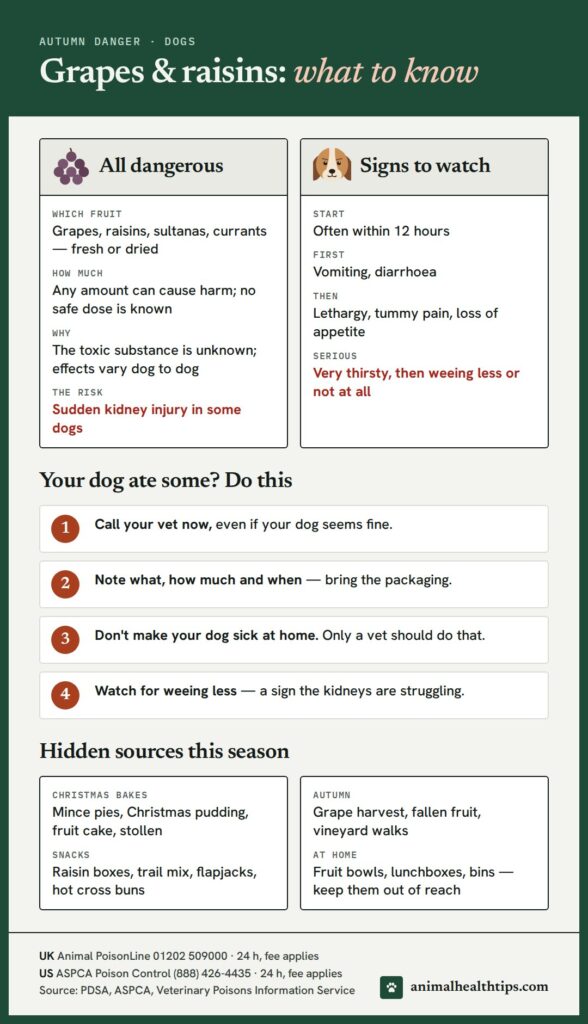
Signs of grape or raisin poisoning in dogs
Signs often start within 12 hours of eating the fruit. The PDSA lists:
- Vomiting and diarrhoea
- Lethargy and loss of appetite
- Tummy pain
- Drinking more than usual
Later signs point to the kidneys struggling: the dog becomes very thirsty and then starts weeing less than normal, or stops weeing altogether. If you notice that change, it is urgent — but do not wait for it before calling the vet.
My dog ate grapes or raisins — what do I do now?
- Call your vet now, even if your dog seems fine. Do not delay — early treatment is what saves kidneys.
- Note what they ate, roughly how much, and when. A photo of the packaging helps the vet judge the situation.
- Do not make your dog sick at home. No salt, no hydrogen peroxide, no home remedies. Only a vet should induce vomiting, and only within the first few hours.
- Keep an eye on drinking and weeing over the next day or two, and tell your vet about any change.
How do vets treat grape poisoning?
Your vet will want to see your dog as quickly as possible. Treatment depends on how much time has passed:
| Stage | What the vet does |
|---|---|
| Within the first few hours | May induce vomiting at the clinic and give activated charcoal to limit absorption |
| After that | Blood tests and monitoring of kidney values and urine output |
| Supportive care | A fluid drip to support the kidneys, usually with a stay at the practice |
Most dogs that are treated promptly recover well. Dogs that arrive late, after the kidneys have already failed, have a much harder fight — which is why the single most important thing you can do is call early.
Where grapes and raisins hide at this time of year
It is not just the fruit bowl. This is the season when dried fruit turns up in all sorts of foods:
- Mince pies, Christmas pudding, Christmas cake, stollen and fruit cake
- Raisin snack boxes, trail mix and flapjacks
- Hot cross buns (still around) and some cereals
- Lunchboxes, handbags and coat pockets
- Bins — a discarded fruit salad or a mince pie wrapper still smells interesting to a dog
- Outdoors: fallen fruit under garden vines, and vineyard walks on holiday
Grapes are far from the only everyday food that can poison a dog. Xylitol, the sweetener in sugar-free gum and some peanut butters, is another one worth knowing about, and our human food safety checker covers dozens more.
How to keep your dog safe
- Store dried fruit and bakes in sealed containers in cupboards, not on low tables or open shelves.
- Empty bins promptly after parties and baking sessions, and use a bin with a lid.
- Tell guests and children — most grape poisonings happen because someone shares a “harmless” snack.
- Check under the table after gatherings; dropped mince pies are a classic.
- On walks, keep your dog away from fallen fruit and teach a solid “leave it”.
Key takeaways
- Grapes, raisins, sultanas and currants are all dangerous to dogs — fresh, dried or baked.
- There is no known safe amount. Any ingestion deserves a vet call.
- Signs often start within 12 hours; weeing less or not at all is a late, urgent sign.
- Never make your dog sick at home — only a vet should do that.
- Watch out for mince pies, Christmas pudding and raisin snacks this season.
Frequently asked questions
How many grapes will kill a dog?
There is no known safe or lethal amount. The toxic substance has never been identified, and in a large ten-year review of cases, how badly a dog was affected was not linked to how much it ate. Treat any amount — even one grape — as an emergency and call your vet.
Are cooked raisins in mince pies still dangerous to dogs?
Yes. Cooking and baking do not remove the risk. The raisins and sultanas in mince pies, Christmas pudding, fruit cake and stollen carry the same danger as fresh grapes, so keep all of them away from your dog.
How long after eating grapes do symptoms start in dogs?
Often within 12 hours: vomiting, diarrhoea, lethargy, tummy pain and loss of appetite. Kidney-related signs, such as drinking a lot and then weeing less, come later. Do not wait for symptoms before calling your vet.
My dog ate a grape yesterday and seems fine. Should I still worry?
Yes — call your vet and explain what happened. Signs can take hours to appear, and the earlier treatment starts, the better the chances of a full recovery. Do not assume that seeming fine means nothing happened.
Can cats eat grapes?
Grapes and raisins are listed as toxic to cats as well, but grape poisoning is overwhelmingly a dog problem. Keep them away from cats too, and call your vet if your cat eats any.
What will the vet do for grape poisoning?
If your dog is seen within the first few hours, the vet may induce vomiting and give activated charcoal. After that, treatment is supportive: blood tests, monitoring of kidney values and urine output, and usually a fluid drip to support the kidneys.
Sources
- PDSA — Are grapes and raisins toxic for dogs?
- ASPCA — Grape
- Merck Veterinary Manual — Grape and raisin toxicity in dogs
- Veterinary Poisons Information Service — VPIS clinical review 2023
This guide is general information, not a diagnosis. If you are worried about your pet, contact your vet.