Seeing your dog’s food brand named in a recall notice is unsettling. The good news is that knowing exactly what to do takes most of the worry out of it. Several pet-food recalls are on the official lists right now: the FDA’s animal and veterinary recalls page currently lists recalls over Salmonella, Listeria and metal contamination, including FI dog supplements (August 2026), Northwest Naturals chicken recipe (August 2026), Fromm wet canned dog food (August 2026) and Oma’s Pride canine food (August 2026). If you buy your dog’s food in the UK, the Food Standards Agency publishes its own food alerts and recall notices.
In this guide7 sections
Whether a notice applies to the bag or tin sitting in your cupboard comes down to one thing: the lot code. A recall only ever covers specific lots, never the whole brand. This guide walks you through checking in the US and the UK, what to do if your food matches, and how to keep your family safe in the meantime.
How do pet food recalls actually work?
A recall is a firm’s action to remove a product from the market. According to the FDA, a recall can be carried out on the firm’s own initiative, at the FDA’s request, or by FDA order under its statutory authority. In practice, most are voluntary: the company spots a problem, or the FDA does, and the company announces the withdrawal.
The FDA posts these company announcements as a public service, and it is explicit that it does not endorse either the product or the company. Recalls that the FDA monitors also appear in the FDA Enforcement Report once they are classified. Before classification they can appear as “not yet classified”, which is why the classification can trail the public warning by some time. In the UK, the Food Standards Agency (FSA) publishes food alerts and product recall notices, and the recalling company displays point-of-sale notices in shops explaining why products are recalled and what to do.
How to check whether your dog’s food is recalled
Checking takes five minutes. Work through these steps in order:
- Keep the packaging. The ASPCA’s advice is to keep the original packaging, or at least a photo of the label and lot number, so you can confirm whether the food your dog ate was involved. The FDA says to save the packaging until the food is consumed, because it holds the information needed to identify the variety, the manufacturing plant and the production date.
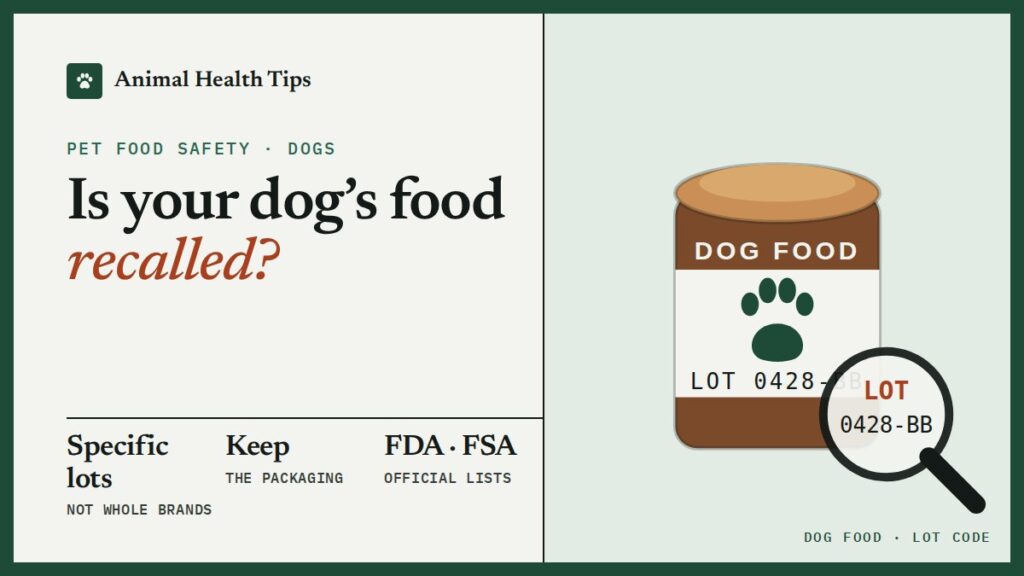
- Find the lot code. The lot number is stamped onto the packaging — often hard to read — in a combination of letters and numbers that always sits close to the best-by, before or expiry date. It identifies the manufacturing plant and the production date, and it is the detail that decides everything.
- Go to the official list. In the US, use the FDA’s animal and veterinary Recalls & Withdrawals page, which lists recent recalls with the date, brand name, product description, reason and company name. In the UK, use the FSA’s food alerts. The AVMA also tracks recalls on its recalls and alerts page, which is a useful second check.
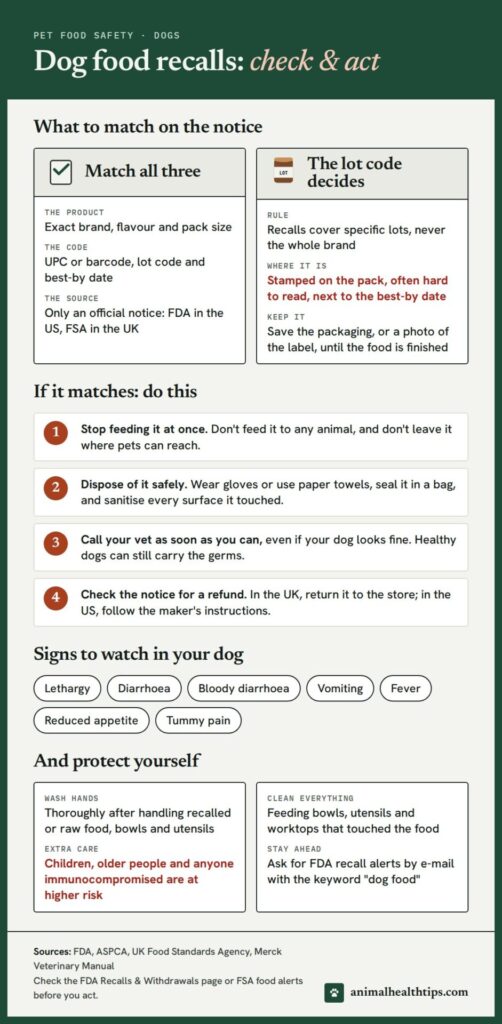
- Match all three details. Recalls target specific lots, not whole brands. An official notice identifies the exact product name, the UPC or barcode, and the lot code with its best-by date. Only if all of them match your pack is your food recalled.
If you use the Can My Dog or Cat Eat This? checker for human foods, the same habit applies to commercial food: check the details, not the brand name alone.
What to do if your dog’s food is recalled
If the lot code, UPC and best-by date all match the notice, do this:
- Stop feeding it at once. Do not feed it to any animal, and do not leave it anywhere pets or children can reach. The ASPCA’s advice is clear: if the food was recalled, stop feeding it and visit your local vet as soon as possible.
- Dispose of it safely. The FDA says any product from the listed lots that has not been eaten should be thrown out or destroyed in a way that children, pets and wildlife cannot access, and that any areas the food touched should be sanitised. Do not touch contaminated food with bare hands: wear gloves or use paper towels, and place it in a sealed bag.
- Call your vet as soon as you can, even if your dog looks completely fine. Your vet may want to run tests such as blood work, a urine test, ultrasound or x-rays, and your pet’s medical report can provide valuable information if you later file an FDA complaint.
- Check the notice for a refund. How refunds work differs from one recall to another, so follow the notice itself. In the UK, the FSA’s standing advice is to return the product to the store where it was bought for a full refund.
Call your vet as soon as possible if
- Your dog ate food that is under recall, even if they seem fine
- Your dog shows signs such as vomiting, diarrhoea, fever or lethargy after eating
- You are unsure whether the bag or tin in your cupboard is one of the recalled lots
Signs of foodborne illness to watch for in your dog
If your dog has eaten recalled food, watch for these signs. The FDA lists lethargy, diarrhoea or bloody diarrhoea, fever and vomiting; some pets only show decreased appetite, fever and abdominal pain. One point the FDA stresses is easy to miss: healthy pets can be carriers and infect other animals or humans, so a dog that looks well can still be passing the germs on.
The Merck Veterinary Manual describes clinical salmonellosis in dogs and cats as usually taking the form of acute diarrhoea with septicemia, and notes that acute cases occur infrequently — occasionally in puppies and kittens, or in adults stressed by concurrent disease. When acute signs do appear, they can include fever of 40.5–41.5°C (105–107°F), severe watery diarrhoea, sometimes dysentery, and often tenesmus (straining). Merck also notes that many dogs and cats are subclinical carriers of salmonellae, and that shedding by dogs and cats has been linked to illness in people living in the same household — particularly where raw meat diets are fed.
| United States | United Kingdom | |
|---|---|---|
| Where recalls are listed | FDA Recalls & Withdrawals page; FDA Enforcement Report once classified | FSA food alerts and product recall notices |
| What to do with recalled food | Stop feeding; throw out or destroy so children, pets and wildlife cannot reach it; sanitise contact areas | Do not use the product; return it to the store |
| Refund route | Follow the recall notice’s instructions; contact the manufacturer | Return to the store where it was bought for a full refund |
| Report a problem | FDA Safety Reporting Portal for pet food complaints | Contact the FSA or the local authority via the food alerts page |
Protect yourself and your family
Recalled food can make people ill too. The FDA warns that people handling contaminated pet food can become infected with Salmonella, especially without thorough hand-washing after contact with exposed surfaces. Human symptoms include nausea, vomiting, diarrhoea or bloody diarrhoea, abdominal cramping and fever. Children, older people and anyone who is immunocompromised are at greater risk.
The FSA gives similar hygiene advice for the UK: wash your hands thoroughly after handling raw pet food, bowls, utensils or animal faeces; clean utensils and feeding bowls thoroughly after use; store raw pet food separately from other food, especially ready-to-eat foods; and take care when defrosting to avoid cross-contamination. The FSA notes that the risk can come through direct handling of the food, or indirectly via bowls, utensils or contact with animal faeces.
Getting ahead of the next recall
You do not have to wait for bad news to find you. The FDA lets you sign up for Enforcement Report e-mail notifications of new and updated recalls: all recalls, commodity-specific ones, or alerts by keyword such as “dog food”, on a daily or weekly basis.
If your dog became ill and you suspect the food, you can also report it. The FDA’s pet food complaint report asks for the exact product name, container and storage type, lot number, best-by date, UPC code, net weight, purchase date and place, and how the food was stored, prepared and handled — plus your dog’s species, age, weight, breed, prior health, clinical signs, how soon the signs appeared, and your vet’s contact and diagnosis. The FDA reviews each report to decide whether a follow-up investigation is possible, and the reports feed its adverse-event surveillance to help prevent future problems. One honest limitation: the FDA cannot pay for private lab testing or reimburse veterinary costs.
Food scares can also come from what your dog steals rather than what you buy. If your dog raids the bins this weekend, our Halloween sweets guide explains what is dangerous and what to do.
Key takeaways
- A recall covers specific lots, never the whole brand: the lot code, UPC and best-by date decide whether your pack is affected.
- Check the official lists — the FDA’s Recalls & Withdrawals page in the US, FSA food alerts in the UK — and keep the packaging until the food is finished.
- If it matches: stop feeding at once, dispose of it safely with gloves and a sealed bag, sanitise, and call your vet even if your dog looks fine.
- Wash your hands after handling recalled or raw food; children, older people and immunocompromised family members are at greater risk.
Frequently asked questions
My dog’s brand is in the news. Should I stop feeding it?
Not on the brand name alone. Recalls cover specific lots, so go straight to the official notice and match the product name, UPC, lot code and best-by date against your pack. If nothing matches, your food is not part of the recall. When in doubt, keep the packaging and call the manufacturer.
I threw away the packaging. What now?
Check your retailer’s order history or receipts for the exact product and when you bought it, and contact the manufacturer with those details. Photograph anything you still have. If your dog was eating the food and seems unwell, call your vet — and keep the packaging next time.
What if my dog seems fine after eating recalled food?
Call your vet anyway. The ASPCA advises a vet visit as soon as possible after any exposure to recalled food, and the FDA notes that healthy pets can carry Salmonella without showing signs while still passing it to other animals or people.
Can I get my money back?
In the UK, the FSA’s advice is to return the product to the store where you bought it for a full refund. In the US, refunds work differently in each recall, so follow the instructions in the recall notice or contact the manufacturer directly.
How do I report a problem with my dog’s food?
In the US, use the FDA’s Safety Reporting Portal for pet food complaints. You will need the exact product name, lot number, best-by date, UPC, where and when you bought it, and your dog’s details, clinical signs and vet records. Your report feeds the FDA’s surveillance of pet food safety.
Should I worry more about raw pet food?
Raw pet food carries particular hygiene risks, which is why both the FDA and the FSA publish specific handling advice for it. The FDA treats any presence of Salmonella or Listeria monocytogenes in pet food as an adulterant, with zero tolerance. Whatever you feed, the hygiene steps in this article — hand-washing, clean bowls, separate storage — apply.
Sources
- U.S. Food and Drug Administration — Recalls & Withdrawals — Animal & Veterinary
- U.S. Food and Drug Administration — How to Report a Pet Food Complaint
- ASPCA — What To Do If Your Pet’s Food Is Recalled
- UK Food Standards Agency — Food Alert: Salmonella in raw pet food (FSA-PRIN-37-2021)
- Merck Veterinary Manual — Salmonellosis in Animals
This guide is general information, not a diagnosis. If you are worried about your pet, contact your vet.