It is late afternoon in October. Your dog has spent the morning charging through oak leaves in a local wood, tail going like a windscreen wiper, and came home his usual hungry self. By evening he is lying flat, will not touch his dinner, and is being sick. When dogs fall ill that quickly after a woodland walk, seasonal canine illness is one of the conditions recorded in the UK — rare and still unexplained, but worth knowing about, because the first hours matter.
In this guide8 sections
- What is seasonal canine illness?
- When and where does seasonal canine illness happen?
- What are the signs of seasonal canine illness?
- What to do if your dog falls ill after a woodland walk
- The suspected harvest-mite link
- Other autumn woodland dangers that can look similar
- Making autumn woodland walks safer
- Frequently asked questions
If your dog falls ill after a woodland walk — go to a vet now
- Contact your vet immediately. PDSA warns that seasonal canine illness can be fatal when left untreated.
- Tell them your dog walked in woodland within the last few days, and describe every sign: vomiting, diarrhoea, lethargy, a high temperature or muscle tremors.
- Do not try to make your dog sick at home, and do not give human medicines. Only your vet should decide what treatment is needed.
- UK: Animal PoisonLine, 01202 509000 — open 24 hours, run by the Veterinary Poisons Information Service; a fee applies.
- US: ASPCA Animal Poison Control, (888) 426-4435 — open 24 hours; a consultation fee applies.
What is seasonal canine illness?
Seasonal canine illness (SCI) is a mystery illness affecting dogs in the UK in autumn, usually after walks in woodland. Its cause is unknown, the Animal Health Trust said in a 2012 statement appealing for case information.
The Trust investigated cases at five study sites — Clumber Park and Sherwood Forest in Nottinghamshire, Rendlesham Forest in Suffolk, and the Sandringham Estate and Thetford Forest in Norfolk — and its research pointed away from man-made poisons: the problem was believed to be natural.
One thing to keep in perspective: the most detailed charity and veterinary material on SCI dates from 2012 to 2020, and our October 2026 check surfaced no fresh alerts from UK charities or veterinary bodies. It appears to be a rare condition, and it may simply be quiet. But the signs it causes are shared with many other emergencies, so the advice in this article still applies to any dog that falls ill suddenly after a walk.
When and where does seasonal canine illness happen?
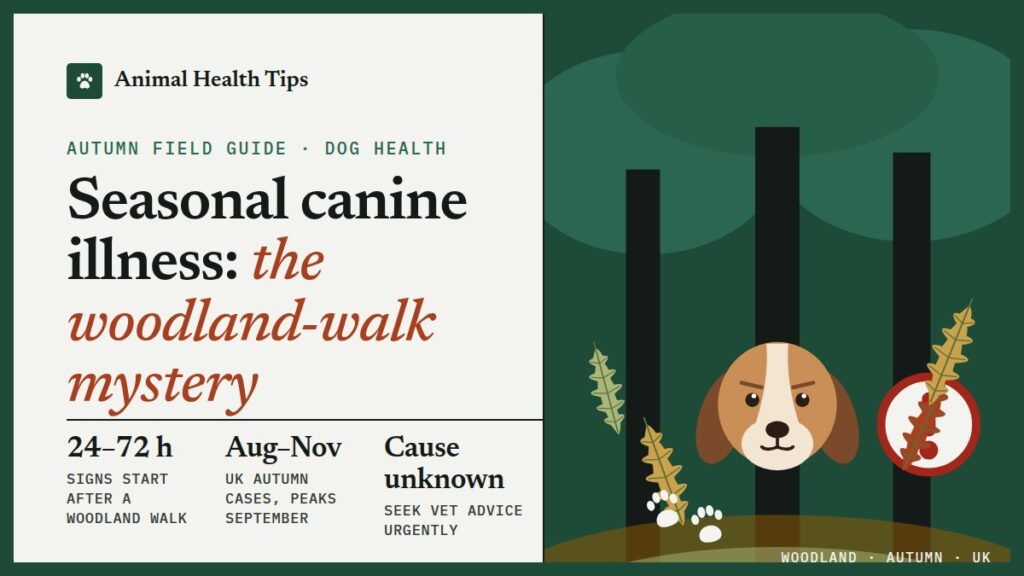
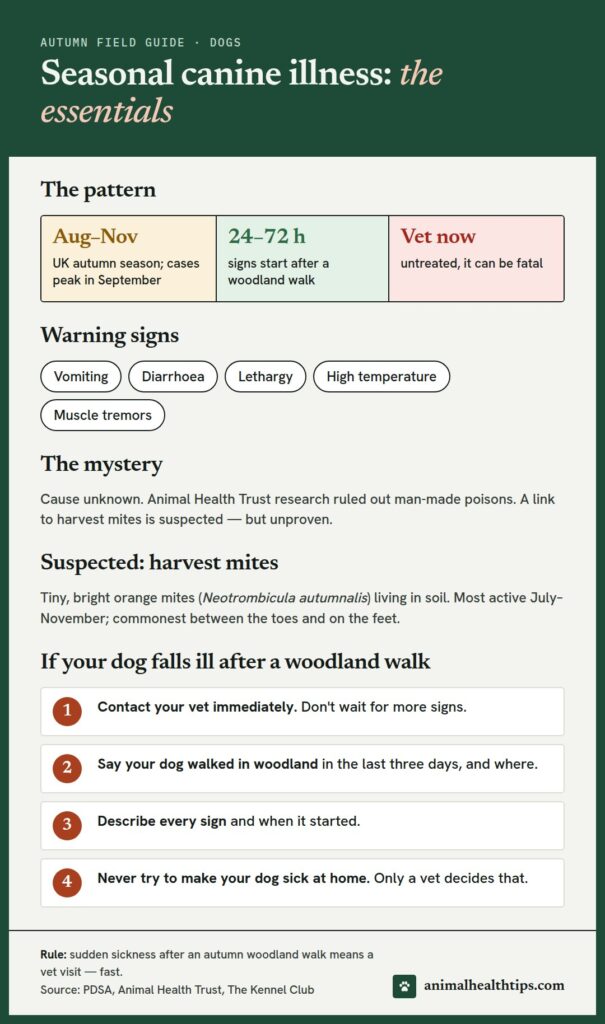
Cases have generally been seen from August onwards, peaking in September and continuing into November, following walks in UK woodland. If you walk your dog in woods through autumn, that window is simply the time to be most watchful.
What are the signs of seasonal canine illness?
Signs come on very quickly, usually within 24 to 72 hours of a woodland walk. The Animal Health Trust named three main clinical signs: vomiting, diarrhoea and lethargy. PDSA’s list adds low energy, a high temperature and muscle tremors.
PDSA’s warning is plain: left untreated, seasonal canine illness can be fatal. That is why the advice is to seek veterinary help immediately rather than waiting to see whether the sickness passes.
What to do if your dog falls ill after a woodland walk
Act at once, even if the signs look mild at first:
- Contact your vet immediately. Do not wait to see if vomiting or diarrhoea pass on their own.
- Mention the woodland walk. Say where and when the walk happened: signs typically start 24 to 72 hours afterwards, and that detail helps the vet.
- Describe every sign and when it started. Vomiting, diarrhoea, tiredness, temperature and tremors are the pattern to report.
- Do not try to make your dog sick at home. Only a vet should decide whether vomiting should be induced.
The suspected harvest-mite link
PDSA says that although no one is sure what causes seasonal canine illness, a link to harvest mites is suspected. The illness typically occurs a few days after walking in woodland, which is where these mites live.
Harvest mites (Neotrombicula autumnalis) are tiny, bright orange mites that live in soil and are common in woodland and grassy areas. They are most active between July and November, and PDSA says infestations are most common between the toes, on the feet and legs, around the armpits, genitals and tummy, and sometimes the ears.
The Animal Health Trust ran a pilot study in 2013 looking at a possible link between SCI and harvest mites — but the link has never been proven. For autumn walks, it is sensible to check your dog’s paws and belly after woodland outings and ask your vet about mite protection; leave any treatment choice to them.
Other autumn woodland dangers that can look similar
Woodland in autumn holds several better-understood hazards, and none of them is the proven cause of SCI. The Kennel Club’s autumn-dangers guide names these:
| Hazard | Why it is dangerous |
|---|---|
| Acorns | Contain tannic acid. In larger amounts they can cause kidney and liver failure, and can block the gut. |
| Conkers | Contain aesculin. They cause sickness and upset stomachs, can be deadly in larger amounts, and are a choking and blockage risk. |
| Wild toadstools | Many are poisonous. Treat every wild toadstool as dangerous to dogs. |
| Alabama rot (CRGV) | Cause unknown, linked to muddy walks. The Kennel Club advises washing and drying dogs after wet or muddy walks. |
For a closer look at two of these, read our guides to wild mushrooms and dogs and conkers and acorns.
Making autumn woodland walks safer
- Watch your dog for a day or three after woodland walks in autumn. The 24-to-72-hour window is the signature of SCI.
- Check paws, legs and belly after walks for tiny bright-orange harvest mites, and mention any you find to your vet.
- Steer your dog away from acorns, conkers and wild toadstools on the ground.
- Wash and dry your dog after wet or muddy walks — the Kennel Club’s advice for Alabama rot, and good practice generally.
Key takeaways
- SCI is a still-unexplained UK autumn illness, usually striking 24–72 hours after a woodland walk.
- The warning signs are vomiting, diarrhoea and lethargy, sometimes a high temperature and muscle tremors.
- Contact your vet immediately. Left untreated, it can be fatal.
- A link to harvest mites is suspected but unproven; check paws and belly after autumn walks.
- Keep autumn walks safe: avoid acorns, conkers and toadstools, and wash off mud afterwards.
Frequently asked questions
What is seasonal canine illness?
A still-unexplained illness affecting dogs in the UK in autumn, usually within 24 to 72 hours of a woodland walk. Its cause is unknown; the Animal Health Trust investigated it at several English woodland sites in 2012 and 2013.
How soon after a woodland walk do signs appear?
Usually within 24 to 72 hours, according to the Animal Health Trust. That fast onset after a woodland walk is the pattern associated with seasonal canine illness. If signs appear in that window, contact your vet at once.
What are the signs of seasonal canine illness?
The main signs are vomiting, diarrhoea and lethargy. PDSA adds low energy, a high temperature and muscle tremors. If you see these after a woodland walk, contact your vet immediately.
What causes seasonal canine illness?
Nobody knows. A link to harvest mites — tiny, bright-orange mites most active from July to November — is suspected but unproven, and the Animal Health Trust’s research ruled out man-made poisons.
Is seasonal canine illness still happening?
The detailed charity and veterinary material largely dates from 2012 to 2020, and an October 2026 check found no fresh alerts. It appears rare, but any dog that falls ill suddenly after a walk still needs urgent vet advice.
Should I avoid woodland walks in autumn?
There is no need to stop walking in woods. Be watchful in the August-to-November window, know the signs, check your dog’s paws and belly afterwards, and steer clear of acorns, conkers and wild toadstools.
Sources
- Animal Health Trust (via VetClick) — Animal Health Trust is appealing for help with seasonal canine illness (Sept 2012)
- Vet Times — New lead in fight against seasonal canine illness (Oct 2013)
- PDSA — Harvest mites in dogs
- The Kennel Club — Autumn dangers
This guide is general information, not a diagnosis. If you are worried about your pet, contact your vet.