If your dog has started coughing with a harsh, goose-like honk — as if something is stuck in their throat — kennel cough is the likely cause. It is the common name for an infectious airway condition that spreads fast wherever dogs gather: kennels, day care, training classes and dog parks. With the October half-term coming up and many dogs heading into boarding, now is the time to know the signs, the rules kennels ask for, and when a cough needs a vet.
In this guide8 sections
Call your vet today if
- The cough is severe, or your dog has been coughing for more than a few days
- Your dog is a puppy, elderly or already unwell and develops a cough
- The cough turns wet, or your dog has laboured breathing, a fever or stops eating
- You are unsure. Most dogs improve on their own, but some need treatment from a vet.
What is kennel cough and what causes it?
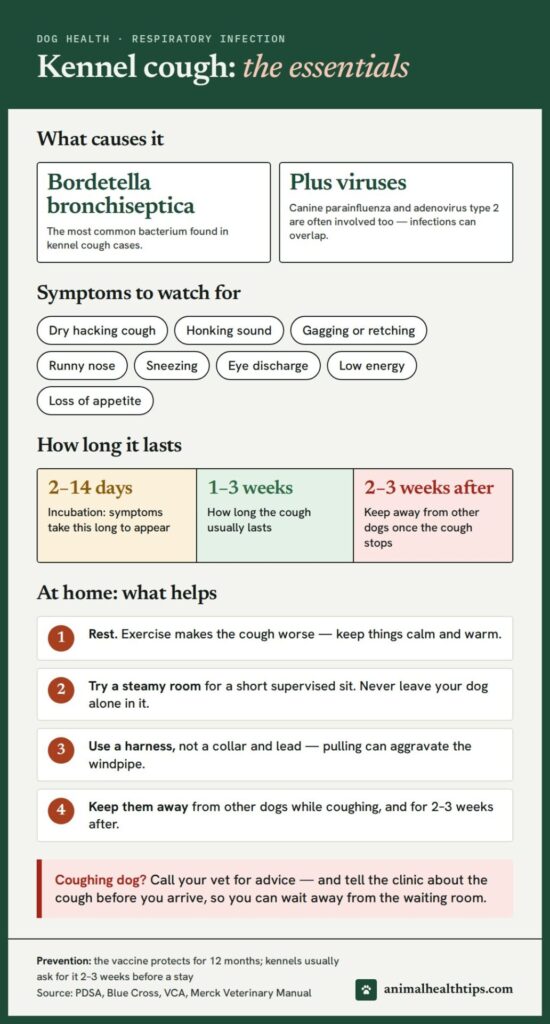
Kennel cough is an airway infection that causes a dry hacking cough in dogs. PDSA describes it as similar to human colds: a number of different germs — viruses and bacteria — can cause it, often in combination.
The most common bacterium is Bordetella bronchiseptica, according to Blue Cross. Viruses are often involved too, including canine parainfluenza virus and canine adenovirus type 2 — some of the same germs covered by dogs’ basic puppy vaccinations. The Merck Veterinary Manual calls it infectious tracheobronchitis: inflammation of the upper airways that is usually mild and normally improves on its own, though more than one organism is often involved at once.
Because so many strains are involved, a dog can catch kennel cough more than once — much like we catch colds again and again. Blue Cross notes that after a natural Bordetella infection, a dog is typically immune for six to 12 months.
What does kennel cough sound like?
The classic sign is unmistakable once you have heard it: a forceful, dry, honking cough that sounds as though the dog has something stuck in their throat. The cough can be dry and hoarse, or it can be followed by a gag, a swallowing motion or a little mucus.
Other signs to watch for:
- Runny nose, sneezing or discharge from the eyes
- Reduced appetite, though most dogs keep eating normally
- Low energy
- In more serious cases, a high temperature
Most dogs stay otherwise quite well. Merck notes that body temperature usually remains normal and any appetite loss is slight. But puppies, older dogs and dogs that are already unwell can develop more serious symptoms — fever, pus-like nasal discharge, depression and a productive cough — which can signal a second infection such as bronchopneumonia.
How do dogs catch kennel cough?
Kennel cough is highly contagious. PDSA says it spreads by direct contact between dogs, through the air, and on surfaces such as food bowls and leads — and it can survive in the environment for several weeks. Blue Cross adds that stress from crowded places, heavy dust or cigarette smoke, cold temperatures and poor ventilation make dogs more vulnerable.
That is why it is most common wherever dogs gather: boarding kennels, doggy day care, dog shows, training classes and busy dog parks. VCA notes that dogs visiting boarding facilities, daycares, dog parks or grooming salons are at increased risk.
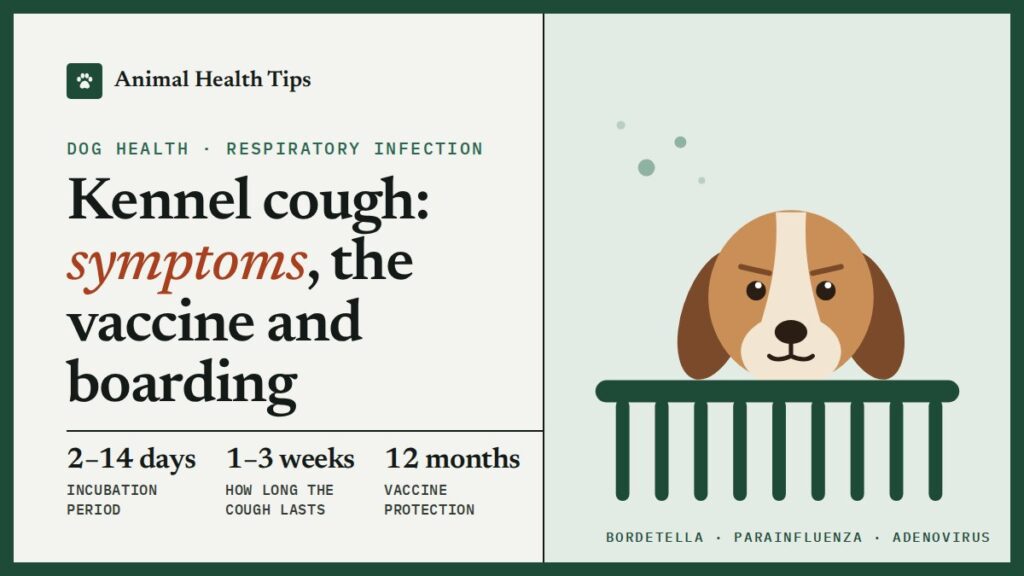
The incubation period is 2–14 days (Blue Cross), so a dog can pick it up at a kennel and only start coughing after they are home. Some dogs can even carry the infection for months without showing symptoms. While coughing — and for two to three weeks afterwards — a dog should be kept away from other dogs and public spaces.
How long does kennel cough last?
For most dogs it is a waiting game. PDSA says symptoms usually take 3–14 days to develop and then last 1–3 weeks. Merck puts the course at 10–20 days, with the worst of the cough easing during the first five days. Blue Cross warns it can sometimes linger for up to six weeks.
| Stage | What happens |
|---|---|
| 2–14 days after exposure | Symptoms appear: the dry hacking cough starts |
| 1–3 weeks | The cough usually lasts this long; most dogs stay otherwise well |
| 2–3 weeks after the cough stops | Keep your dog away from other dogs and public spaces |
| 12 months | How long the kennel cough vaccine protects; it is repeated yearly |
What to do if your dog has kennel cough
- Rest them. Exercise can make the cough much worse. Keep your dog warm, comfortable and calm — PDSA’s advice is rest and TLC.
- Try a steamy room. Sitting with your dog in a steamy bathroom can ease the cough. Never leave them alone in it, and don’t force them to stay if they are not relaxed.
- Swap the collar for a harness. Pulling on a lead can aggravate the windpipe, so walk on a harness until the cough is gone.
- Keep them home. No busy walks, no day care, no dog parks — while coughing and for two to three weeks after.
- Call your vet for advice if the cough is severe, lasts more than a few days, or your dog seems unwell. Tell the clinic about the cough before you arrive and wait outside until called, so it doesn’t spread in the waiting room.
The kennel cough vaccine: what boarding kennels ask for
PDSA calls vaccination the best way to prevent kennel cough, especially for dogs that mix with others or spend time in kennels. The vaccine protects for 12 months, so it is repeated every year.
It comes as nasal drops or an injection (Blue Cross). The nasal version can be given from three weeks of age, takes about four days to become effective, and is the fastest way to build immunity.
Most reputable kennels and day care centres ask for the vaccination two to three weeks before a stay — so with half-term boarding coming up, this is the week to check your dog’s record. Like any vaccine it is not a 100% guarantee: many strains circulate, so it reduces the chance of catching kennel cough and softens the symptoms if they do. And it won’t help a dog that is already incubating the infection.
Merck lists the main organisms vaccines cover: distemper, parainfluenza, canine adenovirus-2 and Bordetella bronchiseptica.
Which dogs are most at risk?
Healthy adult dogs usually shake kennel cough off. The ones to watch are puppies, elderly dogs and dogs with existing health problems — they are more likely to develop complications such as pneumonia. Merck warns it can progress to fatal bronchopneumonia in puppies.
Call your vet immediately if a young dog develops a wet cough and laboured breathing (VCA). One small reassurance: it is extremely rare for humans or cats to catch kennel cough (PDSA).
Key takeaways
- A dry, honking cough is the classic sign; symptoms appear 2–14 days after exposure and last 1–3 weeks.
- Rest, a steamy room and a harness help; keep coughing dogs away from others for 2–3 weeks after.
- The vaccine protects for 12 months — kennels usually want it 2–3 weeks before a stay.
- Puppies, older and unwell dogs are most at risk; a wet cough with laboured breathing needs a vet now.
Frequently asked questions
Can my dog catch kennel cough more than once?
Yes. Many different strains of bacteria and viruses cause it, much like human colds. Blue Cross notes that after a natural Bordetella infection a dog is typically immune for six to 12 months.
Can I or my cat catch it from my dog?
It is extremely rare for humans or cats to catch kennel cough, says PDSA. Still, keep a coughing dog away from other pets and wash shared bowls.
How do vets diagnose kennel cough?
There is no single test. If the dog has the symptoms and has been around other dogs within the incubation period, that is usually enough for a diagnosis; swabs can identify the exact germ (Blue Cross).
Does the vaccine guarantee my dog won’t get it?
No vaccine is 100%, but it significantly cuts the chance of catching kennel cough and softens the symptoms if they do (PDSA). It won’t help a dog that is already incubating the infection (Blue Cross).
My vaccinated dog is coughing — why?
Many strains circulate and the vaccine doesn’t cover every germ in the kennel cough complex (VCA). Call your vet for advice rather than assuming it can’t be kennel cough.
Should I still walk my dog?
Skip busy places while they cough and for two to three weeks after. Gentle, quiet outings on a harness are fine if your dog feels up to it.
Sources
- PDSA — Kennel cough
- Blue Cross — Kennel cough in dogs
- VCA Animal Hospitals — Kennel cough in puppies
- Merck Veterinary Manual — Infectious tracheobronchitis of dogs (kennel cough)
This guide is general information, not a diagnosis. If you are worried about your dog, contact your vet.