
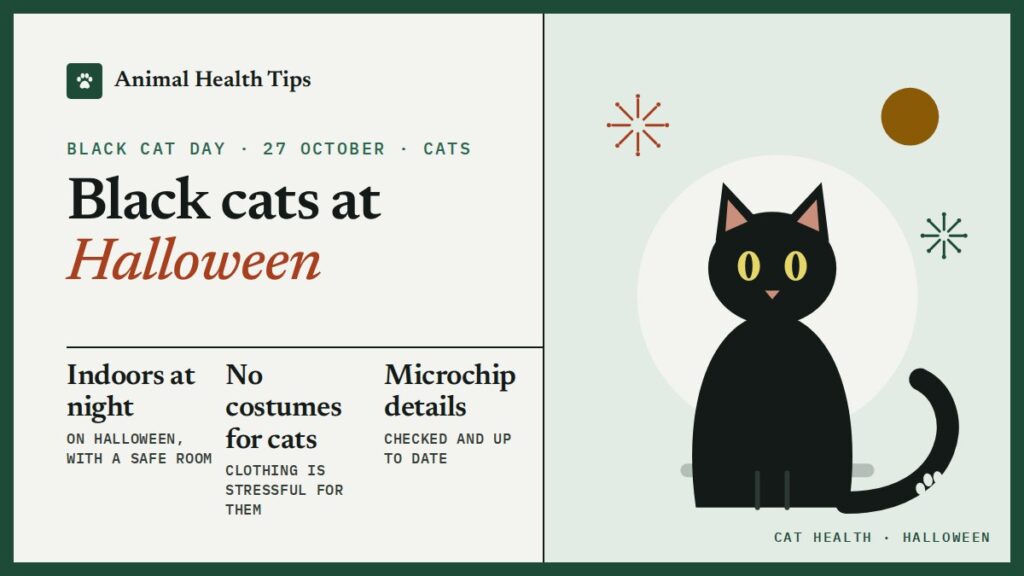
Halloween falls on Saturday this year, and tomorrow, 27 October, is National Black Cat Day. The two dates sit side by side for a reason: black cats are the animal most associated with Halloween, and they are also the cats that rescue centres have historically found hardest to rehome. But the safety advice for Halloween night is the same for every cat, whatever its colour — and some of the claims made about black cats at Halloween do not stand up.
In this guide6 sections
This guide separates what is verified from what is not. It covers the Halloween-night plan that Cats Protection, Blue Cross and VCA Animal Hospitals all agree on, what National Black Cat Day actually is, and what the rehoming figures really show — clearly dated, because the historic numbers are often quoted as if they were current. What it does not do is repeat the unproven claim that black cats face a special Halloween cruelty risk: no approved source opened for this article states one, and this article does not invent one.
Call your vet at once if
- Your cat has eaten chocolate, sweets, decorations or firework debris, or is vomiting, wobbling or fitting
- Your cat has burns from a candle or a lit pumpkin, or has chewed an electrical wire
- Your cat is injured, bleeding, or has been missing and returns hurt or distressed
UK: Animal PoisonLine, 01202 509000 — open 24 hours, run by the Veterinary Poisons Information Service; a fee applies.
US: ASPCA Animal Poison Control, (888) 426-4435 — open 24 hours; a consultation fee applies.
Why is Halloween night hard for cats?
For a cat, Halloween night is a run of small shocks: a doorbell that will not stop ringing, strangers in costumes at the door, parties, fireworks and a house full of decorations that smell, dangle and glow. Cats Protection’s advice is plain: dark autumn evenings can be dangerous for cats, with an increased risk of being injured on the roads, plus the stress of noisy parties and firework displays. Its recommendation follows directly: it is best to keep a cat indoors at night.
Blue Cross makes the same point about visitors. Trick-or-treaters dressed in costumes can be frightening for cats, and keeping cats in a safe room away from the door can prevent them from bolting outside if they get scared. VCA Animal Hospitals describes the scene vividly: scary costumes, a non-stop parade of strangers, squealing children and shouts of trick or treat can be alarming to even the calmest of cats. The advice is not to toughen the cat up. It is to remove the cat from the situation.
Fireworks make the week harder, not just the night. Cats Protection notes that firework season peaks in the last week of October, around Halloween, and the first week of November, around Bonfire Night. A sudden loud noise and flash can cause a cat to bolt in any direction, and a panicked cat can become terrified and disorientated. Our fireworks guide covers the season in full, and the same plan applies here: indoors after dark, curtains drawn, cat flap locked.
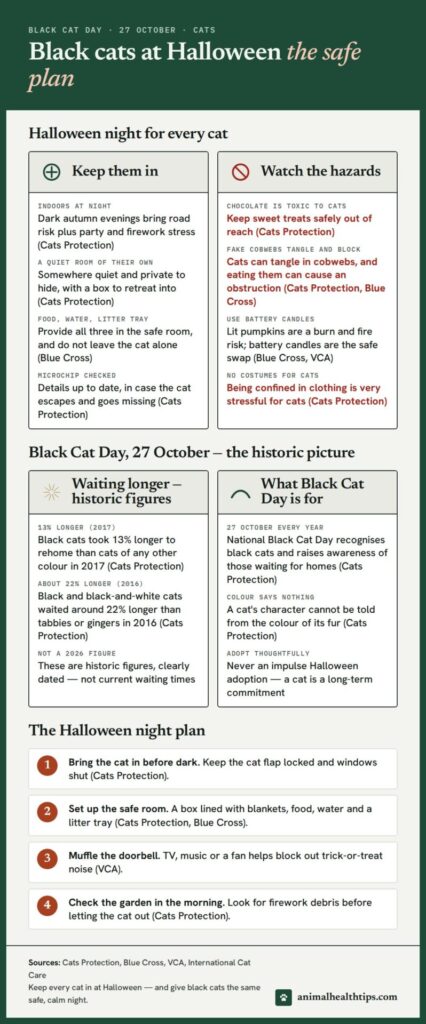
The Halloween-night plan for your cat
Set the plan up before the first trick-or-treater arrives. Work through these steps:
- Bring the cat in before dark. Keep the cat flap locked and windows shut, and provide a litter tray indoors even if one is not normally used (Cats Protection).
- Reserve a quiet room. Give the cat somewhere quiet and private to hide, where it will not be disturbed — a cardboard box or a covered bed to retreat into, with food, water and a litter tray (Cats Protection, Blue Cross).
- Muffle the doorbell. Keep the cat in a room away from the ringing doorbell, and turn on the television, play calming music or turn on a fan to help block out the noise (VCA).
- Check the microchip details. Make sure the cat is microchipped and the contact details are up to date, in case it escapes and goes missing (Cats Protection). In England, pet cats must be microchipped before they reach 20 weeks of age, by law (International Cat Care).
- Check the garden in the morning. Look for firework debris before letting the cat out: debris can stay hot enough to burn a mouth, and some firework metals are very poisonous if licked (Cats Protection).
Sweets, decorations and costumes: what to keep away
The treat bowl is the first hazard. Cats Protection says Halloween treats are very bad for cats: chocolate in particular is toxic to cats, and sweets can also make them unwell, so sugary snacks should be kept safely out of a cat’s reach. VCA adds the detail: chocolate can be toxic depending on the quantity and type eaten, candy wrappers can cause intestinal upset and blockage, and mints and gum may be artificially sweetened with xylitol, which may be toxic for cats. If accidental ingestion is suspected, contact a veterinarian right away.
Decorations are the second hazard, and the most underestimated. Cats Protection warns that cats can become easily tangled in fake cobwebs, chew through fairy-light wires, or try to climb or pull on hanging decorations, and that naked flames, such as those illuminating carved pumpkins, should be kept out of reach. Blue Cross adds that false cobwebs can be particularly dangerous because they can cause an obstruction in a cat’s tummy if eaten, and that a battery-operated candle is a cat-safe alternative to a lit pumpkin.
Costumes are the third hazard, and the advice here is absolute. Cats Protection says being confined in clothing is very stressful for cats, and they could injure themselves as they try to get free — so do not dress a cat up for Halloween. VCA agrees: cat costumes may be uncomfortable or scary, can obstruct the senses, be a constant tripping hazard, or be chewed accidentally, and suggests a festive collar, harness or bandana instead. A Halloween-themed blanket to snooze on, or a safe Halloween-themed toy, is Cats Protection’s own alternative.
| Halloween hazard | What it does | Safe swap |
|---|---|---|
| Chocolate and sweets | Chocolate is toxic to cats; sweets can make them unwell (Cats Protection) | Keep treats in a closed cupboard, out of reach |
| Fake cobwebs | Cats tangle in them; eating them can cause an obstruction (Blue Cross) | Skip cobwebs, or keep them where cats cannot reach |
| Lit pumpkins and candles | Burn and fire hazard with curious cats (VCA) | Battery-operated candles |
| Fairy lights and wires | Cats chew wires; a chewed wire can injure the mouth (ASPCA) | Keep wires covered and out of reach |
| Cat costumes | Confinement in clothing is very stressful; cats may injure themselves escaping (Cats Protection) | A themed blanket or safe toy instead |
| Rotten pumpkins | Fresh pumpkins are not harmful, but rotten ones can upset a cat’s tummy (Blue Cross) | Remove pumpkins as soon as they are no longer fresh |
What is National Black Cat Day?
National Black Cat Day falls on 27 October, and Cats Protection describes it as a time to recognise the beautiful black cats in our lives and raise awareness of those still waiting for a loving home. It encourages more people to adopt a black or black-and-white cat. That is the verified core of the day: a celebration and an adoption prompt, not a warning.
What the day is not, on the evidence available, is a response to a documented Halloween danger to black cats. No approved source opened for this article states a black-cat-specific Halloween cruelty rate, a number of black cats harmed or disappearing at Halloween, or that shelters pausing black-cat adoptions proves such a danger. Those claims circulate on blogs and rescue sites, but they are not on the approved pages, so this article does not repeat them. Keeping a black cat indoors on Halloween night is good advice — but it is good advice for every cat, for the reasons in the sections above: roads, noise, visitors and fireworks.
One more claim deserves the same care: the idea that black cats are overlooked because of bad-luck superstition, or because they photograph badly. Those explanations appear in secondary coverage, but they are not stated on the approved pages opened here. The one cause Cats Protection itself gives, in its historic release on the subject, is simpler: black is a more common colour, so there are more black cats looking for homes. Readers should be wary of any article that states a superstition explanation as a Cats Protection fact.
Do black cats really wait longer for homes?
The historic figures are real, but they are historic, and they should be quoted with their dates attached. In 2017, black cats took 13% longer to rehome than cats of any other colour, according to Cats Protection’s National Black Cat Day page. A year earlier, in 2016, Cats Protection reported that black and black-and-white cats waited around 22% longer to find a new home than other cats such as tabbies or gingers, and that they can be just as fun-loving, playful and affectionate as any other cat.
An earlier Cats Protection release, titled Fifty shades brighter, said that over 40% of cats given up to its centres were black or black-and-white, and that it then had over 1,400 black or black-and-white cats in need of homes across the UK. Those figures describe that period, not today. No current 2026 figure for how much longer black cats wait, what share of shelter cats are black, or how many black cats are currently in care was verified on an approved page for this article, so none is printed here. Any article that quotes a current figure without a dated, approved source should be treated with suspicion.
The useful conclusion survives the dating: colour says nothing about character. As Cats Protection’s own reporting puts it, there is no telling what a cat will be like based on the colour of its fur. If you are thinking of adopting, the sensible route is the one Cats Protection points readers to: search by lifestyle and location, meet the cat, and choose on temperament — and never as an impulse Halloween adoption. A cat is a long-term commitment, and the best Black Cat Day tribute is a thoughtful one, made in November as happily as in October. Our winter cat guide covers the colder months that follow, when outdoor cats need the same kind of planning.
Key takeaways
- Keep every cat indoors on Halloween night, in a quiet room with food, water and a litter tray.
- Do not dress a cat in a costume: Cats Protection says confinement in clothing is very stressful for cats.
- Chocolate is toxic to cats, fake cobwebs can obstruct, and lit pumpkins are a burn risk — use battery candles.
- National Black Cat Day, 27 October, celebrates black cats and encourages adoption — it is not evidence of a Halloween cruelty epidemic.
- Black cats historically waited longer for homes (13% longer in 2017; about 22% longer in 2016) — historic figures, clearly dated, not current ones.
- Check the microchip details are up to date before the season starts: it is the best chance of reunion if a cat bolts.
Frequently asked questions
Should I keep my black cat indoors specifically on Halloween?
Keep every cat indoors on Halloween night, black or not. Cats Protection’s advice is general: dark autumn evenings bring road risk plus party and firework stress. A quiet room, a litter tray and up-to-date microchip details are the plan for all cats, whatever their colour.
Is it true that black cats are in danger from cruel people at Halloween?
No approved source opened for this article states a black-cat-specific Halloween cruelty rate or a number of black cats harmed at Halloween. That claim appears only on blogs and rescue sites, so this article does not repeat it. The verified Halloween risks for cats are roads, noise, visitors, fireworks, sweets and decorations.
Can I dress my cat up for Halloween?
No. Cats Protection says being confined in clothing is very stressful for cats, and they could injure themselves trying to get free. VCA suggests a festive collar, harness or bandana instead, and Cats Protection suggests a themed blanket or safe toy.
What is National Black Cat Day?
It falls on 27 October, and Cats Protection describes it as a time to recognise black cats and raise awareness of those waiting for a loving home. It encourages adoption of black and black-and-white cats — thoughtfully, and never as an impulse Halloween decision.
Do black cats really wait longer to be adopted?
Historically, yes, on Cats Protection’s figures: 13% longer in 2017, and around 22% longer for black and black-and-white cats in 2016. Those are historic figures, not current ones — no verified 2026 figure was found on an approved page, so this article does not print one.
My cat ate Halloween sweets. What should I do?
Contact your vet right away, especially if chocolate was involved. VCA advises not waiting for symptoms: chocolate can be toxic depending on quantity and type, wrappers can block the gut, and some mints and gum may contain xylitol, which may be toxic for cats.
Sources
- Cats Protection — 5 ways to keep your cat safe at Halloween
- Cats Protection — National Black Cat Day
- Cats Protection — Fifty shades brighter for black cats
- Blue Cross — How to keep your cat safe during Halloween
- VCA Animal Hospitals — Halloween Safety Tips for Cats
- International Cat Care — Microchipping cats
- ASPCA — ASPCA’s Top 5 Tips for a Safe Howl-O-Ween
This guide is general information, not a diagnosis. If you are worried about your pet, contact your vet.
1 comment