Fireworks season is here, and for cats it is the most stressful stretch of the year. Cats Protection notes that fireworks go on sale from mid-October, with peak activity in the last week of October and the first week of November — Halloween and Bonfire Night. To a cat, whose hearing the RSPCA says is about three times more sensitive than ours, every bang sounds far louder and far closer than it does to us.
In this guide8 sections
Cats do not need a display on their doorstep to be frightened: Cats Protection explains that cats associate loud noises with danger, and that the sudden noise and flash of fireworks can cause a cat to bolt for safety, in any direction, in panic. The good news is that a few simple preparations — indoors after dark, a safe hiding place, and a calm house — make a real difference. This guide follows the advice of the RSPCA, Cats Protection, Blue Cross and PDSA.
See your vet promptly if
- Your cat is injured — the PDSA says an injured cat must be taken to a vet as soon as possible
- Your cat’s fear or stress signs do not settle once the fireworks are over — the PDSA advises a vet visit for long-term help
- You think your cat has licked or eaten firework debris, which can burn the mouth and contains metals toxic to cats
UK: Animal PoisonLine, 01202 509000 — open 24 hours, run by the Veterinary Poisons Information Service; a fee applies.
US: ASPCA Animal Poison Control, (888) 426-4435 — open 24 hours; a consultation fee applies.
Why fireworks frighten cats
It starts with hearing. The RSPCA explains that a cat’s hearing is about three times more sensitive than ours, so fireworks sound much louder and more frightening to them, and the startling sounds can cause severe distress. A cat that is frightened does not reason about the noise — it runs, hides, or freezes, and a bolted cat can end up far from home.
The season is long. Fireworks go on sale from mid-October, and Cats Protection puts the peak in the last week of October and the first week of November. Blue Cross frames its advice more broadly still, covering the whole stretch from Bonfire Night to New Year’s Eve. That means the plan below is not for one night only — it is a habit for the season.
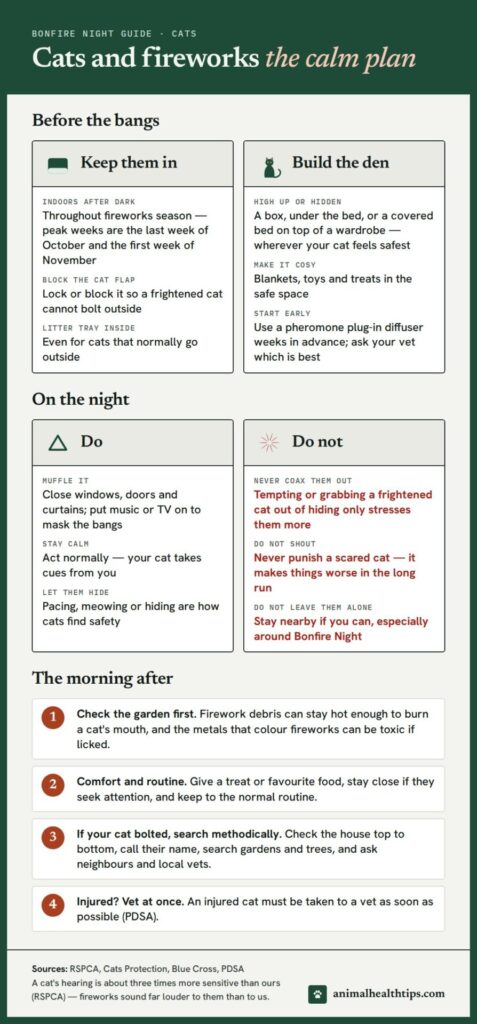
Before the bangs: set up for the season
Most of the work happens before a single firework goes off:
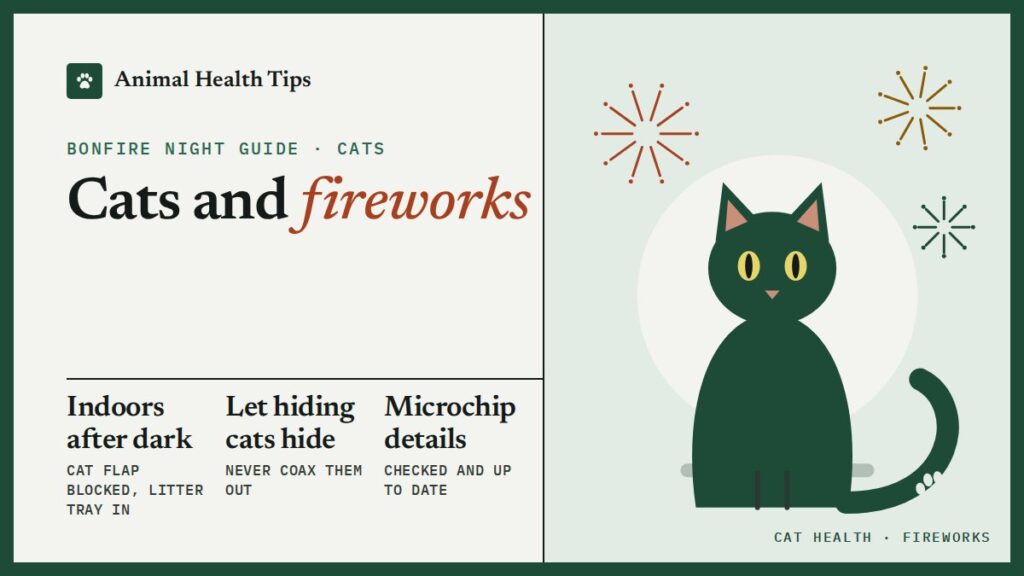
- Keep your cat indoors after dark. The RSPCA’s first instruction for cats is to keep them indoors, especially after dark, throughout the season. Blue Cross adds: check the dates and times of local displays, so you know when to keep your cat in.
- Build a safe space. Wherever your cat usually feels safest — high up, inside a box or under the bed — make it extra cosy with blankets, toys and treats, says the RSPCA. Cats Protection adds that a dark hidey-hole is exactly what a frightened cat wants.
- Provide plenty of hiding places. Give your cat access to the wardrobe, beneath the bed, even cupboards, if that is where they try to hide — but do not forget to let them back out, the RSPCA notes.
- Block the cat flap. Close all windows and doors and block the cat flap, so a frightened cat cannot try to escape — and to muffle the sound, Blue Cross advises.
- Put a litter tray inside. Even if you do not normally use one indoors, this is a time when it is worth doing so, says Cats Protection.
- Start a pheromone diffuser early. Pheromone plug-in diffusers can calm anxious or afraid cats and are best when used weeks in advance, says the RSPCA — talk to your vet to find the best one.
- Check the microchip. Make sure your cat is microchipped and that the registered details are up to date. The RSPCA notes that, by law, any cat over 20 weeks old should already be microchipped.
On the night: what to do
When the fireworks begin, the RSPCA’s advice for cats comes down to muffling, calm and freedom to hide:
- Close windows and curtains. If possible, black out your cat’s safe space so they cannot see flashes from outside.
- Put on music or TV. A pre-made playlist of soothing sounds, or simply the television, helps to mask the firework sounds.
- Stay nearby and stay calm. Do not leave your cat alone if you can help it, and act as you usually do — your cat takes cues from you.
- Let them pace, meow or hide. If your cat is pacing, yowling or hiding, let them. They are trying to find safety, not misbehaving.
- Never coax them out. Do not try to tempt or grab a frightened cat out of hiding — Cats Protection warns it will just stress them more. They will usually come out when the noises are over.
- Comfort, don’t punish. It is fine to cuddle and stroke your cat if it helps them relax, says Blue Cross — but never shout at a frightened cat, and never punish a pet for being scared, says the RSPCA.
Signs your cat is stressed
Knowing what to watch for means you can act early. The RSPCA lists the signs of stress in cats during fireworks as hiding, eating or drinking less, pacing, or appearing visibly scared. The PDSA’s list of anxiety signs is longer: shaking, cowering, hiding, refusing to eat, toileting in the house, pacing and panting, or trying to run away.
If you see these signs, remain calm yourself and provide comfort as you normally would if your cat needs you, the PDSA advises. If your cat hides in a den, do not try to coax them out — let them stay where they feel safest. Cats Protection adds a useful note: a cat can hear far better than we can, so fireworks may still be audible to them even when you think they have stopped. Wait for your cat to emerge of its own accord, and make sure food and water will be available when it comes out.
| Do | Don’t | Why it matters |
|---|---|---|
| Keep your cat indoors after dark | Leave your cat outside during displays | A frightened cat bolts in any direction in panic (Cats Protection) |
| Provide hiding places, high up or dark | Tempt or grab a hiding cat out | Forcing them out only stresses them more (Cats Protection) |
| Close curtains; put music or TV on | Leave windows and curtains open | Muffling sound and blocking flashes reduces the fear (RSPCA) |
| Check microchip details are current | Assume the details are still right | Up-to-date details give the best chance of reunion (Blue Cross) |
| Stay calm and stay nearby | Shout at or punish a scared cat | Punishment makes things worse in the long run (RSPCA) |
The morning after: the garden check
The danger does not end when the noise stops. Before letting your cat out in the morning, or opening the cat flap, check your garden for firework debris carefully. Cats Protection warns that fireworks can stay hot enough to burn a cat’s mouth for a long time, and that many rely on heavy metals for their colour effects — mercury, antimony, barium, strontium and phosphorus — which can be toxic if your cat licks them.
The ASPCA gives the same advice in general terms: keep pets far away from fireworks, keep fireworks securely locked away, and if you set off fireworks at home, thoroughly clean up the area before letting pets have access again. Once the garden is clear, comfort your cat if they still seem stressed: the RSPCA suggests a treat or favourite food, staying close if they seek attention, being patient while they recover, and keeping to the normal routine as much as possible.
If your cat bolts or goes missing
A frightened cat’s natural response is to run away from the perceived danger, the PDSA explains — and should they bolt far away in panic, it may not be easy for them to find their way back home. A spooked cat can go missing for a few hours to several days, depending on how far from home they are.
If yours goes missing, the PDSA’s steps are: check your house from top to bottom in case they have found a new hiding spot; call out your cat’s name and use favourite treats to lure them out; search your immediate area including gardens, tall trees and porches; reach out to neighbours and share contact details; and contact local vet practices, animal welfare groups and rescue centres to ask if any cats have been found or brought in. Check your cat’s microchip details are correct, especially if you have moved address or changed your phone number — microchipping only reunites pets if the information linked to it is up to date.
If you also have a dog, our fireworks guide for dogs covers the dog-specific steps, such as walking during daylight hours. And if you are unsure whether what you are seeing is fear or pain, our guide to recognising pain in cats explains the signs that mean a vet visit.
Helping a very fearful cat long term
If your pet gets very afraid of fireworks this season, the PDSA advises visiting your vet to get advice on tackling the problem long term — they may discuss possible treatments or referral to an accredited pet behaviourist. The RSPCA agrees: if the impact of fireworks is long term, you could ask your vet to refer you to a clinical animal behaviourist to help your pet better cope.
Timing is the catch. Blue Cross notes that behaviour plans should be started at least three to six months in advance of fireworks night, and that veterinary help should be sought six to 12 weeks before the season begins. With patience it is possible to help a pet combat these fears, the PDSA says — but it does take time. So if this season was hard on your cat, book the conversation now, while the memory is fresh, and next year’s season will start from a better place.
Key takeaways
- Keep your cat indoors after dark all season, with the cat flap blocked and a litter tray inside.
- Build a cosy den where your cat feels safest — high up, in a box or under the bed — and never coax a hiding cat out.
- Muffle the bangs with closed curtains and music or TV, stay calm and nearby, and never punish a scared cat.
- Check the garden for hot, toxic firework debris before letting your cat out in the morning.
Frequently asked questions
Should I keep my cat in all day during fireworks season?
The advice is indoors after dark, when fireworks are let off. Daytime outings are fine, but check the dates and times of local displays and bring your cat in well before dark — and block the cat flap for the night.
My cat hides and will not come out. Should I leave food out?
Yes. Cats Protection advises waiting for your cat to emerge of its own accord, and making sure food and water will be available when it comes out. Do not try to tempt or grab them out of hiding.
Do pheromone diffusers help cats with fireworks?
The RSPCA says pheromone plug-in diffusers can calm anxious or afraid cats, and that they are best when used weeks in advance. Talk to your vet to find the best one for your cat.
Is it the law to microchip my cat?
The RSPCA notes that, by law, any cat over 20 weeks old should already be microchipped. Blue Cross adds that you should check your contact details are up to date before fireworks season, for the best chance of reunion if your cat bolts.
What if my cat licks or eats firework debris?
Firework debris can stay hot enough to burn a cat’s mouth, and the metals that colour fireworks can be toxic if licked, Cats Protection warns. Check the garden before letting your cat out, and contact your vet at once if you think your cat has licked or eaten debris.
When should I ask for long-term help with fireworks fear?
If your cat’s fear is severe or does not settle after the season, visit your vet: they may discuss options or refer you to an accredited behaviourist. Blue Cross notes behaviour plans should start three to six months before fireworks night, so start early.
Sources
- RSPCA — Keeping dogs, cats and other small pets safe during fireworks
- Cats Protection — Fireworks and cats: keeping your cat safe
- Blue Cross — Cats and fireworks
- PDSA — Eight million pets fear fireworks
- PDSA — Why do cats go missing?
This guide is general information, not a diagnosis. If you are worried about your pet, contact your vet.