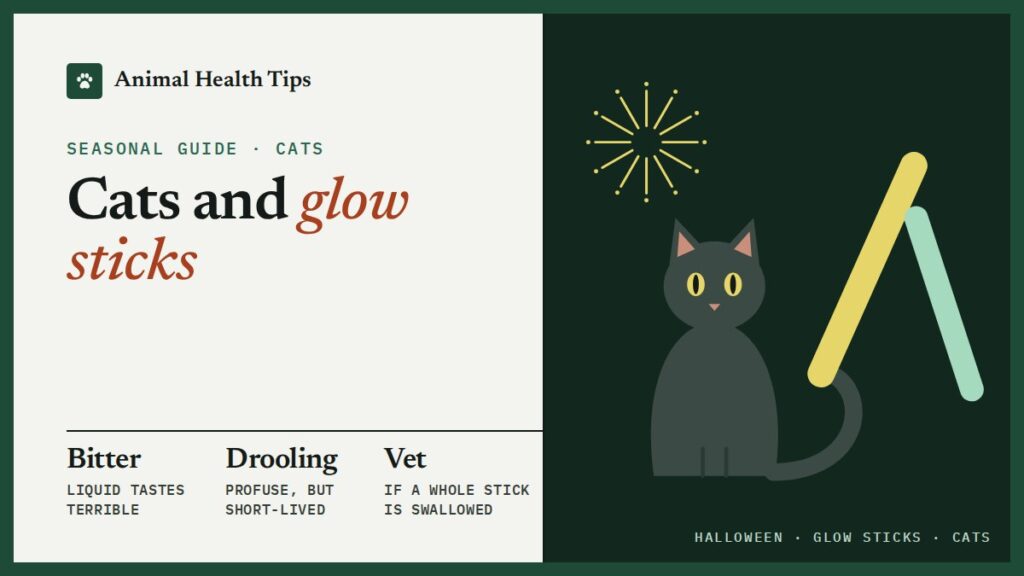
Halloween is tomorrow, and glow sticks are everywhere: in party bags, on costumes, and lying on floors after the party ends. Cats find them fascinating. They are bright, they move, and they are fun to chew — and that is exactly how a cat ends up biting one open.
In this guide6 sections
What follows looks alarming. The ASPCA’s Halloween guidance says pets, especially cats, find glow sticks fun, and that the Animal Poison Control Center commonly gets calls about pets puncturing the sticks, with the pets often seen drooling and racing around the house. The short version is reassuring: the liquid is usually an irritant with a terrible taste, not a poison in the amount inside a party glow stick. The exception matters too, and it is covered below.
Call your vet right away if
- Your cat swallowed a whole glow stick, or part of one
- Your cat is very distressed, or the drooling and agitation do not settle
- Liquid got into your cat’s eyes, or your cat cannot open its eyes comfortably
- Your cat is vomiting repeatedly, or seems unwell after the incident
- UK: Animal PoisonLine, 01202 509000 — open 24 hours, run by the Veterinary Poisons Information Service; a fee applies.
- US: ASPCA Animal Poison Control, (888) 426-4435 — open 24 hours; a consultation fee applies.
What is inside a glow stick?
The liquid in glow sticks and glow jewellery is dibutyl phthalate, often shortened to DBP, a nearly colourless oily liquid that is the primary luminescent component in glow-in-the-dark products. That fact comes from the ASPCA Animal Poison Control Center’s toxicology brief on glow jewellery ingestion in cats. The same brief considers dibutyl phthalate to have a low-order acute toxicity, and notes that the small quantity of fluid in a glow stick generally has a low potential for toxicity if a pet breaks open a tube.
That is the key distinction: irritant, not systemic poison. Pet Poison Helpline’s Halloween guidance puts it plainly, saying the liquid does not cause systemic toxicity or organ damage, but it can cause oral irritation and a very bitter taste. The ASPCA brief agrees that the extremely unpleasant, bitter taste probably limits exposure in most cases to minute quantities, and that most, if not all, of the signs are likely behavioural responses to that unpleasant taste. The cat is not usually being poisoned. It is reacting, dramatically, to something that tastes awful.
There is one important limit to that reassurance. It applies to the small amount of liquid in an ordinary party glow stick or piece of glow jewellery. It does not cover a cat swallowing the whole stick, a large industrial glow product, or an unknown liquid, and this article does not extend it to those cases. If your cat swallowed the stick itself, or part of it, call your vet right away, as VCA advises for a pet that ingested the whole glow stick or is very distressed.
Why cats are drawn to glow sticks, and what happens
Cats are drawn to glow sticks for the same reason they are drawn to anything small, bright and moving. Pet Poison Helpline notes that, due to their curious nature, cats often accidentally ingest glow sticks and jewellery because they are bright and fun to chew, and that while this is not usually life-threatening, the contents can cause mouth pain and irritation as well as profuse drooling and foaming at the mouth.
The signs are distinctive. The ASPCA brief reports that almost all cats that bite into glow-in-the-dark jewellery exhibit a sudden onset of profuse salivation — drooling, in plain terms. VCA lists what one bite can cause: the oily liquid leaking out, causing gagging, drooling and gastrointestinal upset, as well as irritation of the eyes, mouth and skin. Pet Poison Helpline adds that dogs and cats can develop profound drooling or foaming at the mouth and may act agitated due to the bitter taste and irritation in their mouths. Cornell’s CatWatch adds that typical signs include drooling, hyperactivity and agitation, and that the effects are short term, usually a response to the bitter taste.
That agitation is what frightens owners most. A normally calm cat may suddenly race around the house, seem hyperactive, or behave aggressively for a short while. The ASPCA brief, describing cases from 1999, noted that nearly half of the cats in those cases exhibited various neurologic signs, primarily hyperactivity and aggressive behaviour, and that complete recovery, with or without treatment, generally occurred within minutes in those cases. Those figures are dated to 1999 and are not presented here as current figures. The point that still holds, across the ASPCA, VCA and Cornell sources, is that the reaction is usually short-lived and driven by taste and irritation, not by poisoning.
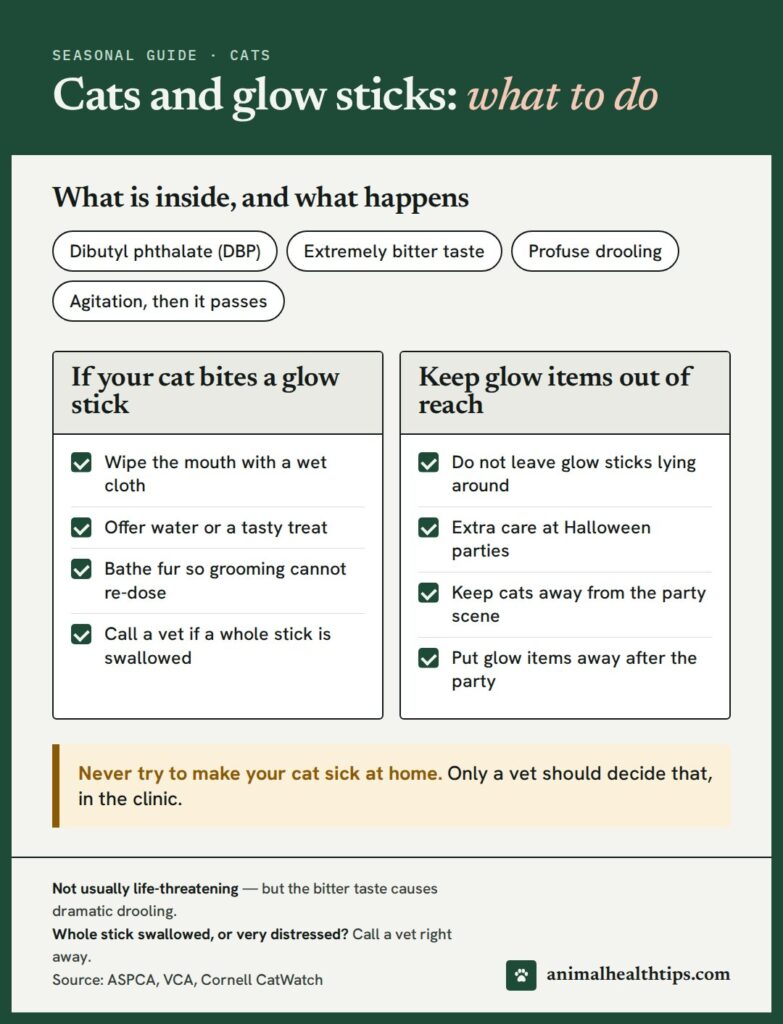
What to do if your cat bites a glow stick
- Stay calm and take the glow stick away. Remove any broken pieces so your cat cannot bite it again.
- Wipe the mouth with a wet cloth. VCA advises using a wet facecloth or towel to remove the DBP from your pet’s mouth and tongue.
- Offer water or a tasty treat. VCA advises offering water or a treat to help reduce the bitter taste, and the ASPCA’s Halloween guidance notes that a little treat or a sip of milk will usually stop the taste reaction.
- Bathe liquid off the fur. VCA advises giving your pet a bath so it will not get another dose of DBP while grooming, and the ASPCA brief advises washing drops of the chemical off the skin or coat with soap and water.
- If liquid got into the eyes, flush them with plenty of water, as the ASPCA brief advises for ocular exposure.
- Do not try to make your cat sick at home. Only a vet should decide that, and there is no known antidote for dibutyl phthalate poisoning, according to the ASPCA brief.
- Watch your cat until it settles, and call your vet if it does not. If your cat swallowed a whole stick or is very distressed, VCA advises consulting your veterinarian right away.
When to call the vet
Most cats settle within minutes once the taste is gone and the fur is clean. Call your vet right away if that does not happen, or if any of the amber-box situations apply: a whole stick swallowed, very great distress, eye exposure that does not settle, repeated vomiting, or a cat that seems unwell after the incident. When you call, say what your cat bit, whether any of it was swallowed, and how your cat is behaving now. Keep the broken stick or its packaging if you can, so the vet can see what product it was.
Do not wait for symptoms in the whole-stick case. VCA’s advice is to consult a veterinarian right away if the pet ingested the whole glow stick or is very distressed, and that advice stands even if your cat seems fine at first. A swallowed plastic tube is a different problem from a mouthful of bitter liquid, and it needs a vet’s judgement, not a wait-and-see approach at home. This is worth keeping in mind for Bonfire Night next week too, when glow items appear again at parties and displays. Our guide to black cats at Halloween covers the wider Halloween safety picture for cats, including keeping cats indoors on Halloween night.
Keeping glow sticks away from cats
| Do | Avoid |
|---|---|
| Put glow sticks and glow jewellery away after the party | Leaving glow sticks lying around — the ASPCA warns against this |
| Keep cats in a separate, quiet room during parties | Letting cats play with glow jewellery as a toy |
| Hand glow items to children, not to pets | Attaching glow sticks to a collar, lead or harness |
| Clear up broken pieces at once | Assuming a bitten stick is harmless because the liquid is low-toxicity |
| Call your vet if a whole stick is swallowed | Trying to make your cat sick at home |
Cornell’s CatWatch gives a useful general Halloween rule: keep the cat in a separate room away from the party scene on Halloween, with bed, food, water and a toy, so its whereabouts are known and it cannot dart out or reach hazards. A cat in its own quiet room cannot bite a glow stick left on the floor, cannot slip out of an open door, and is not stressed by a house full of visitors. For the wider fireworks season, see our guide to cats and fireworks for Bonfire Night.
Key takeaways
- Glow stick liquid is dibutyl phthalate: extremely bitter, an irritant, and generally low-toxicity in the small amount in a party stick.
- Expect sudden profuse drooling, foaming, gagging and agitation — dramatic, but usually short-lived and driven by taste.
- Wipe the mouth, offer water or a tasty treat, and bathe liquid off the fur so grooming cannot re-dose your cat.
- A swallowed whole stick, or a very distressed cat, needs a vet right away — do not wait and see.
- Never try to make your cat sick at home, and never leave glow sticks lying around.
Frequently asked questions
Are glow sticks poisonous to cats?
Usually not in the way owners fear. The liquid, dibutyl phthalate, is considered to have low-order acute toxicity, and Pet Poison Helpline notes it does not cause systemic toxicity or organ damage, though it causes oral irritation and a very bitter taste. A swallowed whole stick is a different matter and needs a vet right away.
Why is my cat drooling so much after biting a glow stick?
Because the liquid tastes extremely bitter. The ASPCA brief reports almost all cats that bite glow jewellery show sudden profuse salivation, and Cornell notes the effects are short term, usually a response to the bitter taste. Wiping the mouth and offering a tasty treat usually helps the reaction pass.
What should I do first if my cat bites a glow stick?
Take the stick away, wipe your cat’s mouth with a wet cloth, and offer water or a tasty treat to mask the bitter taste. Then bathe any liquid off the fur, so grooming cannot give your cat another dose. Call your vet if a whole stick was swallowed or your cat is very distressed.
Will my cat be all right?
In most cases, yes, and quickly. The ASPCA brief, describing 1999 cases, reported complete recovery within minutes in those cases, with no long-term effects or deaths reported at that time. Those figures are dated to 1999. If your cat does not settle, or swallowed the stick itself, call your vet.
Can I put a glow stick on my cat’s collar so I can see it at night?
No. The ASPCA warns not to leave glow sticks lying around, and a glow stick on a collar is a chewable target your cat can bite open. Keep glow items for people, and keep cats in a separate, quiet room during parties.
Should I try to make my cat sick?
No. Never try to make your cat sick at home — only a vet should decide that. There is no known antidote for dibutyl phthalate poisoning, according to the ASPCA brief, so the response is to remove the taste and irritation and to call a vet if the situation is serious.
Sources
- ASPCA Animal Poison Control Center — Glow jewelry (dibutyl phthalate) ingestion in cats — toxicology brief
- VCA Animal Hospitals — Are glow sticks harmful to pets?
- ASPCA — Tips on costumes, candy and celebrating safely with your pets this Halloween
- Cornell CatWatch — Two often-overlooked Halloween hazards
- Pet Poison Helpline — Halloween safety tips for pets
This guide is general information, not a diagnosis. If you are worried about your pet, contact your vet.