You come home, or the doorbell rings, and your cat is gone. Under the bed, behind the sofa, on top of the wardrobe — somewhere you cannot easily reach, and somewhere your cat plainly wants to be. It is easy to read that as rejection, or as a problem to fix by coaxing the cat out. Usually it is neither. Hiding is one of the main ways cats cope with a world that feels threatening, and a cat that can hide will often settle far faster than a cat that cannot.
In this guide7 sections
That does not mean every hiding cat can be left alone. Cats are also experts at hiding illness, and a cat that hides more than usual, or hides and stops eating, drinking or using the litter tray, may be in pain. The skill is telling those two cats apart. Tonight is a good night to learn it: Halloween brings a stream of strangers to the door, and fireworks season runs on into November, with Bonfire Night on Thursday 5 November. Both are exactly the kind of event that sends a cat into hiding — and both are covered below.
Call your vet promptly if
- Hiding is new, sudden, or much more than usual
- Your cat is eating or drinking less, or not at all
- Your cat is not using the litter tray, or is toileting outside it
- Your cat is lethargic, sleeping much more, or uninterested in play
- Your cat is defensive, hisses or flinches when approached
Why cats hide: a coping strategy, not misbehaviour
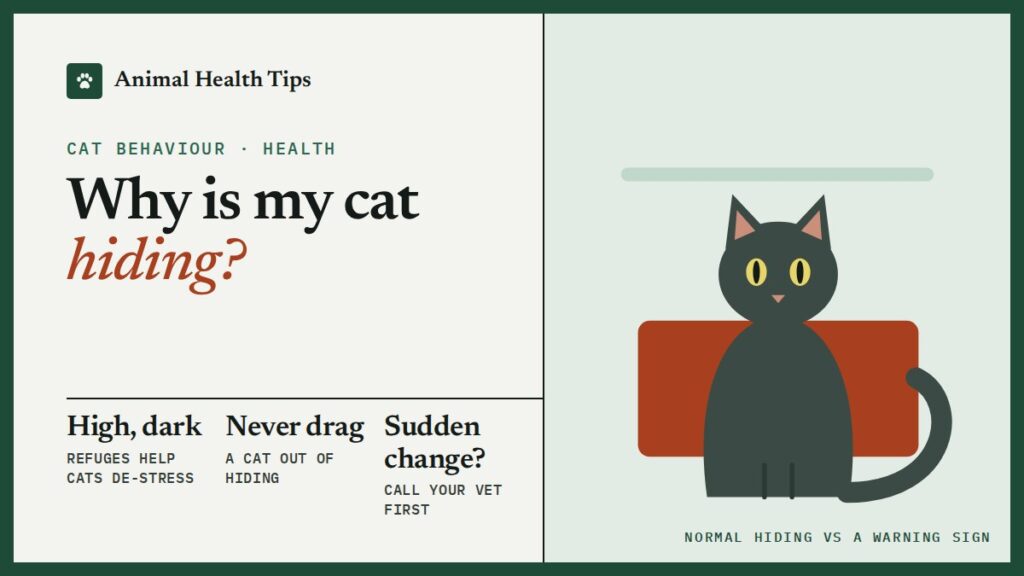
International Cat Care explains the logic plainly: as a solitary species, when a cat feels threatened its best chance of survival, as it perceives it, is to run, hide and stay quiet until the danger has passed. Cats Protection puts it in practical terms: hiding is a way of helping shy cats cope with being afraid or anxious, and if a cat disappears to a cupboard or under a bed when a stranger enters the house, leave them to it, and let friends and family know not to seek them out in their hiding place.
Cats often prefer to hide somewhere up high, Cats Protection adds, which allows them to look out onto their surroundings and keeps them calm when they might be feeling worried. Cats de-stress more quickly if they can hide, preferably somewhere high and dark, such as behind sofas or on shelves.
What frightens a cat into hiding
PDSA lists the common examples of cat fears: strangers or unfamiliar people, fireworks, other cats, loud noises, and dogs or other predators. Festive visitors fit that list directly: PDSA describes a world that can be scary for a cat as running from the loud bangs and bright lights of fireworks, to storms and lots of festive visitors. A new home, a new pet, a new baby, building work or a neighbour’s cat at the window can do the same, and a cat first brought home may be quiet and wary for the first few days or weeks while it gets used to its new home, International Cat Care notes.
Fear has a recognisable shape. Cats Protection lists running away, retreating to hiding places, dilated pupils, flattened ears, and cringing and cowering. PDSA adds freezing or crouching low, arching the back and puffing up fur, wide eyes with big pupils, tucking the tail, hissing or spitting, and peeing or pooing outside the litter tray. If you see that cluster, your cat is not being difficult. It is frightened, and it needs space, not attention.
Normal hiding vs a warning sign
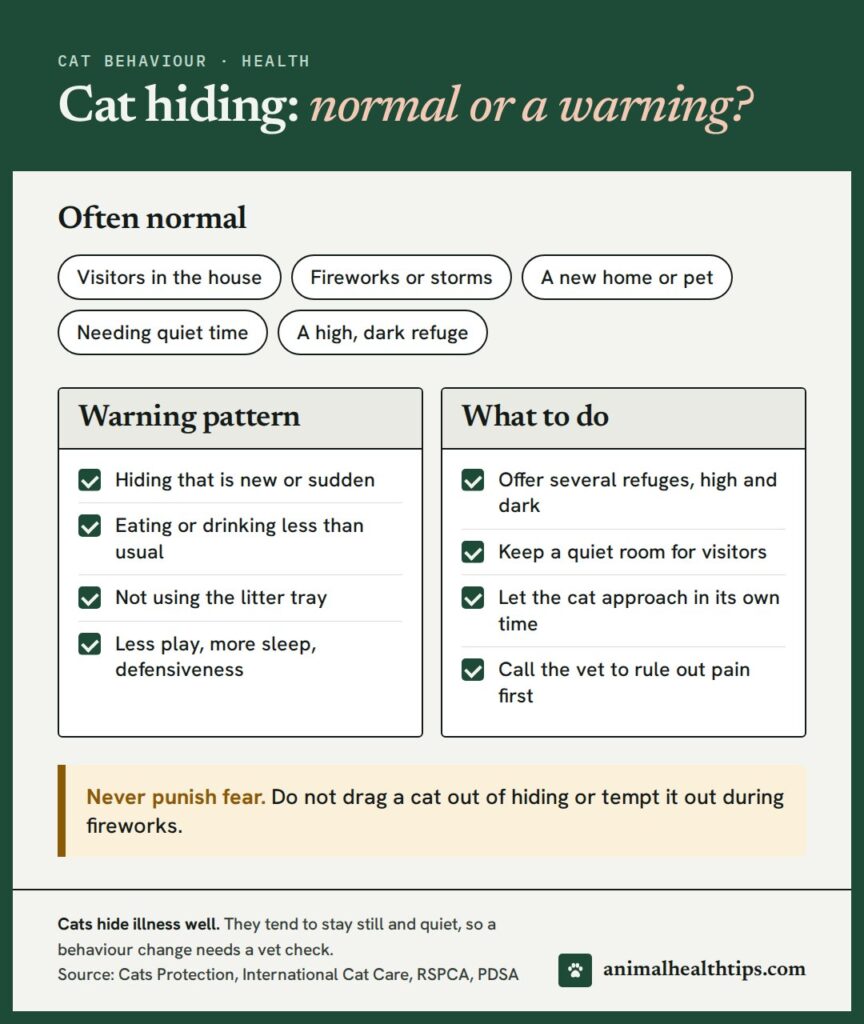
Normal hiding has a pattern: the cat still eats and drinks, still uses the litter tray, and comes out when it feels safe — for food, for its usual sleeping spot, or when the visitors have gone. The trigger is usually visible: a stranger, a loud noise, a change at home. The cat’s behaviour returns to normal once the trigger passes, and the cat is otherwise itself.
The warning pattern is different, and it is a pattern, not a single event. International Cat Care notes that changes in a cat’s behaviour and normal daily routines are the first signs that something is wrong — for example, a cat may start sleeping under the bed instead of on top of it, go outside less, or eat more or less than normal. VCA lists anxiety symptoms that include urinating or defecating out of the litter box, hiding under the bed or in other spaces more than usual, changes to appetite, and disinterest in interaction or play. VCA also warns that signs of anxiety are non-specific, so physical health conditions should be ruled out before assuming a cat is chronically anxious. No hour threshold is given here: no approved source opened for this article gave a single rule for how long hiding alone should last before a vet visit, so do not rely on a clock — rely on the pattern.
Pain and illness: why a vet check comes first
This is the most important section in the article, and the one owners most often skip. Cats are excellent at hiding signs of illness or pain — they tend to stay still and quiet, so as not to attract attention, International Cat Care notes, which is one reason pain and illness are difficult to establish and monitor in cats. Cornell’s Feline Health Center makes the same point for older cats: it is common for a cat to have a serious medical problem yet not show any sign of it until the condition is quite advanced.
That is why every approved source used here says the same thing in different words. Cats Protection: before you do anything, contact your vet for a thorough check to ensure your cat is not in pain or has an illness. International Cat Care: any dramatic behaviour change should not be ignored, and a thorough examination should be arranged, as it may be a sign of illness or pain. PDSA: it is always important to get a cat checked by a vet if it is suddenly acting differently, although most fears are a behavioural issue. Chronic pain, for example arthritis, may cause a cat to behave defensively, including fear-related behaviours such as hissing if approached, International Cat Care adds. If no physical cause is found, the vet can refer to a qualified behaviourist — but the vet comes first. For more on spotting pain, see our guide to how to tell if your cat is in pain.
What to do: refuges, routine and visitors
- Provide several refuges. Cats Protection advises providing plenty of refuges where cats can hide, preferably high and dark. A box, access under the bed, a shelf or a cosy bed on top of a wardrobe all count.
- Never drag a cat out of hiding, and never punish fear. International Cat Care advises not moving a cat from its hiding place, and the RSPCA advises never punishing a pet when scared, as reacting negatively will only make things worse in the long run.
- Let the cat approach you. Cats Protection advises letting your cat approach you, as direct approaches are extremely threatening, and sitting quietly nearby so the cat can get used to you in its own time.
- Give visitors a rule. Tell friends and family not to seek the cat out in its hiding place, and give the cat a quiet room away from the social areas, with food, water and a litter tray.
- Keep routines steady. VCA notes cats thrive on routine, including regular mealtimes, and advises as many litter boxes as cats plus one. PDSA advises maintaining daily routines so a cat knows what to expect.
- Note the pattern for the vet. International Cat Care advises giving the vet when and where the change started, any triggers, how frequently it happens and how it has progressed.
| What you see | More likely | What to do |
|---|---|---|
| Hides when visitors arrive, comes out after | Normal coping | Leave the cat alone; quiet room |
| Hides in a high, dark refuge, eats and drinks normally | Normal coping | Provide refuges; keep routine |
| Hiding is new, sudden or much more than usual | Pain, illness or serious fear | Call your vet promptly |
| Hiding plus eating or drinking less | Illness or pain until proven otherwise | Call your vet promptly |
| Hiding plus toileting outside the tray | Illness, pain or distress | Call your vet promptly |
| Hiding plus lethargy or no interest in play | Illness or pain until proven otherwise | Call your vet promptly |
Halloween tonight and fireworks season
Tonight, keep it simple. Give your cat a quiet room away from the front door, with its bed, food, water and litter tray, and close the door before the first trick-or-treaters arrive. Tell visitors, especially children, not to seek the cat out. A cat in its own room cannot slip out of an open door, cannot be cornered by a stranger in a costume, and can hide in peace — which is exactly what it wants. The general form of this advice is verified: strangers and festive visitors frighten cats, and a safe space away from social areas is the remedy. No claim is made here about costumes, doorbells or sweets specifically, because none was verified on an approved source for this article.
For fireworks nights, the RSPCA’s plan is clear. A cat’s hearing is about three times more sensitive than ours, the RSPCA notes, so fireworks are much louder and frightening to them. Keep cats indoors, especially after dark, and create a safe space wherever the cat usually feels safest — high up, inside a box or under the bed — made extra cosy with blankets, toys and treats. Close all windows and doors, block the cat flap, close curtains to muffle sounds, and play music or television to mask noise. During fireworks, do not try to tempt a cat out — leave it until it is ready, let it pace, meow or hide as it tries to find safety, and do not leave it alone if you can help it. Stay calm and act as usual. For the wider fireworks plan for cats, see our guide to cats and fireworks for Bonfire Night.
Key takeaways
- Hiding is usually coping: a frightened cat runs, hides and stays quiet until the danger passes.
- Provide high, dark refuges, keep routines steady, and never drag a cat out or punish fear.
- Hiding plus eating less, skipping the litter tray, lethargy or defensiveness is a warning pattern.
- Rule out pain or illness with your vet first, before assuming hiding is behaviour alone.
- On Halloween and fireworks nights, give your cat a quiet room and let it hide in peace.
Frequently asked questions
Why is my cat suddenly hiding all the time?
A sudden change should not be ignored. It may be fear — visitors, noise, a new pet or a change at home — or it may be pain or illness, which cats hide well. Contact your vet for a thorough check first, as Cats Protection and International Cat Care both advise, and note when the change started and what triggers it.
Is it normal for a cat to hide from visitors?
Yes, often. Cats Protection notes hiding is a way of helping shy cats cope with being afraid or anxious, and advises leaving a cat that disappears when a stranger enters the house, and telling visitors not to seek it out. Give the cat a quiet room away from guests.
Should I drag my cat out of hiding?
No. International Cat Care advises not moving a cat from its hiding place, and the RSPCA advises never punishing a scared pet. Let the cat approach you in its own time, and sit quietly nearby rather than forcing attention.
When is hiding a reason to call the vet?
Promptly, if hiding is new, sudden or much more than usual, or if it comes with eating or drinking less, not using the litter tray, lethargy, loss of interest in play, or defensiveness when approached. Those patterns need a vet check to rule out pain or illness first.
What should I do on fireworks nights?
Keep your cat indoors after dark, make its usual safe spot extra cosy, close windows and curtains, block the cat flap, and play music or television to mask noise. Do not try to tempt your cat out during fireworks, and do not leave it alone if you can help it.
My cat hides but still eats and plays normally. Should I worry?
Probably not, if the pattern is stable and the trigger is visible, such as visitors or noise. Provide plenty of refuges, keep routines steady, and watch for any change. If the hiding increases, or eating, toileting or play change, call your vet.
Sources
- Cats Protection — Shy cats: how to help your cat relax
- International Cat Care — Anxious cats
- International Cat Care — Problem behaviour in cats
- PDSA — How to help a nervous cat
- RSPCA — Fireworks and pets
- VCA Animal Hospitals — Anxiety in cats
This guide is general information, not a diagnosis. If you are worried about your pet, contact your vet.