
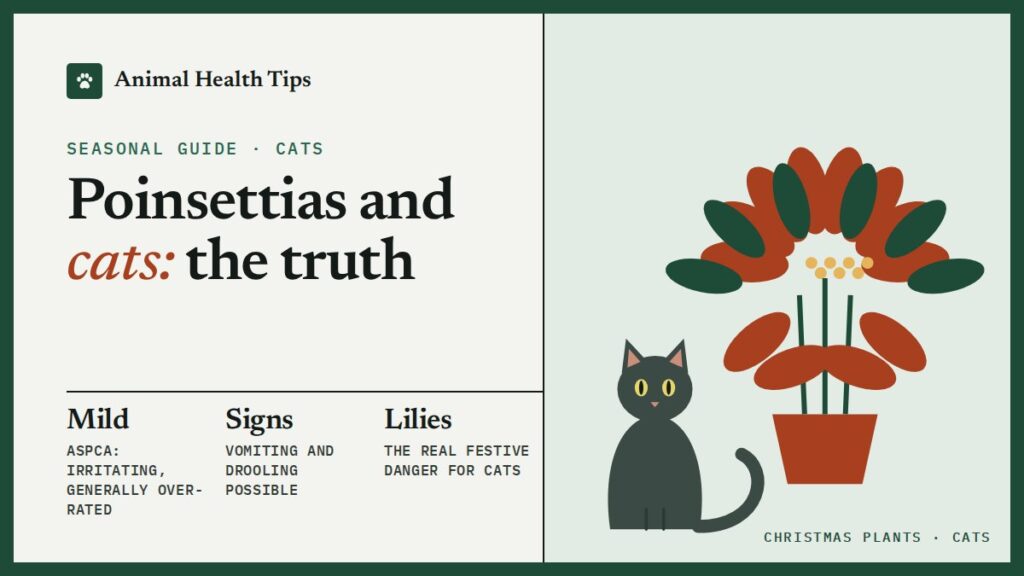
Every December, the same warning circulates: poinsettias will kill your cat. It is one of the most repeated pet warnings of the festive season, and it is mostly wrong — or rather, it is far more dramatic than the evidence supports. Poinsettias are not harmless, and they are listed as toxic to cats. But the charities and veterinary sources that actually list them describe a mild irritant, not a killer. Understanding the difference matters, because it stops owners panicking over a nibbled leaf — and stops the real festive danger, lilies, from hiding in the same warning.
In this guide6 sections
This guide uses only the wording of the approved sources: the ASPCA, Blue Cross, VCA Animal Hospitals, Cornell and the FDA. It covers what poinsettias actually do to cats, what to do if your cat chews one, and how poinsettias compare with holly, mistletoe and lilies. For the wider Christmas picture, including trees and decorations, see our guide to Christmas tree safety for cats and dogs, and for the most dangerous plant of all, see our guide to are lilies poisonous to cats.
Call your vet straight away if
- Your cat has eaten any poisonous plant, including poinsettia
- Vomiting, drooling or going off food lasts more than 24 hours
- Signs are severe, or your cat seems lethargic or unwell
- Your cat may have eaten lilies, in any amount — treat this as an emergency
- UK: Animal PoisonLine, 01202 509000 — open 24 hours, run by the Veterinary Poisons Information Service; a fee applies.
- US: ASPCA Animal Poison Control, (888) 426-4435 — open 24 hours; a consultation fee applies.
Are poinsettias poisonous to cats? The short answer
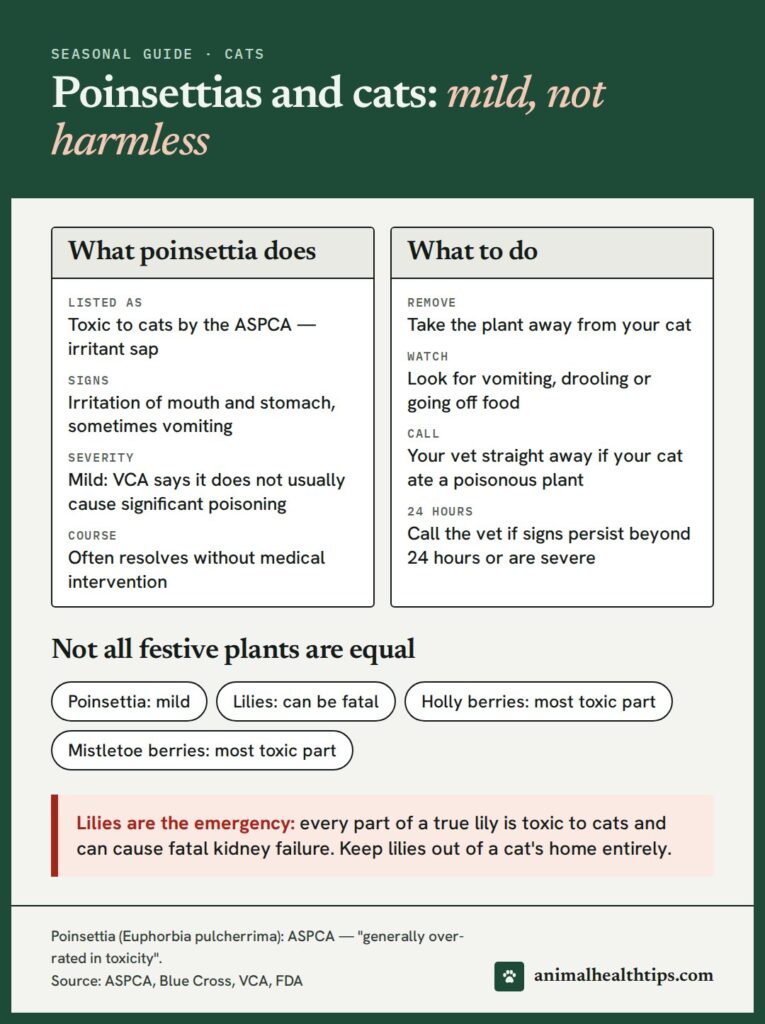
Yes, in the formal sense. The ASPCA lists poinsettia (Euphorbia pulcherrima) as toxic to cats, and to dogs and horses, with the toxic principle given as irritant sap. But the ASPCA’s own clinical signs for poinsettia are the key sentence of this whole article: irritating to the mouth and stomach, sometimes causing vomiting, but generally over-rated in toxicity. Blue Cross describes it the same way, in one word: poinsettia poisoning is mild. Cornell’s veterinary school agrees, noting poinsettias aren’t as dangerous as some people think and, at worst, will cause irritation of the mouth, excess salivation and perhaps vomiting.
VCA Animal Hospitals gives the practical version: poinsettias may cause vomiting and diarrhoea, but do not usually cause significant poisoning. After eating poinsettia leaves, VCA adds, dogs and cats may have a lack of appetite or upset stomach for a short time, and this often resolves without medical intervention. That is the honest picture: a plant to keep away from cats, not a plant to fear as a killer. No quantity threshold is given here, because none was verified on an approved source for this article — do not rely on any claim about how many leaves it takes.
What happens if a cat chews a poinsettia
The pattern is irritation, not systemic poisoning. A cat that chews poinsettia leaves may drool, go off food briefly, vomit, or have diarrhoea. The irritant sap is the mechanism the ASPCA names, and the signs follow from it: mouth and stomach irritation, sometimes vomiting. VCA’s wording is deliberately calm — a short period of upset stomach or lack of appetite, often resolving without medical intervention — and that calm is itself useful information. A cat that nibbles a leaf and vomits once, then eats and drinks normally, fits the mild pattern these sources describe.
That does not mean ignoring it. Blue Cross advises contacting your vet straight away if your cat has eaten any poisonous plant, and that advice stands even for a mild plant: your vet knows your cat’s age, health and what else it may have eaten. VCA adds the clear follow-up rule: if signs of illness persist for more than 24 hours or are severe, contact your veterinarian. Watch for vomiting that keeps coming back, diarrhoea that does not settle, refusal of food and water, or a cat that becomes lethargic or withdrawn — and call sooner, not later, if you are unsure.
What to do if your cat chews a poinsettia
- Take the plant away. Remove the poinsettia from your cat’s reach so the chewing stops. Blue Cross advises that Christmas plants, including poinsettia, are best kept away from curious paws.
- Note what and how much. Tell your vet which plant it was and roughly how much your cat ate, and when. This helps the vet judge whether the mild pattern fits or something else is going on.
- Contact your vet straight away. Blue Cross advises contacting your vet straight away if your cat has eaten any poisonous plant. Do not wait for signs to appear before calling.
- Watch for 24 hours. VCA notes signs often resolve without medical intervention, but advises contacting your veterinarian if signs persist for more than 24 hours or are severe.
- Do not try a home treatment. No home remedy, medicine or method for making a cat vomit is given in this guide, because none was verified on an approved source for it. Only a vet should decide on treatment.
- Check for other plants. If lilies, holly or mistletoe are also in the house, tell your vet: those plants carry very different risks, covered in the next section.
Poinsettia vs the plants that are truly dangerous
The reason poinsettia warnings cause harm is that they blur the line between mild and deadly, and the deadly plants then get the same shrug as the mild one. They should not. Blue Cross states the contrast plainly: festive red lilies can be fatal to cats, and lilies — all parts of the plant are poisonous. The FDA gives the detail: lilies in the true lily and daylily families are very dangerous for cats, the entire lily plant is toxic — stem, leaves, flowers, pollen, and even the water in a vase — and eating a small amount of a lily leaf or petal, licking a few pollen grains off fur, or drinking vase water can cause fatal kidney failure in less than 3 days.
The FDA adds a timing fact every cat owner should know: if lily treatment is delayed by 18 hours or more after ingestion, the cat will generally have irreversible kidney failure, with early signs starting 0 to 12 hours and kidney failure occurring within 24 to 72 hours if untreated. The FDA’s advice is absolute: it is best not to bring these highly toxic lilies into your home if you have a cat. VCA confirms the same mechanism: exposure to true lilies (Lilium or Hemerocallis species) can cause kidney failure in cats, and all parts of the plant and flower can result in poisoning, including the pollen and water in the vase.
Holly and mistletoe sit between the two extremes. Cornell notes that mistletoe, especially mistletoe berries, can be very toxic to cats and dogs, and that holly leaves and berries can cause gastrointestinal irritation, vomiting and diarrhoea. Blue Cross agrees on the key detail: for holly and mistletoe, the berries are the most toxic. VCA adds that Christmas or English holly ingestion can result in severe gastrointestinal upset, thanks to the spiny leaves and potentially toxic substances, with most pets smacking their lips, drooling and shaking their heads excessively from irritation. For American mistletoe, the ASPCA lists vomiting, diarrhoea, low blood pressure (rare), difficulty breathing and low heart rate, and VCA notes that in large amounts signs may include collapse, low blood pressure, difficulty walking, seizures and even death.
| Festive plant | Risk to cats | Key signs |
|---|---|---|
| Poinsettia | Mild; generally over-rated in toxicity | Mouth and stomach irritation, sometimes vomiting |
| Lilies (true lily, daylily) | Can be fatal; every part toxic | Vomiting, lethargy, kidney failure within 24–72 hours |
| Holly | Berries most toxic; severe gut upset possible | Vomiting, diarrhoea, drooling, head shaking |
| Mistletoe | Berries most toxic; very toxic in quantity | Vomiting, diarrhoea; in large amounts, collapse or seizures |
Keeping Christmas plants away from cats
The practical advice is short, because the verified advice is short: Blue Cross advises that Christmas plants, including poinsettia, are best kept away from curious paws. That is the rule to build the house around. Put poinsettias where a cat cannot reach them, or choose not to have them at all — the plant is decorative, and no decoration is worth a vet visit. Dropped leaves and fallen bracts count too: a plant on a high shelf still drops leaves to the floor, so check the floor around it.
For lilies, the rule is stricter and absolute: do not bring them into a cat’s home. That includes bouquets from visitors, who may not know the risk — tell guests before they arrive. For holly and mistletoe, keep berries out of reach and out of the house where possible, and sweep up fallen berries promptly. And keep the vet’s number and the emergency lines in the box above somewhere you can find them in a panic: the difference between a mild poinsettia nibble and a lily emergency is measured in hours, and the first call should never be delayed by searching for a number.
Key takeaways
- Poinsettias are listed as toxic to cats, but only mildly: irritant sap, mouth and stomach irritation, sometimes vomiting.
- The ASPCA calls poinsettia toxicity generally over-rated; VCA says it does not usually cause significant poisoning.
- Contact your vet straight away if your cat eats any poisonous plant, and promptly if signs last over 24 hours or are severe.
- Lilies are the real emergency: every part is toxic to cats and can cause fatal kidney failure — keep them out of the house.
- For holly and mistletoe, the berries are the most toxic part; keep Christmas plants away from curious paws.
Frequently asked questions
Are poinsettias poisonous to cats?
Yes, but only mildly. The ASPCA lists poinsettia as toxic to cats, with irritant sap that irritates the mouth and stomach and sometimes causes vomiting, but adds that its toxicity is generally over-rated. Blue Cross describes poinsettia poisoning as mild, and VCA says it does not usually cause significant poisoning.
What happens if my cat eats a poinsettia leaf?
Expect possible drooling, vomiting, diarrhoea or a short loss of appetite, VCA notes, often resolving without medical intervention. Still contact your vet straight away, Blue Cross advises, and call promptly if signs persist for more than 24 hours or are severe.
Can a poinsettia kill my cat?
No such claim is made on the approved sources used here. They describe poinsettia as mild and its toxicity as generally over-rated, with signs that often resolve without medical intervention. That is not a guarantee for any individual cat, which is why the advice is to contact your vet straight away in every case.
Are poinsettias more dangerous than lilies?
No — far less. Lilies are the emergency: Blue Cross states festive red lilies can be fatal to cats, and the FDA warns the entire lily plant is toxic and can cause fatal kidney failure in less than 3 days. Poinsettia is mild by comparison, and the two should never be treated as equal risks.
Should I keep poinsettias out of my house?
Blue Cross advises Christmas plants, including poinsettia, are best kept away from curious paws. If you keep one, put it where your cat cannot reach it and check the floor for dropped leaves. For lilies, the FDA’s advice is stricter: do not bring them into a cat’s home at all.
What should I do if my cat chews a poinsettia?
Remove the plant, note what and how much your cat ate, and contact your vet straight away. Do not try a home treatment or try to make your cat vomit. Watch for 24 hours, and contact your veterinarian promptly if signs persist beyond 24 hours or are severe.
Sources
- ASPCA — Poinsettia
- Blue Cross — Keep your cat safe at Christmas
- VCA Animal Hospitals — Holiday toxins for pets
- FDA — Lovely lilies and curious cats: a dangerous combination
- Cornell Chronicle — Cornell veterinarian warns of poison perils
- ASPCA — Mistletoe, American
This guide is general information, not a diagnosis. If you are worried about your pet, contact your vet.
1 comment