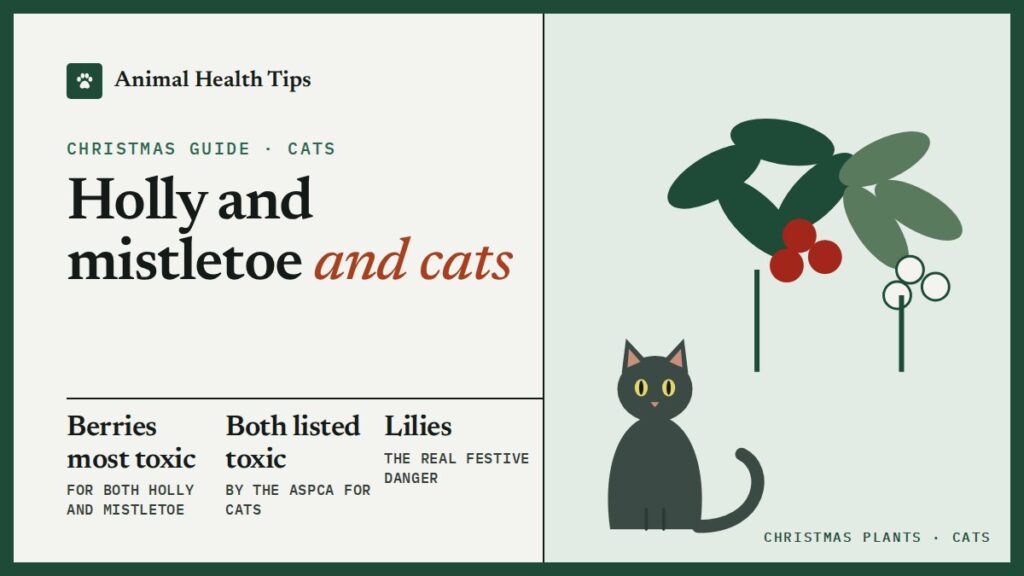
Christmas decorations are already appearing in shops, and holly and mistletoe are among the first to arrive: in wreaths on doors, in garlands over fireplaces, and in sprigs hung from ceilings. Cats, being cats, will investigate all of them. Both plants are listed as toxic to cats, and for both, the berries are the most toxic part. This guide explains what each plant does, how the two differ, and what to do if your cat chews either one.
In this guide7 sections
It is the plant-specific follow-up to our guide to are poinsettias poisonous to cats, which found poinsettias to be mild. Holly and mistletoe are a step up from poinsettias in risk, and a long way below the one festive plant that can kill a cat. The sources are the ASPCA, VCA Animal Hospitals and Blue Cross, and where they disagree or qualify their wording, this guide says so.
Call your vet straight away if
- Your cat has eaten holly or mistletoe, in any amount
- Your cat vomits repeatedly, has diarrhoea, or seems depressed or lethargic
- Your cat has difficulty breathing, seems unsteady, or collapses
- Your cat may have eaten lilies, in any amount — treat this as an emergency
- UK: Animal PoisonLine, 01202 509000 — open 24 hours, run by the Veterinary Poisons Information Service; a fee applies.
- US: ASPCA Animal Poison Control, (888) 426-4435 — open 24 hours; a consultation fee applies.
Are holly and mistletoe poisonous to cats?
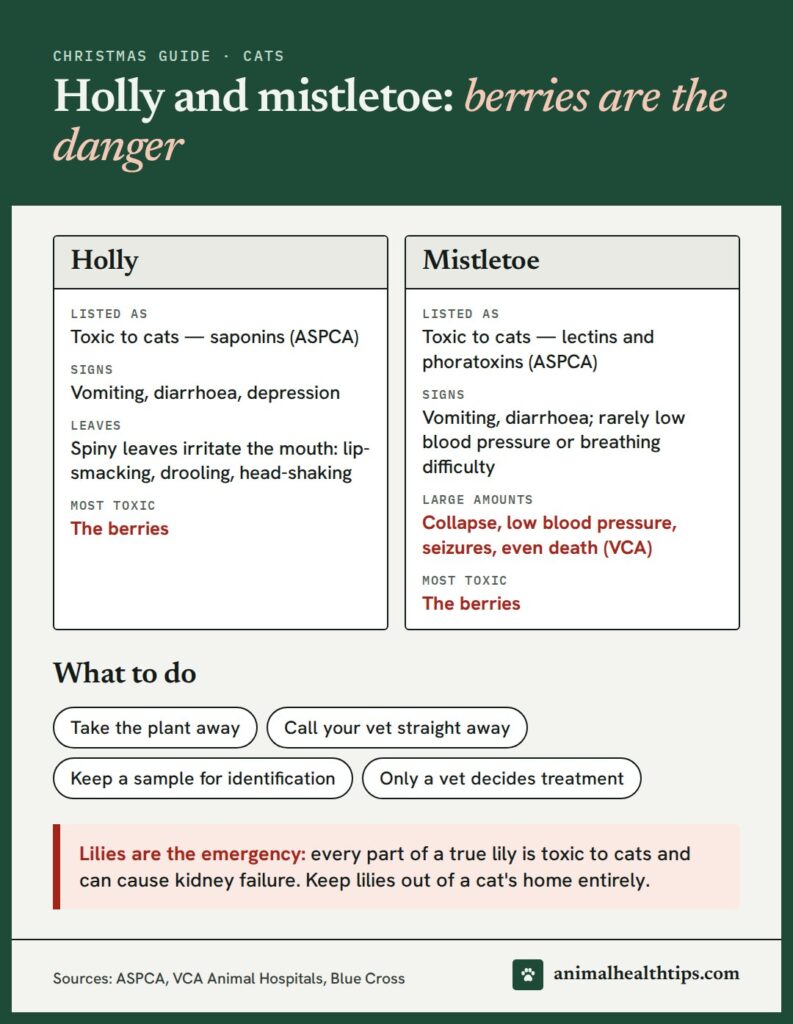
Yes, both of them. The ASPCA lists American holly as toxic to dogs, toxic to cats and toxic to horses, with saponins as the toxic principle. It lists American mistletoe the same way: toxic to dogs, toxic to cats and toxic to horses. Dogs are affected too, so the same decorations that threaten a cat threaten a dog in the same house.
Blue Cross gives the detail that matters most for both plants: for holly and mistletoe, the berries are the most toxic part. That is the practical rule for the whole article. A sprig with no berries is still a plant to keep away from cats, but fallen berries on the floor are the part to hunt for and clear up. The amount eaten matters as well, especially for mistletoe, as the next sections explain.
Holly: berries, spiky leaves and what they do
Holly’s clinical signs, as listed by the ASPCA, are vomiting, diarrhoea and depression. VCA Animal Hospitals describes the effect in stronger terms: when Christmas or English holly is ingested, it can result in severe gastrointestinal upset, thanks to the spiny leaves and potentially toxic substances found in the plant. The two wordings are not a contradiction. Holly irritates in two ways at once: chemically, through its saponins, and mechanically, through leaves that are hard and spiky.
That mechanical irritation has a distinctive picture. VCA states that if holly is ingested, most pets smack their lips, drool and shake their heads excessively due to irritation from the spiny leaves. Note the wording: VCA says most pets, not cats alone, so treat lip-smacking and head-shaking as a sign of mouth irritation in a pet that has chewed holly, not as a cat-only symptom list. A cat that has chewed holly and is drooling, vomiting or off its food fits the pattern both sources describe, and still needs a vet call: the sources describe the signs, not a home treatment.
Mistletoe: American, European and why amount matters
Mistletoe needs more care than holly, because there is more than one mistletoe. The ASPCA entry opened for this article covers American mistletoe, Phoradendron flavescens, and lists its toxic principles as toxalbumins, lectins and phoratoxins. Its clinical signs are vomiting, diarrhoea, low blood pressure (rare), difficulty breathing and low heart rate. Those signs are serious on paper, and they are the reason a mistletoe nibble still earns a vet call even when the cat seems well.
VCA adds the comparison that stops the two mistletoes being confused: American mistletoe is less poisonous than European varieties. VCA states that mild signs of gastrointestinal irritation may be seen with mistletoe, but if ingested in large amounts, signs may include collapse, hypotension (low blood pressure), ataxia (difficulty walking), seizures and even death. Read that sentence with its qualifier attached: the severe signs are tied to large amounts, and to pets generally, not to a typical cat nibbling a single berry. No cat-specific safe number of berries was verified on an approved source for this article, so none is given here. Do not guess one.
How they compare with poinsettias and lilies
Festive plants are not one risk level, and treating them as equal causes two mistakes: panic over a mild plant, and a shrug at a deadly one. Blue Cross describes poinsettia poisoning as mild, and VCA states poinsettias may cause vomiting and diarrhoea but do not usually cause significant poisoning, with signs often resolving without medical intervention — though VCA adds that if signs persist for more than 24 hours or are severe, contact a veterinarian. Holly and mistletoe sit above poinsettias: their berries are the most toxic part, and mistletoe in large amounts can cause collapse.
Lilies sit far above all three, and they are the reason this comparison exists. VCA states that exposure to true lilies (Lilium or Hemerocallis species) can cause kidney failure in cats, and that all parts of the lily plant and flower can result in poisoning, including the pollen and water in the vase. Blue Cross states the same warning in one line: festive red lilies can be fatal to cats, and for lilies, all parts of the plant are poisonous. If you have a cat, lilies do not come into the house at all. For the full lily guide, see our article on are lilies poisonous to cats.
| Festive plant | Risk to cats | Key signs |
|---|---|---|
| Poinsettia | Mild | Mouth and stomach irritation, sometimes vomiting |
| Holly | Berries most toxic; severe gut upset possible | Vomiting, diarrhoea, depression; lip-smacking and drooling |
| Mistletoe | Berries most toxic; severe in large amounts | Vomiting, diarrhoea; rarely low blood pressure, breathing difficulty |
| Lilies (true lily, daylily) | Can be fatal; every part toxic | Kidney failure; even pollen or vase water can poison |
What to do if your cat eats holly or mistletoe
- Take the plant away. Remove the sprig, wreath or garland from your cat’s reach so the chewing stops, and clear up any fallen berries from the floor.
- Note what your cat ate. Tell your vet which plant it was, which part, and roughly how much, and when. Blue Cross advises having any packaging to hand so you can tell the vet exactly what the cat has eaten, and taking samples along if you have seen your cat chewing something.
- Contact your vet straight away. Blue Cross advises contacting your vet straight away if your cat has eaten any poisonous plant. Do not wait for signs to appear before calling.
- Do not try a home treatment. No home remedy, medicine or method for making a cat vomit is given in this guide, because none was verified on an approved source for these plants. Only a vet should decide on treatment.
- Watch and report back. If your vet advises monitoring, watch for vomiting, diarrhoea, drooling, lethargy, breathing difficulty or unsteadiness, and call back promptly if anything worsens.
- Check for other plants. If lilies are also in the house, tell your vet at once: a lily exposure is an emergency even in a tiny amount, and it changes the whole plan.
Decorating safely with cats in the house
Blue Cross gives two practical rules that cover most festive foliage: secure decorations to the tree as tightly as possible so they are not easily knocked off, and hang decorations higher up, out of the reach of playful paws. Apply the same rules to wreaths and garlands: hang them where a cat cannot pull them down, and check the floor beneath them for fallen berries every day. A decoration that is safe on the wall is not safe once it has fallen.
The simplest safe choice is to leave real holly and mistletoe out of a cat’s home altogether, especially where berries are involved. If you do use them, keep berries out of reach, sweep up fallen berries promptly, and remember that tinsel carries its own risk: Blue Cross warns that tinsel in particular can cause serious illness, because if eaten it can cause a blockage in the stomach and intestines and in some cases can be fatal. For the wider picture of trees, lights and decorations, see our guide to Christmas tree safety for cats and dogs. Keep the vet’s number and the emergency lines in the box above somewhere you can find them in a panic.
Key takeaways
- Holly and mistletoe are both listed as toxic to cats by the ASPCA, and dogs are affected too.
- For both plants, the berries are the most toxic part: clear fallen berries from the floor.
- Holly causes vomiting, diarrhoea and depression, with lip-smacking and drooling from its spiny leaves.
- Mistletoe is usually mild in small amounts but can cause collapse in large amounts; American mistletoe is less poisonous than European varieties.
- Contact your vet straight away if your cat eats either plant; lilies, by contrast, are an emergency in any amount.
Frequently asked questions
Are holly and mistletoe poisonous to cats?
Yes, both are. The ASPCA lists American holly and American mistletoe as toxic to cats, and Blue Cross notes that for both plants the berries are the most toxic part. Keep both plants out of your cat’s reach, and clear up any fallen berries promptly.
What happens if my cat eats holly berries?
Expect vomiting, diarrhoea and depression, the ASPCA’s listed signs for holly. VCA adds that holly can cause severe gastrointestinal upset, and that most pets smack their lips, drool and shake their heads from irritation caused by the spiny leaves. Contact your vet straight away.
Is mistletoe more dangerous than holly?
It depends on the amount and the variety. VCA states American mistletoe is less poisonous than European varieties, and that mild gastrointestinal signs are usual, but large amounts can cause collapse, low blood pressure, difficulty walking, seizures and even death. No safe berry number for cats was verified, so do not guess one.
What should I do if my cat eats mistletoe?
Remove the plant, note which plant and roughly how much your cat ate, and contact your vet straight away, Blue Cross advises. Do not try a home treatment or try to make your cat vomit: only a vet should decide on treatment. Watch for vomiting, breathing difficulty or unsteadiness and report back promptly.
Are poinsettias more dangerous than holly and mistletoe?
No, less. Blue Cross describes poinsettia poisoning as mild, and VCA says poinsettias do not usually cause significant poisoning. Holly and mistletoe carry a higher risk, especially their berries, but both are far below lilies, which can be fatal to cats.
Should I keep holly and mistletoe out of my house?
That is the simplest safe choice, especially where berries are involved. If you do use them, Blue Cross advises securing decorations tightly and hanging them higher up, out of the reach of playful paws, and checking the floor for fallen berries. Keep tinsel away too: eaten tinsel can block the gut and can be fatal.
Sources
- ASPCA — American holly
- ASPCA — Mistletoe, American
- VCA Animal Hospitals — Holiday toxins for pets
- Blue Cross — Keep your cat safe at Christmas
This guide is general information, not a diagnosis. If you are worried about your pet, contact your vet.