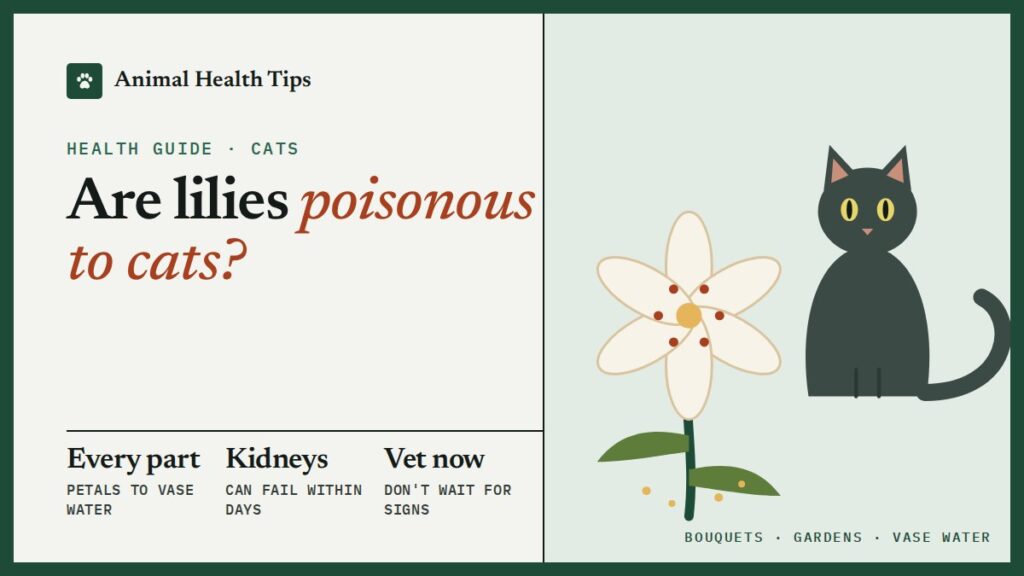
There’s a half-open bouquet on the kitchen table, and your cat has just brushed past it — or worse, taken a curious bite. With most flowers that would be a minor worry. With lilies, it is an emergency. Every part of a true lily is poisonous to cats: the petals, the leaves, the stem, the pollen, even the water in the vase. Here’s what to do, and how fast you need to do it.
In this guide8 sections
Go to a vet now if your cat touched a lily
- Don’t wait for symptoms. By the time they show, the kidneys may already be damaged.
- Wipe any yellow pollen off their fur and paws before you travel, so they can’t groom off any more.
- UK: Animal PoisonLine, 01202 509000 — open 24 hours, run by the Veterinary Poisons Information Service; a fee applies.
- US: ASPCA Animal Poison Control, (888) 426-4435 — open 24 hours; a consultation fee applies.
Are lilies poisonous to cats?
Yes. All species of Lilium (true lilies) and Hemerocallis (daylilies) are poisonous to cats (International Cat Care). The exact toxin is still unknown, but once eaten it causes severe kidney damage that can lead to kidney failure and death (iCatCare).
The dangerous group includes Asiatic, Easter, tiger, stargazer (oriental), Madonna and royal lilies, plus all daylilies (iCatCare). Daylilies are the most common culprit in reported poisonings (Cats Protection).
Watch out for the name trap: lily of the valley, peace lilies and calla (arum) lilies have different toxic effects. It is specifically Lilium and Hemerocallis that cause kidney failure in cats (iCatCare).
Every part is toxic — even pollen and vase water
Flowers, leaves, stems, pollen: all of it. A cat can be poisoned by grooming pollen off its fur, or by drinking the water from a vase of cut lilies — and less than one leaf can be fatal (iCatCare).
“Pollen-free” lilies are still not safe. They are marketed to cat owners, but since every part of the plant is toxic and not just the pollen, removing the pollen doesn’t remove the danger (iCatCare).
The RSPCA’s warning is blunt: “Just brushing against the pollen or drinking water from a vase can lead to kidney failure.” Their advice is to avoid lilies in bouquets and houseplants altogether (RSPCA).
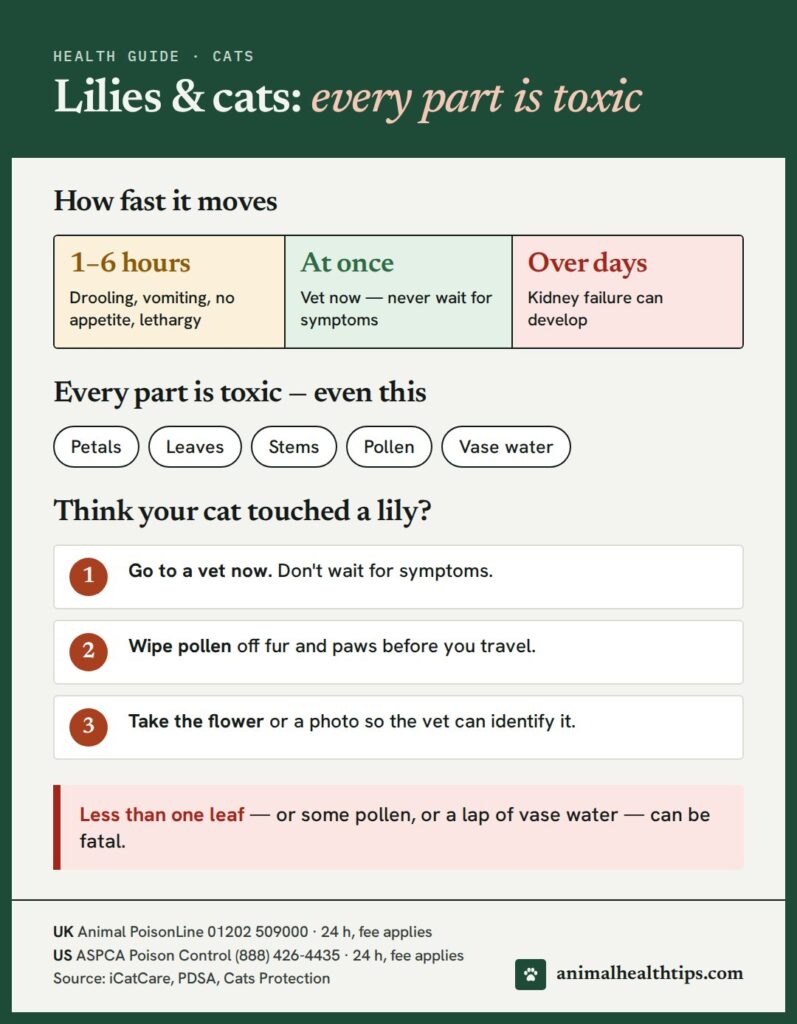
Signs of lily poisoning in cats
Signs usually appear within one to six hours: drooling, vomiting, loss of appetite or refusing food, tiredness and weakness (iCatCare). PDSA adds drinking and weeing more than usual, twitching and seizures to the watch list.
Kidney failure itself can take a few days to develop — which is why a cat that seems to recover after the early signs still needs urgent care (PDSA).
How fast does lily poisoning move?
| When | What happens |
|---|---|
| Within 1–6 hours | Early signs: drooling, vomiting, loss of appetite, lethargy |
| Immediately | Seek vet care. Never wait for symptoms to develop |
| Over the next few days | Kidney failure can develop. Delayed treatment is often fatal |
What to do if your cat touched a lily
- Contact your vet immediately. This is an emergency and needs urgent veterinary care. Never wait for symptoms to develop (PDSA, iCatCare).
- Wipe off any pollen from their fur and paws before you travel, so they can’t groom off any more.
- Take the flower or a photo so your vet can identify exactly what it was.
- Don’t try any home treatment. Emptying the stomach and giving charcoal are procedures for your vet, not for you (iCatCare).
How vets treat lily poisoning
Expect your cat to be hospitalised. Treatment may include emptying the stomach (your vet making them vomit), activated charcoal to stop more toxin being absorbed, cleaning pollen off the coat, and a fluid drip to flush the bloodstream and support the kidneys (iCatCare).
The outlook comes down to speed: prompt treatment gives a much better chance of recovery, while delayed treatment is often fatal. Cats that pull through can be left with permanent kidney damage needing lifelong management (iCatCare).
How to keep lilies away from your cat
- Don’t bring lilies home. If you have a cat, never allow lilies into your home or garden (iCatCare).
- Check every bouquet. Remove any lilies before bringing flowers indoors — and tell the florist you have a cat (PDSA).
- Watch kittens especially. Indoor cats, particularly kittens, are the most likely to investigate a new arrangement (iCatCare).
- Know it’s common. Lilies are the most commonly reported cat poisoning, according to Cats Protection. This is not a rare accident.
- Learn the other household poisons too. Antifreeze poisoning in cats is another emergency every cat owner should know about. And if your cat is vomiting and you’re not sure why, see why cats vomit.
- Give them safe greens instead. Many cats chew plants out of curiosity — see why cats eat grass for what’s behind it.
Key takeaways
- All true lilies and daylilies can kill cats. The toxin is still unknown.
- Every part is toxic: petals, leaves, stems, pollen and vase water.
- Signs start within 1–6 hours. Kidney failure follows over days.
- Vet immediately, never wait. Speed decides the outcome.
Frequently asked questions
Are all lilies poisonous to cats?
All true lilies (Lilium) and daylilies (Hemerocallis) — including Easter, tiger, Asiatic and stargazer types. Lily of the valley, peace lilies and calla lilies have different toxic effects, but it’s safest to keep cats away from all of them.
Is lily pollen dangerous to cats?
Yes. Cats are often poisoned by grooming pollen off their fur, and drinking vase water can also be fatal. Even a small amount of pollen is enough to be dangerous.
Are pollen-free lilies safe for cats?
No. They are marketed as cat-safe, but every part of the lily is toxic, not just the pollen. The advice stays the same: keep lilies out of cat homes.
How quickly must I get my cat to a vet?
Immediately — it is an emergency. Prompt treatment gives a much better chance of recovery, while delayed treatment is often fatal. Never wait for symptoms.
Can cats recover from lily poisoning?
Yes, with fast veterinary treatment. But even cats that pull through can be left with permanent kidney damage that needs lifelong management.
My cat only sniffed a lily. Is that OK?
Sniffing alone is less risky than chewing, but pollen on the nose can be groomed off later. If there is any chance of contact, call your vet — don’t try to judge the dose yourself.
Sources
- International Cat Care — Lily poisoning in cats
- PDSA — Lily poisoning in cats
- Cats Protection — Poisoning in cats
- Blue Cross — Plants poisonous to cats
- RSPCA — Keeping pets safe in spring
- ASPCA — Easter lily
This guide is general information, not a diagnosis. If you are worried about your pet, contact your vet.