Open a tin of tuna and most cats appear as if summoned. It smells like the ocean, it is soft, and cats go wild for it. So it is natural to wonder whether a little tuna now and then does any harm. The answer is reassuring, but it comes with rules: tuna is fine as an occasional treat, it must be the right kind of tin, and it can never take the place of proper cat food.
In this guide7 sections
Usually fine at home
- A small taste of tinned tuna in spring water is fine for a healthy cat as an occasional treat.
- Keep it to a treat-sized amount, and keep treats within 10% of your cat’s daily food.
- Speak to your vet first if your cat has kidney disease, heart disease, or is on a special diet.
The short answer: yes, as a treat, not as a meal
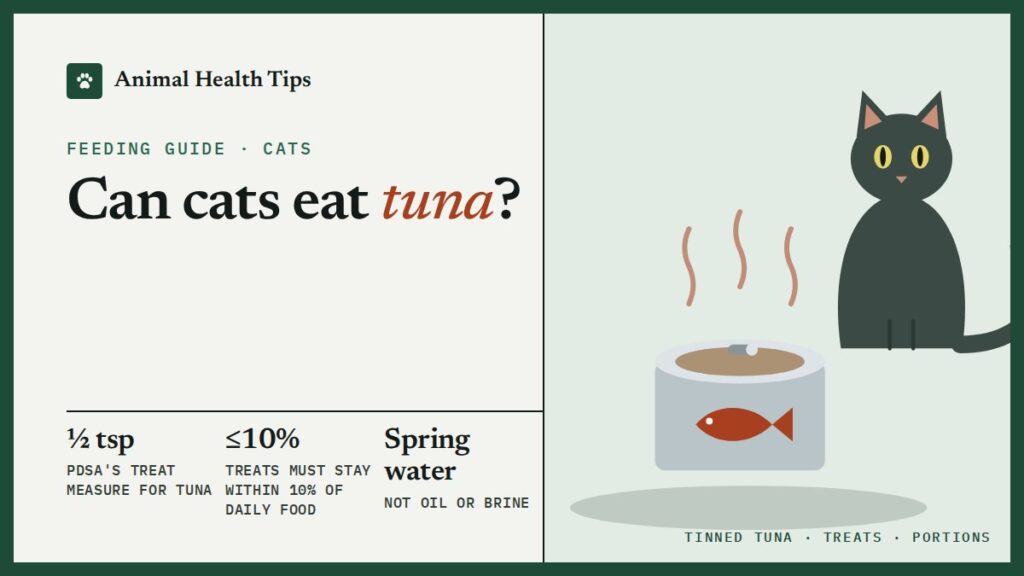
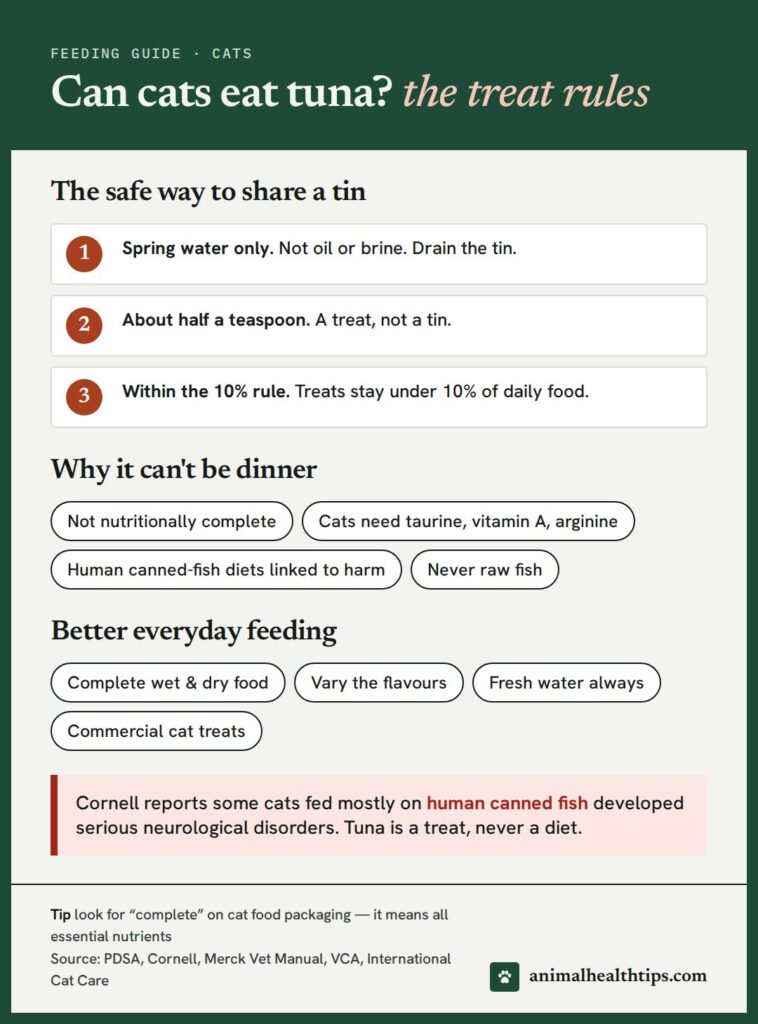
PDSA lists about half a teaspoon of tuna as a suitable cat treat, and says tinned tuna is fine as long as it is stored in spring water, not oil or brine. Treats must not take up more than 10% of a cat’s daily food allowance, and the usual food should be reduced slightly so the cat is not overfed. Cornell University’s feline health centre gives the same guidance: an occasional treat is not generally harmful, but treats are not nutritionally complete and should not exceed 10 to 15% of a cat’s daily calories. VCA adds a useful example: a cat needing about 200 calories a day should get roughly 180 from a complete and balanced diet and only about 20 from treats. The site’s cat calorie calculator can help you work out your own cat’s daily needs.
Why tuna cannot replace cat food
Cats are obligate carnivores: they depend on a meat diet and cannot thrive without it, says International Cat Care. But “meat” alone is not enough. Cats need specific nutrients, including the amino acids taurine, arginine, methionine and cysteine, which are not found in plants, and, unlike dogs, they need dietary sources of vitamin A, arachidonic acid and taurine, with higher requirements for arginine, niacin and vitamin B6 (Merck Veterinary Manual). A tin of tuna does not reliably supply these.
That is why every major source says the same thing: feed a complete, balanced commercial cat food, and look for the word “complete” on the packaging, which means it meets all of a cat’s nutritional needs (International Cat Care). Homemade diets are often deficient in key vitamins and minerals, Merck warns, and Cornell notes that commercial foods carry an AAFCO statement meaning they are nutritionally complete and balanced. There is a sharper warning too: Cornell reports that some cats that consumed canned fish products meant for humans developed potentially serious neurological disorders. A tuna-heavy diet is not just incomplete; it has been linked to real harm.
Which tuna is safest for cats?
Not all tins are equal. PDSA’s rule is simple: tuna in spring water, not oil or brine. VCA advises offering cooked seafood without seasonings and choosing low-calorie options where possible. A few more rules from the research:
- Never feed raw tuna or raw fish. Raw fish contains thiaminases, enzymes that destroy thiamine, an essential B vitamin; cooking destroys these, according to the Merck Veterinary Manual. Raw meat is not safe for cats full stop, and Cornell notes it can carry toxoplasmosis and other infections.
- Avoid tuna with added flavourings, salt or spices. Plain is the only option.
- Do not pour on the oil or brine. Drain the tin and offer the fish, not the packing liquid.
- Tuna made for humans is not cat food. It is a treat from your cupboard, not a diet.
How much tuna can a cat have?
Think of tuna the way PDSA does: a treat, measured in teaspoons, not tins.
| Rule | What it means |
|---|---|
| Treat size | About half a teaspoon of tuna, per PDSA |
| Treat allowance | Treats within 10% of daily food (PDSA); no more than 10–15% of daily calories (Cornell) |
| What 10% looks like | For a cat needing ~200 calories a day, about 20 calories of treats (VCA) |
| Main diet | A complete commercial cat food, fed to the packet’s guidelines |
PDSA’s vets also advise against feeding leftovers and scraps in general: they unbalance the regular diet, cause weight gain, and cats used to scraps may start refusing their normal food. If you are unsure what counts as a complete food, check the human food safety checker or ask your vet.
When to be careful with tuna
Some cats need stricter rules. VCA advises that cats with kidney disease should have low-phosphorus treats, and cats with heart disease should avoid high-salt treats: discuss treats with your vet if your cat has any health condition. Kittens, meanwhile, are growing fast and need complete food formulated for growth, so keep any tuna to the tiniest taste.
There is also the fixation trap. International Cat Care recommends feeding a variety of wet and dry food so cats do not become accustomed to only one type of food. A cat that learns to hold out for tuna can start refusing its balanced meals, which is exactly how an incomplete diet begins. Variety is part of good feeding.
Better everyday options than tuna
- A complete wet and dry cat food, mixed for variety, as the base of every day.
- Commercial cat treats, made to complement a balanced diet, for training and rewards.
- Fresh water, always available. Wet food helps with hydration too.
- Tuna kept for what it is: an occasional high-value treat, in spring water, in tiny amounts.
Key takeaways
- Tuna is fine as an occasional treat: about half a teaspoon, in spring water, not oil or brine.
- Keep treats within 10% of daily food; a complete commercial cat food must provide the rest.
- Tuna is not nutritionally complete and can never replace cat food.
- Never feed raw fish, and ask your vet about treats if your cat has kidney or heart disease.
Frequently asked questions
Can cats eat tuna every day?
No. Tuna should be an occasional treat within the 10% treat allowance, not a daily food. It is not nutritionally complete, and Cornell reports that some cats fed mostly on human canned fish developed serious neurological disorders.
Can cats eat tuna in brine or oil?
PDSA says tinned tuna must be stored in spring water, not oil or brine. Drain the tin and offer the fish itself, in a small amount.
Is raw tuna safe for cats?
No. Raw fish contains thiaminases, which destroy thiamine, an essential vitamin; cooking destroys them. Raw meat can also carry toxoplasmosis and other infections, so always cook fish intended as a treat and serve it plain.
My cat will only eat tuna now. What should I do?
This is the fixation trap. PDSA warns that cats used to scraps may refuse their normal food, and International Cat Care advises feeding a variety of wet and dry food so cats do not fixate on one type. Go back to a complete cat food, offer variety, and speak to your vet if your cat refuses to eat.
How much tuna is a safe treat?
PDSA lists about half a teaspoon as a suitable treat, within the rule that treats must not exceed 10% of daily food. For a cat needing about 200 calories a day, that is roughly 20 calories of treats in total (VCA).
Can kittens eat tuna?
Kittens are growing and need complete food formulated for growth, so tuna should be at most the tiniest taste on rare occasions. Their main diet must be a complete kitten food fed to the packet’s guidelines.
Is tuna-flavoured cat food the same as tinned tuna?
No. Tuna-flavoured commercial cat food is formulated to be complete and balanced, while a tin of tuna from your cupboard is not. Only food labelled “complete” can be a cat’s main diet.
Sources
- PDSA — Weigh up: cat diet and exercise guide
- Cornell University College of Veterinary Medicine — Feeding your cat
- Merck Veterinary Manual — Proper nutrition for cats
- Merck Veterinary Manual — Nutritional requirements of small animals
- VCA Animal Hospitals — Using food and treats for training cats
- International Cat Care — Feeding your cat or kitten
This guide is general information, not a diagnosis. If you are worried about your pet, contact your vet.