Your cat starts sneezing, their eyes water, and their nose runs. It looks like a human cold, and owners often call it cat flu. It is one of the most common health problems in cats, especially kittens, shelter cats and unvaccinated cats. Most cats recover well with care and treatment, but kittens can go downhill quickly, so it helps to know what you are looking at and when to call the vet.
In this guide8 sections
Contact your vet if
- You notice any cat-flu symptoms, such as sneezing, a runny nose or weepy eyes
- Your cat is a kitten. Kittens can deteriorate fast, so have them seen quickly
- Your cat stops eating or drinking, seems dehydrated or is getting worse instead of better
- You are visiting the clinic: wait outside rather than in the waiting room, so the virus doesn’t reach other cats
What causes cat flu?
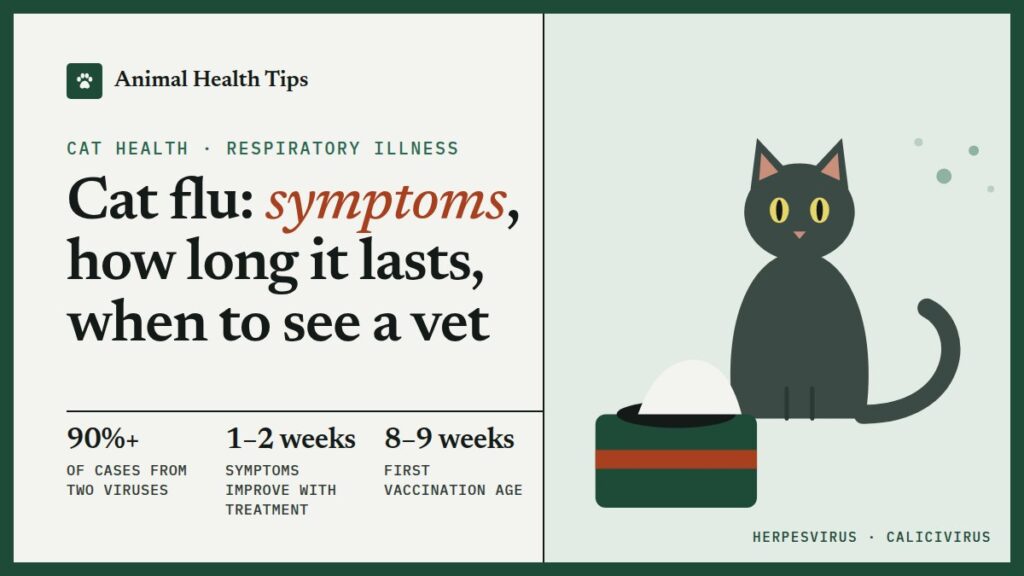
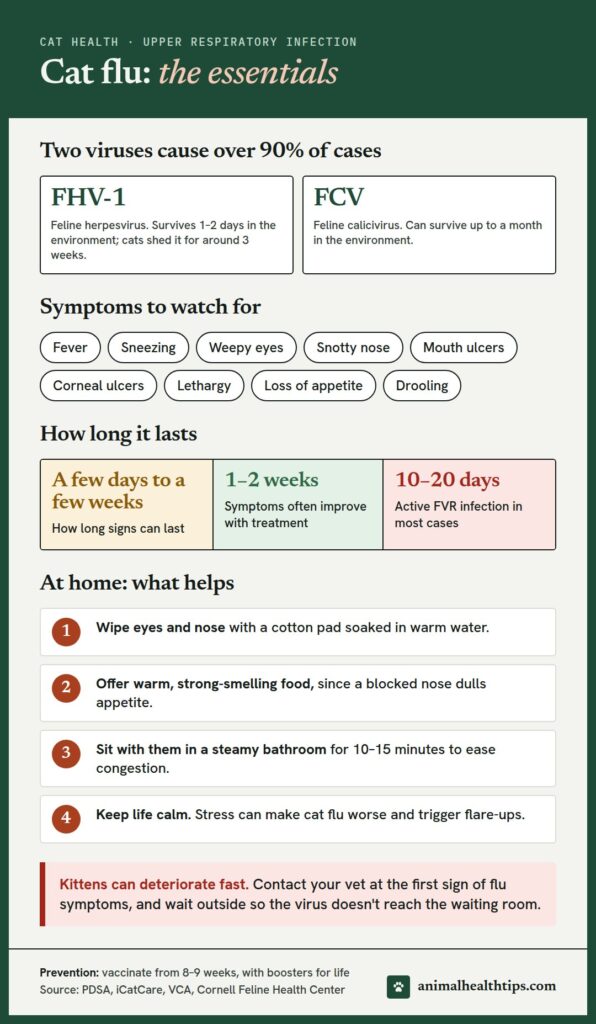
Cat flu is the everyday name for an upper respiratory infection in cats. International Cat Care says that in over 90% of cases it is caused by just two viruses: feline herpesvirus (FHV-1) and feline calicivirus (FCV). Both are widespread and highly contagious, and a cat can be infected with both at once.
Herpesvirus is a lifelong passenger for many cats. Cornell’s Feline Health Center reports that up to 97% of cats are exposed to feline herpesvirus in their lifetime, that it causes lifelong infection in up to 80% of them, and that up to 45% periodically shed the virus, usually when stressed. Calicivirus is tougher outside the body: it can survive up to a month in the environment, while herpesvirus survives only one to two days.
| Virus | What to know |
|---|---|
| Feline herpesvirus (FHV-1) | Fragile virus, survives 1–2 days in the environment. Often becomes a lifelong infection with stress-triggered flare-ups. The most common cause of conjunctivitis in cats. |
| Feline calicivirus (FCV) | Highly contagious and hardy: can survive up to a month in the environment. A classic cause of sneezing, eye and nose discharge, and ulcers on the tongue. |
How does cat flu spread?
It spreads through saliva, snot, sneezes and anything the discharge touches: shared food bowls, water bowls, bedding and litter trays. Breathing in droplets from a sneeze can infect a cat too, and the Merck Veterinary Manual notes the viruses can even be carried to a susceptible cat by a handler. This is why it races through shelters, catteries and multi-cat homes.
One reassurance: cat flu only affects cats. PDSA confirms that humans and other animals are not affected.
What are the symptoms of cat flu?
The classic picture, described by PDSA, is a high temperature, sneezing, weepy eyes and a snotty nose. Beyond that, look out for:
- Discharge from the eyes and nose, which can turn from clear and watery to thick
- Conjunctivitis (sore, red eyes) and, with herpesvirus, corneal ulcers
- Ulcers on the tongue and mouth, especially with calicivirus
- Drooling, a sore throat and coughing
- Lethargy and loss of appetite
- Fever. With herpesvirus it may reach 105°F (40.5°C)
Sneezing can have causes other than flu, from dust to allergies, so if it persists, our guide to why cats sneeze covers the possibilities. And if your cat stops eating, that matters whatever the cause: you can check what their intake should look like with our cat calorie calculator, and contact your vet if they refuse food.
How long does cat flu last?
It depends on the virus and the cat. International Cat Care says signs may last a few days or a few weeks for both viruses. PDSA says that with treatment, cat-flu symptoms often get better within one to two weeks. VCA puts the active phase of a herpesvirus infection at about 10–20 days in most cases, and cats can go on shedding the virus for around three weeks.
For many cats the story doesn’t end there. PDSA notes that a cat can become a lifetime carrier and suffer flare-ups throughout life, most often when stressed or unwell. The good news, from Cornell, is that most cats with herpesvirus respond well to treatment and lead normal lives; flare-ups are often mild and clear up on their own.
How to care for a cat with flu at home
There is no cure for cat flu, but treatment can reduce symptoms, speed up recovery and limit future flare-ups. Your vet will advise on your cat’s case; at home, PDSA and VCA suggest:
- Wipe their eyes and nose gently with a cotton wool pad soaked in warm water, to keep the discharge cleared away.
- Offer warm, strong-smelling food, such as warmed wet food. Warmth makes the smell stronger, which tempts a cat with a blocked nose to eat.
- Ease congestion with steam. Sit with your cat in a steamy bathroom for 10–15 minutes, several times a day. Never force them to stay, and take them out if they seem stressed.
- Keep life calm and comfortable. Stress can make cat flu worse and trigger flare-ups in carriers, so keep their routine steady and their bed warm and quiet.
Antibiotics don’t kill viruses, so PDSA says they are only given if the vet thinks there is a bacterial infection too. If your vet prescribes them, finish the whole course.
When should I take my cat to the vet?
Always contact your vet if you notice cat-flu symptoms. They can confirm the diagnosis, check the eyes for ulcers and advise on treatment. Go sooner, not later, for a kitten: young cats are usually more severely affected than adults, and they can deteriorate rapidly.
Hospital treatment may be needed if your cat:
- Has severe symptoms or is getting worse instead of better
- Stops eating and drinking, or seems dehydrated
- Has eye problems, such as squinting, cloudiness or a sore that won’t close. Corneal ulcers should be treated aggressively to protect the eyesight
Cats Protection advises that if a cat has not eaten for more than 48 hours, an urgent vet appointment should be made.
Can cat flu be prevented?
Vaccination is the main defence. PDSA says kittens can be vaccinated against flu from 8–9 weeks old, and cats need regular boosters throughout life. Even cats that have already had flu benefit, because vaccination reduces the symptoms of future flare-ups.
Be realistic about what the vaccine does. International Cat Care, VCA and Cornell all say it greatly reduces the severity of disease but may not fully prevent infection, and boosters are needed because immunity doesn’t last indefinitely. Your vet will set the schedule based on your cat’s lifestyle and risk.
Good hygiene helps too: wash food and water bowls regularly, clean bedding, and keep a new or poorly cat’s things separate from your other cats’ while they recover.
Key takeaways
- Over 90% of cat flu cases are caused by feline herpesvirus and feline calicivirus.
- Watch for sneezing, a snotty nose, weepy eyes, ulcers and loss of appetite.
- With treatment, most cats recover within one to two weeks. Recovered cats can become lifetime carriers with stress-triggered flare-ups.
- Contact your vet at the first sign of symptoms, faster still for a kitten.
- Vaccinate from 8–9 weeks with lifelong boosters. It softens the disease, though it can’t fully prevent it.
Frequently asked questions
Is cat flu the same as a cold?
Not quite. Cat flu is the common name for feline upper respiratory infection, and in over 90% of cases it is caused by two specific viruses, feline herpesvirus and feline calicivirus. A human cold is caused by different viruses entirely, and cat flu only affects cats.
Can I catch cat flu from my cat?
No. PDSA confirms that cat flu only affects cats; humans and other animals are not affected. You can still carry the virus to another cat on your hands or clothes, so wash up after handling a poorly cat.
How long is a cat with flu contagious?
A cat with herpesvirus is infective during the incubation period and for up to three weeks after symptoms develop, according to VCA. That is why PDSA advises waiting outside the vet’s waiting room with a flu-suspect cat.
Will my cat get cat flu again?
Possibly. A cat that has had flu can become a lifetime carrier and suffer flare-ups, usually when stressed or unwell. Vaccination and a calm routine reduce the frequency and severity of flare-ups.
Can cat flu kill a cat?
Most cats recover well with treatment, but severe cases can be dangerous, especially in kittens, elderly cats and cats with other health problems. Hospital treatment with fluids and supportive care is sometimes needed.
Should I isolate my cat with flu from my other cats?
Yes, while they are ill. Cat flu spreads through discharge and shared bowls, bedding and litter trays, so keep the poorly cat’s things separate and wash your hands between cats. Ask your vet how long to keep them apart.
Sources
- PDSA — Cat flu
- International Cat Care — Feline herpesvirus (FHV)
- International Cat Care — Feline calicivirus (FCV)
- VCA Animal Hospitals — Feline herpesvirus infection (feline viral rhinotracheitis)
- Cornell Feline Health Center — Feline respiratory infections
This guide is general information, not a diagnosis. If you are worried about your pet, contact your vet.