
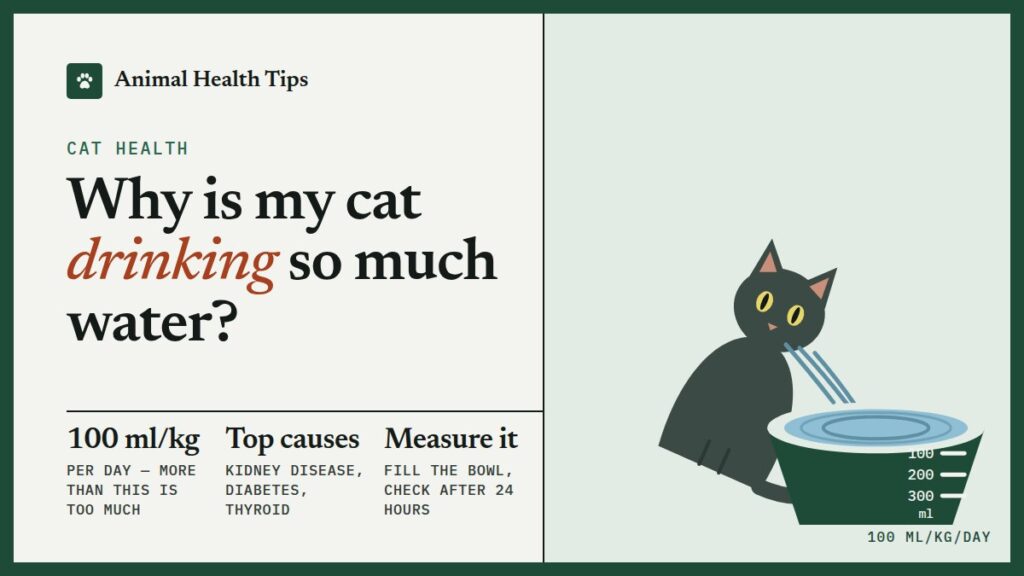
You fill the bowl in the morning and it is empty by lunch. Your cat visits the water bowl far more often, or the litter tray is suddenly heavier. Increased thirst can be nothing: warm weather or a dry-food diet. Or it can be one of the earliest signs of disease. International Cat Care says a cat drinking more than 100 ml per kg of body weight a day is drinking more than usual, and any marked increase deserves a vet’s attention.
In this guide7 sections
Call your vet if
- You notice a marked increase in drinking, or your cat is drinking more than about 100 ml per kg a day
- Your cat is weeing more as well, losing weight, going off food or seems lethargic
- You see signs of diabetic ketoacidosis: vomiting, diarrhoea, loss of appetite or collapse. International Cat Care says contact your veterinary team immediately
- Even without measuring, report more frequent trips to the water bowl. Share any measured amounts with the vet
What’s a normal amount of water for a cat?
How much a cat drinks depends heavily on diet. International Cat Care explains that a cat fed wet food gets a large proportion of its water from food, while a cat fed mainly dry food naturally drinks more. As a rule of thumb, iCatCare says a cat drinking more than 100 ml per kg of body weight daily is drinking more than usual. Measurement gets tricky if the cat shares bowls with other pets or spends lots of time outside.
How to measure how much your cat drinks
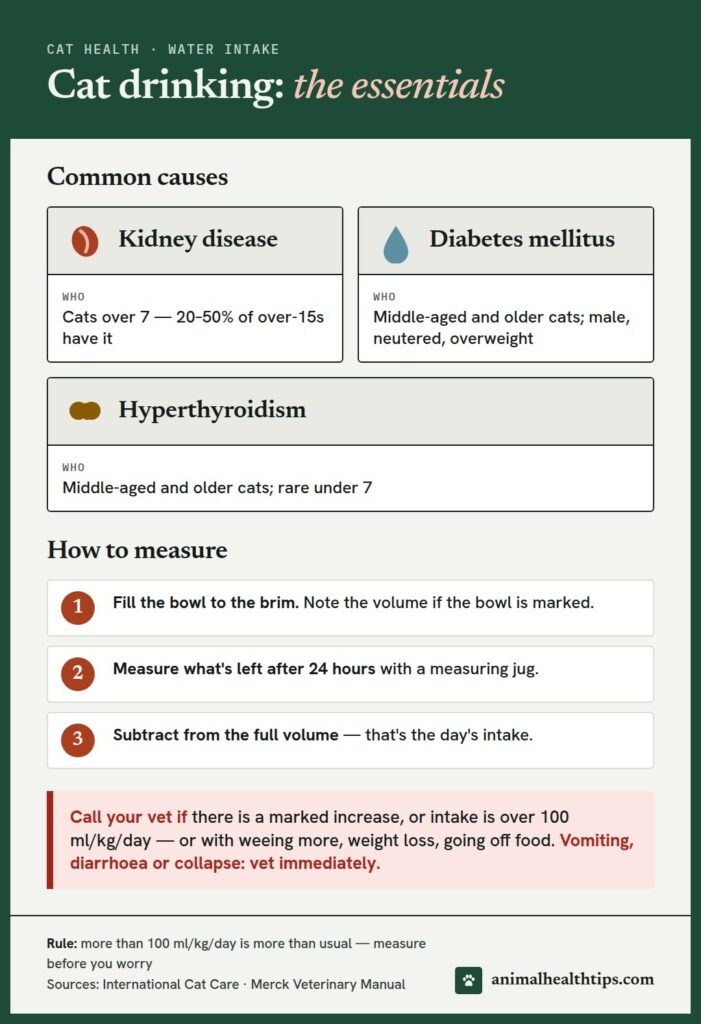
If the increase is borderline, a 24-hour measurement gives your vet something concrete. International Cat Care suggests this method: fill the water bowl or bowls to the brim, measure what is left after 24 hours, and subtract. Where cats share bowls or roam outdoors, you can keep pets separate for a day to measure one cat, provided it causes no distress. Tell the vet what you feed too, since wet food contributes water the bowl does not show.
The most common medical causes
International Cat Care names the leading causes of increased thirst: kidney disease, diabetes mellitus, hyperthyroidism and high blood calcium, adding that liver disease can cause it too. This is what vets look for:
| Cause | Typical signs | Who it hits |
|---|---|---|
| Chronic kidney disease | Increased thirst and urination, weight loss, poor appetite, lethargy | More common in cats over 7; 20–50% of cats over 15 have some degree |
| Diabetes mellitus | Urinating more often, drinking more, weight loss, eating more | Middle-aged and older cats; male, neutered and overweight cats |
| Hyperthyroidism | Weight loss despite good appetite, thirst, restlessness, unkempt coat | Middle-aged and older cats; rarely under 7; males and females equally |
Chronic kidney disease is more common in cats over seven; estimates suggest 20–50% of cats over 15 have some degree of it, says iCatCare. Affected cats struggle to concentrate their urine, so they drink more to make up for it, which then makes them wee more. It is a slow disease: around two-thirds to three-quarters of total kidney function must be lost before signs appear. Vets diagnose it with blood tests (raised urea and creatinine), urine tests (dilute urine) and a blood pressure check, says iCatCare. For cats with kidney disease, tinned or sachet foods are preferred over dry foods to increase water intake.
Diabetes mellitus. iCatCare lists the most common signs: passing urine more often, drinking more, weight loss and eating more. It is more common in middle-aged and older cats, in male cats, in neutered cats and in overweight cats. Severe diabetes can cause diabetic ketoacidosis: vomiting, diarrhoea, loss of appetite and collapse, and iCatCare says to contact your veterinary team immediately if you see these. Diabetes can also occur secondary to prolonged corticosteroid therapy.
Hyperthyroidism. The classic signs are weight loss despite good or increased appetite, increased thirst, restlessness and irritability, increased heart rate and a poor, unkempt coat, says iCatCare. It is usually seen in middle-aged and older cats, rarely in cats under seven, and male and female cats are affected equally. Diagnosis is a blood test measuring thyroid hormone (T4), plus blood and urine tests to rule out concurrent kidney disease.
Harmless reasons your cat might drink more
Not every increase means disease. International Cat Care notes that cats drink more to make up for water loss, for example after a bout of vomiting or diarrhoea, and in warmer weather. A cat that has recently moved to a drier diet will drink more too, since dry-food cats naturally drink more than wet-food cats. If the increase is small, recent, and your cat is otherwise well, watch and measure before you worry.
When should I take my cat to the vet?
International Cat Care’s position is simple: any cat drinking more than usual should be seen by a vet, particularly if drinking exceeds 100 ml per kg a day. Go sooner if your cat is weeing more as well, losing weight, going off food, or seems lethargic. Signs of diabetic ketoacidosis, vomiting, diarrhoea, loss of appetite or collapse, mean contacting your veterinary team immediately.
One note for unspayed females: among the causes vets consider is uterine infection, known as pyometra, so mention your cat’s spay status at the appointment. If the extra drinking follows a bout of sickness, our guide to why cats vomit covers what to watch for.
What will the vet do?
To find the cause, the vet will usually take blood and urine samples, says iCatCare, and treatment begins once the cause is diagnosed. The Merck Veterinary Manual describes the blood work-up: urea and creatinine point to kidney disease, calcium flags high blood calcium, and glucose may indicate diabetes. For thyroid trouble the vet measures thyroid hormone (T4) and checks blood pressure; kidney checks include whether the urine is dilute. Share your 24-hour measurement and feeding details: they help.
Key takeaways
- More than 100 ml per kg a day counts as drinking more than usual.
- Kidney disease, diabetes and hyperthyroidism are the leading causes.
- Increased drinking usually comes with increased urination: keep the litter tray clean.
- Any marked increase deserves a vet visit. Measure intake for 24 hours first.
- Warm weather, dry food and recovery from sickness can explain small rises.
Frequently asked questions
How much water should my cat drink a day?
It depends on diet. International Cat Care says a cat drinking more than 100 ml per kg of body weight daily is drinking more than usual. A cat on wet food takes much of its water from food and will drink less from the bowl than a cat on dry food.
My cat eats dry food and drinks a lot. Is that normal?
Cats fed mainly dry food naturally drink more than cats on wet food, says International Cat Care. Still, if the increase is new or marked, measure the intake over 24 hours and report it to your vet.
Do cats with kidney disease always drink more?
Not necessarily at first. International Cat Care says around two-thirds to three-quarters of total kidney function must be lost before signs of chronic kidney disease appear. When signs do come, they include increased thirst and urination, weight loss, poor appetite and lethargy.
Is drinking a lot ever an emergency?
It can be. Vomiting, diarrhoea, loss of appetite or collapse can signal diabetic ketoacidosis, and International Cat Care says to contact your veterinary team immediately. For a marked increase without those signs, call your vet the same day.
Will the vet need blood and urine tests?
Usually, yes. International Cat Care says the vet will usually take blood and urine samples. The Merck Veterinary Manual adds that urea and creatinine point to kidney disease, calcium flags high blood calcium and glucose may indicate diabetes, with a thyroid hormone (T4) test for hyperthyroidism.
Should older cats be checked for this?
Yes. Chronic kidney disease is more common in cats over seven, hyperthyroidism is usually seen in middle-aged and older cats and is rare under seven, and diabetes is more common in middle-aged and older cats. Extra drinking in a senior cat is worth a vet visit.
Sources
- International Cat Care — Increased thirst and drinking
- International Cat Care — Diabetes mellitus in cats
- International Cat Care — Chronic kidney disease (CKD) in cats
- International Cat Care — Hyperthyroidism in cats
- Merck Veterinary Manual — Clinical biochemistry
This guide is general information, not a diagnosis. If you are worried about your pet, contact your vet.
1 comment