Bird flu is back in the headlines, and this time cat owners are part of the story. On 2 October 2026, the Scottish government confirmed highly pathogenic avian influenza (H5N5) at Ness on the Isle of Lewis, and declared a 3 km protection zone and a 10 km surveillance zone around the site. Vets are reminding pet owners to keep their animals away from wild birds — and cats, it turns out, are genuinely at risk.
In this guide6 sections
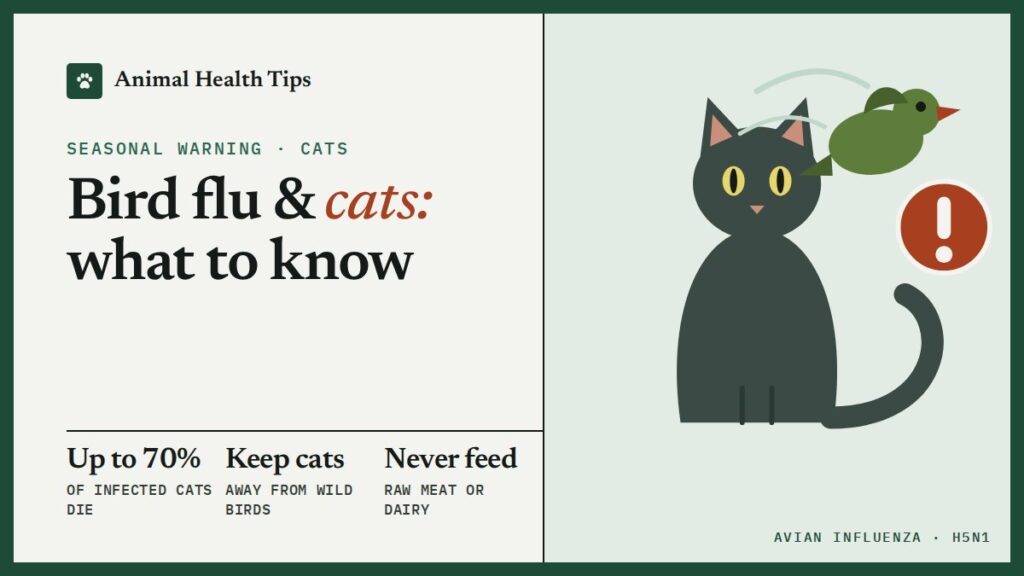
The virus most often discussed is H5N1, a subtype of avian influenza A that occurs naturally in waterfowl and has evolved to infect a variety of other birds and mammals. Cornell University’s Feline Health Center is direct about what that means for cats: cats are susceptible to H5N1 infection, it can cause serious, even life-threatening illness, and up to 70% of infected cats die. That figure alone is why this is worth your attention this season.
How do cats get bird flu?
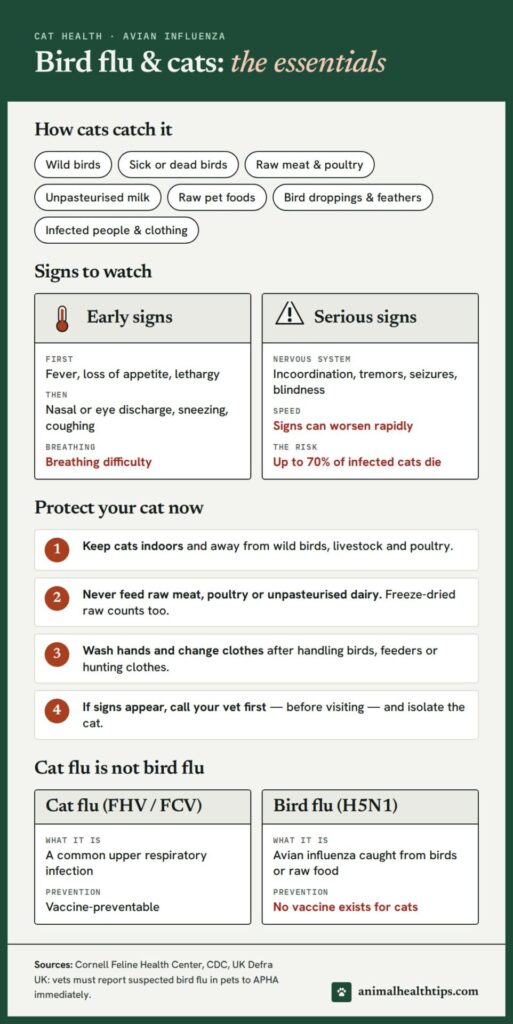
Cornell lists the suspected or verified sources of feline infections. Cats can pick up the virus by ingesting raw (unpasteurised) cow’s milk or raw meat and poultry products, through exposure to infected livestock or poultry and their environments, through exposure to wild birds, and — strikingly — through exposure to infected people and their clothing.
Raw pet foods have been a real route. Cornell describes how the New York City Health Department linked two presumptive and one suspected case of highly pathogenic avian influenza in cats to Savage Cat Food raw pet food (lot 11152026), and how the FDA reported a San Francisco cat that became ill and was euthanised after eating RAWR Raw Cat Food Chicken Eats (lots CCS 25 093 and CCS 25 077), with the same H5N1 genotype confirmed in the cat and both food lots. This is why Cornell’s protection advice starts with food: refrain from feeding raw (even freeze-dried raw) meat-based foods and treats, and unpasteurised dairy products.
What are the signs of bird flu in cats?
Infected cats often develop a fever, loss of appetite and lethargy early on. Cornell warns that signs can worsen rapidly to include nasal or eye discharge, sneezing, coughing and breathing difficulty, followed by neurologic signs such as incoordination, tremors, seizures and blindness. If your cat hunts or roams and you notice this progression, treat it as urgent.
Call your vet immediately if
- Your cat shows fever, lethargy, loss of appetite, nasal or eye discharge, or breathing difficulty — especially after contact with wild birds or raw food
- Your cat develops incoordination, tremors, seizures or sudden blindness
- Your cat caught or ate a wild bird and then becomes unwell
- UK: Animal PoisonLine, 01202 509000 — open 24 hours, run by the Veterinary Poisons Information Service; a fee applies.
- US: ASPCA Animal Poison Control, (888) 426-4435 — open 24 hours; a consultation fee applies.
What should you do if your cat catches or eats a wild bird?
A hunting cat does not need to be locked in a panic room after one catch, but take these steps:
- Keep your cat away from dead or sick wild birds, and from droppings, feathers and any bowls or surfaces wild birds have contaminated. The UK government’s pet guidance advises exactly this.
- Watch for signs over the coming days. Early signs are fever, appetite loss and lethargy. If any appear, isolate the cat from other pets and people, wash your hands thoroughly before and after handling the cat, and call your vet immediately.
- Do not bring the cat to the vet before calling. Cornell stresses this: contact the practice first so the vet can take appropriate precautions to protect your cat, other patients and the whole veterinary team.
- In the UK, vets have a reporting duty. If a vet suspects bird flu in a pet, they must report it to the Animal and Plant Health Agency (APHA) immediately.
How to protect your cat this season
Cornell’s protection list is practical and specific:
- Refrain from feeding raw (even freeze-dried raw) meat-based foods and treats, and unpasteurised dairy products.
- Keep your cat indoors and away from livestock, poultry and their environments, and from sick or dead birds.
- Thoroughly wash your hands and change your clothing — including footwear — after interacting with any livestock, poultry, wild birds, other animals or bird feeders.
- Isolate any cats or people showing signs of infection from other cats and animals.
Two honest limitations: there is currently no vaccine available for H5N1 in cats, so prevention rests entirely on these everyday measures. And while the risk to the public remains low, Cornell advises owners of cats diagnosed with avian influenza to monitor their own health and contact their health care professional if they feel ill after exposure.
Cat flu is not bird flu
The names invite confusion, and cat flu is a far more common problem — but it is a different disease. According to International Cat Care, cat flu is an upper respiratory infection caused by feline herpesvirus or feline calicivirus, responsible for more than 90% of upper respiratory infections in cats, and it is vaccine-preventable. Bird flu is avian influenza A (H5N1), caught from birds, raw meat or raw dairy — a different virus family, a far more severe course, and no cat vaccine.
| Cat flu (FHV / FCV) | Bird flu (H5N1) | |
|---|---|---|
| What it is | Upper respiratory infection from feline herpesvirus or calicivirus | Avian influenza A virus, caught from birds, raw meat or raw dairy |
| How common | Very common: the two viruses cause over 90% of upper respiratory infections in cats | Uncommon, but severe when it happens |
| Main signs | Sneezing, weepy eyes, snotty nose, mouth ulcers | Fever, lethargy, breathing difficulty, then incoordination, tremors, seizures |
| Severity | Usually manageable; kittens can deteriorate fast | Up to 70% of infected cats die |
| Vaccine | Yes: vaccinate from 8–9 weeks, with boosters for life | No vaccine exists for cats |
If your cat is sneezing but otherwise well, our sneezing guide covers the usual, milder causes — bird flu is the one to rule out when the signs are severe or follow bird or raw-food contact.
Key takeaways
- Cats can catch bird flu (H5N1), and Cornell reports that up to 70% of infected cats die — take it seriously, but don’t panic.
- The main routes are wild birds, raw meat or poultry, unpasteurised milk, raw pet foods, and — rarely — infected people or clothing.
- Never feed raw meat-based foods or unpasteurised dairy; keep cats indoors and away from wild birds, and wash hands and change clothes after bird contact.
- If signs appear, isolate the cat and call your vet before visiting. There is no H5N1 vaccine for cats.
Frequently asked questions
Can my cat give bird flu to me?
Cornell says this is theoretically possible, but it is not aware of any cases of cat-to-human transmission of H5N1 during the current outbreak. The CDC documented a 2016 cat-to-person transmission of a different strain (H7N2) in New York City, and advises that exposed people be monitored for 10 days. If your cat is showing signs, don’t let it lick anyone’s face or interact closely with people until your vet has advised you.
Can cats give bird flu to each other?
Cornell is not aware of any definitive cases of cat-to-cat transmission of H5N1 during the current outbreak, although in one reported case transmission via contaminated objects could not be ruled out. Out of caution, any cat showing signs should be isolated from other cats until your vet has advised you.
Is there a vaccine against bird flu for cats?
No. Cornell states plainly that there is currently no vaccine available for H5N1. Protection comes from the everyday measures in this article: keep cats from wild birds, feed no raw meat or dairy, and practise good hand and clothing hygiene.
My cat lives indoors. Is there any risk?
The risk is much lower, but not zero. Cornell describes two indoor-only cats in Michigan whose owners worked on dairy farms where H5N1 was circulating — the route was never definitively identified, but contact with the workers’ clothing was a possibility. Changing clothes and washing hands after contact with birds or livestock is the sensible precaution.
Should I stop feeding my usual commercial cat food?
The documented food cases involved raw meat-based pet foods and raw dairy — never ordinary cooked commercial cat food. If you feed a raw diet, this is a good reason to switch to a cooked food. If your cat’s food was part of a recall, follow the recall notice exactly.
My cat caught a bird. Should I panic?
No — one catch does not mean infection. Watch for the signs over the coming days: fever, appetite loss, lethargy, discharge or breathing difficulty. Call your vet promptly if any appear. And use it as a nudge to keep your cat from hunting where you can.
Sources
- Cornell University College of Veterinary Medicine — H5N1 Avian Influenza and Your Cat
- U.S. Centers for Disease Control and Prevention — Bird Flu in Pets
- UK Government (Defra) — Bird flu: how to keep pets safe
- Scottish Government — Avian flu (bird flu): Ness, Isle of Lewis (AIV 2026/20)
- International Cat Care — Cat Flu — Upper Respiratory Infection
This guide is general information, not a diagnosis. If you are worried about your pet, contact your vet.