
If your older dog has been slower on the stairs or stiffer getting up in the mornings, winter will show you why. Arthritis is one of the most common reasons older dogs slow down: it causes stiff, painful, swollen joints, and cold weather can make those joints stiffer and more painful still. The good news is that much of the suffering is manageable — and most of what helps comes down to small, everyday changes at home.
In this guide8 sections
Call your vet if you notice these signs
- Slowing down, reluctance to play, climb the stairs or go on walks
- Limping or a stiff gait, usually worse first thing in the morning or after exercise
- Groaning or caution when lying down or getting back up; wariness at being touched
- Licking or chewing at sore areas; muscle wasting, tiredness or a short temper
What is arthritis in dogs?
Arthritis, usually osteoarthritis, is a progressive condition in which the smooth surfaces inside a joint become uneven and worn, so the bones rub instead of gliding past each other. The joints swell, ache, thicken and stiffen. PDSA describes it as a very common condition that makes moving around difficult — VCA estimates it affects 20% of dogs of all ages.
It cannot be cured, but it can be treated: there are several options to slow its progression and manage the pain. It is very common in older dogs, because joint function deteriorates with age. Causes include normal wear and tear, genetics — Labradors, Springer Spaniels, German Shepherds, Golden Retrievers, Rottweilers and Bernese mountain dogs are among the breeds PDSA lists — hip or elbow dysplasia, and old injuries.
Signs your older dog’s joints are struggling
Dogs are good at hiding pain, so arthritis often announces itself quietly: the dog may simply slow down, go off playing, avoid the stairs or flag on walks. Watch for:
- Limping or a stiff gait, worse first thing in the morning or after exercise
- Groaning or caution when lying down or getting up; flinching when the joints are touched
- Muscle wasting, tiredness, irritability, or licking and chewing at painful areas
Even a slight limp is worth a vet check. You know your dog best, and you will notice the small changes first.
Why cold weather makes it worse
The RSPCA’s winter guidance says it plainly: cold weather can affect dogs with arthritis, making their joints more stiff and painful — especially in older dogs. On cold days it lists the signs to watch for: changes in behaviour, licking, limping, difficulty sitting, standing and going up stairs, and snapping when being touched.
What helps most is warmth. Heat soothes painful joints: PDSA suggests a heat pad under the bed can give extra comfort on cold days. Keep your dog dry — always dry them after wet walks — and you can warm individual joints with a hot water bottle wrapped in a blanket or towel, though never leave your dog alone with one.
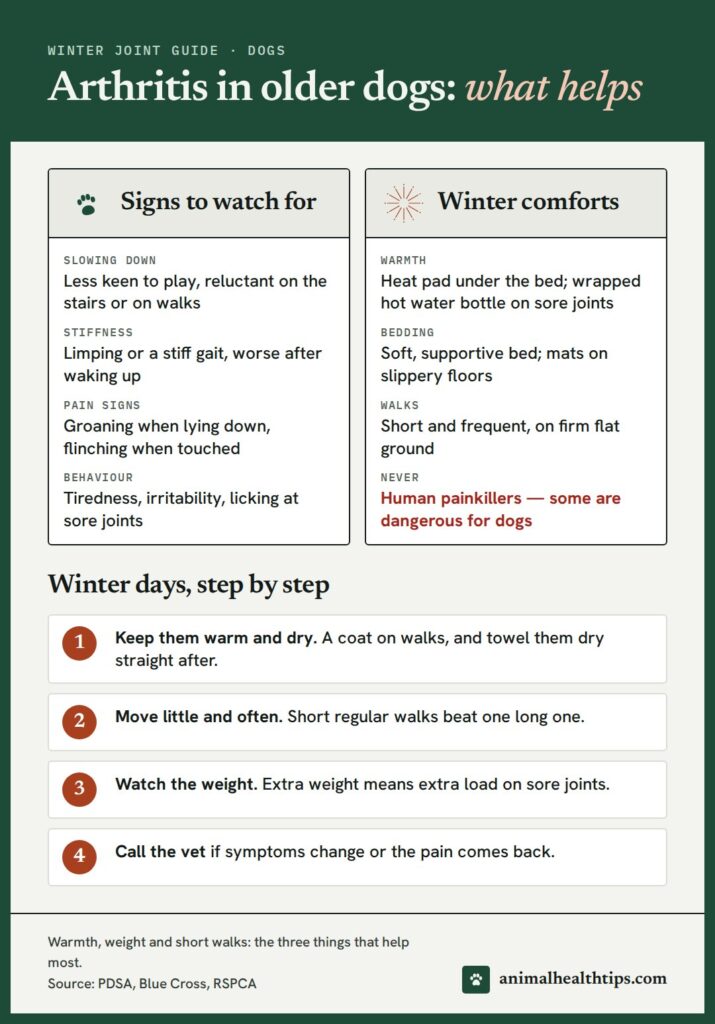
Winter comforts that really help
| Winter problem | What helps in cold weather |
|---|---|
| Stiff, painful joints in the cold | Heat soothes: a heat pad under the bed, and a wrapped hot water bottle on sore joints — never left alone with the dog. |
| Slipping on hard floors | Put mats or rugs down for grip — dogs with arthritis have weak muscles, and slipping can cause injury. |
| Damp fur chilling the joints | Always dry your dog after wet walks. |
| Feeling the cold on walks | Consider a dog coat or jumper on winter walks, and aim to keep indoor sleeping spaces between 10°C and 25°C. |
Give your dog a soft, comfortable bed to take pressure off the joints — memory-foam beds are kind to joints. Support the dog on the stairs and when getting on or off the sofa, the bed or into the car; a ramp can be a big help. If the dog is having a bad day, rest them — massaging muscles at the start of the day may help too.
Staying gently active is part of keeping any dog well, whatever their age: see our five tips for a happy, healthy dog at every age.
Movement that helps, not harms
Exercise still matters, but the kind and the amount change. Give regular short walks each day: short, frequent walks with rest in between beat one long outing that strains the joints, while a sudden burst of exercise can make the dog stiff and painful. Stick to firm, flat terrain and low-impact movement such as walking or gentle trotting; avoid running, chasing balls and turning at speed. Swimming can be great low-impact exercise if your dog enjoys it. Do not let them jump, skid or run on uneven ground.
Encourage the dog to get up and move around through the day — lying down for hours makes joints stiff. Hydrotherapy can be a useful exercise that spares the joints; your vet can advise on a suitable centre, and physiotherapy and massage may help too.
Weight: the biggest difference you can make
Keeping your dog at a healthy body weight is the most important thing you can do for arthritic joints. Extra weight is more load on sore joints and makes inflammation worse — fat cells produce inflammatory chemicals, and the repeated stress of excess weight contributes to osteoarthritis. If your dog is overweight, speak to your vet or vet nurse about a diet plan.
What the vet can do
Book a check-up if you notice any of the signs above. Diagnosis usually rests on the history of symptoms plus a physical examination of the joints for stiffness, pain or swelling. In younger dogs, or where surgery might help, X-rays or scans may be used to establish the underlying cause.
Treatment aims to slow progression and control pain. Your vet may prescribe anti-inflammatories and/or painkillers — daily tablets or liquids with food, or a monthly injection — and may discuss joint supplements or special diets. Supplements are not a replacement for medication, so let the vet advise on a suitable product.
Surgery is not beneficial to most arthritic pets, but it may be advised in particular cases, and newer therapies such as stem cell therapy are becoming more available with promising results. If the pain is not well controlled or symptoms return, tell your vet — there are several medicines, and swapping or adding one may help. Arthritis needs life-long management, but if well managed, most dogs can live happily for many years after diagnosis.
One last rule: never give your pet human painkillers or arthritis medication. Some are dangerous for dogs. Only ever use medicines prescribed by your vet.
Your cold-day walk routine, in seven steps:
- Check the coat. Dogs that feel the cold — and most arthritic older dogs do — appreciate a coat or jumper on winter walks.
- Warm up slowly. Start gently; stiff joints loosen once moving.
- Keep it short and flat. A few short walks beat one long one.
- Skip the ball. No running, chasing, jumping or skidding.
- Dry them off. Towel them dry the moment you are home.
- Check the house. Mats on floors, a warm bed ready, a ramp by the car.
- Rest on bad days. A quiet day with a gentle massage is enough.
Key takeaways
- Arthritis is progressive but manageable — and cold weather often makes it worse, so winter care matters.
- Short, frequent, low-impact walks; avoid running, jumping and ball-chasing.
- A healthy weight is the single biggest thing you can do for sore joints.
- Heat, dry bedding, mats on floors and ramps all help at home.
- Never give human painkillers to dogs; tell your vet if the pain returns.
Frequently asked questions
Does cold weather really make arthritis worse?
Yes. The RSPCA’s winter guidance confirms that cold weather can affect dogs with arthritis, making their joints more stiff and painful, especially in older dogs. Warmth helps in the other direction — heat soothes painful joints, so a heat pad under the bed can give extra comfort on cold days.
Can arthritis in dogs be cured?
No. PDSA describes arthritis as progressive: it gets slowly worse and cannot be cured. But several treatments can slow its progression and manage the pain, and if well managed, most dogs can live happily for many years after diagnosis.
What age do dogs get arthritis?
Dogs of any age can be affected — VCA cites estimates that 20% of dogs of all ages have osteoarthritis. But it is very common in older dogs, and older dogs benefit from regular check-ups so the vet can pick up early signs.
Should I still walk my arthritic dog in winter?
Yes, but adjust the routine: regular short walks on firm, flat ground, no running or ball-chasing, a coat for dogs that feel the cold, and dry your dog after wet walks. Rest on bad days.
Can I give my dog ibuprofen or paracetamol for arthritis pain?
No — never. Some human painkillers are dangerous for dogs; use only medicines prescribed by your vet.
Do joint supplements replace arthritis medication?
No. PDSA says joint supplements are not a replacement for medications and do not work for all dogs. Your vet can advise on a suitable product to support the treatment plan.
Sources
- PDSA — Arthritis in dogs
- Blue Cross — Arthritis in dogs
- RSPCA — Winter care for dogs
- VCA Animal Hospitals — Joint support and disease-modifying osteoarthritis drugs in dogs
This guide is general information, not a diagnosis. If you are worried about your dog, contact your vet.
1 comment